%20--%3e%3csvg%20version='1.0'%20id='Layer_1'%20xmlns='http://www.w3.org/2000/svg'%20xmlns:xlink='http://www.w3.org/1999/xlink'%20x='0px'%20y='0px'%20viewBox='0%200%20755.52%20814.35'%20style='enable-background:new%200%200%20755.52%20814.35;'%20xml:space='preserve'%3e%3cstyle%20type='text/css'%3e%20.st0{fill:%231ae5ce;stroke:%231ae5ce;stroke-width:7;stroke-miterlimit:10;}%20.st1{fill:%23FFFFFF;stroke:%231ae5ce;stroke-width:7;stroke-miterlimit:10;}%20.st2{fill:%231ae5ce;stroke:%23FFFFFF;stroke-width:7;stroke-miterlimit:10;}%20.st3{fill:%23FFFFFF;stroke:%23FFFFFF;stroke-width:6;stroke-miterlimit:10;}%20%3c/style%3e%3cg%20id='Dark_Logo_00000159431215648494653180000015900878925932721032_'%3e%3cpath%20id='shield_00000152259091539869183100000001926543869452564382_'%20class='st0'%20d='M711.13,173.42%20c-3.37-49.07-38.92-44.9-75.96-52.18c-67.4-13.25-130.47-34.47-192.36-63.92c-22.48-10.7-41.88-25.74-65.05-26.28%20c-23.17,0.54-42.58,15.59-65.05,26.28c-61.89,29.45-124.95,50.68-192.36,63.92c-37.04,7.28-72.59,3.11-75.96,52.18%20c-1.55,22.6,0.34,46.4,1.05,68.92c5.99,190.78,52.91,345.39,206.27,466.46c29.71,23.46,74.51,55.8,108.84,70.75%20c5.99,2.61,11.7,3.73,17.21,3.75c5.51-0.02,11.22-1.14,17.21-3.75c34.33-14.95,79.12-47.3,108.84-70.75%20c153.37-121.07,200.28-275.68,206.27-466.46C710.79,219.82,712.68,196.02,711.13,173.42z'/%3e%3cpath%20id='magnifyingglass_00000073685934697636024790000000342567780940956808_'%20class='st1'%20d='M648.78,624.21l-96.64-104.65%20c34.89-40.63,55.98-93.46,55.98-151.21c0-128.27-103.98-232.24-232.24-232.24S143.63,240.08,143.63,368.35%20s103.98,232.24,232.24,232.24c48.87,0,94.21-15.11,131.62-40.89l97.18,105.24c11.25,12.18,30.24,12.93,42.42,1.69l0,0%20C659.27,655.38,660.03,636.39,648.78,624.21z'/%3e%3ccircle%20id='ellipse_00000129904010550392394720000017056154833629780114_'%20class='st2'%20cx='375.87'%20cy='368.35'%20r='181.21'/%3e%3cpath%20id='dollarsign_00000057140127156649725250000003772530148495155891_'%20class='st3'%20d='M362.91,492.03v-23.91%20c0-2.01-1.58-3.69-3.59-3.77c-18.49-0.78-37.12-5.4-49.4-11.83c-1.75-0.92-2.53-3.01-1.76-4.84l5.87-13.89%20c0.86-2.02,3.23-2.88,5.2-1.89c12.94,6.52,30.45,11.44,49.18,11.44c26.02,0,43.6-12.73,43.6-30.43c0-17.08-14.29-27.63-41.4-36.95%20c-37.37-12.42-60.46-26.7-60.46-53.72c0-24.97,20.29-44.11,52.22-49.51c1.8-0.31,3.11-1.89,3.11-3.72v-24.35%20c0-2.09,1.69-3.78,3.78-3.78h15.16c2.09,0,3.78,1.69,3.78,3.78v22.71c0,2.01,1.58,3.67,3.58,3.77c17.85,0.92,30.88,4.75,40.61,9.1%20c1.92,0.86,2.79,3.09,1.94,5.01l-6.08,13.6c-0.85,1.91-3.09,2.77-4.99,1.91c-8.37-3.8-22.38-8.95-42.75-8.95%20c-28.21,0-38.84,14.28-38.84,26.7c0,16.15,13.56,24.22,45.44,35.4c37.74,13.04,56.79,29.19,56.79,56.82%20c0,23.85-19.05,46.23-54.78,52.3c-1.8,0.31-3.11,1.89-3.11,3.72v25.28c0,2.09-1.69,3.78-3.78,3.78h-15.53%20C364.6,495.81,362.91,494.12,362.91,492.03z'/%3e%3c/g%3e%3c/svg%3e)
If you’ve ever received a medical bill that feels like a punch to the gut, you’re not alone. In the U.S., the healthcare system is a labyrinth of hidden fees, surprise charges, and enough fine print to fill a novel. Despite laws like the No Surprises Act, families are still getting slammed with bills that turn life’s scariest moments into financial nightmares. Drawing from real stories shared on X (formerly Twitter), I’ve curated five of the most outrageous examples from recent threads and posts. These aren’t just anecdotes—they’re a wake-up call. Buckle up; these will have you fuming.
- $5,000 for Sitting in the ER Waiting Room (No Treatment Needed)
Picture this: Your 11-year-old has a rash. You rush to the ER in the Bay Area, give him Benadryl at home, decide it’s not an emergency, and leave before seeing a doctor. Sounds harmless, right? Wrong. The family got slapped with a $5,000 bill just for breathing the waiting room air. It only got waived after local media got involved—highlighting how hospitals charge for “facility fees” even if you bolt early.
This absurdity exposes the profit-driven side of emergency care, where showing up is half the battle (and the bill).
Read the full story on ABC7 News | Original X post by @chizznutty - $70,000 for a 15-Minute Helicopter Ride to Save a Baby’s Life
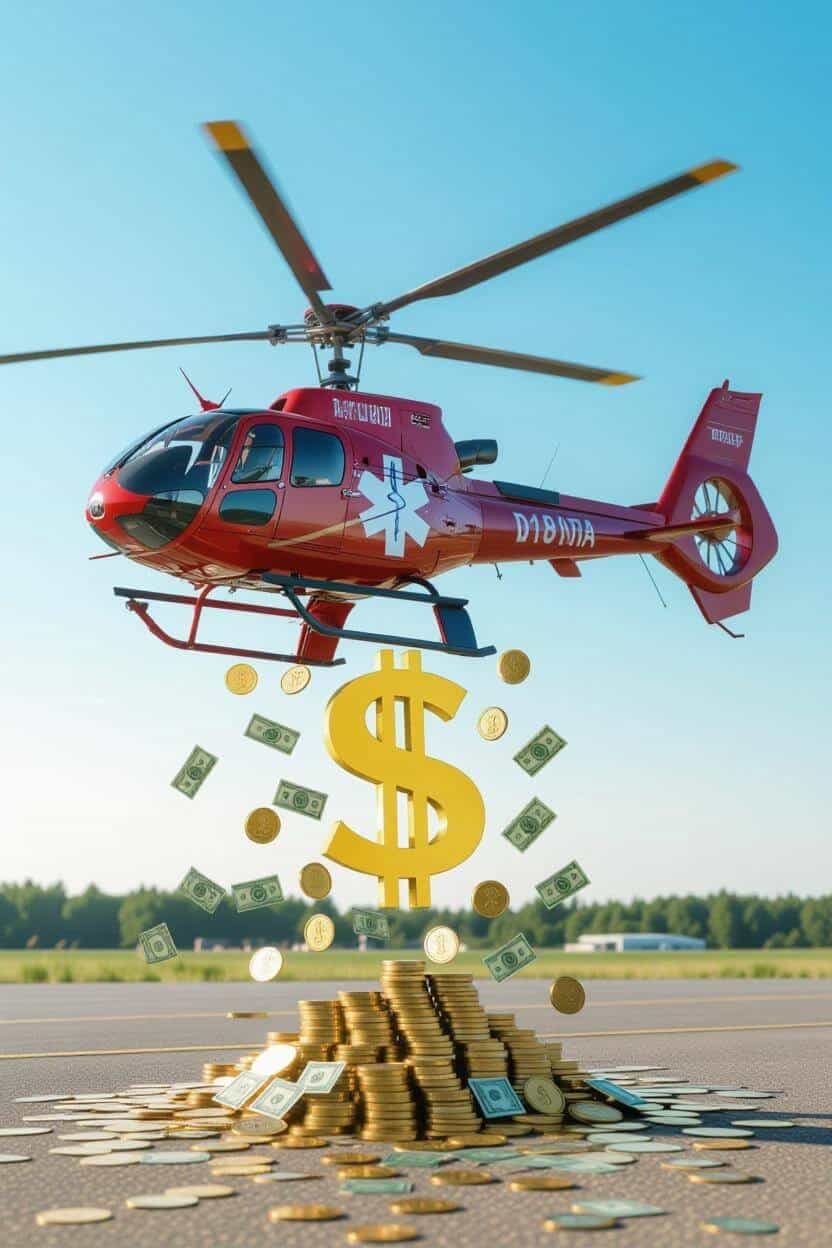
California mom Jessica Farwell’s 6-month-old son suffered burns from a hot car seat. Doctors insisted on an airlift to a burn center—just 15 minutes away by chopper. The total tab? $90,000, leaving her with about $70,000 out-of-pocket after insurance haggling. Oh, and don’t forget the $600 “waiting fee” and a whopping $10,200 for a 0.3-mile ambulance ride afterward.
It’s a heart-wrenching reminder that life-saving urgency comes with a sky-high price tag—literally. The bill was eventually resolved thanks to public pressure, but how many families suffer in silence?
Read the full story on ABC7 News | Original X post by @CollinRugg - $108,000 Hospital Bill for a Quick U.S. Trip Gone Wrong
A woman from British Columbia was visiting the U.S. when a medical emergency struck, landing her in an American hospital. The final bill? A staggering $108,000. Even with travel insurance, the claims process turned into a nightmare of denials and disputes, leaving her drowning in paperwork and debt.
This cross-border horror story underscores how U.S. bills don’t care about passports—turning a vacation into a fiscal catastrophe. It’s a stark example of why “surprise” billing hits tourists hardest.
Read the full story on Global News | Original X post by @mfk6621 - $220,000+ for a 6-Hour Surgery That Started at $40,000
One American underwent a routine 6-hour surgery for a medical device implant. The quoted cost for the device? About $40,000. But then the avalanche began: $30,000 for the surgeon, $20,000 for anesthesia, and a jaw-dropping $149,800 from the hospital. Grand total: Over $220,000.
The poster’s question—”What happened to America?”—echoes the frustration of opaque pricing where one procedure spirals into bankruptcy bait. Hidden fees like these are why pre-op estimates feel like fairy tales.
Original X post by @WallStreetApes - $52,112 Air Ambulance Bill for a COVID Patient’s Short Hospital Hop
In the early days of the pandemic, a Pennsylvania man critically ill with COVID-19 needed a quick transfer between two hospitals—just 20 miles away. What should have been routine became a $52,112 surprise bill from the out-of-network air ambulance service. Despite the life-or-death stakes, the charge landed squarely on the patient, exposing how even “essential” transport can bankrupt you in America’s fractured system.
This pandemic-fueled outrage fueled calls for reform, but stories like it persist, proving urgency doesn’t come cheap—or fair.
Read the full story on The New York Times | Original X post by @RoKhanna
Why These Stories Matter (And What We Can Do About It)
These five tales—from absurd waiting-room charges to helicopter heists—aren’t outliers; they’re symptoms of a broken system where profit often trumps patients. In 2025, with inflation biting and families already stretched thin, surprise bills affect millions annually. The good news? Awareness is power. Share these stories, support advocacy groups like the Patient Advocate Foundation, and push for stronger enforcement of protections.