%20--%3e%3csvg%20version='1.0'%20id='Layer_1'%20xmlns='http://www.w3.org/2000/svg'%20xmlns:xlink='http://www.w3.org/1999/xlink'%20x='0px'%20y='0px'%20viewBox='0%200%20755.52%20814.35'%20style='enable-background:new%200%200%20755.52%20814.35;'%20xml:space='preserve'%3e%3cstyle%20type='text/css'%3e%20.st0{fill:%231ae5ce;stroke:%231ae5ce;stroke-width:7;stroke-miterlimit:10;}%20.st1{fill:%23FFFFFF;stroke:%231ae5ce;stroke-width:7;stroke-miterlimit:10;}%20.st2{fill:%231ae5ce;stroke:%23FFFFFF;stroke-width:7;stroke-miterlimit:10;}%20.st3{fill:%23FFFFFF;stroke:%23FFFFFF;stroke-width:6;stroke-miterlimit:10;}%20%3c/style%3e%3cg%20id='Dark_Logo_00000159431215648494653180000015900878925932721032_'%3e%3cpath%20id='shield_00000152259091539869183100000001926543869452564382_'%20class='st0'%20d='M711.13,173.42%20c-3.37-49.07-38.92-44.9-75.96-52.18c-67.4-13.25-130.47-34.47-192.36-63.92c-22.48-10.7-41.88-25.74-65.05-26.28%20c-23.17,0.54-42.58,15.59-65.05,26.28c-61.89,29.45-124.95,50.68-192.36,63.92c-37.04,7.28-72.59,3.11-75.96,52.18%20c-1.55,22.6,0.34,46.4,1.05,68.92c5.99,190.78,52.91,345.39,206.27,466.46c29.71,23.46,74.51,55.8,108.84,70.75%20c5.99,2.61,11.7,3.73,17.21,3.75c5.51-0.02,11.22-1.14,17.21-3.75c34.33-14.95,79.12-47.3,108.84-70.75%20c153.37-121.07,200.28-275.68,206.27-466.46C710.79,219.82,712.68,196.02,711.13,173.42z'/%3e%3cpath%20id='magnifyingglass_00000073685934697636024790000000342567780940956808_'%20class='st1'%20d='M648.78,624.21l-96.64-104.65%20c34.89-40.63,55.98-93.46,55.98-151.21c0-128.27-103.98-232.24-232.24-232.24S143.63,240.08,143.63,368.35%20s103.98,232.24,232.24,232.24c48.87,0,94.21-15.11,131.62-40.89l97.18,105.24c11.25,12.18,30.24,12.93,42.42,1.69l0,0%20C659.27,655.38,660.03,636.39,648.78,624.21z'/%3e%3ccircle%20id='ellipse_00000129904010550392394720000017056154833629780114_'%20class='st2'%20cx='375.87'%20cy='368.35'%20r='181.21'/%3e%3cpath%20id='dollarsign_00000057140127156649725250000003772530148495155891_'%20class='st3'%20d='M362.91,492.03v-23.91%20c0-2.01-1.58-3.69-3.59-3.77c-18.49-0.78-37.12-5.4-49.4-11.83c-1.75-0.92-2.53-3.01-1.76-4.84l5.87-13.89%20c0.86-2.02,3.23-2.88,5.2-1.89c12.94,6.52,30.45,11.44,49.18,11.44c26.02,0,43.6-12.73,43.6-30.43c0-17.08-14.29-27.63-41.4-36.95%20c-37.37-12.42-60.46-26.7-60.46-53.72c0-24.97,20.29-44.11,52.22-49.51c1.8-0.31,3.11-1.89,3.11-3.72v-24.35%20c0-2.09,1.69-3.78,3.78-3.78h15.16c2.09,0,3.78,1.69,3.78,3.78v22.71c0,2.01,1.58,3.67,3.58,3.77c17.85,0.92,30.88,4.75,40.61,9.1%20c1.92,0.86,2.79,3.09,1.94,5.01l-6.08,13.6c-0.85,1.91-3.09,2.77-4.99,1.91c-8.37-3.8-22.38-8.95-42.75-8.95%20c-28.21,0-38.84,14.28-38.84,26.7c0,16.15,13.56,24.22,45.44,35.4c37.74,13.04,56.79,29.19,56.79,56.82%20c0,23.85-19.05,46.23-54.78,52.3c-1.8,0.31-3.11,1.89-3.11,3.72v25.28c0,2.09-1.69,3.78-3.78,3.78h-15.53%20C364.6,495.81,362.91,494.12,362.91,492.03z'/%3e%3c/g%3e%3c/svg%3e)
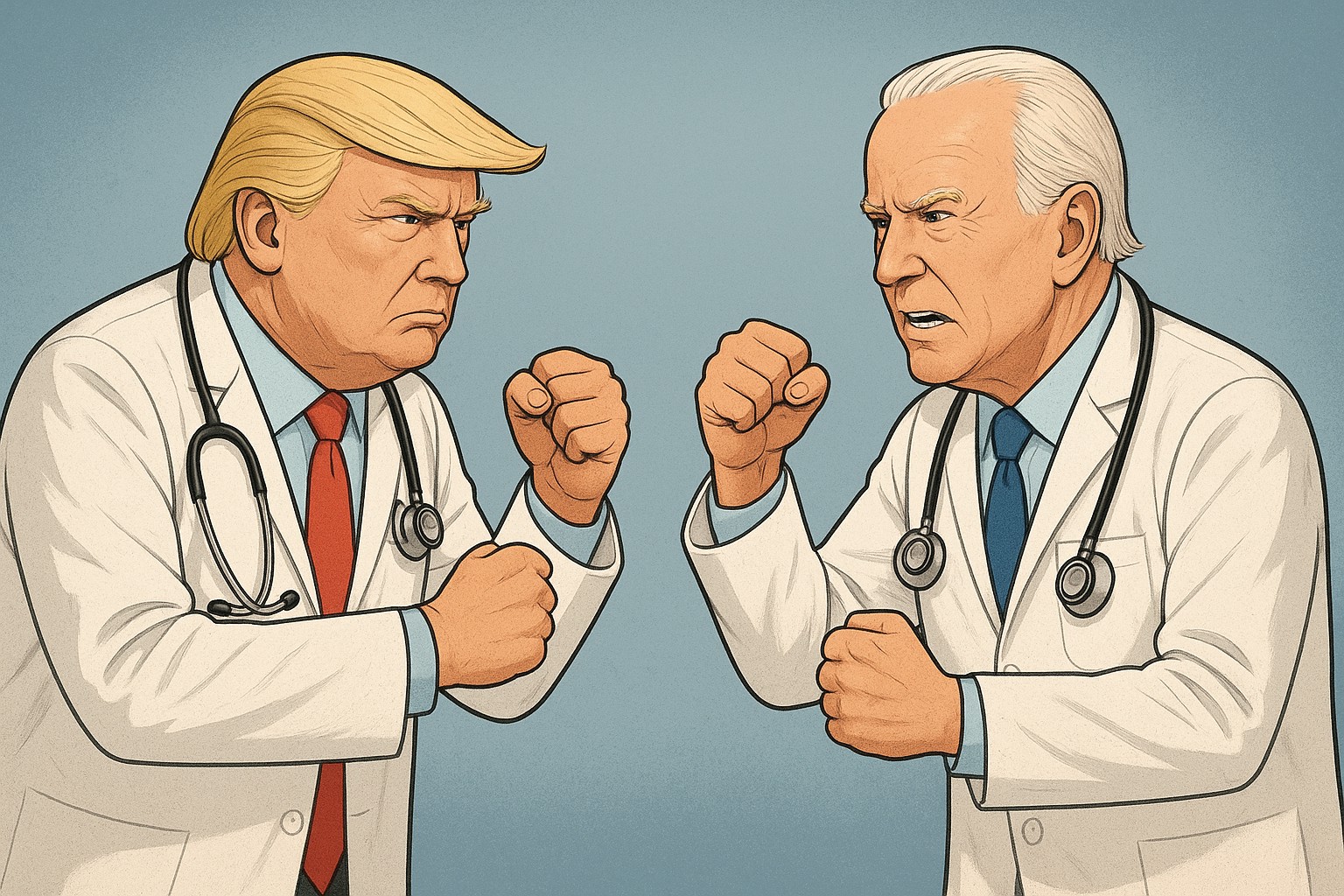
Donald Trump has made health care one of his top political issues since 2016. Trump’s first Executive Order (EO) in his first term was an effort at “repeal and replace” on the Affordable Care Act (ACA). Trump had made several promises to repeal “Obamacare” during his campaign events in reference to the ACA.
The overarching theme of Trump’s reform was removing Federal requirements and encouraging States to create markets for insurance. Despite the promises of the ACA there had been several problems with the launch of the website and some dispute about the cost and value of the of available health plans. In short, coverage got more expensive with the added regulations.
A lot has changed since 2016, but the American people keep asking for a heathcare system that make a noticeable improvement for their families, and politicians keep repeating their slogans on healthcare reform.
Biden’s Healthcare Policy
Biden’s stated policy was, “protect and strengthen Medicaid and the ACA and to make high-quality healthcare accessible and affordable for every American”. President Biden issued Executive Order 14009, rescinding Trump’s Executive Order 14070, “Continuing to Strengthen Americans’ Access to Affordable, Quality Health Coverage,” on January 28, 2021 with these goals in mind. Biden expanded special enrollment periods and allowed states to expand offerings for enrollment.
Trump’s Healthcare Policy
Trump undid 30 of Biden’s EOs on his first day in office. Revoking EO 14009 effectively ended the “Special Enrollment Period” for uninsured and underinsured, limited States’ ability to expand enrollment, and ended Federal review of existing rules and guidance to remove barriers to Medicaid enrollment.
It is clear that the Trump administration is favoring market-based approaches to lowering the cost of healthcare for Americans, while simultaneously limiting who can participate in the program by instating shortened enrollment periods and changing eligibility requirements, including work requirements for people aged 18-64. Estimates from the CBO project that 7.6 million people are enrolled in Medicaid who are not eligible, with 4.6 million able-bodied working age adults in the program.
Trump administration officials have noted that 1.4 million illegal immigrants were receiving benefits from state run exchanges. Who paid for this is in dispute, states put their own money into the pool, but the pool of money approximately 70% federally funded.
Summary of Projected Outcomes (as of August 2025)
| Aspect | Pre-Revocation (Biden Era) | Post-Revocation Changes | Potential Impacts (per Sources) |
|---|---|---|---|
| Enrollment Periods | Extended OEPs (75+ days) and SEPs for crises like COVID | Shortened to max 9 weeks (e.g., Nov 1–Dec 15/31); no state extensions | 1M+ fewer improper enrollments but higher uninsured rates. |
| Medicaid Expansions | Reviews to remove barriers; pandemic-era growth | Halts expansions; $1T cuts via reconciliation | Reduced access for low-income/disabled; states can impose work requirements |
| Subsidies & Affordability | Directives to enhance affordability | Expiry of enhanced subsidies; tighter eligibility | Higher costs for 24M+ enrollees; deficit reduction but equity concerns |
| Overall Access | Policy to strengthen protections | Shift to integrity/cost controls | Millions at risk of losing coverage; |
Citations:
https://www.cbsnews.com/news/aca-obamacare-medicaid-expansion-trump-law-health-consequences
https://www.americanprogress.org/article/the-trump-administrations-war-on-disability/
https://nclnet.org/guest-blog-trumps-executive-orders-could-jeopardize-immigrants-health-coverage/
https://www.theguardian.com/us-news/2025/jan/22/trump-executive-orders-healthcare
| State Category | Examples | Post-Revocation Changes | Projected Impacts |
|---|---|---|---|
| Non-Expansion States (10 GOP-led) | Alabama, Florida, Georgia, Kansas, Mississippi, South Carolina, Tennessee, Texas, Wisconsin, Wyoming | No Medicaid expansion under ACA; revocation allows pursuit of work requirements and caps via Section 1115 waivers. In July 2025, Texas and Florida approved waivers for mandatory work reporting, reducing enrollment by ~15% in pilot programs. | Higher uninsured rates (e.g., Texas at 18%); potential loss of 2M+ in coverage if federal cuts deepen. |
| Expansion States (40, including DC; mostly Democratic or mixed) | California, New York, Illinois, Michigan, Ohio | States like California and New York have state-funded subsidies to offset federal subsidy expirations and maintain longer enrollment periods via state exchanges. In June 2025, California passed legislation to extend OEPs to 90 days, defying federal shortening. | Minimal immediate losses (e.g., <5% in NY); but reliant on state budgets, potentially straining resources amid $1T federal Medicaid cuts. |
| Waiver-Seeking States | Arkansas, Indiana, Kentucky (expansion but with restrictions) | Post-revocation, these states revived Trump-era waivers for premiums or lockouts for non-payment. Kentucky’s June 2025 waiver approval could disenroll 100K+ for failing work requirements. | Mixed outcomes: Cost savings for states but increased emergency care usage; CBO projects 500K national losses from waivers alone. |
https://www.cbsnews.com/news/aca-obamacare-medicaid-expansion-trump-law-health-consequences/
https://regintel-content.thomsonreuters.com/document/I555C9C30DCC711EFB622FE0229258DAD
https://publichealth.berkeley.edu/articles/news/commentary/what-do-cuts-to-medicaid-really-mean
https://www.afscme.org/blog/trumps-project-2025-would-tear-down-our-countrys-health-care-system
https://publichealth.jhu.edu/2025/the-changes-coming-to-the-aca-medicaid-and-medicare
Differing Policy Approaches
Healthcare continues to be a hot button political issue, everyone agrees that the system needs reform, but what that means precisely is unclear. Republicans have long favored market based approaches to the uninsured; while Democrats have favored an government prescribed solution, with the presumption that if the market was likely to “fix” this problem it hasn’t happened in anyone’s lifetime.
Consumers of healthcare have almost no ability to comparison shop healthcare plans or prescription costs, or procedures. Market-based solutions require market dynamics to function. Competition, price transparency, easily substitutable goods are some of the hallmarks of an free market economy that our current healthcare system lacks. Consumers aren’t in charge of their own decisions in the health care system, insurance programs dictate which doctors you can see and what treatments you can receive.
Healthcare Rhetoric vs Reality
While Americans continue to pay more and more for healthcare, while receiving increasingly poor outcomes, politicians have not changed their policy recommendations and helpful reforms get held up by partisanship. None of this is helped by an increasing number of “safe” Congressional Districts that would be accurately called “noncompetitive” for the opposing political party.
The consensus between these two polar positions is only that “something” should be done, it is not clear what that something is because the solutions are increasingly partisan and polarizing.
That also means that there is less room to compromise because the ideologues in the party are increasingly committed to their respective solutions and so are their constituents.