%20--%3e%3csvg%20version='1.0'%20id='Layer_1'%20xmlns='http://www.w3.org/2000/svg'%20xmlns:xlink='http://www.w3.org/1999/xlink'%20x='0px'%20y='0px'%20viewBox='0%200%20755.52%20814.35'%20style='enable-background:new%200%200%20755.52%20814.35;'%20xml:space='preserve'%3e%3cstyle%20type='text/css'%3e%20.st0{fill:%231ae5ce;stroke:%231ae5ce;stroke-width:7;stroke-miterlimit:10;}%20.st1{fill:%23FFFFFF;stroke:%231ae5ce;stroke-width:7;stroke-miterlimit:10;}%20.st2{fill:%231ae5ce;stroke:%23FFFFFF;stroke-width:7;stroke-miterlimit:10;}%20.st3{fill:%23FFFFFF;stroke:%23FFFFFF;stroke-width:6;stroke-miterlimit:10;}%20%3c/style%3e%3cg%20id='Dark_Logo_00000159431215648494653180000015900878925932721032_'%3e%3cpath%20id='shield_00000152259091539869183100000001926543869452564382_'%20class='st0'%20d='M711.13,173.42%20c-3.37-49.07-38.92-44.9-75.96-52.18c-67.4-13.25-130.47-34.47-192.36-63.92c-22.48-10.7-41.88-25.74-65.05-26.28%20c-23.17,0.54-42.58,15.59-65.05,26.28c-61.89,29.45-124.95,50.68-192.36,63.92c-37.04,7.28-72.59,3.11-75.96,52.18%20c-1.55,22.6,0.34,46.4,1.05,68.92c5.99,190.78,52.91,345.39,206.27,466.46c29.71,23.46,74.51,55.8,108.84,70.75%20c5.99,2.61,11.7,3.73,17.21,3.75c5.51-0.02,11.22-1.14,17.21-3.75c34.33-14.95,79.12-47.3,108.84-70.75%20c153.37-121.07,200.28-275.68,206.27-466.46C710.79,219.82,712.68,196.02,711.13,173.42z'/%3e%3cpath%20id='magnifyingglass_00000073685934697636024790000000342567780940956808_'%20class='st1'%20d='M648.78,624.21l-96.64-104.65%20c34.89-40.63,55.98-93.46,55.98-151.21c0-128.27-103.98-232.24-232.24-232.24S143.63,240.08,143.63,368.35%20s103.98,232.24,232.24,232.24c48.87,0,94.21-15.11,131.62-40.89l97.18,105.24c11.25,12.18,30.24,12.93,42.42,1.69l0,0%20C659.27,655.38,660.03,636.39,648.78,624.21z'/%3e%3ccircle%20id='ellipse_00000129904010550392394720000017056154833629780114_'%20class='st2'%20cx='375.87'%20cy='368.35'%20r='181.21'/%3e%3cpath%20id='dollarsign_00000057140127156649725250000003772530148495155891_'%20class='st3'%20d='M362.91,492.03v-23.91%20c0-2.01-1.58-3.69-3.59-3.77c-18.49-0.78-37.12-5.4-49.4-11.83c-1.75-0.92-2.53-3.01-1.76-4.84l5.87-13.89%20c0.86-2.02,3.23-2.88,5.2-1.89c12.94,6.52,30.45,11.44,49.18,11.44c26.02,0,43.6-12.73,43.6-30.43c0-17.08-14.29-27.63-41.4-36.95%20c-37.37-12.42-60.46-26.7-60.46-53.72c0-24.97,20.29-44.11,52.22-49.51c1.8-0.31,3.11-1.89,3.11-3.72v-24.35%20c0-2.09,1.69-3.78,3.78-3.78h15.16c2.09,0,3.78,1.69,3.78,3.78v22.71c0,2.01,1.58,3.67,3.58,3.77c17.85,0.92,30.88,4.75,40.61,9.1%20c1.92,0.86,2.79,3.09,1.94,5.01l-6.08,13.6c-0.85,1.91-3.09,2.77-4.99,1.91c-8.37-3.8-22.38-8.95-42.75-8.95%20c-28.21,0-38.84,14.28-38.84,26.7c0,16.15,13.56,24.22,45.44,35.4c37.74,13.04,56.79,29.19,56.79,56.82%20c0,23.85-19.05,46.23-54.78,52.3c-1.8,0.31-3.11,1.89-3.11,3.72v25.28c0,2.09-1.69,3.78-3.78,3.78h-15.53%20C364.6,495.81,362.91,494.12,362.91,492.03z'/%3e%3c/g%3e%3c/svg%3e)
Abscess incision and drainage (simple case) Dermatology Surgery
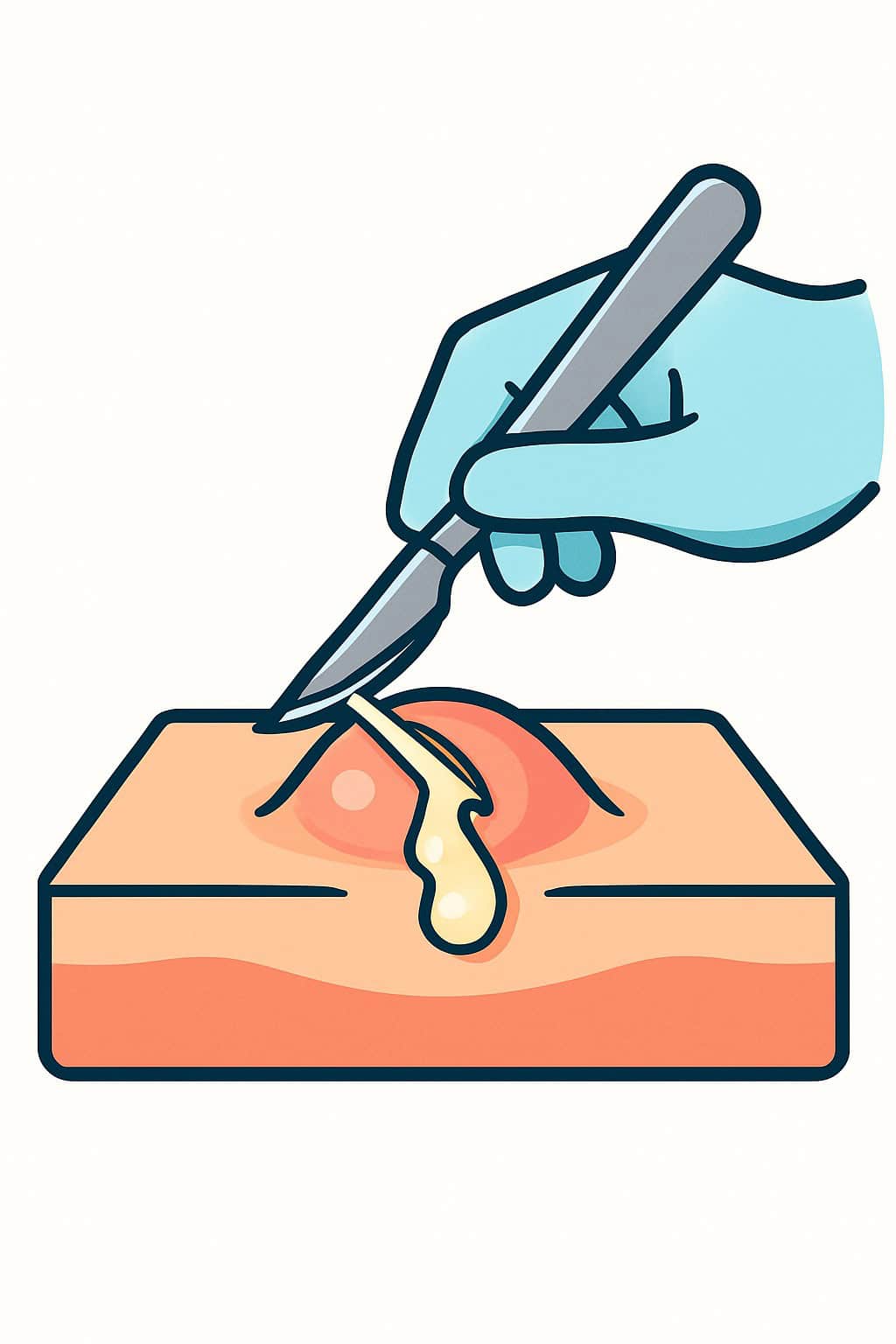
Abscess incision and drainage is a minor procedure that opens a pocket of pus under the skin so it can drain.
Overview
Abscess incision and drainage is a minor procedure that opens a pocket of pus under the skin so it can drain. A local anesthetic is used to numb the area. The clinician makes a small cut, breaks up inner pockets, and lets the fluid drain. The area may be rinsed and lightly packed with gauze. This procedure is done to relieve pain and pressure, clear the infection source, and help the area heal. A sample of the fluid may be sent to a lab. Some people also receive antibiotics depending on the size, location, and risk factors.
Also known as: I&D, Incision and drainage, Skin abscess drainage, Simple abscess drainage
Preparation & Next Steps
Everything you need to know before and after your procedure
Before Care
- Bring a current list of medicines and supplements, including any blood thinners, and note any allergies to medicines, latex, or antiseptics.
- No fasting is usually needed for a simple in-office procedure with local anesthetic.
- Wear loose clothing that allows easy access to the area and can handle drainage.
- Plan for a short visit plus observation time; the procedure itself is usually brief.
- Have basic wound supplies at home such as gauze, nonstick pads, and tape.
- Arrange a ride if the site could affect driving comfort or if sedatives might be used.
- Be prepared for a follow-up check in 24 to 48 hours, especially if packing is placed.
- Bring a photo ID, insurance card, and a payment method if applicable.
- Share any recent fevers, previous skin infections, or antibiotic use with the care team.
After Care
- Keep the bandage clean and dry for the first day unless told otherwise; then change dressings as instructed.
- If packing is placed, it is often removed or replaced by a clinician in 24 to 48 hours.
- Gently wash with soap and water after the initial period; avoid soaking in baths, pools, or hot tubs until healed.
- Use warm compresses several times a day to support continued drainage and comfort.
- Take any prescribed medicines exactly as directed and complete the course if antibiotics are given.
- Elevate the area when possible and avoid friction or pressure on the site.
- Practice hand hygiene before and after touching the bandage; dispose of used dressings safely.
- Contact a clinician if pain worsens, redness spreads, swelling increases, drainage has a strong odor, or fever or chills develop.
- Attend scheduled follow-up visits to check healing and remove packing if used.
- Avoid squeezing or picking at the area to reduce the chance of spread or scarring.
Clinical Information
Important medical details about this procedure
Indications
- Painful, swollen skin lump with pus
- Redness and warmth with a soft center that feels fluid filled
- Abscess that does not improve with warm compresses
- Recurrent skin infection such as suspected staph or MRSA
- Abscess causing significant discomfort or limited movement
Alternatives
- Warm compresses for very small superficial abscesses
- Watchful waiting when there is no clear pocket of pus
- Needle aspiration in selected small cases
- Antibiotics alone for minor skin infections without a drainable pocket
Risks
- Pain or bleeding at the site
- Scarring or skin discoloration
- Infection spreading to nearby skin or tissue
- Recurrence or need for another drainage
- Allergic reaction to anesthetic or antiseptic
- Damage to nearby structures depending on location
Contraindications
- Deep or poorly located abscess near major nerves or blood vessels
- Abscess on the face around the nose and upper lip area
- Perirectal, genital, or hand abscess that may need specialist care
- Bleeding disorder or use of blood thinners that requires planning
- Extensive surrounding cellulitis or signs of severe illness that may require higher level care
Recovery Timeline
What to expect during your recovery
Pain and pressure often improve within 1 to 2 days after drainage. Skin healing commonly takes about 1 to 2 weeks, depending on size, location, and drainage.
Typical Range
7–14 days
Return to Work
1–3 days
Recovery Milestones
Rest the area and keep the first dressing in place
First follow-up for packing removal or check if used
Light daily activities; avoid soaking the wound
Gradually resume normal tasks as drainage and pain decrease
Return to exercise when the site is comfortable and no longer draining
Frequently Asked Questions
Common questions and expert answers about this procedure
How is abscess incision and drainage performed?
How is abscess incision and drainage performed?
The area is cleaned and numbed. A small cut is made to release pus, inner pockets are opened, and the cavity may be rinsed and lightly packed. A bandage is placed.
Will I need antibiotics after drainage?
Will I need antibiotics after drainage?
Antibiotics are used in some cases, such as larger abscesses, multiple sites, surrounding cellulitis, or certain risk factors. Many simple abscesses improve after drainage alone.
How long does the procedure take?
How long does the procedure take?
The procedure itself is usually completed in 10 to 30 minutes, not including preparation and observation time.
Is packing always necessary?
Is packing always necessary?
Packing is sometimes used to help the cavity drain and not close too quickly. Some small cavities heal well without packing.
Will there be a scar?
Will there be a scar?
A small scar or color change can occur. Keeping the area clean and protected during healing can help reduce scarring.
Will a culture be taken?
Will a culture be taken?
A sample of the pus may be sent to a lab to identify bacteria, especially if there is concern for resistant germs like MRSA or if infections recur.
When can I shower?
When can I shower?
Many people can shower after the first day if the wound is covered and then rebandaged. Avoid baths, pools, or hot tubs until fully healed.
References
Medical literature and sources