%20--%3e%3csvg%20version='1.0'%20id='Layer_1'%20xmlns='http://www.w3.org/2000/svg'%20xmlns:xlink='http://www.w3.org/1999/xlink'%20x='0px'%20y='0px'%20viewBox='0%200%20755.52%20814.35'%20style='enable-background:new%200%200%20755.52%20814.35;'%20xml:space='preserve'%3e%3cstyle%20type='text/css'%3e%20.st0{fill:%231ae5ce;stroke:%231ae5ce;stroke-width:7;stroke-miterlimit:10;}%20.st1{fill:%23FFFFFF;stroke:%231ae5ce;stroke-width:7;stroke-miterlimit:10;}%20.st2{fill:%231ae5ce;stroke:%23FFFFFF;stroke-width:7;stroke-miterlimit:10;}%20.st3{fill:%23FFFFFF;stroke:%23FFFFFF;stroke-width:6;stroke-miterlimit:10;}%20%3c/style%3e%3cg%20id='Dark_Logo_00000159431215648494653180000015900878925932721032_'%3e%3cpath%20id='shield_00000152259091539869183100000001926543869452564382_'%20class='st0'%20d='M711.13,173.42%20c-3.37-49.07-38.92-44.9-75.96-52.18c-67.4-13.25-130.47-34.47-192.36-63.92c-22.48-10.7-41.88-25.74-65.05-26.28%20c-23.17,0.54-42.58,15.59-65.05,26.28c-61.89,29.45-124.95,50.68-192.36,63.92c-37.04,7.28-72.59,3.11-75.96,52.18%20c-1.55,22.6,0.34,46.4,1.05,68.92c5.99,190.78,52.91,345.39,206.27,466.46c29.71,23.46,74.51,55.8,108.84,70.75%20c5.99,2.61,11.7,3.73,17.21,3.75c5.51-0.02,11.22-1.14,17.21-3.75c34.33-14.95,79.12-47.3,108.84-70.75%20c153.37-121.07,200.28-275.68,206.27-466.46C710.79,219.82,712.68,196.02,711.13,173.42z'/%3e%3cpath%20id='magnifyingglass_00000073685934697636024790000000342567780940956808_'%20class='st1'%20d='M648.78,624.21l-96.64-104.65%20c34.89-40.63,55.98-93.46,55.98-151.21c0-128.27-103.98-232.24-232.24-232.24S143.63,240.08,143.63,368.35%20s103.98,232.24,232.24,232.24c48.87,0,94.21-15.11,131.62-40.89l97.18,105.24c11.25,12.18,30.24,12.93,42.42,1.69l0,0%20C659.27,655.38,660.03,636.39,648.78,624.21z'/%3e%3ccircle%20id='ellipse_00000129904010550392394720000017056154833629780114_'%20class='st2'%20cx='375.87'%20cy='368.35'%20r='181.21'/%3e%3cpath%20id='dollarsign_00000057140127156649725250000003772530148495155891_'%20class='st3'%20d='M362.91,492.03v-23.91%20c0-2.01-1.58-3.69-3.59-3.77c-18.49-0.78-37.12-5.4-49.4-11.83c-1.75-0.92-2.53-3.01-1.76-4.84l5.87-13.89%20c0.86-2.02,3.23-2.88,5.2-1.89c12.94,6.52,30.45,11.44,49.18,11.44c26.02,0,43.6-12.73,43.6-30.43c0-17.08-14.29-27.63-41.4-36.95%20c-37.37-12.42-60.46-26.7-60.46-53.72c0-24.97,20.29-44.11,52.22-49.51c1.8-0.31,3.11-1.89,3.11-3.72v-24.35%20c0-2.09,1.69-3.78,3.78-3.78h15.16c2.09,0,3.78,1.69,3.78,3.78v22.71c0,2.01,1.58,3.67,3.58,3.77c17.85,0.92,30.88,4.75,40.61,9.1%20c1.92,0.86,2.79,3.09,1.94,5.01l-6.08,13.6c-0.85,1.91-3.09,2.77-4.99,1.91c-8.37-3.8-22.38-8.95-42.75-8.95%20c-28.21,0-38.84,14.28-38.84,26.7c0,16.15,13.56,24.22,45.44,35.4c37.74,13.04,56.79,29.19,56.79,56.82%20c0,23.85-19.05,46.23-54.78,52.3c-1.8,0.31-3.11,1.89-3.11,3.72v25.28c0,2.09-1.69,3.78-3.78,3.78h-15.53%20C364.6,495.81,362.91,494.12,362.91,492.03z'/%3e%3c/g%3e%3c/svg%3e)
Biopsy of Skin Lesion Dermatology Surgery
A biopsy of a skin lesion is a small procedure that removes a sample of skin so a lab can look at it under a microscope.
Overview
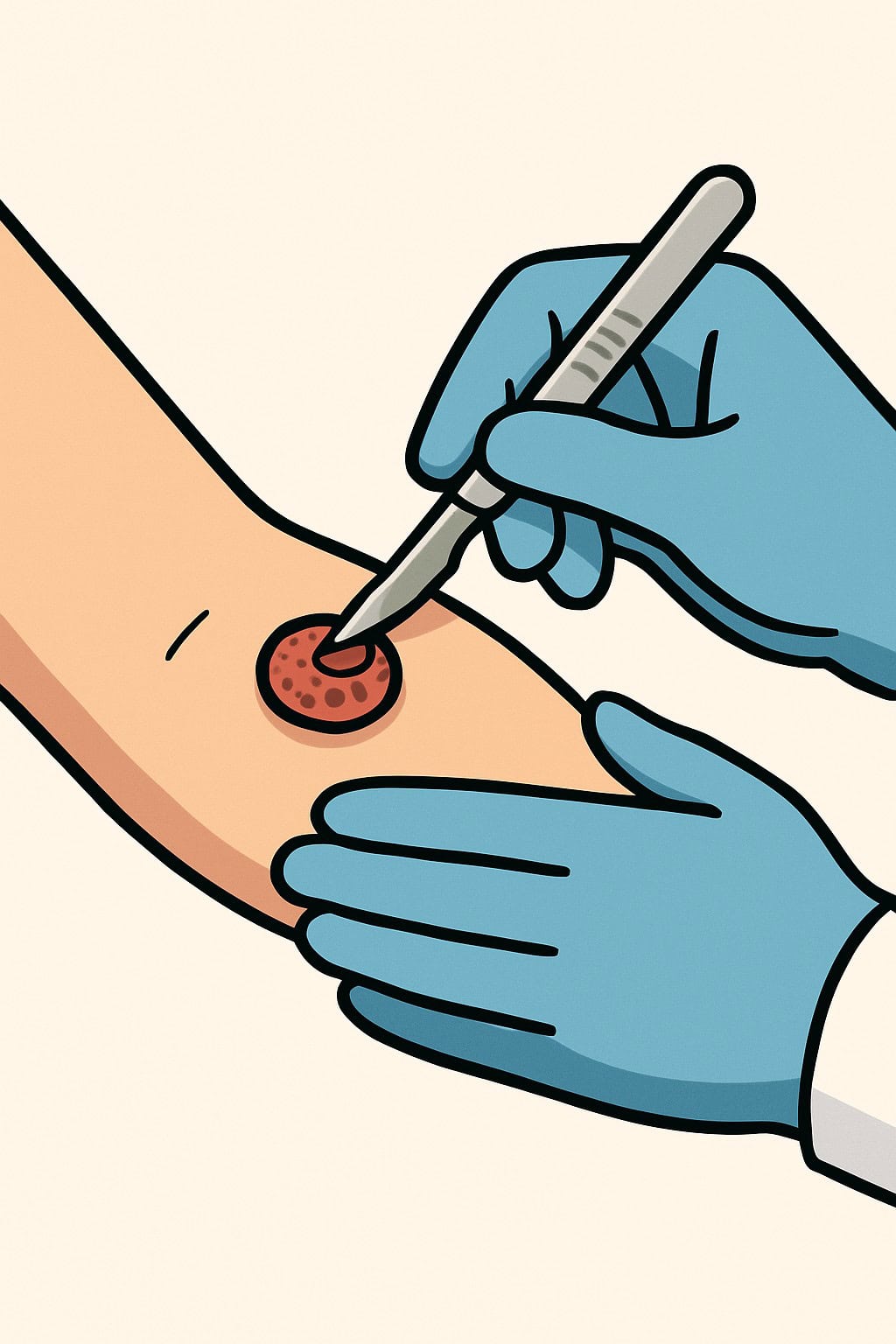
A biopsy of a skin lesion is a small procedure that removes a sample of skin so a lab can look at it under a microscope. It helps identify the cause of a spot, rash, growth, or wound on the skin. Depending on the size and depth of the lesion, the clinician may remove a thin slice from the surface (shave), a small core using a circular tool (punch), or the whole lesion with a scalpel (excisional). Local anesthetic numbs the area. Stitches may be used if needed.
Also known as: Skin biopsy, Punch biopsy, Shave biopsy, Excisional skin biopsy
Preparation & Next Steps
Everything you need to know before and after your procedure
Before Care
- Bring a list of all medicines, supplements, and allergies, including reactions to local anesthetics or adhesives
- Tell the clinic about blood thinners or bleeding problems; many skin biopsies can be done without stopping them
- Ask how results will be delivered and when to expect them
- Wear clothing that makes the area easy to expose and avoids rubbing the site afterward
- Avoid lotions, makeup, or sunscreen on the biopsy area the day of the procedure if possible
- Plan time for paperwork and consent before the procedure
- Arrange a ride if the site is in a spot that could affect safe driving or if advised by the clinic
- Have basic bandage supplies at home such as gauze, nonstick pads, and petroleum jelly
- Fasting is usually not required because local anesthetic is commonly used
After Care
- Keep the initial dressing in place as instructed, then change it with clean hands
- Gently clean the area with soap and water after the first 24 hours unless told otherwise
- Apply a thin layer of plain petroleum jelly and cover with a clean bandage until the site closes
- Avoid stretching, heavy lifting, or high-friction activities that pull on the area for several days
- Do not swim or soak the site until it has sealed and stitches, if any, are removed
- Protect the healing area from sun with clothing or shade; use sunscreen after the skin has closed
- If stitches were placed, confirm how and when they will be removed
- Expect mild oozing; if bleeding continues, apply firm pressure with clean gauze and contact the clinic
- Contact the clinic for increasing redness, warmth, swelling, pus, fever, or pain that is getting worse
- Ask how and when results will be available and how to get a copy for your records
Clinical Information
Important medical details about this procedure
Indications
- A mole or spot changing in size, shape, or color
- A new or nonhealing lesion, sore, or ulcer
- Suspicion for skin cancer such as melanoma, basal cell, or squamous cell
- Unclear cause of a rash or inflammatory skin condition
- Possible skin infection such as fungal or bacterial disease
- Blistering or autoimmune skin disorders
Alternatives
- Clinical exam with dermoscopy
- Short-term monitoring with photos to track changes
- Skin scraping, swab, or culture for suspected infections
- Patch testing for suspected contact allergy
- Noninvasive imaging such as reflectance confocal microscopy where available
- Trial of topical or systemic treatment when appropriate and safe
Risks
- Bleeding or bruising at the site
- Infection
- Pain or tenderness
- Scarring or changes in skin color
- Allergic reaction to local anesthetic or adhesive
- Numbness or nerve irritation near the site
- Sampling error that may require repeat biopsy
Contraindications
- Known severe allergy to local anesthetics without an alternative available
- Uncontrolled bleeding disorder
- Use of blood thinners that cannot be managed around the procedure
- Active skin infection at the site that obscures the lesion
- High risk of keloid scarring in cosmetically sensitive areas
Recovery Timeline
What to expect during your recovery
Most small shave or punch biopsies heal in 1 to 3 weeks. Larger or deeper excisions can take longer. Many people return to normal daily activities the same day or the next day, with activity limits based on the biopsy site.
Typical Range
7–21 days
Return to Work
0–2 days
Recovery Milestones
Keep pressure dressing on and limit friction at the site
Light daily activities; gentle washing and bandage changes
Avoid swimming and high-sweat or high-stretch activities until the wound seals
Typical window for suture removal if placed, depending on body site
Resume most activities as the site strengthens; begin sun protection on the new scar
Frequently Asked Questions
Common questions and expert answers about this procedure
What types of skin biopsies are there?
What types of skin biopsies are there?
Common types are shave (removes a thin slice), punch (removes a small core of skin), and excisional (removes the entire lesion). The choice depends on the lesion and location.
Does a skin biopsy hurt?
Does a skin biopsy hurt?
You will feel a quick sting from the local anesthetic, then pressure but usually no sharp pain during the biopsy. Soreness at the site is common for a day or two.
Will I have a scar?
Will I have a scar?
Any biopsy can leave a mark. Shave biopsies usually leave a flat spot or slight color change. Punch and excisional biopsies may leave a small line scar, especially if stitches are used.
How long does the procedure take?
How long does the procedure take?
Many skin biopsies take 10 to 30 minutes, including numbing, the biopsy, and bandaging.
When will I get results?
When will I get results?
Pathology results are often ready within about 1 to 2 weeks, but timing varies by lab and the tests needed. Ask your clinic how they will share results.
Do I need to stop blood thinners?
Do I need to stop blood thinners?
Many biopsies can be done while continuing blood thinners, with a higher chance of minor bleeding or bruising. Discuss the plan with your prescribing clinician and the biopsy team.
Can a biopsy spread cancer?
Can a biopsy spread cancer?
Skin biopsies are standard tools to diagnose cancer and are not known to spread it.
Do I need to fast or have sedation?
Do I need to fast or have sedation?
Fasting and sedation are not usually needed. A local anesthetic numbs only the biopsy area.
References
Medical literature and sources