%20--%3e%3csvg%20version='1.0'%20id='Layer_1'%20xmlns='http://www.w3.org/2000/svg'%20xmlns:xlink='http://www.w3.org/1999/xlink'%20x='0px'%20y='0px'%20viewBox='0%200%20755.52%20814.35'%20style='enable-background:new%200%200%20755.52%20814.35;'%20xml:space='preserve'%3e%3cstyle%20type='text/css'%3e%20.st0{fill:%231ae5ce;stroke:%231ae5ce;stroke-width:7;stroke-miterlimit:10;}%20.st1{fill:%23FFFFFF;stroke:%231ae5ce;stroke-width:7;stroke-miterlimit:10;}%20.st2{fill:%231ae5ce;stroke:%23FFFFFF;stroke-width:7;stroke-miterlimit:10;}%20.st3{fill:%23FFFFFF;stroke:%23FFFFFF;stroke-width:6;stroke-miterlimit:10;}%20%3c/style%3e%3cg%20id='Dark_Logo_00000159431215648494653180000015900878925932721032_'%3e%3cpath%20id='shield_00000152259091539869183100000001926543869452564382_'%20class='st0'%20d='M711.13,173.42%20c-3.37-49.07-38.92-44.9-75.96-52.18c-67.4-13.25-130.47-34.47-192.36-63.92c-22.48-10.7-41.88-25.74-65.05-26.28%20c-23.17,0.54-42.58,15.59-65.05,26.28c-61.89,29.45-124.95,50.68-192.36,63.92c-37.04,7.28-72.59,3.11-75.96,52.18%20c-1.55,22.6,0.34,46.4,1.05,68.92c5.99,190.78,52.91,345.39,206.27,466.46c29.71,23.46,74.51,55.8,108.84,70.75%20c5.99,2.61,11.7,3.73,17.21,3.75c5.51-0.02,11.22-1.14,17.21-3.75c34.33-14.95,79.12-47.3,108.84-70.75%20c153.37-121.07,200.28-275.68,206.27-466.46C710.79,219.82,712.68,196.02,711.13,173.42z'/%3e%3cpath%20id='magnifyingglass_00000073685934697636024790000000342567780940956808_'%20class='st1'%20d='M648.78,624.21l-96.64-104.65%20c34.89-40.63,55.98-93.46,55.98-151.21c0-128.27-103.98-232.24-232.24-232.24S143.63,240.08,143.63,368.35%20s103.98,232.24,232.24,232.24c48.87,0,94.21-15.11,131.62-40.89l97.18,105.24c11.25,12.18,30.24,12.93,42.42,1.69l0,0%20C659.27,655.38,660.03,636.39,648.78,624.21z'/%3e%3ccircle%20id='ellipse_00000129904010550392394720000017056154833629780114_'%20class='st2'%20cx='375.87'%20cy='368.35'%20r='181.21'/%3e%3cpath%20id='dollarsign_00000057140127156649725250000003772530148495155891_'%20class='st3'%20d='M362.91,492.03v-23.91%20c0-2.01-1.58-3.69-3.59-3.77c-18.49-0.78-37.12-5.4-49.4-11.83c-1.75-0.92-2.53-3.01-1.76-4.84l5.87-13.89%20c0.86-2.02,3.23-2.88,5.2-1.89c12.94,6.52,30.45,11.44,49.18,11.44c26.02,0,43.6-12.73,43.6-30.43c0-17.08-14.29-27.63-41.4-36.95%20c-37.37-12.42-60.46-26.7-60.46-53.72c0-24.97,20.29-44.11,52.22-49.51c1.8-0.31,3.11-1.89,3.11-3.72v-24.35%20c0-2.09,1.69-3.78,3.78-3.78h15.16c2.09,0,3.78,1.69,3.78,3.78v22.71c0,2.01,1.58,3.67,3.58,3.77c17.85,0.92,30.88,4.75,40.61,9.1%20c1.92,0.86,2.79,3.09,1.94,5.01l-6.08,13.6c-0.85,1.91-3.09,2.77-4.99,1.91c-8.37-3.8-22.38-8.95-42.75-8.95%20c-28.21,0-38.84,14.28-38.84,26.7c0,16.15,13.56,24.22,45.44,35.4c37.74,13.04,56.79,29.19,56.79,56.82%20c0,23.85-19.05,46.23-54.78,52.3c-1.8,0.31-3.11,1.89-3.11,3.72v25.28c0,2.09-1.69,3.78-3.78,3.78h-15.53%20C364.6,495.81,362.91,494.12,362.91,492.03z'/%3e%3c/g%3e%3c/svg%3e)
Debridement of skin/tissue (first 20 sq cm) Dermatology Surgery
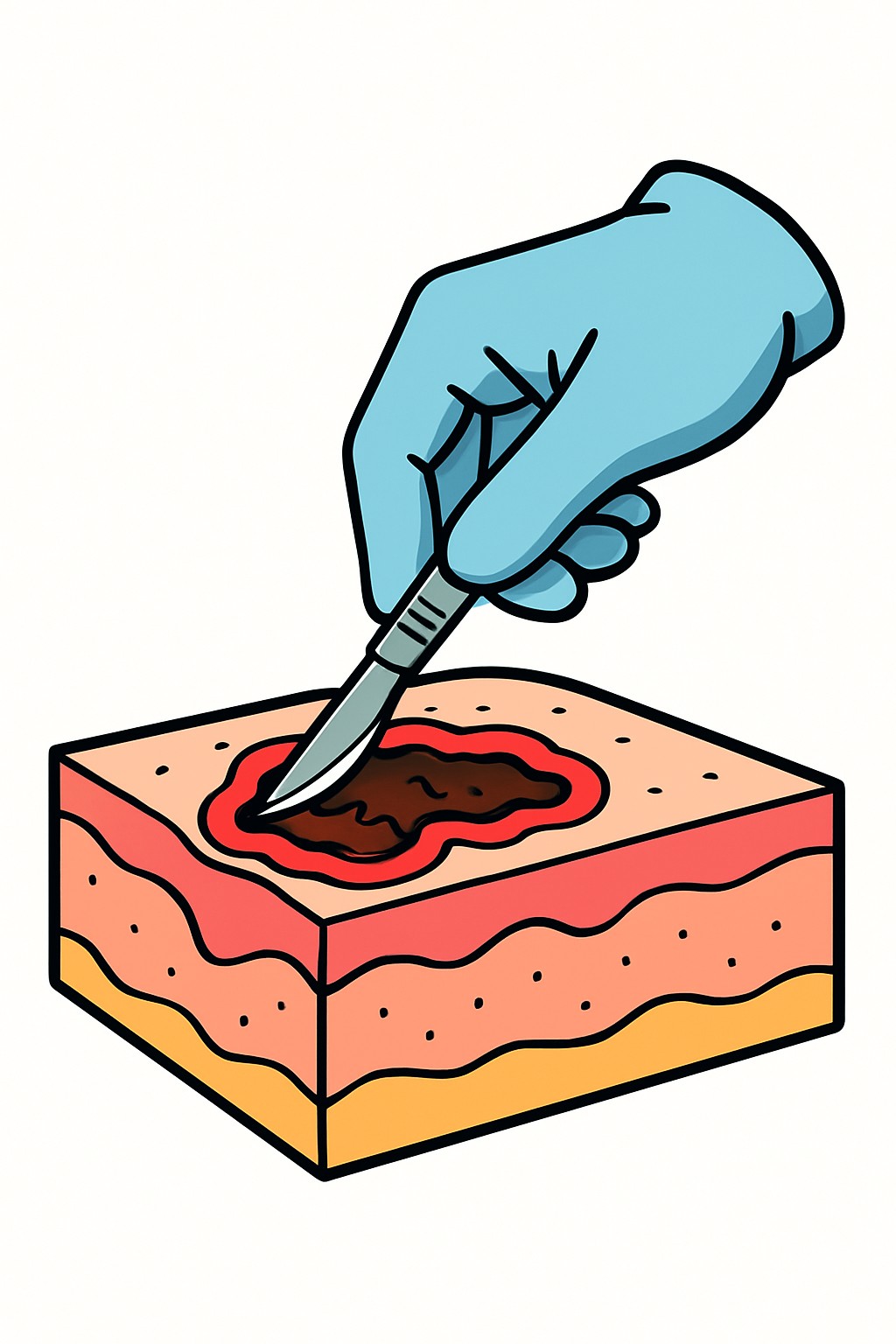
Debridement removes dead, damaged, or infected skin and soft tissue from a wound so healthier tissue can grow.
Overview
Debridement removes dead, damaged, or infected skin and soft tissue from a wound so healthier tissue can grow. The goal is to reduce bacteria, control odor and drainage, and help the wound heal. The phrase "first 20 sq cm" describes the size of tissue treated in one session. Larger areas may be treated in sections. Debridement can be done in a clinic, at the bedside, an outpatient center, or an operating room depending on the wound and method.
Also known as: Wound debridement, Skin debridement, Sharp debridement, Selective debridement
Preparation & Next Steps
Everything you need to know before and after your procedure
Before Care
- Bring a list of medicines and supplements, including blood thinners and allergies
- Wear clothing that allows easy access to the wound area
- Ask the clinic if you need a driver; a ride is often needed if sedation is planned
- Follow any clinic instructions about eating or drinking if sedation is planned
- Bring prior wound photos, measurements, or dressing details if available
- Confirm insurance requirements for wound care supplies or home health services
- Plan for time to rest after the visit, especially if a larger area is treated
- Tell the team about prior reactions to local anesthetics or adhesives
- Ask how to obtain dressings and cleansing supplies for after the procedure
After Care
- Keep the dressing clean and dry as instructed by your care team
- Change dressings on the schedule provided by the clinic or home health
- Avoid soaking the wound (baths, pools, hot tubs) until the team says it is safe
- Protect the area from pressure or friction; use offloading or compression if part of the plan
- Use prescribed or recommended pain control methods and report uncontrolled pain
- Resume normal activities gradually; limit strenuous activity if it increases bleeding or pain
- Monitor for increasing redness, warmth, swelling, bad odor, pus, fever, or heavy bleeding and contact a clinician if these occur
- Keep track of drainage amount and color to discuss at follow-up
- Schedule and attend follow-up visits; repeated debridement may be needed
- Store dressings and supplies in a clean, dry place and wash hands before wound care
Clinical Information
Important medical details about this procedure
Indications
- Chronic nonhealing wounds
- Diabetic foot ulcers
- Pressure injuries (bedsores)
- Venous leg ulcers
- Traumatic or surgical wounds with dead tissue
- Burns with slough or eschar
- Wound infection or heavy biofilm
Alternatives
- Autolytic debridement using moisture-retentive dressings
- Enzymatic debridement with prescription ointments
- Mechanical debridement (e.g., irrigation, specialized dressings)
- Biological debridement with sterile medical maggots
- Supportive wound care such as offloading, compression, and optimized glucose control
Risks
- Pain during or after the procedure
- Bleeding
- Infection
- Damage to nearby healthy tissue
- Scarring or changes in skin appearance
- Delayed healing or need for repeat procedures
- Allergic reaction to anesthetics or products used
Contraindications
- Uncontrolled bleeding problems
- Severe poor blood flow to the area without a plan to address it
- Allergy to local anesthetics or debridement products
- Systemic illness or instability that makes the setting unsafe
Recovery Timeline
What to expect during your recovery
Most people return to light daily activities the same day. Soreness or minor bleeding can occur for 1 to 3 days. Wound healing time varies by size, location, blood flow, and health conditions, and repeat sessions may be needed.
Typical Range
0–3 days
Return to Work
0–2 days
Recovery Milestones
Resume light walking and usual home activities as comfortable
Return to desk work if pain is controlled and dressing can be maintained
Expect tenderness to decrease; keep dressing dry
Gradually increase routine activity while avoiding soaking the wound
Follow-up visit to reassess the wound and decide on further care
Frequently Asked Questions
Common questions and expert answers about this procedure
What does debridement do?
What does debridement do?
It removes dead or infected tissue and surface buildup so healthier tissue can grow and the wound can heal.
What does “first 20 sq cm” mean?
What does “first 20 sq cm” mean?
It describes the area size treated during the session. Larger wounds are often treated in sections, and additional area may be documented separately.
Will it hurt?
Will it hurt?
A local anesthetic is often used to numb the area. Some pressure may be felt. Soreness afterward is common and usually short-lived.
How long does the procedure take?
How long does the procedure take?
Many sessions take about 10 to 30 minutes, but timing varies with wound size, method used, and dressing needs.
What types of debridement are used?
What types of debridement are used?
Methods include sharp (surgical), mechanical, enzymatic ointments, autolytic dressings, and biological therapy with sterile medical maggots.
How often is debridement repeated?
How often is debridement repeated?
Some wounds need repeated sessions, such as weekly or as the wound changes. The schedule depends on healing progress and method.
Will I need antibiotics?
Will I need antibiotics?
Not always. Antibiotics are used when there are signs of infection or if the clinician thinks bacteria are a problem.
When should I contact a clinician after debridement?
When should I contact a clinician after debridement?
Contact the clinic for heavy bleeding, worsening pain, spreading redness, warmth, pus, bad odor, fever, or if the dressing is soaked through.
References
Medical literature and sources