%20--%3e%3csvg%20version='1.0'%20id='Layer_1'%20xmlns='http://www.w3.org/2000/svg'%20xmlns:xlink='http://www.w3.org/1999/xlink'%20x='0px'%20y='0px'%20viewBox='0%200%20755.52%20814.35'%20style='enable-background:new%200%200%20755.52%20814.35;'%20xml:space='preserve'%3e%3cstyle%20type='text/css'%3e%20.st0{fill:%231ae5ce;stroke:%231ae5ce;stroke-width:7;stroke-miterlimit:10;}%20.st1{fill:%23FFFFFF;stroke:%231ae5ce;stroke-width:7;stroke-miterlimit:10;}%20.st2{fill:%231ae5ce;stroke:%23FFFFFF;stroke-width:7;stroke-miterlimit:10;}%20.st3{fill:%23FFFFFF;stroke:%23FFFFFF;stroke-width:6;stroke-miterlimit:10;}%20%3c/style%3e%3cg%20id='Dark_Logo_00000159431215648494653180000015900878925932721032_'%3e%3cpath%20id='shield_00000152259091539869183100000001926543869452564382_'%20class='st0'%20d='M711.13,173.42%20c-3.37-49.07-38.92-44.9-75.96-52.18c-67.4-13.25-130.47-34.47-192.36-63.92c-22.48-10.7-41.88-25.74-65.05-26.28%20c-23.17,0.54-42.58,15.59-65.05,26.28c-61.89,29.45-124.95,50.68-192.36,63.92c-37.04,7.28-72.59,3.11-75.96,52.18%20c-1.55,22.6,0.34,46.4,1.05,68.92c5.99,190.78,52.91,345.39,206.27,466.46c29.71,23.46,74.51,55.8,108.84,70.75%20c5.99,2.61,11.7,3.73,17.21,3.75c5.51-0.02,11.22-1.14,17.21-3.75c34.33-14.95,79.12-47.3,108.84-70.75%20c153.37-121.07,200.28-275.68,206.27-466.46C710.79,219.82,712.68,196.02,711.13,173.42z'/%3e%3cpath%20id='magnifyingglass_00000073685934697636024790000000342567780940956808_'%20class='st1'%20d='M648.78,624.21l-96.64-104.65%20c34.89-40.63,55.98-93.46,55.98-151.21c0-128.27-103.98-232.24-232.24-232.24S143.63,240.08,143.63,368.35%20s103.98,232.24,232.24,232.24c48.87,0,94.21-15.11,131.62-40.89l97.18,105.24c11.25,12.18,30.24,12.93,42.42,1.69l0,0%20C659.27,655.38,660.03,636.39,648.78,624.21z'/%3e%3ccircle%20id='ellipse_00000129904010550392394720000017056154833629780114_'%20class='st2'%20cx='375.87'%20cy='368.35'%20r='181.21'/%3e%3cpath%20id='dollarsign_00000057140127156649725250000003772530148495155891_'%20class='st3'%20d='M362.91,492.03v-23.91%20c0-2.01-1.58-3.69-3.59-3.77c-18.49-0.78-37.12-5.4-49.4-11.83c-1.75-0.92-2.53-3.01-1.76-4.84l5.87-13.89%20c0.86-2.02,3.23-2.88,5.2-1.89c12.94,6.52,30.45,11.44,49.18,11.44c26.02,0,43.6-12.73,43.6-30.43c0-17.08-14.29-27.63-41.4-36.95%20c-37.37-12.42-60.46-26.7-60.46-53.72c0-24.97,20.29-44.11,52.22-49.51c1.8-0.31,3.11-1.89,3.11-3.72v-24.35%20c0-2.09,1.69-3.78,3.78-3.78h15.16c2.09,0,3.78,1.69,3.78,3.78v22.71c0,2.01,1.58,3.67,3.58,3.77c17.85,0.92,30.88,4.75,40.61,9.1%20c1.92,0.86,2.79,3.09,1.94,5.01l-6.08,13.6c-0.85,1.91-3.09,2.77-4.99,1.91c-8.37-3.8-22.38-8.95-42.75-8.95%20c-28.21,0-38.84,14.28-38.84,26.7c0,16.15,13.56,24.22,45.44,35.4c37.74,13.04,56.79,29.19,56.79,56.82%20c0,23.85-19.05,46.23-54.78,52.3c-1.8,0.31-3.11,1.89-3.11,3.72v25.28c0,2.09-1.69,3.78-3.78,3.78h-15.53%20C364.6,495.81,362.91,494.12,362.91,492.03z'/%3e%3c/g%3e%3c/svg%3e)
Extensive wart destruction (15+ lesions) Dermatology Surgery
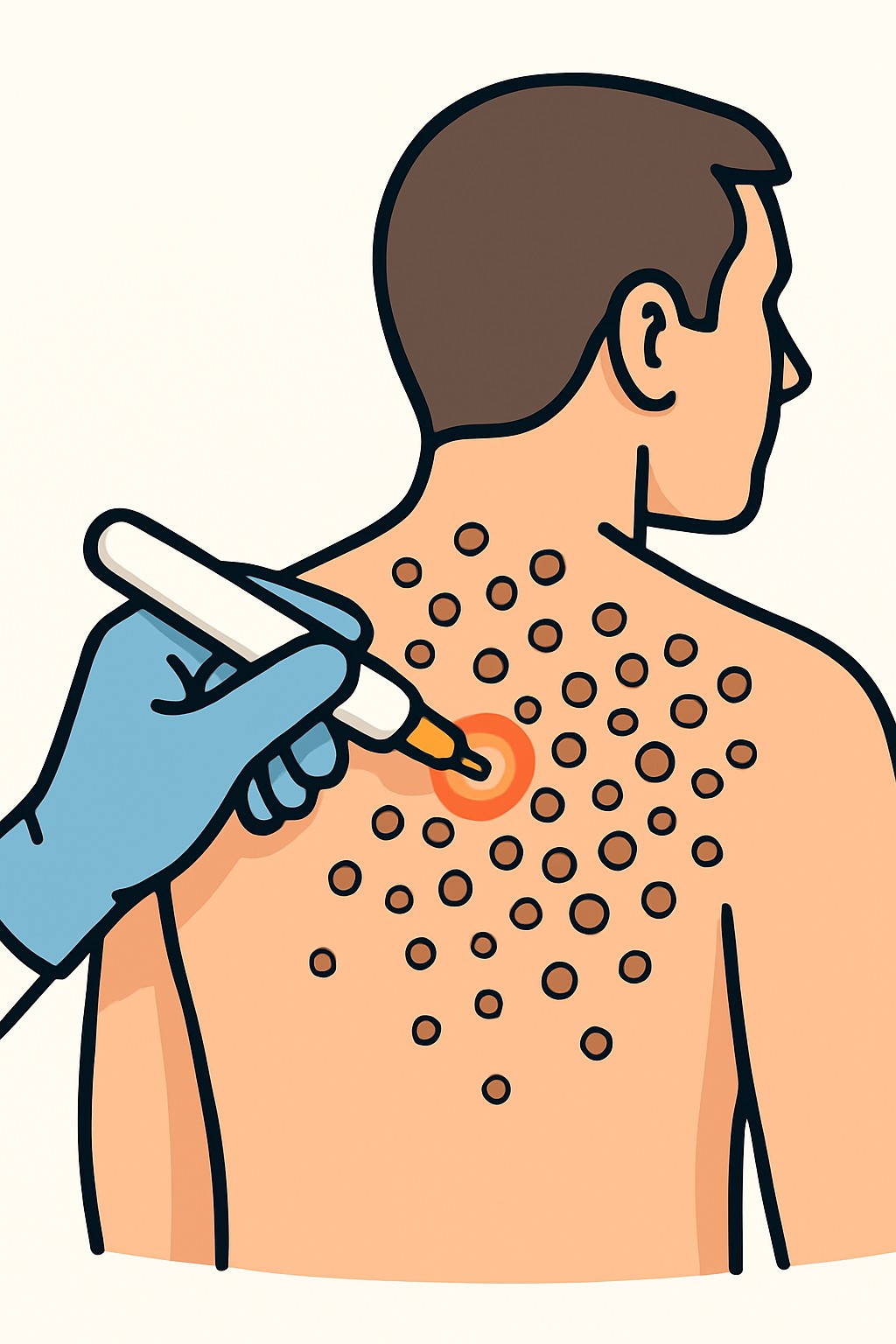
Extensive wart destruction is a procedure to remove 15 or more skin warts during the same visit.
Overview
Extensive wart destruction is a procedure to remove 15 or more skin warts during the same visit. Warts are noncancerous skin growths caused by human papillomavirus (HPV). The clinician may use freezing (cryotherapy), chemicals, electrosurgery, curettage, or laser to destroy the wart tissue. This procedure is done to reduce pain, irritation, or spreading to new areas. Many people need more than one session, spaced a few weeks apart, because warts can be stubborn and may return.
Also known as: Wart removal (extensive), Multiple wart treatment, Destruction of multiple warts
Preparation & Next Steps
Everything you need to know before and after your procedure
Before Care
- Bring a photo ID, insurance card, and a current list of medicines and supplements, including blood thinners
- Tell the clinic about any allergies to adhesives, topical medicines, or anesthetics
- Wear loose clothing or footwear that allows easy access to the treatment areas
- Clean the skin before the visit and remove nail polish if warts are on or near nails
- Avoid shaving, clipping, or picking at warts before the appointment to reduce spreading the virus on the skin
- Plan your schedule in case treated areas are sore or blistered later that day
- Arrange a ride if many lesions on hands or feet will be treated and you may be uncomfortable driving
- Bring records or photos of prior wart treatments and response, if available
- Confirm the number and locations of warts you want addressed at this session
After Care
- Keep the area clean and dry for the first day, then gently wash with soap and water
- Do not pick at scabs or pop blisters; cover draining blisters with a clean bandage
- Change dressings if they get wet or dirty and use simple nonstick bandages as needed
- Expect soreness or blistering for a few days; protect tender areas from friction
- For foot lesions, wear cushioned socks and supportive shoes until walking is comfortable
- Avoid swimming pools, hot tubs, or soaking until the skin surface has closed
- After the skin heals, protect the area from sun with clothing or sunscreen to reduce dark spots
- Resume normal bathing when the skin is not weeping; moisturize healed skin if it feels dry
- Schedule follow-up in 2 to 4 weeks if recommended; repeat treatments are common
- Contact a clinician if you notice spreading redness, warmth, pus, fever, severe pain, or worsening swelling
Clinical Information
Important medical details about this procedure
Indications
- 15 or more visible warts
- Painful plantar warts that affect walking
- Warts that are spreading or keep returning
- Bleeding, irritation, or snagging on clothing
- Cosmetic concerns or impact on daily activities
- Widespread warts in people with reduced immunity
Alternatives
- Watchful waiting, since some warts clear on their own
- Over-the-counter salicylic acid products
- Topical treatments applied in a series of visits
- Immunotherapy options directed by a clinician
- Laser therapy, curettage, or surgical removal
- Treating a smaller number of lesions per visit
Risks
- Pain, swelling, or blistering at treated sites
- Temporary or permanent skin color changes
- Scarring or thickened skin
- Infection at the treatment site
- Nail changes if treated near nails
- Nerve or tissue injury is uncommon
- Warts may recur and need further treatment
Contraindications
- Uncertain diagnosis or a lesion that could be skin cancer
- Active skin infection at the treatment area
- Poor blood flow or severe neuropathy in the area
- Conditions sensitive to cold exposure for cryotherapy
- Allergy or sensitivity to planned treatment agents
Recovery Timeline
What to expect during your recovery
Most treated spots form blisters or scabs and heal over 1 to 3 weeks. Some people return to work or school the same day, but soreness can last a few days. Multiple sessions are often needed.
Typical Range
7–21 days
Return to Work
0–2 days
Recovery Milestones
Manage soreness and protect treated areas from rubbing
Blistering or crusting appears; keep clean and covered if needed
Scab forms and begins to lift; resume usual light activities as comfortable
Most sites close; reduce friction and sun exposure to healing skin
Assess remaining warts and plan next treatment session if advised
Frequently Asked Questions
Common questions and expert answers about this procedure
What does wart destruction mean?
What does wart destruction mean?
It refers to removing wart tissue using methods like freezing, chemical application, electrosurgery, curettage, or laser during an office procedure.
Why is this called extensive?
Why is this called extensive?
Extensive means 15 or more warts are treated during the same session.
How many sessions are usually needed?
How many sessions are usually needed?
Many warts need several sessions spaced a few weeks apart because warts can be resistant and may return.
Will it hurt?
Will it hurt?
Brief stinging or burning is common during treatment. Soreness or blistering may last a few days afterward.
Will I have scars or skin color changes?
Will I have scars or skin color changes?
Small scars or light or dark spots can occur, especially on darker skin or after deeper treatments.
Can I go back to work or school the same day?
Can I go back to work or school the same day?
Many people do, but tenderness can affect activities, especially if the feet or hands were treated.
Do warts go away forever after removal?
Do warts go away forever after removal?
Warts can recur because the virus may remain in the skin. Repeat or different treatments may be needed.
Are warts contagious?
Are warts contagious?
Yes. They can spread through direct contact or shared surfaces. Avoid picking and keep skin clean to reduce spread.
References
Medical literature and sources