%20--%3e%3csvg%20version='1.0'%20id='Layer_1'%20xmlns='http://www.w3.org/2000/svg'%20xmlns:xlink='http://www.w3.org/1999/xlink'%20x='0px'%20y='0px'%20viewBox='0%200%20755.52%20814.35'%20style='enable-background:new%200%200%20755.52%20814.35;'%20xml:space='preserve'%3e%3cstyle%20type='text/css'%3e%20.st0{fill:%231ae5ce;stroke:%231ae5ce;stroke-width:7;stroke-miterlimit:10;}%20.st1{fill:%23FFFFFF;stroke:%231ae5ce;stroke-width:7;stroke-miterlimit:10;}%20.st2{fill:%231ae5ce;stroke:%23FFFFFF;stroke-width:7;stroke-miterlimit:10;}%20.st3{fill:%23FFFFFF;stroke:%23FFFFFF;stroke-width:6;stroke-miterlimit:10;}%20%3c/style%3e%3cg%20id='Dark_Logo_00000159431215648494653180000015900878925932721032_'%3e%3cpath%20id='shield_00000152259091539869183100000001926543869452564382_'%20class='st0'%20d='M711.13,173.42%20c-3.37-49.07-38.92-44.9-75.96-52.18c-67.4-13.25-130.47-34.47-192.36-63.92c-22.48-10.7-41.88-25.74-65.05-26.28%20c-23.17,0.54-42.58,15.59-65.05,26.28c-61.89,29.45-124.95,50.68-192.36,63.92c-37.04,7.28-72.59,3.11-75.96,52.18%20c-1.55,22.6,0.34,46.4,1.05,68.92c5.99,190.78,52.91,345.39,206.27,466.46c29.71,23.46,74.51,55.8,108.84,70.75%20c5.99,2.61,11.7,3.73,17.21,3.75c5.51-0.02,11.22-1.14,17.21-3.75c34.33-14.95,79.12-47.3,108.84-70.75%20c153.37-121.07,200.28-275.68,206.27-466.46C710.79,219.82,712.68,196.02,711.13,173.42z'/%3e%3cpath%20id='magnifyingglass_00000073685934697636024790000000342567780940956808_'%20class='st1'%20d='M648.78,624.21l-96.64-104.65%20c34.89-40.63,55.98-93.46,55.98-151.21c0-128.27-103.98-232.24-232.24-232.24S143.63,240.08,143.63,368.35%20s103.98,232.24,232.24,232.24c48.87,0,94.21-15.11,131.62-40.89l97.18,105.24c11.25,12.18,30.24,12.93,42.42,1.69l0,0%20C659.27,655.38,660.03,636.39,648.78,624.21z'/%3e%3ccircle%20id='ellipse_00000129904010550392394720000017056154833629780114_'%20class='st2'%20cx='375.87'%20cy='368.35'%20r='181.21'/%3e%3cpath%20id='dollarsign_00000057140127156649725250000003772530148495155891_'%20class='st3'%20d='M362.91,492.03v-23.91%20c0-2.01-1.58-3.69-3.59-3.77c-18.49-0.78-37.12-5.4-49.4-11.83c-1.75-0.92-2.53-3.01-1.76-4.84l5.87-13.89%20c0.86-2.02,3.23-2.88,5.2-1.89c12.94,6.52,30.45,11.44,49.18,11.44c26.02,0,43.6-12.73,43.6-30.43c0-17.08-14.29-27.63-41.4-36.95%20c-37.37-12.42-60.46-26.7-60.46-53.72c0-24.97,20.29-44.11,52.22-49.51c1.8-0.31,3.11-1.89,3.11-3.72v-24.35%20c0-2.09,1.69-3.78,3.78-3.78h15.16c2.09,0,3.78,1.69,3.78,3.78v22.71c0,2.01,1.58,3.67,3.58,3.77c17.85,0.92,30.88,4.75,40.61,9.1%20c1.92,0.86,2.79,3.09,1.94,5.01l-6.08,13.6c-0.85,1.91-3.09,2.77-4.99,1.91c-8.37-3.8-22.38-8.95-42.75-8.95%20c-28.21,0-38.84,14.28-38.84,26.7c0,16.15,13.56,24.22,45.44,35.4c37.74,13.04,56.79,29.19,56.79,56.82%20c0,23.85-19.05,46.23-54.78,52.3c-1.8,0.31-3.11,1.89-3.11,3.72v25.28c0,2.09-1.69,3.78-3.78,3.78h-15.53%20C364.6,495.81,362.91,494.12,362.91,492.03z'/%3e%3c/g%3e%3c/svg%3e)
Incision and drainage of abscess - complicated Dermatology Surgery
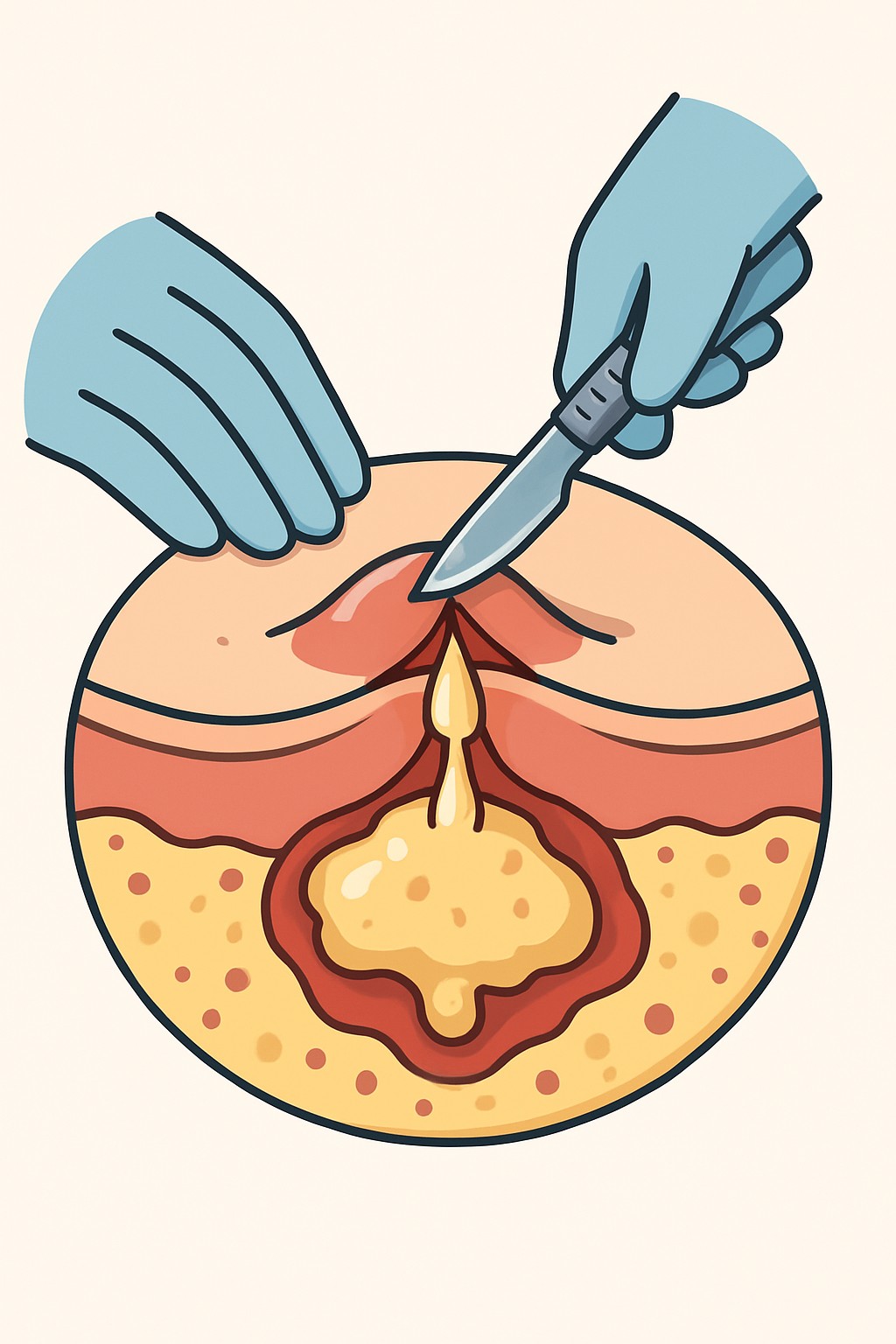
Incision and drainage of abscess - complicated is a procedure to open, empty, and clean a collection of pus when it is large, deep, has multiple chambers, or is in a sensitive area.
Overview
Incision and drainage of abscess - complicated is a procedure to open, empty, and clean a collection of pus when it is large, deep, has multiple chambers, or is in a sensitive area. After numbing or anesthesia, the clinician makes a cut, breaks up pockets, rinses the cavity, and may place packing or a small drain. It is done to relieve pressure and pain, remove infected material, and help the area heal. A sample of the pus may be sent for culture to help choose antibiotics. Antibiotics are sometimes used along with the procedure, especially for more severe infections.
Also known as: I&D of abscess, Complex abscess drainage, Incision and drainage - complicated
Preparation & Next Steps
Everything you need to know before and after your procedure
Before Care
- Bring a current list of all medicines and allergies, including blood thinners and supplements
- Arrange a ride if sedation or anesthesia may be used
- Follow any instructions about eating and drinking if sedation is planned
- Wear loose clothing that allows easy access to the area
- Complete any ordered imaging or labs before the visit when possible
- Plan time off work or school for the procedure day and short recovery
- Set up basic wound supplies at home, such as clean gauze, tape, and a waterproof cover for bathing
- Confirm a preferred pharmacy for any prescriptions that may be given
- Ask about work or activity limits that may apply based on the site of the abscess
- Confirm the follow-up plan for wound checks, packing or drain care, and culture results
After Care
- Keep the dressing clean and dry; change it as directed by your care team
- If packing or a drain was placed, leave it in place until your care team removes or changes it
- Take any prescribed antibiotics exactly as instructed
- Use pain relief as recommended by your care team and avoid medicines you were told to hold
- Avoid soaking the area in baths, pools, or hot tubs until the wound has closed
- Elevate the affected limb when resting to help reduce swelling if the area is on an arm or leg
- Use warm compresses over the dressing for comfort if allowed by your care team
- Practice hand hygiene before and after touching the dressing; keep the site covered in public settings
- Return for wound checks, packing or drain removal, and to review culture results as scheduled
- Contact a clinician if you notice worsening pain, spreading redness, fever, pus with foul odor, heavy bleeding, numbness, or if the wound is not improving
Clinical Information
Important medical details about this procedure
Indications
- Large or deep skin or soft tissue abscess
- Multiple or loculated abscesses that do not drain on their own
- Failure of antibiotics alone
- Abscess in locations where spread can cause problems, such as face, hand, groin, or perirectal area
- Systemic symptoms such as fever or feeling ill with a skin abscess
- Underlying conditions that raise risk of complications, such as diabetes or immune suppression
Alternatives
- Warm compresses for small, early abscesses
- Antibiotics alone for small abscesses without a drainable pocket
- Needle aspiration in select cases
- Image-guided drainage for deeper collections
- Observation if a very small abscess drains spontaneously and symptoms are improving
Risks
- Bleeding or bruising
- Pain during or after the procedure
- Scarring or skin discoloration
- Injury to nearby nerves or blood vessels
- Spread of infection or sepsis
- Recurrence or need for repeat drainage
- Allergic reaction or side effects from local anesthetic or antibiotics
Contraindications
- Abscess over major vessels or nerves without specialist support
- Anatomic areas that often need specialist care, such as face, hand, genitals, or perirectal region
- Uncontrolled bleeding disorder
- Severe illness requiring hospital-level care instead of an office procedure
Recovery Timeline
What to expect during your recovery
Most people improve over several days, with wound healing over 1 to 3 weeks for larger or deeper abscesses. Timing varies with the size and location of the abscess and whether packing or a drain is used.
Typical Range
7–21 days
Return to Work
1–7 days
Recovery Milestones
Light daily activities while keeping the dressing protected
First dressing change and wound check per the care plan
Gradual increase in routine activities as pain and drainage decrease
Resume most activities that do not strain the treated area
Return to full activities if the wound is closing and pain is controlled
Frequently Asked Questions
Common questions and expert answers about this procedure
What makes an abscess incision and drainage complicated?
What makes an abscess incision and drainage complicated?
Complicated usually means the abscess is large, deep, has multiple pockets, or is in a sensitive area. It may require imaging, wider opening, breaking up pockets, and use of packing or a drain.
Will I need antibiotics after the procedure?
Will I need antibiotics after the procedure?
Antibiotics are often added for more severe or complicated infections, for patients with systemic symptoms, or when the abscess is in a high-risk location. Some abscesses improve with drainage alone.
Will a drain or packing be used?
Will a drain or packing be used?
Sometimes. Packing or a small drain helps keep the cavity open so it can continue to drain and heal from the inside out, especially when the abscess is large or has multiple pockets.
Is a culture taken?
Is a culture taken?
A sample of pus is often sent to the lab in complicated, recurrent, or severe infections to identify the germ and help guide antibiotic choices.
How painful is the procedure?
How painful is the procedure?
Local anesthesia is commonly used to numb the area. You may feel pressure. Soreness after the procedure is common and usually improves over a few days.
How soon can I return to work or school?
How soon can I return to work or school?
Many people with desk work return within a few days. Jobs that strain the treated area or involve heavy lifting may require more time.
Will there be a scar?
Will there be a scar?
A small scar is common. The appearance often improves over months as the wound heals and the tissue remodels.
Can the abscess come back?
Can the abscess come back?
Recurrence can happen, especially with certain skin conditions or ongoing irritation. Good wound care and addressing contributing factors may lower the risk.
References
Medical literature and sources