%20--%3e%3csvg%20version='1.0'%20id='Layer_1'%20xmlns='http://www.w3.org/2000/svg'%20xmlns:xlink='http://www.w3.org/1999/xlink'%20x='0px'%20y='0px'%20viewBox='0%200%20755.52%20814.35'%20style='enable-background:new%200%200%20755.52%20814.35;'%20xml:space='preserve'%3e%3cstyle%20type='text/css'%3e%20.st0{fill:%231ae5ce;stroke:%231ae5ce;stroke-width:7;stroke-miterlimit:10;}%20.st1{fill:%23FFFFFF;stroke:%231ae5ce;stroke-width:7;stroke-miterlimit:10;}%20.st2{fill:%231ae5ce;stroke:%23FFFFFF;stroke-width:7;stroke-miterlimit:10;}%20.st3{fill:%23FFFFFF;stroke:%23FFFFFF;stroke-width:6;stroke-miterlimit:10;}%20%3c/style%3e%3cg%20id='Dark_Logo_00000159431215648494653180000015900878925932721032_'%3e%3cpath%20id='shield_00000152259091539869183100000001926543869452564382_'%20class='st0'%20d='M711.13,173.42%20c-3.37-49.07-38.92-44.9-75.96-52.18c-67.4-13.25-130.47-34.47-192.36-63.92c-22.48-10.7-41.88-25.74-65.05-26.28%20c-23.17,0.54-42.58,15.59-65.05,26.28c-61.89,29.45-124.95,50.68-192.36,63.92c-37.04,7.28-72.59,3.11-75.96,52.18%20c-1.55,22.6,0.34,46.4,1.05,68.92c5.99,190.78,52.91,345.39,206.27,466.46c29.71,23.46,74.51,55.8,108.84,70.75%20c5.99,2.61,11.7,3.73,17.21,3.75c5.51-0.02,11.22-1.14,17.21-3.75c34.33-14.95,79.12-47.3,108.84-70.75%20c153.37-121.07,200.28-275.68,206.27-466.46C710.79,219.82,712.68,196.02,711.13,173.42z'/%3e%3cpath%20id='magnifyingglass_00000073685934697636024790000000342567780940956808_'%20class='st1'%20d='M648.78,624.21l-96.64-104.65%20c34.89-40.63,55.98-93.46,55.98-151.21c0-128.27-103.98-232.24-232.24-232.24S143.63,240.08,143.63,368.35%20s103.98,232.24,232.24,232.24c48.87,0,94.21-15.11,131.62-40.89l97.18,105.24c11.25,12.18,30.24,12.93,42.42,1.69l0,0%20C659.27,655.38,660.03,636.39,648.78,624.21z'/%3e%3ccircle%20id='ellipse_00000129904010550392394720000017056154833629780114_'%20class='st2'%20cx='375.87'%20cy='368.35'%20r='181.21'/%3e%3cpath%20id='dollarsign_00000057140127156649725250000003772530148495155891_'%20class='st3'%20d='M362.91,492.03v-23.91%20c0-2.01-1.58-3.69-3.59-3.77c-18.49-0.78-37.12-5.4-49.4-11.83c-1.75-0.92-2.53-3.01-1.76-4.84l5.87-13.89%20c0.86-2.02,3.23-2.88,5.2-1.89c12.94,6.52,30.45,11.44,49.18,11.44c26.02,0,43.6-12.73,43.6-30.43c0-17.08-14.29-27.63-41.4-36.95%20c-37.37-12.42-60.46-26.7-60.46-53.72c0-24.97,20.29-44.11,52.22-49.51c1.8-0.31,3.11-1.89,3.11-3.72v-24.35%20c0-2.09,1.69-3.78,3.78-3.78h15.16c2.09,0,3.78,1.69,3.78,3.78v22.71c0,2.01,1.58,3.67,3.58,3.77c17.85,0.92,30.88,4.75,40.61,9.1%20c1.92,0.86,2.79,3.09,1.94,5.01l-6.08,13.6c-0.85,1.91-3.09,2.77-4.99,1.91c-8.37-3.8-22.38-8.95-42.75-8.95%20c-28.21,0-38.84,14.28-38.84,26.7c0,16.15,13.56,24.22,45.44,35.4c37.74,13.04,56.79,29.19,56.79,56.82%20c0,23.85-19.05,46.23-54.78,52.3c-1.8,0.31-3.11,1.89-3.11,3.72v25.28c0,2.09-1.69,3.78-3.78,3.78h-15.53%20C364.6,495.81,362.91,494.12,362.91,492.03z'/%3e%3c/g%3e%3c/svg%3e)
Intralesional injection (medication into skin lesion) Dermatology Surgery
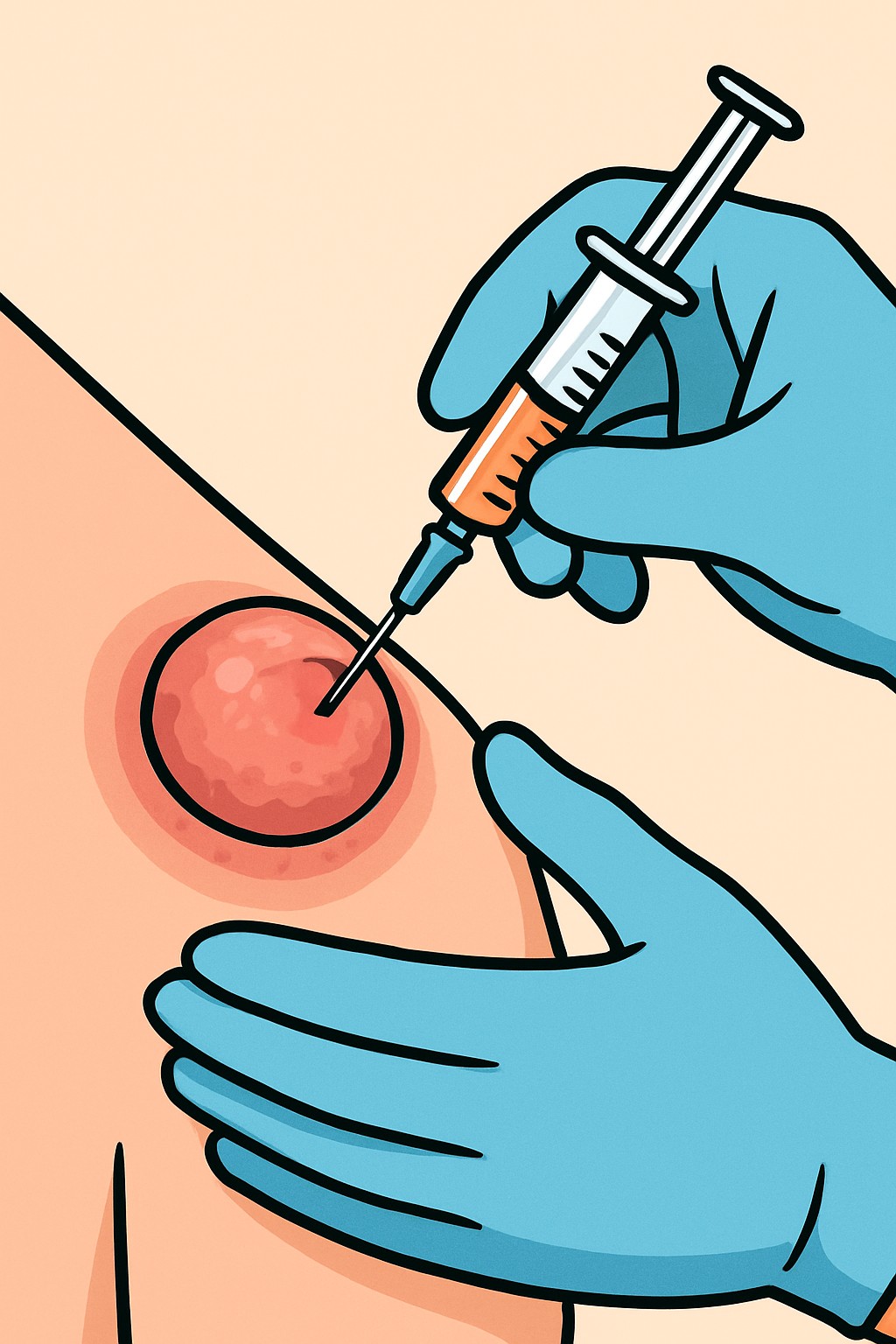
An intralesional injection places a small amount of medicine directly into a skin lesion.
Overview
An intralesional injection places a small amount of medicine directly into a skin lesion. The goal is to deliver treatment right where it is needed while limiting how much of the drug reaches the rest of the body. Dermatology clinics often use this method to shrink thick or inflamed spots, calm overactive immune reactions in the skin, or treat stubborn growths. The medicine and dose depend on the condition and the size and location of the lesion.
Also known as: Intralesional corticosteroid, IL steroid injection, Kenalog injection into lesion, Intralesional therapy
Preparation & Next Steps
Everything you need to know before and after your procedure
Before Care
- Bring a list of your medicines and supplements, including blood thinners and doses
- Tell the clinic about allergies, prior reactions to injections, and past keloid formation
- Ask whether to pause any skin products on the area the day of the visit
- Arrive with clean skin over the lesion; avoid creams, makeup, or self-tanner on that area
- Share if you have a bleeding disorder or history of poor wound healing
- Confirm if numbing cream will be used and when to apply it, if provided by the clinic
- Plan for a small bandage and minor soreness that may affect activities the same day
- Arrange follow-up timing if a series of injections is expected
- Verify insurance coverage and any needed authorization for the procedure
- Bring previous dermatology records or photos if they help track response
After Care
- Keep the small bandage on as advised and keep the site clean and dry the first day
- Avoid picking, rubbing, or scratching the area
- Skip hot tubs, swimming, and heavy friction on the site for 24 to 48 hours
- Use only products recommended by your clinician on the treated area
- Expect mild soreness or tenderness for 1 to 2 days
- Protect the area from sun; use clothing or sunscreen once the skin is intact
- Track changes in size, texture, or symptoms with notes or photos
- Attend follow-up visits if a series of injections is planned
- Contact the clinic if you notice spreading redness, warmth, pus, fever, severe pain, or signs of an allergic reaction
- Report any dimpling, color change, or delayed healing at the site at your next visit
Clinical Information
Important medical details about this procedure
Indications
- Keloids and hypertrophic scars
- Alopecia areata patches
- Psoriasis plaques or thick localized lesions
- Lichen simplex chronicus or prurigo nodules
- Granuloma annulare or other localized inflammatory nodules
- Cystic acne nodules
- Certain warts or other selected growths
Alternatives
- Topical medicines (steroids, retinoids, immunomodulators)
- Cryotherapy (freezing)
- Laser treatments
- Surgical removal or shave
- Phototherapy
- Systemic medicines (pills or injections)
- Watchful waiting when appropriate
Risks
- Pain, tenderness, or bruising at the injection site
- Bleeding or infection at the site
- Skin thinning or small depression (atrophy)
- Lightening or darkening of skin color
- Small surface blood vessels (telangiectasia)
- Ulceration or delayed healing
- Allergic or local reaction to the medication
- Rare steroid side effects if high doses or many sites are treated
Contraindications
- Active skin infection at the planned site
- Known allergy to the planned medication or its components
- Significant bleeding disorder or use of strong blood thinners without a plan
- Pregnancy or breastfeeding when the chosen drug is not recommended
- Extensive unstable skin disease where injection could worsen irritation
Recovery Timeline
What to expect during your recovery
Most people resume normal activities the same day. Tenderness or a small bandage may be needed for 1 to 2 days. Visible changes can develop over days to weeks depending on the condition and medicine used.
Typical Range
0–2 days
Return to Work
0–1 days
Recovery Milestones
Resume light daily activities
Expect tenderness; avoid friction, swimming, and hot tubs
Remove bandage per instructions and keep site clean
Monitor lesion for changes in size, texture, or symptoms
Typical window for reassessment or next injection if planned
Frequently Asked Questions
Common questions and expert answers about this procedure
What happens during an intralesional injection?
What happens during an intralesional injection?
The skin is cleaned, sometimes numbed, and a small needle places medicine into the lesion. A bandage may be applied afterward.
Which medicines are commonly used?
Which medicines are commonly used?
Corticosteroids such as triamcinolone are most common. In selected cases, other drugs like 5‑fluorouracil or bleomycin may be used for specific lesions.
Does it hurt?
Does it hurt?
You may feel brief stinging or pressure. Numbing spray or cream may be used. Soreness can last a day or two.
How many treatments might be needed?
How many treatments might be needed?
Some lesions respond to one session; many need a series spaced weeks apart. The number depends on the condition and response.
When will I see results?
When will I see results?
Inflammation can start to improve within days, while changes in thickness or hair regrowth may take weeks.
Are there scars or color changes?
Are there scars or color changes?
Most sites heal with a small mark or none, but skin thinning or lightening can occur, especially with higher steroid doses.
Can I have this if I take blood thinners?
Can I have this if I take blood thinners?
Minor bleeding or bruising risk is higher. Your care team may adjust the plan to reduce bleeding at the site.
What conditions are not good candidates?
What conditions are not good candidates?
Active infection at the site or a known allergy to the drug are common reasons to avoid this approach.