%20--%3e%3csvg%20version='1.0'%20id='Layer_1'%20xmlns='http://www.w3.org/2000/svg'%20xmlns:xlink='http://www.w3.org/1999/xlink'%20x='0px'%20y='0px'%20viewBox='0%200%20755.52%20814.35'%20style='enable-background:new%200%200%20755.52%20814.35;'%20xml:space='preserve'%3e%3cstyle%20type='text/css'%3e%20.st0{fill:%231ae5ce;stroke:%231ae5ce;stroke-width:7;stroke-miterlimit:10;}%20.st1{fill:%23FFFFFF;stroke:%231ae5ce;stroke-width:7;stroke-miterlimit:10;}%20.st2{fill:%231ae5ce;stroke:%23FFFFFF;stroke-width:7;stroke-miterlimit:10;}%20.st3{fill:%23FFFFFF;stroke:%23FFFFFF;stroke-width:6;stroke-miterlimit:10;}%20%3c/style%3e%3cg%20id='Dark_Logo_00000159431215648494653180000015900878925932721032_'%3e%3cpath%20id='shield_00000152259091539869183100000001926543869452564382_'%20class='st0'%20d='M711.13,173.42%20c-3.37-49.07-38.92-44.9-75.96-52.18c-67.4-13.25-130.47-34.47-192.36-63.92c-22.48-10.7-41.88-25.74-65.05-26.28%20c-23.17,0.54-42.58,15.59-65.05,26.28c-61.89,29.45-124.95,50.68-192.36,63.92c-37.04,7.28-72.59,3.11-75.96,52.18%20c-1.55,22.6,0.34,46.4,1.05,68.92c5.99,190.78,52.91,345.39,206.27,466.46c29.71,23.46,74.51,55.8,108.84,70.75%20c5.99,2.61,11.7,3.73,17.21,3.75c5.51-0.02,11.22-1.14,17.21-3.75c34.33-14.95,79.12-47.3,108.84-70.75%20c153.37-121.07,200.28-275.68,206.27-466.46C710.79,219.82,712.68,196.02,711.13,173.42z'/%3e%3cpath%20id='magnifyingglass_00000073685934697636024790000000342567780940956808_'%20class='st1'%20d='M648.78,624.21l-96.64-104.65%20c34.89-40.63,55.98-93.46,55.98-151.21c0-128.27-103.98-232.24-232.24-232.24S143.63,240.08,143.63,368.35%20s103.98,232.24,232.24,232.24c48.87,0,94.21-15.11,131.62-40.89l97.18,105.24c11.25,12.18,30.24,12.93,42.42,1.69l0,0%20C659.27,655.38,660.03,636.39,648.78,624.21z'/%3e%3ccircle%20id='ellipse_00000129904010550392394720000017056154833629780114_'%20class='st2'%20cx='375.87'%20cy='368.35'%20r='181.21'/%3e%3cpath%20id='dollarsign_00000057140127156649725250000003772530148495155891_'%20class='st3'%20d='M362.91,492.03v-23.91%20c0-2.01-1.58-3.69-3.59-3.77c-18.49-0.78-37.12-5.4-49.4-11.83c-1.75-0.92-2.53-3.01-1.76-4.84l5.87-13.89%20c0.86-2.02,3.23-2.88,5.2-1.89c12.94,6.52,30.45,11.44,49.18,11.44c26.02,0,43.6-12.73,43.6-30.43c0-17.08-14.29-27.63-41.4-36.95%20c-37.37-12.42-60.46-26.7-60.46-53.72c0-24.97,20.29-44.11,52.22-49.51c1.8-0.31,3.11-1.89,3.11-3.72v-24.35%20c0-2.09,1.69-3.78,3.78-3.78h15.16c2.09,0,3.78,1.69,3.78,3.78v22.71c0,2.01,1.58,3.67,3.58,3.77c17.85,0.92,30.88,4.75,40.61,9.1%20c1.92,0.86,2.79,3.09,1.94,5.01l-6.08,13.6c-0.85,1.91-3.09,2.77-4.99,1.91c-8.37-3.8-22.38-8.95-42.75-8.95%20c-28.21,0-38.84,14.28-38.84,26.7c0,16.15,13.56,24.22,45.44,35.4c37.74,13.04,56.79,29.19,56.79,56.82%20c0,23.85-19.05,46.23-54.78,52.3c-1.8,0.31-3.11,1.89-3.11,3.72v25.28c0,2.09-1.69,3.78-3.78,3.78h-15.53%20C364.6,495.81,362.91,494.12,362.91,492.03z'/%3e%3c/g%3e%3c/svg%3e)
Mohs Micrographic Surgery (first stage) Dermatology Surgery
Mohs micrographic surgery is a precise method to remove certain skin cancers.
Overview
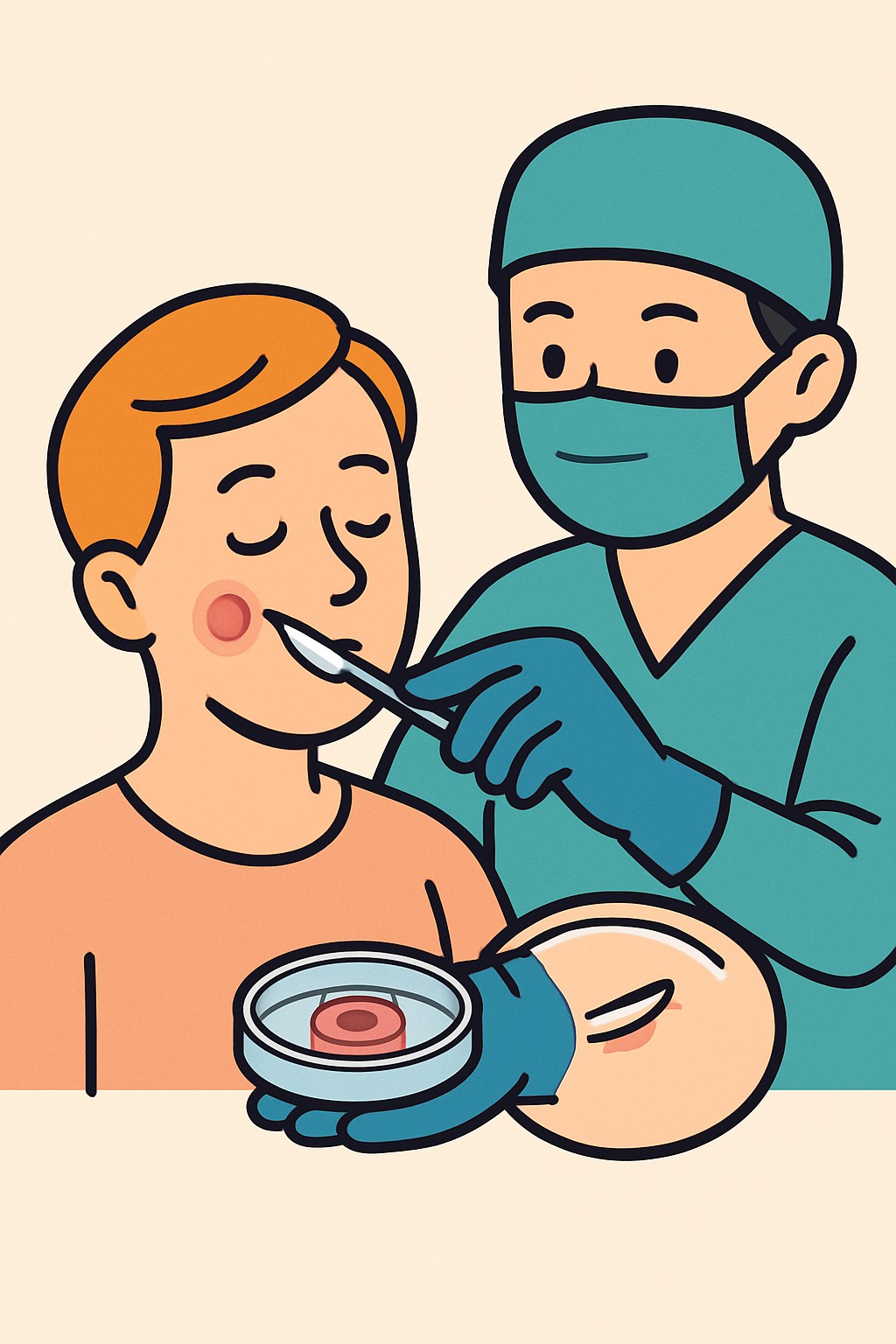
Mohs micrographic surgery is a precise method to remove certain skin cancers. The first stage means the surgeon removes the visible tumor with a very thin rim of surrounding skin, then maps and examines the tissue under a microscope to check the edges (margins). If cancer is still seen at the edges, more tissue is taken in additional stages from only the areas where cancer remains. Many people clear the margins in the first stage; others need several stages the same day. The procedure is usually done in an outpatient clinic with local anesthesia.
Also known as: Mohs surgery, first stage, Stage 1 Mohs, Initial Mohs stage, MMS first stage
Preparation & Next Steps
Everything you need to know before and after your procedure
Before Care
- Plan to be at the clinic for several hours because tissue processing between stages takes time
- Bring a list of your medicines, supplements, and allergies
- Follow your clinic’s guidance about blood thinners and other medicines; do not stop medicines unless instructed by your care team
- Eat a normal meal before arrival unless your clinic gave different instructions
- Wear comfortable clothing that allows easy access to the surgical area
- Avoid makeup, lotions, or sunscreen on the area to be treated
- Arrange transportation or support if your clinic anticipates complex reconstruction or if vision may be temporarily affected
- Bring something to do while waiting between stages (for example, a book or device)
- Confirm pharmacy information for any post-procedure prescriptions
- Share any history of keloids, poor wound healing, or prior procedures in the area
After Care
- Keep the pressure bandage in place and the area clean and dry as instructed by your clinic
- Use prescribed or recommended pain control as directed by your clinician; avoid dosing changes without guidance
- Limit strenuous activity and heavy lifting until your care team says it is safe
- Elevate the area if possible to reduce swelling and bruising
- Follow wound care steps for cleaning and dressing changes at the times provided by your clinic
- Protect the site from sun exposure; cover the area when outdoors
- Take medicines exactly as prescribed, including any antibiotics if ordered
- Watch for increasing redness, warmth, swelling, pus, fever, or bleeding that soaks the bandage and contact the clinic if these occur
- Attend scheduled follow-up to check healing and remove stitches if placed
- Ask your clinic when you can return to work, exercise, swimming, or contact sports based on the site and closure type
Clinical Information
Important medical details about this procedure
Indications
- Basal cell carcinoma
- Squamous cell carcinoma of the skin
- Skin cancers with unclear borders or that returned after prior treatment
- Tumors on areas where preserving healthy tissue is important (face, ears, nose, eyelids, lips, hands, genitals)
- Certain other skin cancers in selected cases, based on specialist judgment
Alternatives
- Standard surgical excision
- Curettage and electrodessication
- Cryosurgery (freezing)
- Topical therapies (for selected superficial cancers)
- Radiation therapy
- Photodynamic therapy (for selected superficial lesions)
- Observation in rare, carefully selected situations
Risks
- Bleeding or bruising
- Infection at the surgical site
- Pain or discomfort after numbing wears off
- Scarring or cosmetic changes
- Numbness or weakness from temporary or, rarely, permanent nerve injury
- Allergic reaction or side effects from local anesthesia
- Need for skin flap, graft, or referral for reconstruction
- A longer visit if multiple stages are required
Contraindications
- Inability to tolerate or receive local anesthesia
- Uncontrolled bleeding disorders or issues with blood thinners without a plan from the care team
- Inability to lie still for extended periods without support
- Active skin infection at the site that needs treatment first
Recovery Timeline
What to expect during your recovery
Most people resume light activities within 1 to 2 days. Bruising or swelling can last about a week, and stitches are often removed in 5 to 14 days depending on the site and closure.
Typical Range
1–14 days
Return to Work
1–3 days
Recovery Milestones
Keep pressure bandage in place; do light activities at home
Resume light daily tasks; avoid strenuous exercise and heavy lifting
Bruising and swelling improve; continue wound care as instructed
Stitches typically removed in this window, depending on location
Gradually return to usual exercise and activities if cleared by your clinician
Frequently Asked Questions
Common questions and expert answers about this procedure
What does the first stage of Mohs surgery include?
What does the first stage of Mohs surgery include?
The surgeon numbs the area, removes a thin layer of the tumor with a small rim of skin, maps it, and examines it under a microscope to check if the edges are clear.
How long will the first stage take?
How long will the first stage take?
The removal is usually brief. Processing and microscopic review can take 30 to 60 minutes or more. The whole visit may last several hours if more stages are needed.
Will I be awake during the procedure?
Will I be awake during the procedure?
Yes. Mohs surgery is typically done with local anesthesia to numb the skin. Most people remain awake and comfortable.
Will I need more than one stage?
Will I need more than one stage?
Some cancers are cleared in the first stage. Others need additional stages the same day until no cancer is seen at the margins.
How will the wound be closed?
How will the wound be closed?
Options include stitches, a skin flap or graft, or letting the wound heal on its own. The choice depends on size, depth, and location.
Will there be a scar?
Will there be a scar?
Any skin surgery leaves a scar. Mohs aims to spare healthy tissue, which can help with cosmetic results compared to wider removal.
Can I drive myself home?
Can I drive myself home?
Many people can after local anesthesia. If the site affects vision or complex reconstruction is planned, clinics may recommend arranging a ride.
What are common risks?
What are common risks?
Bleeding, infection, scarring, and temporary numbness are the most common. Nerve injury or need for more complex reconstruction are less common.
References
Medical literature and sources