%20--%3e%3csvg%20version='1.0'%20id='Layer_1'%20xmlns='http://www.w3.org/2000/svg'%20xmlns:xlink='http://www.w3.org/1999/xlink'%20x='0px'%20y='0px'%20viewBox='0%200%20755.52%20814.35'%20style='enable-background:new%200%200%20755.52%20814.35;'%20xml:space='preserve'%3e%3cstyle%20type='text/css'%3e%20.st0{fill:%231ae5ce;stroke:%231ae5ce;stroke-width:7;stroke-miterlimit:10;}%20.st1{fill:%23FFFFFF;stroke:%231ae5ce;stroke-width:7;stroke-miterlimit:10;}%20.st2{fill:%231ae5ce;stroke:%23FFFFFF;stroke-width:7;stroke-miterlimit:10;}%20.st3{fill:%23FFFFFF;stroke:%23FFFFFF;stroke-width:6;stroke-miterlimit:10;}%20%3c/style%3e%3cg%20id='Dark_Logo_00000159431215648494653180000015900878925932721032_'%3e%3cpath%20id='shield_00000152259091539869183100000001926543869452564382_'%20class='st0'%20d='M711.13,173.42%20c-3.37-49.07-38.92-44.9-75.96-52.18c-67.4-13.25-130.47-34.47-192.36-63.92c-22.48-10.7-41.88-25.74-65.05-26.28%20c-23.17,0.54-42.58,15.59-65.05,26.28c-61.89,29.45-124.95,50.68-192.36,63.92c-37.04,7.28-72.59,3.11-75.96,52.18%20c-1.55,22.6,0.34,46.4,1.05,68.92c5.99,190.78,52.91,345.39,206.27,466.46c29.71,23.46,74.51,55.8,108.84,70.75%20c5.99,2.61,11.7,3.73,17.21,3.75c5.51-0.02,11.22-1.14,17.21-3.75c34.33-14.95,79.12-47.3,108.84-70.75%20c153.37-121.07,200.28-275.68,206.27-466.46C710.79,219.82,712.68,196.02,711.13,173.42z'/%3e%3cpath%20id='magnifyingglass_00000073685934697636024790000000342567780940956808_'%20class='st1'%20d='M648.78,624.21l-96.64-104.65%20c34.89-40.63,55.98-93.46,55.98-151.21c0-128.27-103.98-232.24-232.24-232.24S143.63,240.08,143.63,368.35%20s103.98,232.24,232.24,232.24c48.87,0,94.21-15.11,131.62-40.89l97.18,105.24c11.25,12.18,30.24,12.93,42.42,1.69l0,0%20C659.27,655.38,660.03,636.39,648.78,624.21z'/%3e%3ccircle%20id='ellipse_00000129904010550392394720000017056154833629780114_'%20class='st2'%20cx='375.87'%20cy='368.35'%20r='181.21'/%3e%3cpath%20id='dollarsign_00000057140127156649725250000003772530148495155891_'%20class='st3'%20d='M362.91,492.03v-23.91%20c0-2.01-1.58-3.69-3.59-3.77c-18.49-0.78-37.12-5.4-49.4-11.83c-1.75-0.92-2.53-3.01-1.76-4.84l5.87-13.89%20c0.86-2.02,3.23-2.88,5.2-1.89c12.94,6.52,30.45,11.44,49.18,11.44c26.02,0,43.6-12.73,43.6-30.43c0-17.08-14.29-27.63-41.4-36.95%20c-37.37-12.42-60.46-26.7-60.46-53.72c0-24.97,20.29-44.11,52.22-49.51c1.8-0.31,3.11-1.89,3.11-3.72v-24.35%20c0-2.09,1.69-3.78,3.78-3.78h15.16c2.09,0,3.78,1.69,3.78,3.78v22.71c0,2.01,1.58,3.67,3.58,3.77c17.85,0.92,30.88,4.75,40.61,9.1%20c1.92,0.86,2.79,3.09,1.94,5.01l-6.08,13.6c-0.85,1.91-3.09,2.77-4.99,1.91c-8.37-3.8-22.38-8.95-42.75-8.95%20c-28.21,0-38.84,14.28-38.84,26.7c0,16.15,13.56,24.22,45.44,35.4c37.74,13.04,56.79,29.19,56.79,56.82%20c0,23.85-19.05,46.23-54.78,52.3c-1.8,0.31-3.11,1.89-3.11,3.72v25.28c0,2.09-1.69,3.78-3.78,3.78h-15.53%20C364.6,495.81,362.91,494.12,362.91,492.03z'/%3e%3c/g%3e%3c/svg%3e)
Mohs Micrographic Surgery (skin cancer removal) Dermatology Surgery
Mohs micrographic surgery is a precise way to remove certain skin cancers.
Overview
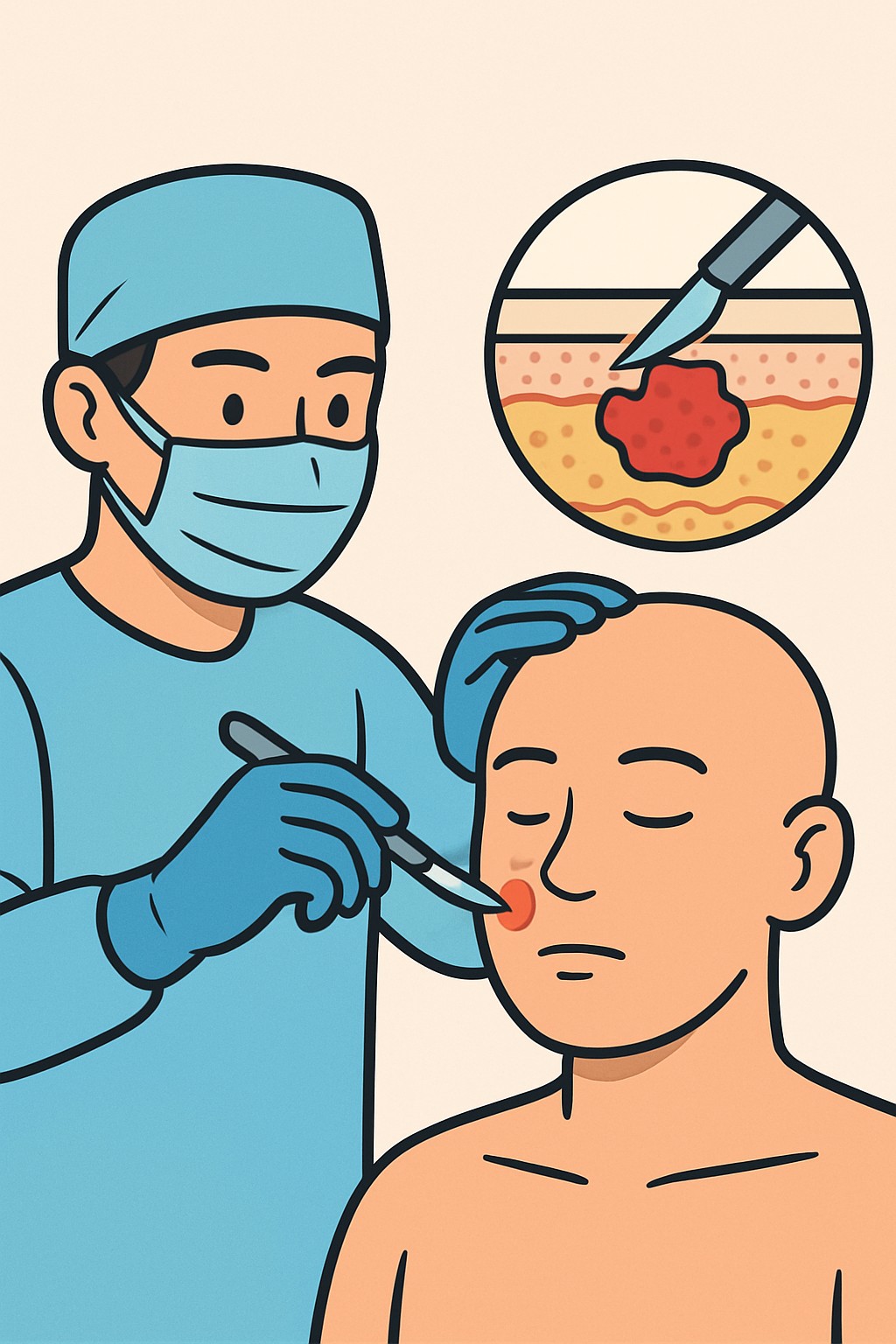
Mohs micrographic surgery is a precise way to remove certain skin cancers. The surgeon removes thin layers of tissue and examines each layer under a microscope during the visit. This continues until no cancer cells are seen at the edges (margins). Mohs surgery targets only the cancer while saving as much healthy skin as possible. It is commonly done under local anesthesia in an outpatient clinic. Many people go home the same day.
Also known as: Mohs surgery, Mohs skin cancer surgery, Tissue-sparing skin cancer surgery
Preparation & Next Steps
Everything you need to know before and after your procedure
Before Care
- Bring a list of all medicines and supplements, including blood thinners and any allergies.
- Follow any clinic instructions about taking or holding medicines; do not change them unless told by your care team.
- Eat a normal meal unless your clinic gives different instructions; most Mohs surgery uses local anesthesia.
- Wear comfortable clothing and avoid makeup, lotion, or sunscreen on the area being treated.
- Plan for several hours at the clinic; there is waiting time between stages while tissue is examined.
- Arrange transportation if a large repair is expected, if the surgery is near an eye, or if sedating medicines may be used.
- Confirm your pharmacy information for any prescriptions after surgery.
- Set aside time off from work or school based on the site and your job demands.
- Ask the clinic how to prepare for bandaging and wound care at home (supplies, activity limits).
After Care
- Keep the pressure bandage and wound clean and dry as instructed by the clinic.
- Change dressings using clean technique and apply ointment if told to do so by your care team.
- Limit strenuous activity, bending, or heavy lifting that could raise blood pressure and cause bleeding for several days.
- Elevate the area and use cold packs wrapped in cloth to help reduce swelling if advised by the clinic.
- Take pain medicine only as instructed by your clinician and avoid adding new medicines without checking first.
- Protect the area from sun exposure with clothing or shade; ask your clinic when sunscreen is appropriate.
- Watch for concerning signs and contact the clinic if you see heavy bleeding that does not stop with steady pressure, spreading redness, pus, fever, or severe pain.
- Know when to return for suture removal or a wound check; timing varies by body site.
- Keep a simple log of symptoms and any drainage to review at follow-up.
Clinical Information
Important medical details about this procedure
Indications
- Basal cell carcinoma (BCC), especially high-risk or on the face, ears, nose, lips, eyelids
- Squamous cell carcinoma (SCC), especially high-risk or on hands, feet, or genitals
- Skin cancers with unclear borders or that returned after prior treatment
- Large, aggressive, or scar-associated tumors
- Skin cancers near critical structures (eyes, nose, mouth), where tissue-sparing is important
- Selected cases of melanoma in situ (such as lentigo maligna) using specialized techniques
Alternatives
- Standard surgical excision
- Curettage and electrodesiccation (scrape and cautery)
- Cryotherapy (freezing)
- Topical treatments for some superficial cancers (such as imiquimod or 5-fluorouracil)
- Photodynamic therapy for selected superficial lesions
- Radiation therapy
- Wide local excision for invasive melanoma
Risks
- Bleeding or bruising
- Infection at the surgery site
- Scarring or poor wound healing
- Pain, swelling, or temporary numbness
- Nerve injury causing weakness or numbness near the site
- Allergic reaction to local anesthetic or bandage materials
- Need for reconstruction with stitches, flap, or graft
- Cancer recurrence that may need further treatment
Contraindications
- Low-risk, small superficial lesions in low-risk areas where simpler treatments may work
- Inability to tolerate a prolonged local procedure without necessary supports
- Unmanaged bleeding disorders or medicines that greatly increase bleeding risk
- Active infection at the surgery site that requires treatment first
- Situations where Mohs is not appropriate for the cancer type (for example, most invasive melanoma)
Recovery Timeline
What to expect during your recovery
Most people return to light daily activities within a few days. Bruising and swelling often improve over 1 to 2 weeks. Scars continue to mature and soften over several months.
Typical Range
7–21 days
Return to Work
1–14 days
Recovery Milestones
Rest, keep pressure bandage in place, and limit bending or heavy lifting
Resume light activities such as short walks and desk work if comfortable
Suture removal window depending on body site and repair type
Gradually increase activity; avoid strain on the surgery site
Most people resume vigorous exercise if healing is on track
Scar remodeling; massage or silicone may be discussed with your clinic
Frequently Asked Questions
Common questions and expert answers about this procedure
What makes Mohs surgery different from standard excision?
What makes Mohs surgery different from standard excision?
The surgeon checks 100% of the margin under a microscope during the visit and removes more tissue only where cancer remains. This spares healthy skin and helps ensure clear margins.
How long does Mohs surgery take?
How long does Mohs surgery take?
Plan for several hours. Each stage takes time to remove tissue, process it in the lab, and review slides. Many cases clear in 1–3 stages, but it varies.
Will I be awake?
Will I be awake?
Yes. Mohs surgery is usually done with local anesthesia. You stay awake and the area is numbed.
Will there be a scar?
Will there be a scar?
Any skin surgery leaves a scar. Mohs aims to keep it as small as possible by removing only tissue with cancer. Scars soften and fade over months.
What kinds of skin cancer are treated with Mohs?
What kinds of skin cancer are treated with Mohs?
Commonly basal cell and squamous cell carcinomas, especially in high-risk or sensitive areas. Some melanoma in situ cases may be treated with special techniques.
What repairs might be needed after the cancer is removed?
What repairs might be needed after the cancer is removed?
Options include stitches in a straight line, skin flaps, skin grafts, or letting the wound heal on its own. The choice depends on size, depth, and location.
Can I drive myself home?
Can I drive myself home?
Many people can, but this depends on the site, the size of the bandage, and whether sedating medicines were used. Ask your clinic about your plan.
How are costs determined?
How are costs determined?
Costs vary based on the number of stages, the type of repair, pathology work, and facility fees. Insurance coverage differs by plan.
References
Medical literature and sources