%20--%3e%3csvg%20version='1.0'%20id='Layer_1'%20xmlns='http://www.w3.org/2000/svg'%20xmlns:xlink='http://www.w3.org/1999/xlink'%20x='0px'%20y='0px'%20viewBox='0%200%20755.52%20814.35'%20style='enable-background:new%200%200%20755.52%20814.35;'%20xml:space='preserve'%3e%3cstyle%20type='text/css'%3e%20.st0{fill:%231ae5ce;stroke:%231ae5ce;stroke-width:7;stroke-miterlimit:10;}%20.st1{fill:%23FFFFFF;stroke:%231ae5ce;stroke-width:7;stroke-miterlimit:10;}%20.st2{fill:%231ae5ce;stroke:%23FFFFFF;stroke-width:7;stroke-miterlimit:10;}%20.st3{fill:%23FFFFFF;stroke:%23FFFFFF;stroke-width:6;stroke-miterlimit:10;}%20%3c/style%3e%3cg%20id='Dark_Logo_00000159431215648494653180000015900878925932721032_'%3e%3cpath%20id='shield_00000152259091539869183100000001926543869452564382_'%20class='st0'%20d='M711.13,173.42%20c-3.37-49.07-38.92-44.9-75.96-52.18c-67.4-13.25-130.47-34.47-192.36-63.92c-22.48-10.7-41.88-25.74-65.05-26.28%20c-23.17,0.54-42.58,15.59-65.05,26.28c-61.89,29.45-124.95,50.68-192.36,63.92c-37.04,7.28-72.59,3.11-75.96,52.18%20c-1.55,22.6,0.34,46.4,1.05,68.92c5.99,190.78,52.91,345.39,206.27,466.46c29.71,23.46,74.51,55.8,108.84,70.75%20c5.99,2.61,11.7,3.73,17.21,3.75c5.51-0.02,11.22-1.14,17.21-3.75c34.33-14.95,79.12-47.3,108.84-70.75%20c153.37-121.07,200.28-275.68,206.27-466.46C710.79,219.82,712.68,196.02,711.13,173.42z'/%3e%3cpath%20id='magnifyingglass_00000073685934697636024790000000342567780940956808_'%20class='st1'%20d='M648.78,624.21l-96.64-104.65%20c34.89-40.63,55.98-93.46,55.98-151.21c0-128.27-103.98-232.24-232.24-232.24S143.63,240.08,143.63,368.35%20s103.98,232.24,232.24,232.24c48.87,0,94.21-15.11,131.62-40.89l97.18,105.24c11.25,12.18,30.24,12.93,42.42,1.69l0,0%20C659.27,655.38,660.03,636.39,648.78,624.21z'/%3e%3ccircle%20id='ellipse_00000129904010550392394720000017056154833629780114_'%20class='st2'%20cx='375.87'%20cy='368.35'%20r='181.21'/%3e%3cpath%20id='dollarsign_00000057140127156649725250000003772530148495155891_'%20class='st3'%20d='M362.91,492.03v-23.91%20c0-2.01-1.58-3.69-3.59-3.77c-18.49-0.78-37.12-5.4-49.4-11.83c-1.75-0.92-2.53-3.01-1.76-4.84l5.87-13.89%20c0.86-2.02,3.23-2.88,5.2-1.89c12.94,6.52,30.45,11.44,49.18,11.44c26.02,0,43.6-12.73,43.6-30.43c0-17.08-14.29-27.63-41.4-36.95%20c-37.37-12.42-60.46-26.7-60.46-53.72c0-24.97,20.29-44.11,52.22-49.51c1.8-0.31,3.11-1.89,3.11-3.72v-24.35%20c0-2.09,1.69-3.78,3.78-3.78h15.16c2.09,0,3.78,1.69,3.78,3.78v22.71c0,2.01,1.58,3.67,3.58,3.77c17.85,0.92,30.88,4.75,40.61,9.1%20c1.92,0.86,2.79,3.09,1.94,5.01l-6.08,13.6c-0.85,1.91-3.09,2.77-4.99,1.91c-8.37-3.8-22.38-8.95-42.75-8.95%20c-28.21,0-38.84,14.28-38.84,26.7c0,16.15,13.56,24.22,45.44,35.4c37.74,13.04,56.79,29.19,56.79,56.82%20c0,23.85-19.05,46.23-54.78,52.3c-1.8,0.31-3.11,1.89-3.11,3.72v25.28c0,2.09-1.69,3.78-3.78,3.78h-15.53%20C364.6,495.81,362.91,494.12,362.91,492.03z'/%3e%3c/g%3e%3c/svg%3e)
Removal of foreign body - subcutaneous (e.g. splinter) Dermatology Surgery
This is a minor procedure to take out an object that is stuck just under the skin.
Overview
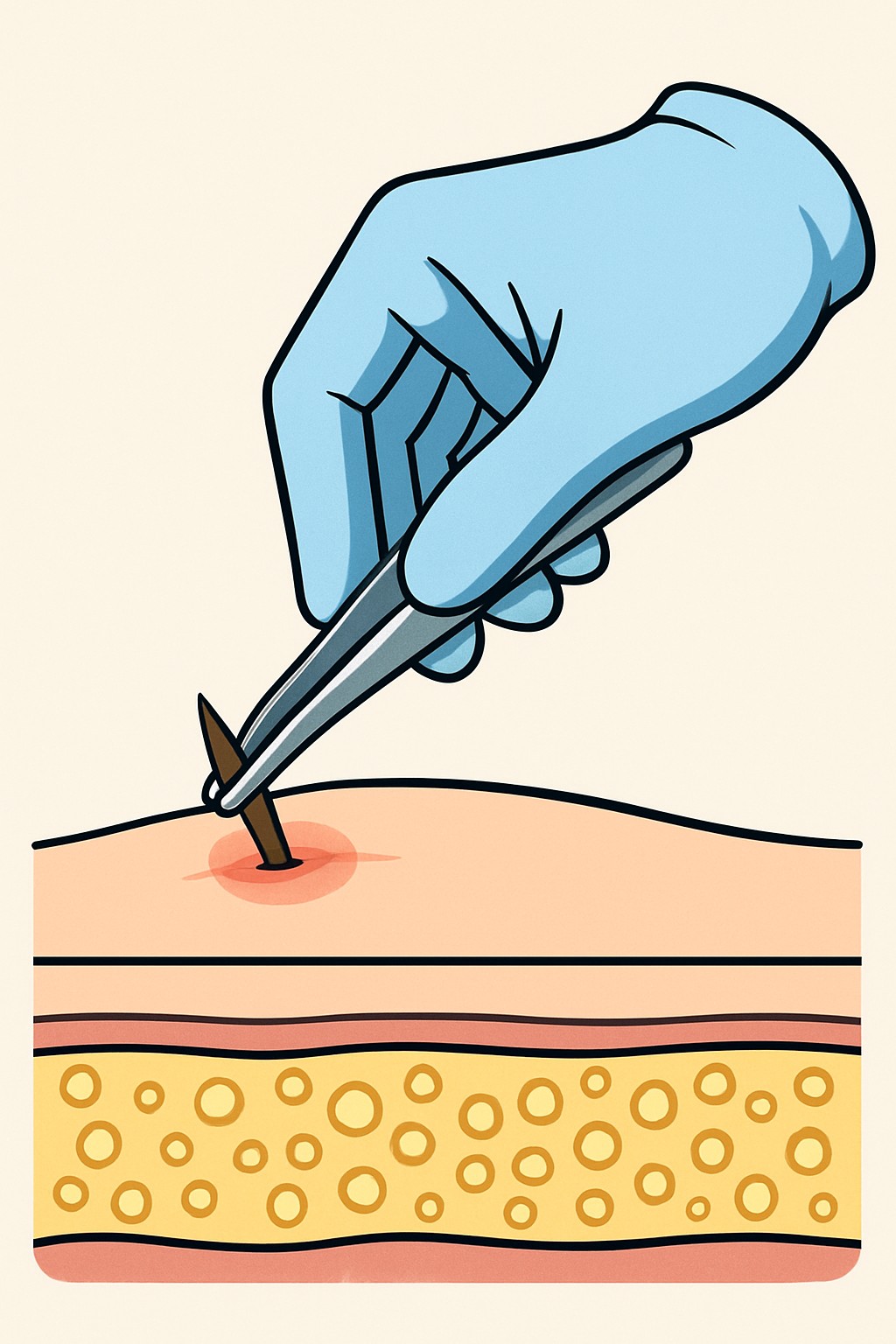
This is a minor procedure to take out an object that is stuck just under the skin. Subcutaneous means it is beneath the surface layer of the skin. The clinician may numb the area, make a small opening if needed, and remove the object with tools like tweezers or a small blade. The wound is then cleaned, and the skin may be closed with adhesive strips or stitches if needed.
Also known as: Splinter removal, Subcutaneous foreign body removal, Skin foreign body removal
Preparation & Next Steps
Everything you need to know before and after your procedure
Before Care
- Know the material if possible (wood, glass, metal) and how the injury happened
- Do not apply ointments, creams, or adhesives on the day of the procedure
- Bring a list of your medicines and allergies, including blood thinners
- Have your tetanus vaccination record available if you know it
- Gently clean the area with soap and water; avoid digging into the skin
- Wear clothing that lets the clinician easily access the site
- Bring prior imaging or reports if already done
- Arrange a ride if the clinic expects to use sedating medicine
- Follow any clinic instructions about food or drink if sedation is planned
After Care
- Keep the bandage clean and dry as instructed; change it with clean hands
- Protect the area from friction and pressure; avoid picking at scabs
- Avoid soaking the wound (baths, pools, hot tubs) until the skin has closed
- Use pain control measures only as directed by your clinician
- If stitches or adhesive strips were placed, follow the plan for care and removal
- Watch for spreading redness, warmth, swelling, pus, fever, or increasing pain and contact a clinician if these appear
- If any fragment was left in place, follow the monitoring plan provided by your clinician
- Resume activities gradually and avoid tasks that strain the treated area until comfortable
- Ask the clinic about tetanus vaccination updates if they recommended one
Clinical Information
Important medical details about this procedure
Indications
- Painful or enlarging splinter, thorn, glass, or metal under the skin
- Signs of infection such as redness, warmth, swelling, or drainage
- Limited movement or function due to the object
- Foreign body near a joint, tendon, or nerve
- Contaminated or deep puncture wound
- Failure of home removal for a superficial splinter
Alternatives
- Observation if the fragment is tiny, not causing symptoms, and safe to leave
- Warm soaks or watchful waiting for very superficial splinters
- At-home removal for shallow splinters with clean tweezers
- Referral to a specialist for deep or complex cases
- Imaging-guided removal if the object is hard to locate
Risks
- Infection
- Bleeding or bruising
- Scarring or skin discoloration
- Nerve or blood vessel injury
- Incomplete removal or recurrence if fragments remain
- Allergic reaction to local anesthetic or adhesive
- Need for imaging or a second procedure
Contraindications
- Severe infection requiring higher-level care
- Uncorrected bleeding problems
- Known allergy to the planned local anesthetic without alternatives
- Objects adjacent to critical structures that may require specialist removal
Recovery Timeline
What to expect during your recovery
Most small wounds from removing a subcutaneous splinter calm down over a few days. Tenderness can last longer if the object was deep or the area is used often.
Typical Range
2–14 days
Return to Work
0–3 days
Recovery Milestones
Light use of the area; keep bandage clean and dry
Resume normal daily activities if comfortable; avoid soaking the wound
Gradually return to heavier tasks that do not stress the wound
Have stitches removed as scheduled if they were placed
Frequently Asked Questions
Common questions and expert answers about this procedure
How is a subcutaneous splinter or foreign body removed?
How is a subcutaneous splinter or foreign body removed?
The area is cleaned, usually numbed with local anesthetic, and the object is located by exam or imaging. A small opening may be made to grasp and remove it, then the wound is irrigated and covered.
Will I need an X-ray or ultrasound?
Will I need an X-ray or ultrasound?
Imaging is not always needed. X-rays can show metal and most glass. Ultrasound can help find wood or plastic and guide removal when the object is hard to locate.
Do I need antibiotics?
Do I need antibiotics?
Antibiotics are not routine for clean, uncomplicated removals. They may be used when the wound is contaminated, infected, or high risk based on location and history.
Do I need a tetanus shot?
Do I need a tetanus shot?
It depends on your vaccine history and the type of wound. Clinicians follow CDC guidance for when to give tetanus shots after injuries.
Will there be a scar?
Will there be a scar?
A small mark is possible. Scarring depends on the size and location of the wound, skin type, and how the area heals.
How long does the procedure take?
How long does the procedure take?
Many simple removals take about 10 to 30 minutes. Complex, deep, or hard-to-find objects can take longer and may need imaging or a specialist.
Can urgent care do this?
Can urgent care do this?
Many clinics and urgent care centers remove simple skin foreign bodies. Deep, large, or high-risk cases may be referred to a specialist or the emergency department.
What if a small piece is left behind?
What if a small piece is left behind?
If removal risks harm, a tiny fragment may be left and watched. Some fragments work their way out over time. Persistent symptoms may lead to another attempt.