%20--%3e%3csvg%20version='1.0'%20id='Layer_1'%20xmlns='http://www.w3.org/2000/svg'%20xmlns:xlink='http://www.w3.org/1999/xlink'%20x='0px'%20y='0px'%20viewBox='0%200%20755.52%20814.35'%20style='enable-background:new%200%200%20755.52%20814.35;'%20xml:space='preserve'%3e%3cstyle%20type='text/css'%3e%20.st0{fill:%231ae5ce;stroke:%231ae5ce;stroke-width:7;stroke-miterlimit:10;}%20.st1{fill:%23FFFFFF;stroke:%231ae5ce;stroke-width:7;stroke-miterlimit:10;}%20.st2{fill:%231ae5ce;stroke:%23FFFFFF;stroke-width:7;stroke-miterlimit:10;}%20.st3{fill:%23FFFFFF;stroke:%23FFFFFF;stroke-width:6;stroke-miterlimit:10;}%20%3c/style%3e%3cg%20id='Dark_Logo_00000159431215648494653180000015900878925932721032_'%3e%3cpath%20id='shield_00000152259091539869183100000001926543869452564382_'%20class='st0'%20d='M711.13,173.42%20c-3.37-49.07-38.92-44.9-75.96-52.18c-67.4-13.25-130.47-34.47-192.36-63.92c-22.48-10.7-41.88-25.74-65.05-26.28%20c-23.17,0.54-42.58,15.59-65.05,26.28c-61.89,29.45-124.95,50.68-192.36,63.92c-37.04,7.28-72.59,3.11-75.96,52.18%20c-1.55,22.6,0.34,46.4,1.05,68.92c5.99,190.78,52.91,345.39,206.27,466.46c29.71,23.46,74.51,55.8,108.84,70.75%20c5.99,2.61,11.7,3.73,17.21,3.75c5.51-0.02,11.22-1.14,17.21-3.75c34.33-14.95,79.12-47.3,108.84-70.75%20c153.37-121.07,200.28-275.68,206.27-466.46C710.79,219.82,712.68,196.02,711.13,173.42z'/%3e%3cpath%20id='magnifyingglass_00000073685934697636024790000000342567780940956808_'%20class='st1'%20d='M648.78,624.21l-96.64-104.65%20c34.89-40.63,55.98-93.46,55.98-151.21c0-128.27-103.98-232.24-232.24-232.24S143.63,240.08,143.63,368.35%20s103.98,232.24,232.24,232.24c48.87,0,94.21-15.11,131.62-40.89l97.18,105.24c11.25,12.18,30.24,12.93,42.42,1.69l0,0%20C659.27,655.38,660.03,636.39,648.78,624.21z'/%3e%3ccircle%20id='ellipse_00000129904010550392394720000017056154833629780114_'%20class='st2'%20cx='375.87'%20cy='368.35'%20r='181.21'/%3e%3cpath%20id='dollarsign_00000057140127156649725250000003772530148495155891_'%20class='st3'%20d='M362.91,492.03v-23.91%20c0-2.01-1.58-3.69-3.59-3.77c-18.49-0.78-37.12-5.4-49.4-11.83c-1.75-0.92-2.53-3.01-1.76-4.84l5.87-13.89%20c0.86-2.02,3.23-2.88,5.2-1.89c12.94,6.52,30.45,11.44,49.18,11.44c26.02,0,43.6-12.73,43.6-30.43c0-17.08-14.29-27.63-41.4-36.95%20c-37.37-12.42-60.46-26.7-60.46-53.72c0-24.97,20.29-44.11,52.22-49.51c1.8-0.31,3.11-1.89,3.11-3.72v-24.35%20c0-2.09,1.69-3.78,3.78-3.78h15.16c2.09,0,3.78,1.69,3.78,3.78v22.71c0,2.01,1.58,3.67,3.58,3.77c17.85,0.92,30.88,4.75,40.61,9.1%20c1.92,0.86,2.79,3.09,1.94,5.01l-6.08,13.6c-0.85,1.91-3.09,2.77-4.99,1.91c-8.37-3.8-22.38-8.95-42.75-8.95%20c-28.21,0-38.84,14.28-38.84,26.7c0,16.15,13.56,24.22,45.44,35.4c37.74,13.04,56.79,29.19,56.79,56.82%20c0,23.85-19.05,46.23-54.78,52.3c-1.8,0.31-3.11,1.89-3.11,3.72v25.28c0,2.09-1.69,3.78-3.78,3.78h-15.53%20C364.6,495.81,362.91,494.12,362.91,492.03z'/%3e%3c/g%3e%3c/svg%3e)
Skin lesion excision - malignant (small) Dermatology Surgery
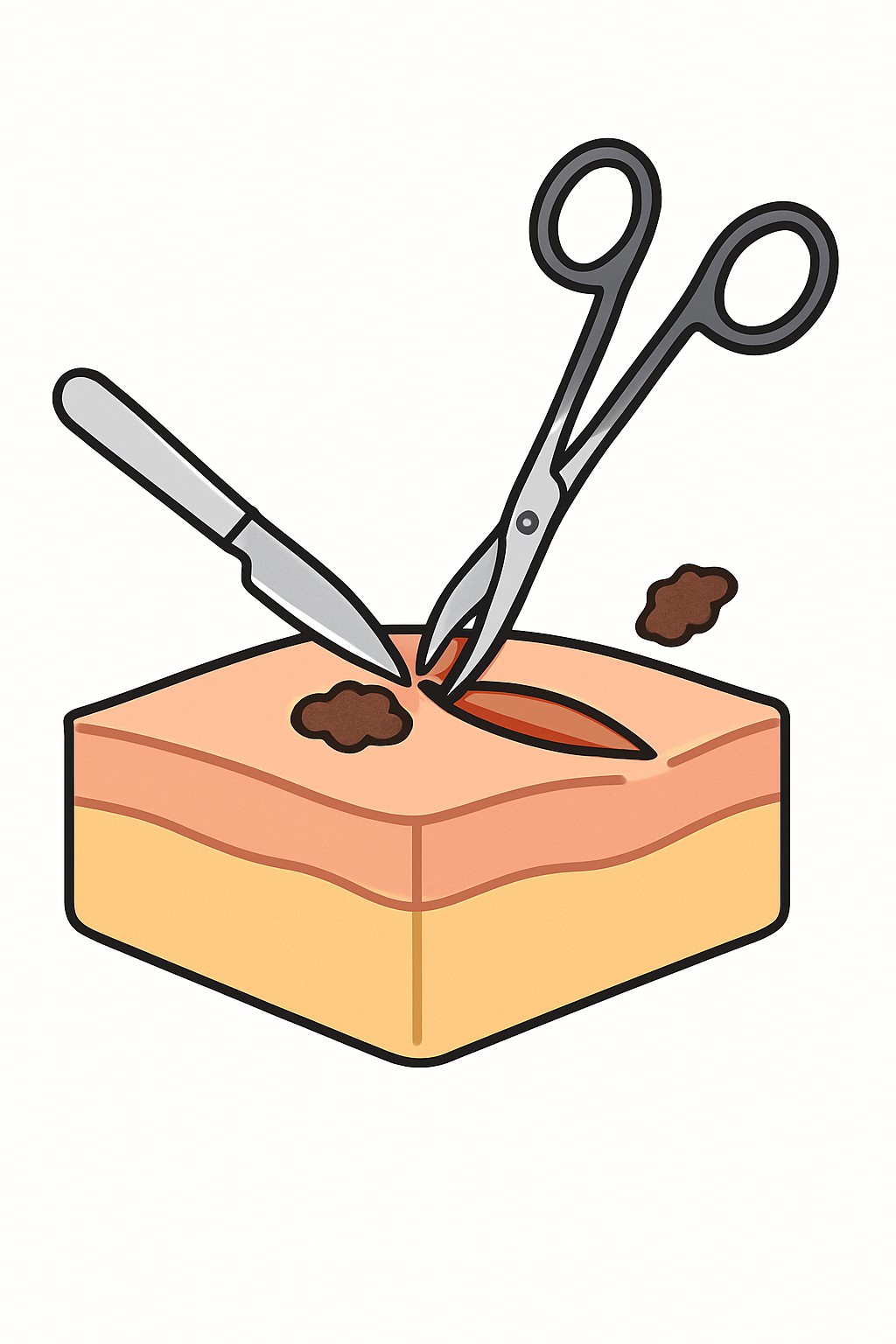
Skin lesion excision - malignant (small) is a minor surgical procedure to remove a small skin cancer along with a thin rim of normal-looking skin.
Overview
Skin lesion excision - malignant (small) is a minor surgical procedure to remove a small skin cancer along with a thin rim of normal-looking skin. The goal is to fully remove the cancer and reduce the chance it will grow back. Most small excisions are done in an office or clinic using local anesthetic to numb the area. The removed tissue is sent to a laboratory where a pathologist checks the diagnosis and whether the edges are clear of cancer cells.
Also known as: Excision of malignant skin lesion (small), Skin cancer excision (small), Wide local excision (small lesion)
Preparation & Next Steps
Everything you need to know before and after your procedure
Before Care
- Bring any prior biopsy reports, clinic notes, and a list of the lesion locations to the appointment
- Share a complete list of medicines and supplements, including blood thinners and any allergies
- Ask the clinic whether you should adjust medicines before the procedure and how to handle the day of surgery
- Plan transportation if advised by your clinic and allow time for the visit and observation
- Wear clothing that allows easy access to the area and avoid lotions, makeup, or sunscreen on the site
- Plan for limited activity after the procedure and check any work or sports restrictions with the clinic
- Ask how you will receive the pathology report and typical timing for results
- Have basic wound care supplies at home such as soap, clean gauze, and bandage materials
- Confirm insurance coverage and any prior authorization requirements with your insurer or clinic
- Tell the team about implanted devices or conditions that might affect bleeding or healing
After Care
- Keep the initial dressing in place as instructed and avoid getting the area wet until you receive care instructions
- Clean the wound gently as directed and replace dressings with clean, dry materials
- Use pain relief as instructed on the label or by your clinician and avoid applying unapproved products to the wound
- Limit stretching, heavy lifting, or high-impact activity that could pull on the stitches
- Elevate the area, when possible, to reduce swelling and consider a wrapped cold pack for short intervals
- Watch for increasing redness, warmth, pus, fever, or heavy bleeding and contact a clinician if these occur
- Protect the site from sun exposure and avoid tanning while the wound heals
- Keep stitches dry and intact and return for stitch removal if scheduled
- Confirm how and when you will receive your pathology results and who will discuss next steps
- Keep a copy of your pathology report for your records and future care
Clinical Information
Important medical details about this procedure
Indications
- Biopsy-proven basal cell carcinoma
- Biopsy-proven squamous cell carcinoma or squamous cell carcinoma in situ
- Melanoma in situ or thin invasive melanoma requiring excision
- Suspicious small lesion with clinical features of malignancy
- Positive margins after initial biopsy requiring complete removal
Alternatives
- Mohs micrographic surgery for selected cancers and locations
- Curettage and electrodesiccation for selected low-risk non-melanoma skin cancers
- Cryosurgery for selected superficial lesions
- Topical therapies such as imiquimod or 5-fluorouracil for selected superficial basal cell carcinomas
- Radiation therapy when surgery is not feasible
- Staged excision for selected melanoma in situ
Risks
- Bleeding or infection
- Scarring or changes in skin color and texture
- Pain, swelling, or bruising at the site
- Nerve or vessel injury causing numbness or weakness near the site
- Wound healing problems or wound separation
- Allergic reaction to local anesthetic or adhesives
- Cancer not fully removed and need for additional surgery
Contraindications
- Active infection at the planned excision site
- Uncontrolled bleeding disorder
- Allergy to local anesthetics or antiseptics without an alternative available
- Inability to lie still or cooperate for a procedure under local anesthesia
- Medical conditions that make wound healing difficult without a plan to manage them
Recovery Timeline
What to expect during your recovery
Most people resume light activities the same day or the next day. Initial healing often takes 1 to 3 weeks, with the scar continuing to mature for several months.
Typical Range
7–21 days
Return to Work
0–3 days
Recovery Milestones
Walk and do light daily activities with care to protect the dressing
Begin routine wound care after removing the bulky dressing as instructed
Have stitches removed if needed, per the scheduled visit
Resume most routine activities that do not stress the excision site
Scar softening and color changes continue; protect from sun
Frequently Asked Questions
Common questions and expert answers about this procedure
What does malignant mean for a skin lesion?
What does malignant mean for a skin lesion?
Malignant means cancerous. The procedure removes a skin cancer along with a small rim of nearby normal-looking skin.
What does small refer to in this procedure?
What does small refer to in this procedure?
Small generally refers to a lesion of limited size as measured by the clinician. Coding systems may use size ranges that include the lesion and a margin.
Will I be awake during the excision?
Will I be awake during the excision?
Yes, most small skin excisions use local anesthetic to numb the area while you remain awake.
How is standard excision different from Mohs surgery?
How is standard excision different from Mohs surgery?
Standard excision removes the lesion and a margin, then a lab reviews the tissue later. Mohs removes thin layers with immediate microscopic checks until clear margins are reached, often used for certain cancers or locations.
Will the tissue be sent for pathology?
Will the tissue be sent for pathology?
Yes. A pathologist examines the specimen to confirm the diagnosis and whether the edges are free of cancer cells.
Will there be a scar?
Will there be a scar?
All excisions leave a scar. Its appearance depends on the lesion size, location, skin type, and healing.
How long do results take?
How long do results take?
Pathology results are typically available within several business days, but timing varies by clinic and laboratory.
What if the margins are not clear?
What if the margins are not clear?
If cancer cells are found at the edge, another procedure may be recommended to remove additional tissue.
References
Medical literature and sources