%20--%3e%3csvg%20version='1.0'%20id='Layer_1'%20xmlns='http://www.w3.org/2000/svg'%20xmlns:xlink='http://www.w3.org/1999/xlink'%20x='0px'%20y='0px'%20viewBox='0%200%20755.52%20814.35'%20style='enable-background:new%200%200%20755.52%20814.35;'%20xml:space='preserve'%3e%3cstyle%20type='text/css'%3e%20.st0{fill:%231ae5ce;stroke:%231ae5ce;stroke-width:7;stroke-miterlimit:10;}%20.st1{fill:%23FFFFFF;stroke:%231ae5ce;stroke-width:7;stroke-miterlimit:10;}%20.st2{fill:%231ae5ce;stroke:%23FFFFFF;stroke-width:7;stroke-miterlimit:10;}%20.st3{fill:%23FFFFFF;stroke:%23FFFFFF;stroke-width:6;stroke-miterlimit:10;}%20%3c/style%3e%3cg%20id='Dark_Logo_00000159431215648494653180000015900878925932721032_'%3e%3cpath%20id='shield_00000152259091539869183100000001926543869452564382_'%20class='st0'%20d='M711.13,173.42%20c-3.37-49.07-38.92-44.9-75.96-52.18c-67.4-13.25-130.47-34.47-192.36-63.92c-22.48-10.7-41.88-25.74-65.05-26.28%20c-23.17,0.54-42.58,15.59-65.05,26.28c-61.89,29.45-124.95,50.68-192.36,63.92c-37.04,7.28-72.59,3.11-75.96,52.18%20c-1.55,22.6,0.34,46.4,1.05,68.92c5.99,190.78,52.91,345.39,206.27,466.46c29.71,23.46,74.51,55.8,108.84,70.75%20c5.99,2.61,11.7,3.73,17.21,3.75c5.51-0.02,11.22-1.14,17.21-3.75c34.33-14.95,79.12-47.3,108.84-70.75%20c153.37-121.07,200.28-275.68,206.27-466.46C710.79,219.82,712.68,196.02,711.13,173.42z'/%3e%3cpath%20id='magnifyingglass_00000073685934697636024790000000342567780940956808_'%20class='st1'%20d='M648.78,624.21l-96.64-104.65%20c34.89-40.63,55.98-93.46,55.98-151.21c0-128.27-103.98-232.24-232.24-232.24S143.63,240.08,143.63,368.35%20s103.98,232.24,232.24,232.24c48.87,0,94.21-15.11,131.62-40.89l97.18,105.24c11.25,12.18,30.24,12.93,42.42,1.69l0,0%20C659.27,655.38,660.03,636.39,648.78,624.21z'/%3e%3ccircle%20id='ellipse_00000129904010550392394720000017056154833629780114_'%20class='st2'%20cx='375.87'%20cy='368.35'%20r='181.21'/%3e%3cpath%20id='dollarsign_00000057140127156649725250000003772530148495155891_'%20class='st3'%20d='M362.91,492.03v-23.91%20c0-2.01-1.58-3.69-3.59-3.77c-18.49-0.78-37.12-5.4-49.4-11.83c-1.75-0.92-2.53-3.01-1.76-4.84l5.87-13.89%20c0.86-2.02,3.23-2.88,5.2-1.89c12.94,6.52,30.45,11.44,49.18,11.44c26.02,0,43.6-12.73,43.6-30.43c0-17.08-14.29-27.63-41.4-36.95%20c-37.37-12.42-60.46-26.7-60.46-53.72c0-24.97,20.29-44.11,52.22-49.51c1.8-0.31,3.11-1.89,3.11-3.72v-24.35%20c0-2.09,1.69-3.78,3.78-3.78h15.16c2.09,0,3.78,1.69,3.78,3.78v22.71c0,2.01,1.58,3.67,3.58,3.77c17.85,0.92,30.88,4.75,40.61,9.1%20c1.92,0.86,2.79,3.09,1.94,5.01l-6.08,13.6c-0.85,1.91-3.09,2.77-4.99,1.91c-8.37-3.8-22.38-8.95-42.75-8.95%20c-28.21,0-38.84,14.28-38.84,26.7c0,16.15,13.56,24.22,45.44,35.4c37.74,13.04,56.79,29.19,56.79,56.82%20c0,23.85-19.05,46.23-54.78,52.3c-1.8,0.31-3.11,1.89-3.11,3.72v25.28c0,2.09-1.69,3.78-3.78,3.78h-15.53%20C364.6,495.81,362.91,494.12,362.91,492.03z'/%3e%3c/g%3e%3c/svg%3e)
Skin tag removal (up to 15 lesions) Dermatology Surgery
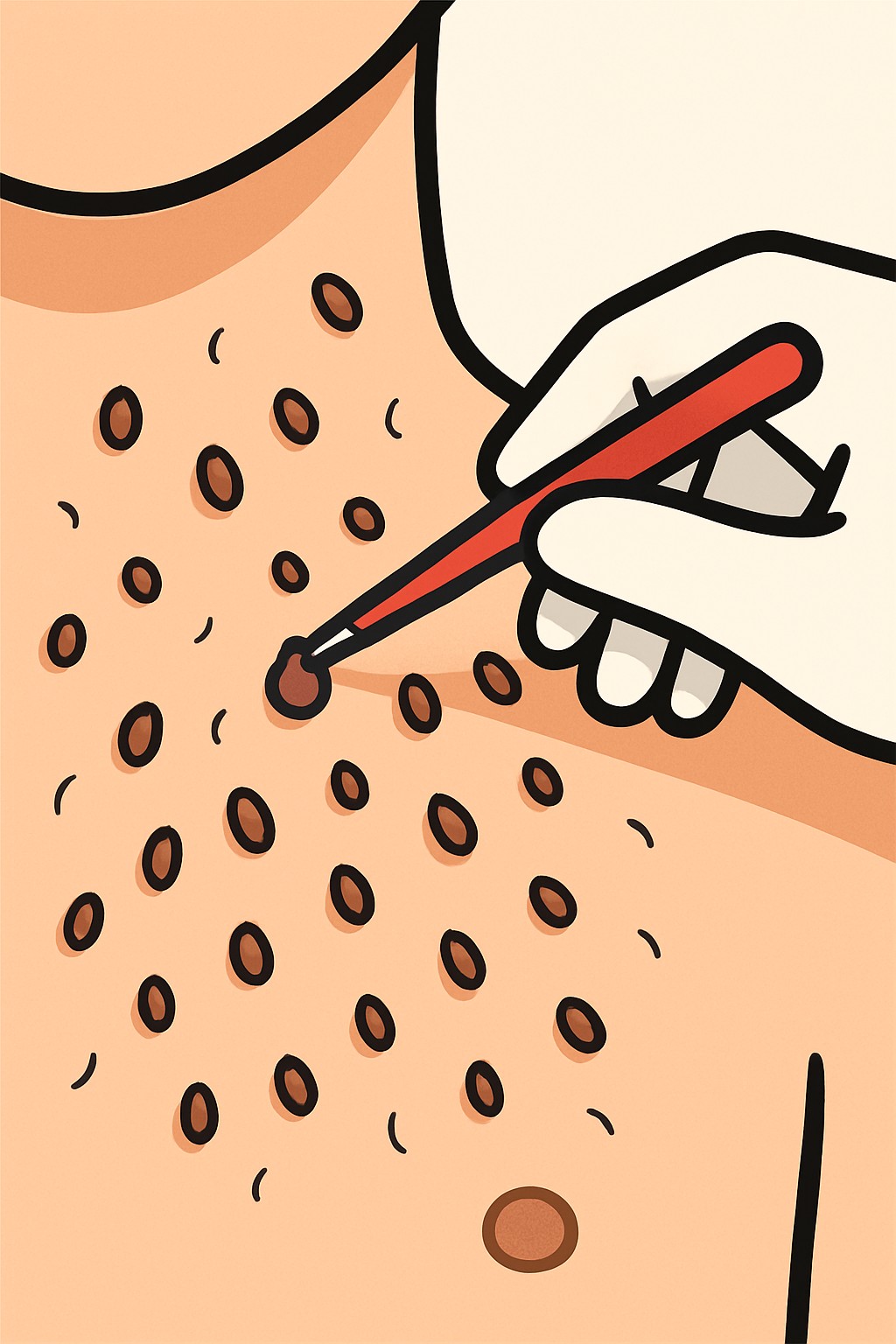
Skin tag removal is a minor procedure to take off small, soft growths called skin tags.
Overview
Skin tag removal is a minor procedure to take off small, soft growths called skin tags. A clinician may cut, freeze, or cauterize (burn) the base of the tag. Local anesthesia, which numbs only the area being treated, is often used for comfort. This listing typically describes removing multiple skin tags in one visit, up to 15 lesions. People choose removal when tags snag on clothing or jewelry, get irritated or bleed, or for appearance. If a growth is not clearly a skin tag, it may be sent to a lab to confirm the diagnosis.
Also known as: Acrochordon removal, Skin tag excision, Skin tag cryotherapy
Preparation & Next Steps
Everything you need to know before and after your procedure
Before Care
- Confirm the growths are skin tags; ask how they will be removed (snip, freeze, or cautery).
- Provide a current list of medicines, including blood thinners and supplements.
- Tell the clinic about allergies, especially to numbing medicines or antiseptics.
- Ask whether any medicine changes are needed before the visit; do not stop medicines unless instructed by your prescriber.
- Plan clothing that allows easy access to the treatment area and reduces rubbing afterward.
- Avoid lotions, oils, or makeup on the treatment sites the day of the procedure unless told otherwise.
- Arrange time for the visit; removing many tags can take longer than a single lesion.
- Ask if any removed tissue may be sent to a lab and whether there could be a separate charge.
- Bring a payment method and ID; verify costs and coverage with your insurer or clinic.
After Care
- Keep the area clean and dry; follow the bandage instructions provided by your clinic.
- Avoid picking at scabs or crusts; let them fall off on their own.
- Limit friction from clothing, jewelry, or shaving on the area until healed.
- Avoid swimming, hot tubs, and soaking the area until the skin has closed.
- Use sun protection on healing skin to reduce discoloration once the area is uncovered.
- If mild bleeding occurs, apply gentle pressure with clean gauze; contact the clinic if bleeding continues.
- Watch for spreading redness, warmth, pus, fever, or worsening pain and contact a clinician if these occur.
- Take any prescribed or recommended medicines as directed by your clinician.
- Schedule follow-up if advised, especially if tissue was sent to a lab or if new lesions appear.
Clinical Information
Important medical details about this procedure
Indications
- Irritation or bleeding from friction
- Snagging on clothing or jewelry
- Cosmetic concerns
- Recurrent inflammation
- Uncertain diagnosis requiring removal and possible lab review
Alternatives
- Observation without treatment
- Delayed removal if not bothersome
- Cryotherapy (freezing) in clinic
- Cautery (heat) in clinic
- Snip or shave removal in clinic
- Ligation (tying off the base) performed by a clinician
Risks
- Bleeding or bruising
- Infection at the treated site
- Scarring or skin discoloration
- Pain or soreness after the procedure
- Allergic reaction to local anesthetic
- Recurrence or new skin tags forming nearby
- Thicker scars (keloids) in people prone to them
Contraindications
- Lesion that is not clearly a skin tag or appears atypical
- Active skin infection in the treatment area
- Uncontrolled bleeding disorder
- Use of blood thinners without a plan from the prescribing clinician
- History of keloids in high-risk areas
- Allergy to local anesthetics used for the procedure
Recovery Timeline
What to expect during your recovery
Most people return to routine activities the same day. Tenderness and redness usually improve within a few days, and small wounds typically heal in about 1 to 2 weeks.
Typical Range
7–14 days
Return to Work
0–1 days
Recovery Milestones
Resume light daily activities with basic wound protection
Most soreness and redness start to lessen
Scabs or crusts form; minimize friction and moisture
Small wounds usually closed; gradually return to normal skin care
Frequently Asked Questions
Common questions and expert answers about this procedure
What is a skin tag?
What is a skin tag?
A skin tag is a small, soft, skin-colored growth that hangs off the skin. They are common and benign.
How is skin tag removal done?
How is skin tag removal done?
Clinicians may cut the tag at its base, freeze it with liquid nitrogen, or cauterize it. A small amount of numbing medicine is often used.
Is it painful?
Is it painful?
You may feel brief stinging from the numbing medicine and mild soreness afterward. Discomfort is usually short-lived.
Will there be a scar?
Will there be a scar?
Small marks or lighter or darker spots can occur. Most sites heal with minimal scarring, but scars can be more visible in some people.
Will the skin tags come back?
Will the skin tags come back?
The removed tag does not grow back, but new tags can form in the same area over time.
How long does the procedure take?
How long does the procedure take?
Removing a few tags can take minutes. Treating many areas may take longer, especially if multiple methods are used.
Are samples sent to a lab?
Are samples sent to a lab?
If a growth looks unusual or the diagnosis is uncertain, the removed tissue may be sent to a lab to confirm what it is.
References
Medical literature and sources