%20--%3e%3csvg%20version='1.0'%20id='Layer_1'%20xmlns='http://www.w3.org/2000/svg'%20xmlns:xlink='http://www.w3.org/1999/xlink'%20x='0px'%20y='0px'%20viewBox='0%200%20755.52%20814.35'%20style='enable-background:new%200%200%20755.52%20814.35;'%20xml:space='preserve'%3e%3cstyle%20type='text/css'%3e%20.st0{fill:%231ae5ce;stroke:%231ae5ce;stroke-width:7;stroke-miterlimit:10;}%20.st1{fill:%23FFFFFF;stroke:%231ae5ce;stroke-width:7;stroke-miterlimit:10;}%20.st2{fill:%231ae5ce;stroke:%23FFFFFF;stroke-width:7;stroke-miterlimit:10;}%20.st3{fill:%23FFFFFF;stroke:%23FFFFFF;stroke-width:6;stroke-miterlimit:10;}%20%3c/style%3e%3cg%20id='Dark_Logo_00000159431215648494653180000015900878925932721032_'%3e%3cpath%20id='shield_00000152259091539869183100000001926543869452564382_'%20class='st0'%20d='M711.13,173.42%20c-3.37-49.07-38.92-44.9-75.96-52.18c-67.4-13.25-130.47-34.47-192.36-63.92c-22.48-10.7-41.88-25.74-65.05-26.28%20c-23.17,0.54-42.58,15.59-65.05,26.28c-61.89,29.45-124.95,50.68-192.36,63.92c-37.04,7.28-72.59,3.11-75.96,52.18%20c-1.55,22.6,0.34,46.4,1.05,68.92c5.99,190.78,52.91,345.39,206.27,466.46c29.71,23.46,74.51,55.8,108.84,70.75%20c5.99,2.61,11.7,3.73,17.21,3.75c5.51-0.02,11.22-1.14,17.21-3.75c34.33-14.95,79.12-47.3,108.84-70.75%20c153.37-121.07,200.28-275.68,206.27-466.46C710.79,219.82,712.68,196.02,711.13,173.42z'/%3e%3cpath%20id='magnifyingglass_00000073685934697636024790000000342567780940956808_'%20class='st1'%20d='M648.78,624.21l-96.64-104.65%20c34.89-40.63,55.98-93.46,55.98-151.21c0-128.27-103.98-232.24-232.24-232.24S143.63,240.08,143.63,368.35%20s103.98,232.24,232.24,232.24c48.87,0,94.21-15.11,131.62-40.89l97.18,105.24c11.25,12.18,30.24,12.93,42.42,1.69l0,0%20C659.27,655.38,660.03,636.39,648.78,624.21z'/%3e%3ccircle%20id='ellipse_00000129904010550392394720000017056154833629780114_'%20class='st2'%20cx='375.87'%20cy='368.35'%20r='181.21'/%3e%3cpath%20id='dollarsign_00000057140127156649725250000003772530148495155891_'%20class='st3'%20d='M362.91,492.03v-23.91%20c0-2.01-1.58-3.69-3.59-3.77c-18.49-0.78-37.12-5.4-49.4-11.83c-1.75-0.92-2.53-3.01-1.76-4.84l5.87-13.89%20c0.86-2.02,3.23-2.88,5.2-1.89c12.94,6.52,30.45,11.44,49.18,11.44c26.02,0,43.6-12.73,43.6-30.43c0-17.08-14.29-27.63-41.4-36.95%20c-37.37-12.42-60.46-26.7-60.46-53.72c0-24.97,20.29-44.11,52.22-49.51c1.8-0.31,3.11-1.89,3.11-3.72v-24.35%20c0-2.09,1.69-3.78,3.78-3.78h15.16c2.09,0,3.78,1.69,3.78,3.78v22.71c0,2.01,1.58,3.67,3.58,3.77c17.85,0.92,30.88,4.75,40.61,9.1%20c1.92,0.86,2.79,3.09,1.94,5.01l-6.08,13.6c-0.85,1.91-3.09,2.77-4.99,1.91c-8.37-3.8-22.38-8.95-42.75-8.95%20c-28.21,0-38.84,14.28-38.84,26.7c0,16.15,13.56,24.22,45.44,35.4c37.74,13.04,56.79,29.19,56.79,56.82%20c0,23.85-19.05,46.23-54.78,52.3c-1.8,0.31-3.11,1.89-3.11,3.72v25.28c0,2.09-1.69,3.78-3.78,3.78h-15.53%20C364.6,495.81,362.91,494.12,362.91,492.03z'/%3e%3c/g%3e%3c/svg%3e)
UV light therapy (phototherapy for skin) Dermatology Surgery
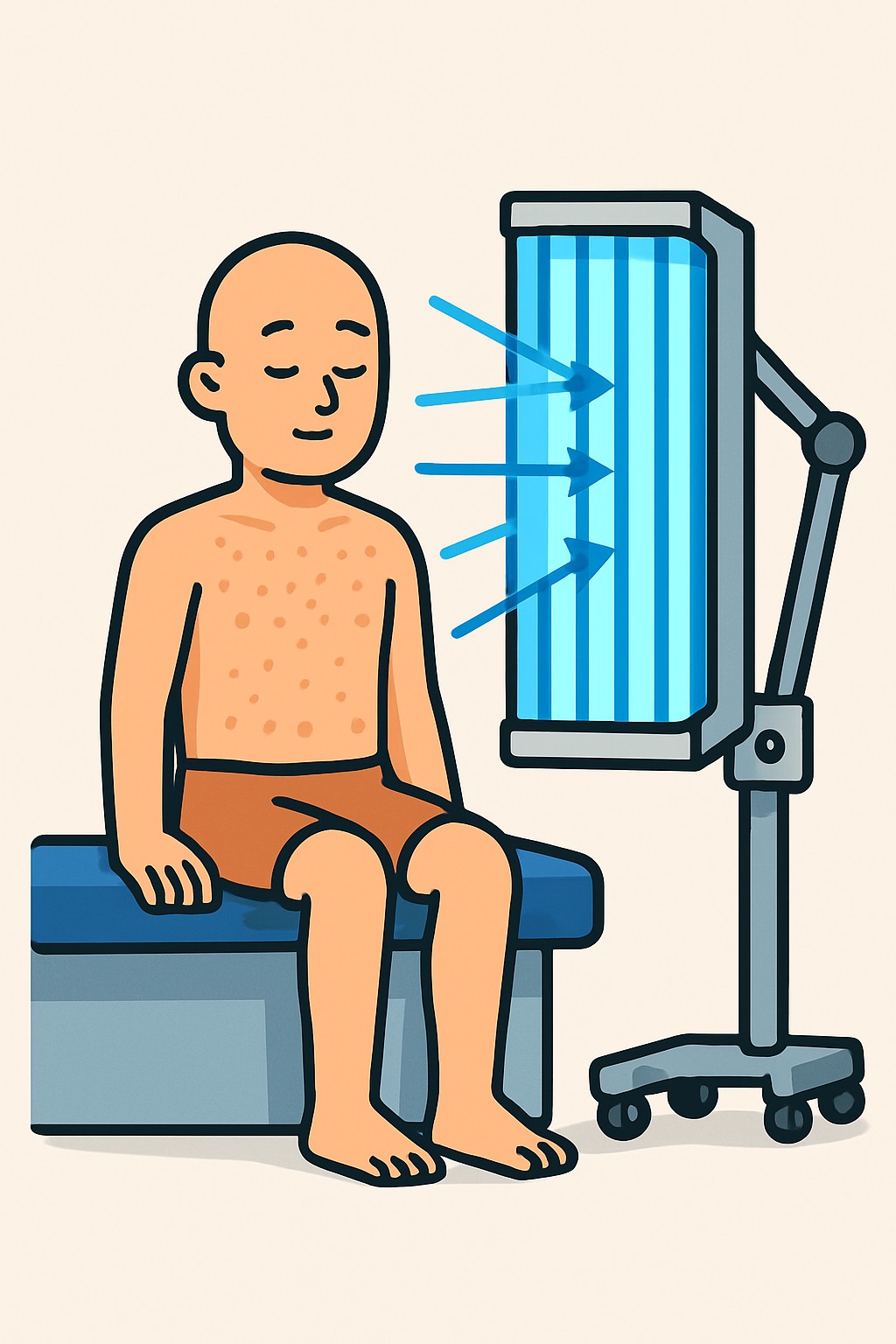
UV light therapy, also called phototherapy, uses controlled ultraviolet light to treat certain skin conditions.
Overview
UV light therapy, also called phototherapy, uses controlled ultraviolet light to treat certain skin conditions. Clinics commonly use UVB light or UVA light with a light-sensitizing medicine called psoralen (PUVA). Sessions are brief and repeated on a set schedule. Phototherapy can reduce inflammation, slow fast-growing skin cells, and help restore pigment in some conditions. It is done in a light booth or with targeted lamps under trained supervision.
Also known as: Phototherapy, UVB therapy, PUVA therapy, Narrowband UVB, Light therapy for skin
Preparation & Next Steps
Everything you need to know before and after your procedure
Before Care
- Plan for multiple short sessions per week over several weeks; ask the clinic about the schedule
- Share an up-to-date list of all medicines and supplements, including any that can increase light sensitivity
- Arrive with clean, lotion-free skin and no perfume, makeup, or deodorant unless the clinic instructs otherwise
- Wear comfortable, easy-to-remove clothing; some areas may be covered or shielded during treatment
- Use the protective eyewear provided by the clinic; bring prescription glasses if needed for fit
- Avoid tanning beds and intentional sunbathing during the treatment course
- Confirm which areas should be protected with sunscreen or clothing before the session, such as face or genitals
- If receiving PUVA, plan for light sensitivity after the visit and bring UV-blocking sunglasses
- Check transportation and time needs, as appointments are brief but frequent
After Care
- Moisturize treated skin with a bland, fragrance-free emollient as recommended by your clinic
- Avoid additional sun exposure the rest of the day; cover up if outdoors
- Use a broad-spectrum sunscreen SPF 30 or higher on exposed skin when outside
- Watch for severe redness, blistering, swelling, intense itching, or eye discomfort and contact the clinic
- If you had PUVA, wear UVA-blocking sunglasses outdoors for the remainder of the day as directed
- Do not use tanning beds or sunlamps during the treatment course
- Track any skin reactions and report them at your next session
- Keep all scheduled sessions; consistent timing affects results and dosing
- Review any updated shielding instructions for sensitive areas before the next visit
Clinical Information
Important medical details about this procedure
Indications
- Psoriasis
- Atopic dermatitis (eczema)
- Vitiligo
- Cutaneous T-cell lymphoma (early stages)
- Chronic itching (pruritus) from some causes
- Lichen planus
Alternatives
- Topical medicines such as corticosteroids, calcineurin inhibitors, or vitamin D analogs
- Systemic medicines such as oral immunomodulators or biologic injections
- Excimer laser or targeted 308 nm light for small areas
- Home phototherapy units with clinician guidance
- Skin care routines and trigger avoidance plans
Risks
- Sunburn-like redness, pain, or blistering
- Dry or itchy skin
- Temporary darkening or lightening of skin
- Eye injury without proper protective goggles
- Premature skin aging with cumulative exposure
- Higher risk of skin cancer with long-term UV exposure, especially with PUVA
Contraindications
- History of melanoma or multiple nonmelanoma skin cancers
- Photosensitivity disorders (for example, lupus or porphyria)
- Use of medicines that increase light sensitivity without an adjusted plan
- Inability to wear eye protection or follow shielding instructions
- Cataracts or eye conditions without appropriate UVA-blocking protection for PUVA
- Liver disease or other conditions that may restrict psoralen use (PUVA)
Recovery Timeline
What to expect during your recovery
Most people resume normal activities right after a session. Skin may feel warm or mildly sensitive for a short time. Courses often involve several weeks of repeated visits.
Typical Range
Same day
Return to Work
Same day
Recovery Milestones
Resume normal daily activities the same day
Protect skin from extra sun exposure after each session
Attend scheduled treatments and monitor for redness or irritation
Many treatment plans continue several weeks; clinic may adjust dose based on response
Frequently Asked Questions
Common questions and expert answers about this procedure
What conditions is UV light therapy used for?
What conditions is UV light therapy used for?
Common uses include psoriasis, eczema, vitiligo, some cases of cutaneous T-cell lymphoma, and certain types of chronic itching.
How does phototherapy work?
How does phototherapy work?
Controlled UVB or UVA light reduces inflammation, slows fast-growing skin cells, and can stimulate pigment cells in some conditions like vitiligo.
What are the main types of phototherapy?
What are the main types of phototherapy?
Narrowband UVB is most common. Other types include broadband UVB, excimer light for small areas, and PUVA, which combines UVA with psoralen.
How many sessions will I need?
How many sessions will I need?
Many plans involve 2 to 5 short sessions per week for several weeks. The total number varies by condition and response.
Will the treatment hurt?
Will the treatment hurt?
Most sessions are not painful. Skin may feel warm or mildly sunburned if the dose is high. The clinic adjusts dosing to reduce reactions.
Can I do phototherapy at home?
Can I do phototherapy at home?
Some people use home UVB units with clinic guidance on dosing and safety. Not all conditions or situations are suited to home units.
Are there long-term risks?
Are there long-term risks?
Cumulative UV exposure can age the skin and raise skin cancer risk, especially with PUVA. Clinics track dose and use protection to limit risk.
References
Medical literature and sources