%20--%3e%3csvg%20version='1.0'%20id='Layer_1'%20xmlns='http://www.w3.org/2000/svg'%20xmlns:xlink='http://www.w3.org/1999/xlink'%20x='0px'%20y='0px'%20viewBox='0%200%20755.52%20814.35'%20style='enable-background:new%200%200%20755.52%20814.35;'%20xml:space='preserve'%3e%3cstyle%20type='text/css'%3e%20.st0{fill:%231ae5ce;stroke:%231ae5ce;stroke-width:7;stroke-miterlimit:10;}%20.st1{fill:%23FFFFFF;stroke:%231ae5ce;stroke-width:7;stroke-miterlimit:10;}%20.st2{fill:%231ae5ce;stroke:%23FFFFFF;stroke-width:7;stroke-miterlimit:10;}%20.st3{fill:%23FFFFFF;stroke:%23FFFFFF;stroke-width:6;stroke-miterlimit:10;}%20%3c/style%3e%3cg%20id='Dark_Logo_00000159431215648494653180000015900878925932721032_'%3e%3cpath%20id='shield_00000152259091539869183100000001926543869452564382_'%20class='st0'%20d='M711.13,173.42%20c-3.37-49.07-38.92-44.9-75.96-52.18c-67.4-13.25-130.47-34.47-192.36-63.92c-22.48-10.7-41.88-25.74-65.05-26.28%20c-23.17,0.54-42.58,15.59-65.05,26.28c-61.89,29.45-124.95,50.68-192.36,63.92c-37.04,7.28-72.59,3.11-75.96,52.18%20c-1.55,22.6,0.34,46.4,1.05,68.92c5.99,190.78,52.91,345.39,206.27,466.46c29.71,23.46,74.51,55.8,108.84,70.75%20c5.99,2.61,11.7,3.73,17.21,3.75c5.51-0.02,11.22-1.14,17.21-3.75c34.33-14.95,79.12-47.3,108.84-70.75%20c153.37-121.07,200.28-275.68,206.27-466.46C710.79,219.82,712.68,196.02,711.13,173.42z'/%3e%3cpath%20id='magnifyingglass_00000073685934697636024790000000342567780940956808_'%20class='st1'%20d='M648.78,624.21l-96.64-104.65%20c34.89-40.63,55.98-93.46,55.98-151.21c0-128.27-103.98-232.24-232.24-232.24S143.63,240.08,143.63,368.35%20s103.98,232.24,232.24,232.24c48.87,0,94.21-15.11,131.62-40.89l97.18,105.24c11.25,12.18,30.24,12.93,42.42,1.69l0,0%20C659.27,655.38,660.03,636.39,648.78,624.21z'/%3e%3ccircle%20id='ellipse_00000129904010550392394720000017056154833629780114_'%20class='st2'%20cx='375.87'%20cy='368.35'%20r='181.21'/%3e%3cpath%20id='dollarsign_00000057140127156649725250000003772530148495155891_'%20class='st3'%20d='M362.91,492.03v-23.91%20c0-2.01-1.58-3.69-3.59-3.77c-18.49-0.78-37.12-5.4-49.4-11.83c-1.75-0.92-2.53-3.01-1.76-4.84l5.87-13.89%20c0.86-2.02,3.23-2.88,5.2-1.89c12.94,6.52,30.45,11.44,49.18,11.44c26.02,0,43.6-12.73,43.6-30.43c0-17.08-14.29-27.63-41.4-36.95%20c-37.37-12.42-60.46-26.7-60.46-53.72c0-24.97,20.29-44.11,52.22-49.51c1.8-0.31,3.11-1.89,3.11-3.72v-24.35%20c0-2.09,1.69-3.78,3.78-3.78h15.16c2.09,0,3.78,1.69,3.78,3.78v22.71c0,2.01,1.58,3.67,3.58,3.77c17.85,0.92,30.88,4.75,40.61,9.1%20c1.92,0.86,2.79,3.09,1.94,5.01l-6.08,13.6c-0.85,1.91-3.09,2.77-4.99,1.91c-8.37-3.8-22.38-8.95-42.75-8.95%20c-28.21,0-38.84,14.28-38.84,26.7c0,16.15,13.56,24.22,45.44,35.4c37.74,13.04,56.79,29.19,56.79,56.82%20c0,23.85-19.05,46.23-54.78,52.3c-1.8,0.31-3.11,1.89-3.11,3.72v25.28c0,2.09-1.69,3.78-3.78,3.78h-15.53%20C364.6,495.81,362.91,494.12,362.91,492.03z'/%3e%3c/g%3e%3c/svg%3e)
Abdominal Ultrasound Diagnostic Imaging
An abdominal ultrasound uses sound waves to create pictures of organs and blood vessels in your belly.
Overview
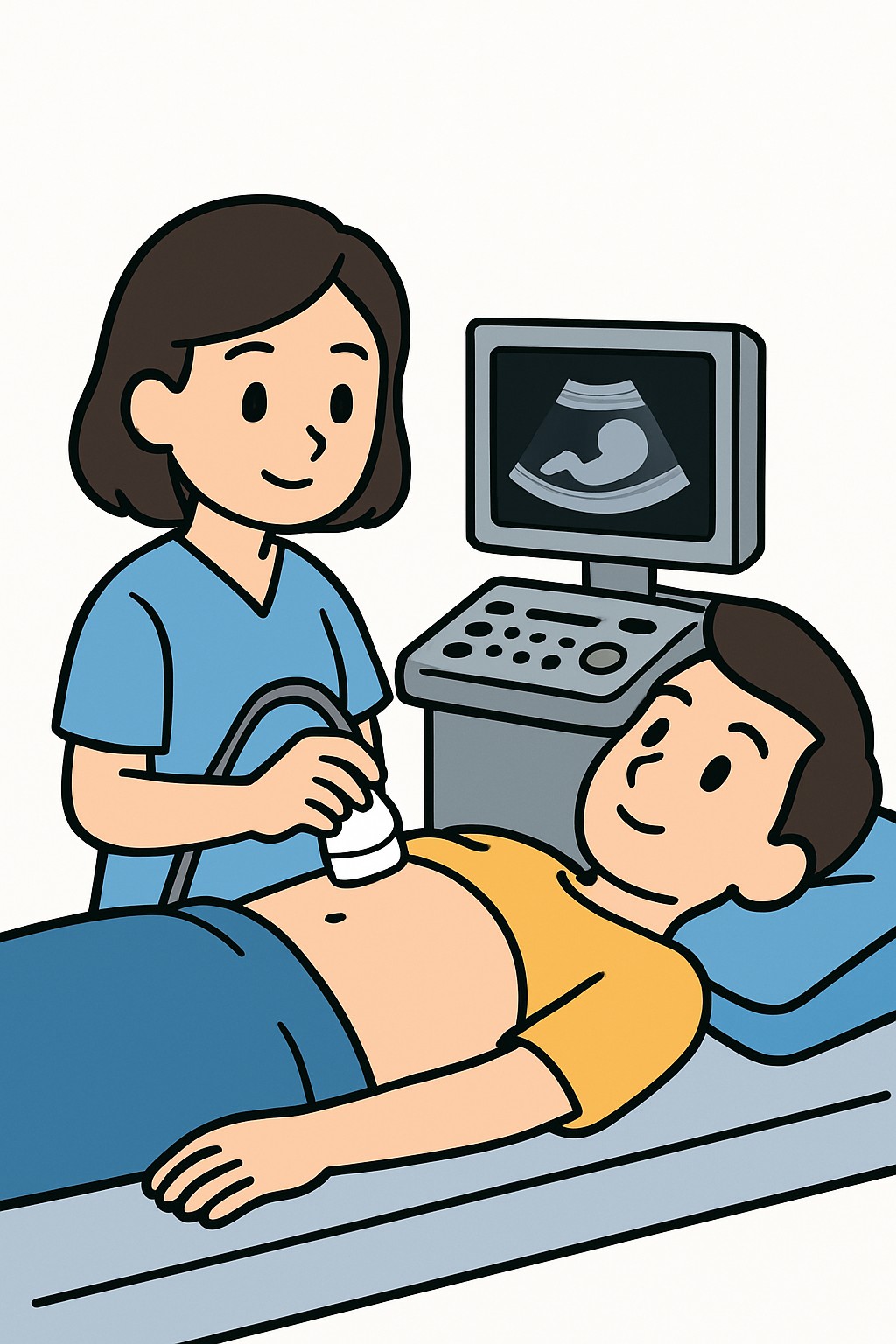
An abdominal ultrasound uses sound waves to create pictures of organs and blood vessels in your belly. A technologist moves a small handheld device called a transducer over your skin after applying gel. The scan does not use radiation. Clinicians use this test to check the liver, gallbladder, pancreas, spleen, kidneys, and major vessels like the aorta. It can help find gallstones, liver disease, kidney stones or blockage, fluid (ascites), and other causes of abdominal pain or swelling.
Also known as: Abdomen ultrasound, Abdominal sonogram, Abdominal sonography
Preparation & Next Steps
Everything you need to know before and after your procedure
Before Care
- Confirm the appointment location, arrival time, and check-in process
- Ask the imaging center about fasting instructions; many exams require no food for 6–8 hours so the gallbladder is better seen
- Drink water only if instructed; avoid carbonated drinks and gum before the exam to reduce stomach gas
- Wear comfortable two-piece clothing and remove belly piercings or jewelry
- Bring a photo ID, insurance card, and a list of your medicines and allergies
- Carry prior imaging reports and recent lab results related to the abdomen if available
- Plan extra time for parking and forms so the scan can start on time
- If you have diabetes or take medicines that must be timed with food, ask the imaging center how to prepare when fasting is required
- Let the staff know ahead of time about pregnancy, implanted devices, or skin sensitivity to gels or adhesives
After Care
- The gel is wiped off and you can resume normal activities and usual eating unless you were given other instructions by the imaging center
- Review how and when results will be shared (patient portal, report to your clinician, or follow-up call)
- Keep any follow-up appointments to discuss results and next steps
- If the technologist mentioned that images were limited by gas or body habitus, ask whether a repeat or different test may be planned
- Contact the imaging center or your clinician if you notice unusual skin irritation at the gel site or have questions about the report
- Save a copy of the imaging report for your personal health records
- Check your insurance portal for claim status and keep billing statements for your records
Clinical Information
Important medical details about this procedure
Indications
- Abdominal pain, bloating, or swelling
- Suspected gallstones or gallbladder disease
- Abnormal liver tests or known liver disease
- Kidney stones, blockage, or changes in kidney size
- Pancreatitis or pancreatic lesions
- Follow-up of cysts, masses, or enlarged organs
- Checking for fluid in the abdomen (ascites)
- Evaluation of the aorta for aneurysm
Alternatives
- CT scan of the abdomen
- MRI of the abdomen
- HIDA scan for gallbladder function
- Endoscopic ultrasound in select cases
- Blood and urine tests for related conditions
- Abdominal X-ray for limited uses
Risks
- No known risk from diagnostic ultrasound at standard settings
- Mild discomfort from probe pressure
- Rare skin irritation from the gel
- Limited detail if there is bowel gas or obesity; sometimes another test is needed
Contraindications
- No common absolute contraindications for standard diagnostic ultrasound
- Open wounds or dressings over the scan area may limit imaging
- Inability to remain still or follow brief breath holds can affect image quality
Recovery Timeline
What to expect during your recovery
Most people return to normal activities right after an abdominal ultrasound. There is no medical recovery period for a standard diagnostic scan.
Typical Range
Same day
Return to Work
Same day
Recovery Milestones
Resume normal diet and daily activities
Review how results will be delivered and note any follow-up steps
Attend follow-up visit or testing if scheduled
Frequently Asked Questions
Common questions and expert answers about this procedure
What does an abdominal ultrasound show?
What does an abdominal ultrasound show?
It produces images of the liver, gallbladder, pancreas, spleen, kidneys, and major blood vessels. It can help detect stones, cysts, masses, fluid, or signs of infection or inflammation.
Does it use radiation?
Does it use radiation?
No. Ultrasound uses high-frequency sound waves, not ionizing radiation.
How long does the test take?
How long does the test take?
Most exams take 20–45 minutes. Time varies based on the reason for the test and how easily structures can be seen.
Will it hurt?
Will it hurt?
It is usually painless. You may feel mild pressure from the probe. Brief breath holds help capture clear images.
Do I need to fast?
Do I need to fast?
Many abdominal ultrasounds require no food for several hours so the gallbladder and bile ducts are easier to see. Follow the imaging center’s instructions.
Can I drive afterward?
Can I drive afterward?
Yes. No sedation is used for a standard ultrasound, and you can return to normal activities right away.
What if the images are unclear?
What if the images are unclear?
Bowel gas or body habitus can limit views. The clinician may order repeat images, a targeted ultrasound, or another test like CT or MRI.
When will I get results?
When will I get results?
A radiologist reviews the images and sends a report to your clinician. Many centers also release reports to the patient portal, often within 1–2 business days.
References
Medical literature and sources