%20--%3e%3csvg%20version='1.0'%20id='Layer_1'%20xmlns='http://www.w3.org/2000/svg'%20xmlns:xlink='http://www.w3.org/1999/xlink'%20x='0px'%20y='0px'%20viewBox='0%200%20755.52%20814.35'%20style='enable-background:new%200%200%20755.52%20814.35;'%20xml:space='preserve'%3e%3cstyle%20type='text/css'%3e%20.st0{fill:%231ae5ce;stroke:%231ae5ce;stroke-width:7;stroke-miterlimit:10;}%20.st1{fill:%23FFFFFF;stroke:%231ae5ce;stroke-width:7;stroke-miterlimit:10;}%20.st2{fill:%231ae5ce;stroke:%23FFFFFF;stroke-width:7;stroke-miterlimit:10;}%20.st3{fill:%23FFFFFF;stroke:%23FFFFFF;stroke-width:6;stroke-miterlimit:10;}%20%3c/style%3e%3cg%20id='Dark_Logo_00000159431215648494653180000015900878925932721032_'%3e%3cpath%20id='shield_00000152259091539869183100000001926543869452564382_'%20class='st0'%20d='M711.13,173.42%20c-3.37-49.07-38.92-44.9-75.96-52.18c-67.4-13.25-130.47-34.47-192.36-63.92c-22.48-10.7-41.88-25.74-65.05-26.28%20c-23.17,0.54-42.58,15.59-65.05,26.28c-61.89,29.45-124.95,50.68-192.36,63.92c-37.04,7.28-72.59,3.11-75.96,52.18%20c-1.55,22.6,0.34,46.4,1.05,68.92c5.99,190.78,52.91,345.39,206.27,466.46c29.71,23.46,74.51,55.8,108.84,70.75%20c5.99,2.61,11.7,3.73,17.21,3.75c5.51-0.02,11.22-1.14,17.21-3.75c34.33-14.95,79.12-47.3,108.84-70.75%20c153.37-121.07,200.28-275.68,206.27-466.46C710.79,219.82,712.68,196.02,711.13,173.42z'/%3e%3cpath%20id='magnifyingglass_00000073685934697636024790000000342567780940956808_'%20class='st1'%20d='M648.78,624.21l-96.64-104.65%20c34.89-40.63,55.98-93.46,55.98-151.21c0-128.27-103.98-232.24-232.24-232.24S143.63,240.08,143.63,368.35%20s103.98,232.24,232.24,232.24c48.87,0,94.21-15.11,131.62-40.89l97.18,105.24c11.25,12.18,30.24,12.93,42.42,1.69l0,0%20C659.27,655.38,660.03,636.39,648.78,624.21z'/%3e%3ccircle%20id='ellipse_00000129904010550392394720000017056154833629780114_'%20class='st2'%20cx='375.87'%20cy='368.35'%20r='181.21'/%3e%3cpath%20id='dollarsign_00000057140127156649725250000003772530148495155891_'%20class='st3'%20d='M362.91,492.03v-23.91%20c0-2.01-1.58-3.69-3.59-3.77c-18.49-0.78-37.12-5.4-49.4-11.83c-1.75-0.92-2.53-3.01-1.76-4.84l5.87-13.89%20c0.86-2.02,3.23-2.88,5.2-1.89c12.94,6.52,30.45,11.44,49.18,11.44c26.02,0,43.6-12.73,43.6-30.43c0-17.08-14.29-27.63-41.4-36.95%20c-37.37-12.42-60.46-26.7-60.46-53.72c0-24.97,20.29-44.11,52.22-49.51c1.8-0.31,3.11-1.89,3.11-3.72v-24.35%20c0-2.09,1.69-3.78,3.78-3.78h15.16c2.09,0,3.78,1.69,3.78,3.78v22.71c0,2.01,1.58,3.67,3.58,3.77c17.85,0.92,30.88,4.75,40.61,9.1%20c1.92,0.86,2.79,3.09,1.94,5.01l-6.08,13.6c-0.85,1.91-3.09,2.77-4.99,1.91c-8.37-3.8-22.38-8.95-42.75-8.95%20c-28.21,0-38.84,14.28-38.84,26.7c0,16.15,13.56,24.22,45.44,35.4c37.74,13.04,56.79,29.19,56.79,56.82%20c0,23.85-19.05,46.23-54.78,52.3c-1.8,0.31-3.11,1.89-3.11,3.72v25.28c0,2.09-1.69,3.78-3.78,3.78h-15.53%20C364.6,495.81,362.91,494.12,362.91,492.03z'/%3e%3c/g%3e%3c/svg%3e)
Abdominal X-ray (1 view) Diagnostic Imaging
An abdominal X-ray is a quick imaging test that uses a small amount of ionizing radiation to create a picture of the abdomen.
Overview
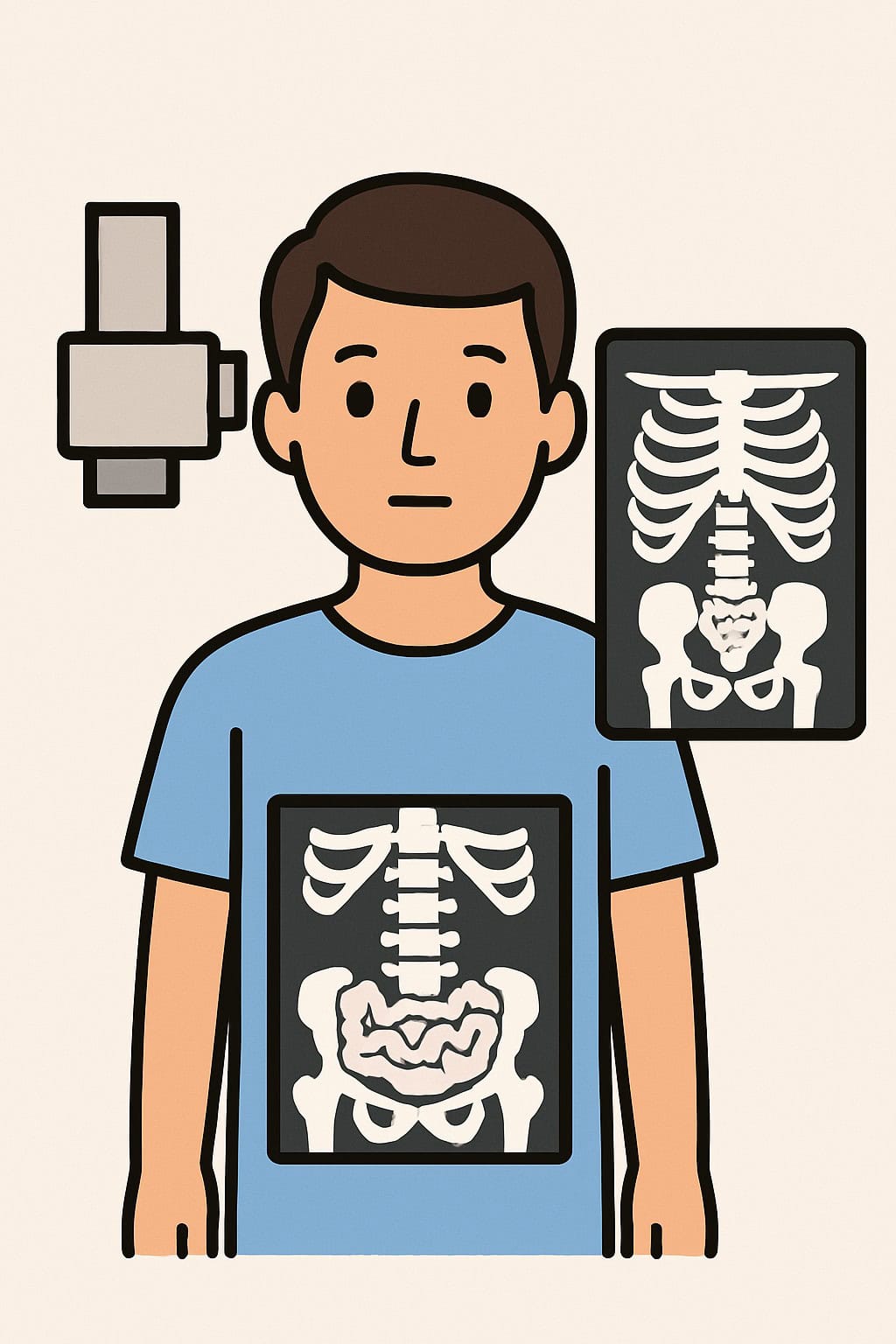
An abdominal X-ray is a quick imaging test that uses a small amount of ionizing radiation to create a picture of the abdomen. A 1-view study means a single image, often taken while you are lying on your back. Clinicians use it to look at bowel gas patterns, check for signs of blockage, see some types of stones, or confirm the position of tubes or foreign objects. It is commonly done in urgent care, emergency departments, and hospitals.
Also known as: Abdomen X-ray, KUB X-ray, Abdominal radiograph, Single-view abdominal X-ray
Preparation & Next Steps
Everything you need to know before and after your procedure
Before Care
- Bring a photo ID, insurance card, and the imaging order or referral if you have it
- Arrive a few minutes early to confirm registration and any paperwork
- Wear comfortable clothing without metal zippers, snaps, or belts; you may be asked to change into a gown
- Remove metal objects from the waist area, such as jewelry, belts, coins, or piercings if possible
- Tell the imaging staff if you are or might be pregnant
- Let the technologist know about recent imaging with barium or other contrast
- Share any limits with movement or lying flat so positioning can be adjusted
- Bring prior abdominal imaging reports or discs if available for comparison
- Follow any instructions from the imaging center; most abdominal X-rays do not require fasting or special preparation
- Confirm how and when results will be shared with you by the ordering clinician
After Care
- You can usually return to normal activities and diet right away
- There is no radiation left in your body after the X-ray
- Mild stiffness from holding still can improve with gentle movement
- Keep the radiology department contact information in case questions come up
- Know how results will be delivered, such as through a patient portal or a call from your clinician
- Ask the ordering clinician’s office about timing if you have not seen results when expected
- Contact your clinician if your symptoms change or worsen after the exam
- Store any image copies or reports you receive for your personal health records
Clinical Information
Important medical details about this procedure
Indications
- Abdominal pain or swelling
- Nausea, vomiting, or constipation
- Suspected bowel obstruction
- Evaluation of swallowed or inserted foreign object
- Suspected kidney or ureteral stones
- Check position of feeding or drainage tubes
- Follow-up of known abdominal conditions
Alternatives
- Abdominal ultrasound
- CT scan of the abdomen and pelvis
- MRI of the abdomen
- Observation and repeat physical exam
- Laboratory tests such as blood work or urinalysis
- Point-of-care ultrasound in the clinic or emergency department
Risks
- Small exposure to ionizing radiation
- Lower detail than CT or MRI, so some problems may not be seen
- Potential harm to an unborn baby if pregnant
- Incidental findings that may require further testing
- Temporary discomfort from positioning or holding still
Contraindications
- Known or possible pregnancy when an alternative test is reasonable
- Inability to hold still or follow instructions during the exposure
- Recent barium contrast study that can obscure the abdomen on X-ray
Recovery Timeline
What to expect during your recovery
No medical recovery period is expected after a standard abdominal X-ray. Most people resume normal activities immediately.
Typical Range
Same day
Return to Work
Same day
Recovery Milestones
Resume normal daily activities and diet
Review how and when results will be communicated
Discuss results with the ordering clinician if not already reviewed
Frequently Asked Questions
Common questions and expert answers about this procedure
What does 1 view mean on an abdominal X-ray?
What does 1 view mean on an abdominal X-ray?
It means a single image is taken, typically from the front while you lie on your back. Some evaluations may need more views.
How long does an abdominal X-ray take?
How long does an abdominal X-ray take?
The exposure is seconds. The entire visit, including positioning and setup, is often 10 to 15 minutes.
Do I need to fast or do any bowel prep?
Do I need to fast or do any bowel prep?
Usually no special preparation is needed. Follow any instructions from the imaging center if they give you specific directions.
Will the X-ray hurt?
Will the X-ray hurt?
You should not feel the X-ray itself. You may be asked to hold still or briefly hold your breath, which can be uncomfortable but is short.
Can this test find kidney stones or a bowel blockage?
Can this test find kidney stones or a bowel blockage?
It can show some stones and signs of blockage, but not all. Other tests such as CT or ultrasound may be used for more detail.
Is it safe during pregnancy?
Is it safe during pregnancy?
If you are or might be pregnant, tell the staff. X-rays are usually avoided in pregnancy unless clearly needed, and other imaging may be considered.
How much radiation is used?
How much radiation is used?
A small amount. For a single abdominal X-ray, the dose is roughly similar to a few months of natural background radiation.
When will I get the results?
When will I get the results?
A radiologist interprets the images and sends a report to your ordering clinician, often the same day or within a few days, depending on the site.
References
Medical literature and sources