%20--%3e%3csvg%20version='1.0'%20id='Layer_1'%20xmlns='http://www.w3.org/2000/svg'%20xmlns:xlink='http://www.w3.org/1999/xlink'%20x='0px'%20y='0px'%20viewBox='0%200%20755.52%20814.35'%20style='enable-background:new%200%200%20755.52%20814.35;'%20xml:space='preserve'%3e%3cstyle%20type='text/css'%3e%20.st0{fill:%231ae5ce;stroke:%231ae5ce;stroke-width:7;stroke-miterlimit:10;}%20.st1{fill:%23FFFFFF;stroke:%231ae5ce;stroke-width:7;stroke-miterlimit:10;}%20.st2{fill:%231ae5ce;stroke:%23FFFFFF;stroke-width:7;stroke-miterlimit:10;}%20.st3{fill:%23FFFFFF;stroke:%23FFFFFF;stroke-width:6;stroke-miterlimit:10;}%20%3c/style%3e%3cg%20id='Dark_Logo_00000159431215648494653180000015900878925932721032_'%3e%3cpath%20id='shield_00000152259091539869183100000001926543869452564382_'%20class='st0'%20d='M711.13,173.42%20c-3.37-49.07-38.92-44.9-75.96-52.18c-67.4-13.25-130.47-34.47-192.36-63.92c-22.48-10.7-41.88-25.74-65.05-26.28%20c-23.17,0.54-42.58,15.59-65.05,26.28c-61.89,29.45-124.95,50.68-192.36,63.92c-37.04,7.28-72.59,3.11-75.96,52.18%20c-1.55,22.6,0.34,46.4,1.05,68.92c5.99,190.78,52.91,345.39,206.27,466.46c29.71,23.46,74.51,55.8,108.84,70.75%20c5.99,2.61,11.7,3.73,17.21,3.75c5.51-0.02,11.22-1.14,17.21-3.75c34.33-14.95,79.12-47.3,108.84-70.75%20c153.37-121.07,200.28-275.68,206.27-466.46C710.79,219.82,712.68,196.02,711.13,173.42z'/%3e%3cpath%20id='magnifyingglass_00000073685934697636024790000000342567780940956808_'%20class='st1'%20d='M648.78,624.21l-96.64-104.65%20c34.89-40.63,55.98-93.46,55.98-151.21c0-128.27-103.98-232.24-232.24-232.24S143.63,240.08,143.63,368.35%20s103.98,232.24,232.24,232.24c48.87,0,94.21-15.11,131.62-40.89l97.18,105.24c11.25,12.18,30.24,12.93,42.42,1.69l0,0%20C659.27,655.38,660.03,636.39,648.78,624.21z'/%3e%3ccircle%20id='ellipse_00000129904010550392394720000017056154833629780114_'%20class='st2'%20cx='375.87'%20cy='368.35'%20r='181.21'/%3e%3cpath%20id='dollarsign_00000057140127156649725250000003772530148495155891_'%20class='st3'%20d='M362.91,492.03v-23.91%20c0-2.01-1.58-3.69-3.59-3.77c-18.49-0.78-37.12-5.4-49.4-11.83c-1.75-0.92-2.53-3.01-1.76-4.84l5.87-13.89%20c0.86-2.02,3.23-2.88,5.2-1.89c12.94,6.52,30.45,11.44,49.18,11.44c26.02,0,43.6-12.73,43.6-30.43c0-17.08-14.29-27.63-41.4-36.95%20c-37.37-12.42-60.46-26.7-60.46-53.72c0-24.97,20.29-44.11,52.22-49.51c1.8-0.31,3.11-1.89,3.11-3.72v-24.35%20c0-2.09,1.69-3.78,3.78-3.78h15.16c2.09,0,3.78,1.69,3.78,3.78v22.71c0,2.01,1.58,3.67,3.58,3.77c17.85,0.92,30.88,4.75,40.61,9.1%20c1.92,0.86,2.79,3.09,1.94,5.01l-6.08,13.6c-0.85,1.91-3.09,2.77-4.99,1.91c-8.37-3.8-22.38-8.95-42.75-8.95%20c-28.21,0-38.84,14.28-38.84,26.7c0,16.15,13.56,24.22,45.44,35.4c37.74,13.04,56.79,29.19,56.79,56.82%20c0,23.85-19.05,46.23-54.78,52.3c-1.8,0.31-3.11,1.89-3.11,3.72v25.28c0,2.09-1.69,3.78-3.78,3.78h-15.53%20C364.6,495.81,362.91,494.12,362.91,492.03z'/%3e%3c/g%3e%3c/svg%3e)
Abdominal X-ray series (acute abdomen imaging) Diagnostic Imaging
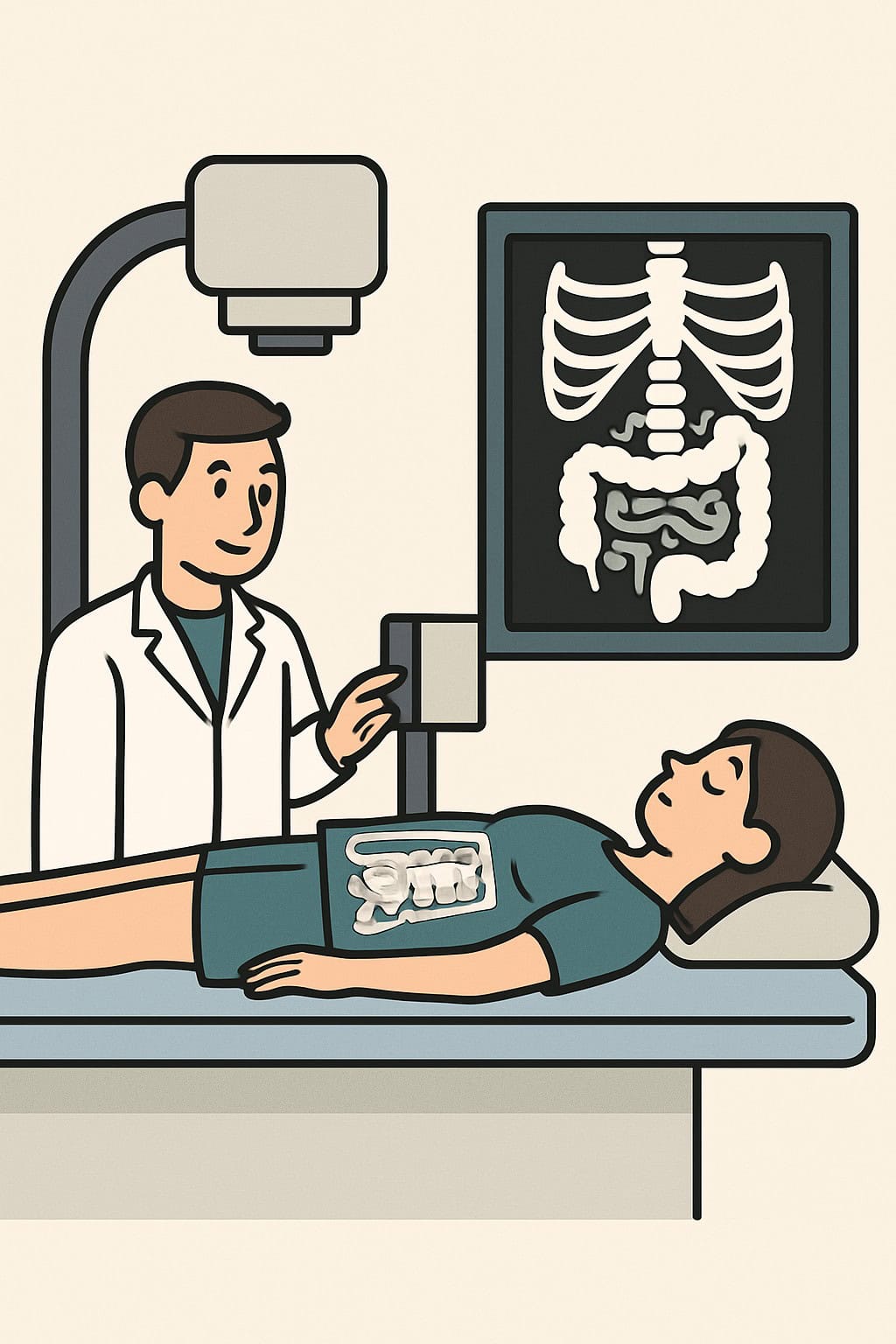
An abdominal X-ray series is a set of X-ray images used to look for causes of sudden belly pain.
Overview
An abdominal X-ray series is a set of X-ray images used to look for causes of sudden belly pain. It often includes pictures of the abdomen while lying down and standing, and sometimes a chest X-ray to check for air under the diaphragm. This test can show bowel blockage, holes in the bowel (free air), certain kidney stones, swallowed objects, and abnormal fluid or air levels. It is quick, widely available, and does not use injected contrast.
Also known as: Acute abdominal series, Abdominal radiograph series, KUB and upright abdomen, AAS
Preparation & Next Steps
Everything you need to know before and after your procedure
Before Care
- Plan for a short visit; most exams take about 15–30 minutes including positioning
- Wear comfortable clothing without metal snaps or zippers; you may be asked to change into a gown
- Remove metal objects in the imaging area such as belts, jewelry, and piercings if possible
- Tell the technologist if you might be pregnant or are breastfeeding
- Let staff know if you recently had an imaging test with barium or other oral contrast
- Share if you have severe pain, cannot stand, or have limited mobility so positioning can be adjusted
- Bring a list of your current medicines and any relevant prior imaging reports
- Ask how and when results will be shared through your portal or by your clinician
After Care
- You can eat, drink, and take your usual medicines after the exam
- Resume normal activities unless your clinician has given other instructions
- X-rays do not leave radiation in your body; nothing needs to be flushed out
- Note how and when you will receive the radiology report and who will explain the results
- Keep copies of the report and images if offered through a patient portal or on a disc
- If your symptoms change or worsen after the exam, contact a clinician
- If you are or might be pregnant and had imaging, make sure this is documented in your medical record
Clinical Information
Important medical details about this procedure
Indications
- Acute abdominal pain
- Suspected bowel obstruction
- Concern for bowel perforation (free air)
- Evaluation of kidney stones or calcifications
- Monitoring known bowel gas patterns
- Swallowed foreign body
Alternatives
- CT scan of the abdomen and pelvis
- Abdominal ultrasound
- MRI of the abdomen
- Point-of-care ultrasound
- Observation with repeat exams and labs
Risks
- Exposure to a small amount of ionizing radiation
- Possible lower accuracy for some conditions compared with CT or ultrasound
- Incidental findings that may require more testing
- Reduced image quality if motion or body habitus limits views
- Potential risk to a developing fetus from radiation
Contraindications
- Pregnancy without a risk–benefit review
- Recent barium contrast study that may obscure images
- Inability to cooperate with positioning without support
- Unstable trauma or medical emergency where other imaging is prioritized
Recovery Timeline
What to expect during your recovery
There is no medical recovery period for an abdominal X-ray series. Most people return to normal activities right away.
Typical Range
Same day
Return to Work
Same day
Recovery Milestones
Resume normal daily activities
Return to usual eating and drinking
Review preliminary or final report in your patient portal if available
Arrange any follow-up imaging or visit if recommended by your care team
Frequently Asked Questions
Common questions and expert answers about this procedure
What images are included in an abdominal X-ray series?
What images are included in an abdominal X-ray series?
Usually a lying-down and standing view of the abdomen, and often a chest X-ray to look for free air or lung issues that can cause belly pain.
How long does the exam take?
How long does the exam take?
The imaging itself is brief. With positioning and setup, most visits take about 15–30 minutes.
Do I need to fast or drink anything before the test?
Do I need to fast or drink anything before the test?
No special preparation is typical. Let the staff know if you recently had a barium study, which can affect the images.
Is there radiation exposure?
Is there radiation exposure?
Yes, it uses a small amount of ionizing radiation. The dose is generally lower than a CT scan and is kept as low as reasonably achievable.
Can it diagnose appendicitis?
Can it diagnose appendicitis?
X-rays are limited for appendicitis. CT or ultrasound is often more helpful if appendicitis is a concern.
Will it hurt?
Will it hurt?
The exam is not painful. You may feel brief discomfort from holding certain positions.
What if I might be pregnant?
What if I might be pregnant?
Tell the technologist before the exam. X-rays during pregnancy are used only when the expected benefit outweighs the risk.
Why include a chest X-ray for belly pain?
Why include a chest X-ray for belly pain?
It can show free air under the diaphragm from a bowel perforation and detect lung problems, like pneumonia, that can mimic abdominal pain.
References
Medical literature and sources