%20--%3e%3csvg%20version='1.0'%20id='Layer_1'%20xmlns='http://www.w3.org/2000/svg'%20xmlns:xlink='http://www.w3.org/1999/xlink'%20x='0px'%20y='0px'%20viewBox='0%200%20755.52%20814.35'%20style='enable-background:new%200%200%20755.52%20814.35;'%20xml:space='preserve'%3e%3cstyle%20type='text/css'%3e%20.st0{fill:%231ae5ce;stroke:%231ae5ce;stroke-width:7;stroke-miterlimit:10;}%20.st1{fill:%23FFFFFF;stroke:%231ae5ce;stroke-width:7;stroke-miterlimit:10;}%20.st2{fill:%231ae5ce;stroke:%23FFFFFF;stroke-width:7;stroke-miterlimit:10;}%20.st3{fill:%23FFFFFF;stroke:%23FFFFFF;stroke-width:6;stroke-miterlimit:10;}%20%3c/style%3e%3cg%20id='Dark_Logo_00000159431215648494653180000015900878925932721032_'%3e%3cpath%20id='shield_00000152259091539869183100000001926543869452564382_'%20class='st0'%20d='M711.13,173.42%20c-3.37-49.07-38.92-44.9-75.96-52.18c-67.4-13.25-130.47-34.47-192.36-63.92c-22.48-10.7-41.88-25.74-65.05-26.28%20c-23.17,0.54-42.58,15.59-65.05,26.28c-61.89,29.45-124.95,50.68-192.36,63.92c-37.04,7.28-72.59,3.11-75.96,52.18%20c-1.55,22.6,0.34,46.4,1.05,68.92c5.99,190.78,52.91,345.39,206.27,466.46c29.71,23.46,74.51,55.8,108.84,70.75%20c5.99,2.61,11.7,3.73,17.21,3.75c5.51-0.02,11.22-1.14,17.21-3.75c34.33-14.95,79.12-47.3,108.84-70.75%20c153.37-121.07,200.28-275.68,206.27-466.46C710.79,219.82,712.68,196.02,711.13,173.42z'/%3e%3cpath%20id='magnifyingglass_00000073685934697636024790000000342567780940956808_'%20class='st1'%20d='M648.78,624.21l-96.64-104.65%20c34.89-40.63,55.98-93.46,55.98-151.21c0-128.27-103.98-232.24-232.24-232.24S143.63,240.08,143.63,368.35%20s103.98,232.24,232.24,232.24c48.87,0,94.21-15.11,131.62-40.89l97.18,105.24c11.25,12.18,30.24,12.93,42.42,1.69l0,0%20C659.27,655.38,660.03,636.39,648.78,624.21z'/%3e%3ccircle%20id='ellipse_00000129904010550392394720000017056154833629780114_'%20class='st2'%20cx='375.87'%20cy='368.35'%20r='181.21'/%3e%3cpath%20id='dollarsign_00000057140127156649725250000003772530148495155891_'%20class='st3'%20d='M362.91,492.03v-23.91%20c0-2.01-1.58-3.69-3.59-3.77c-18.49-0.78-37.12-5.4-49.4-11.83c-1.75-0.92-2.53-3.01-1.76-4.84l5.87-13.89%20c0.86-2.02,3.23-2.88,5.2-1.89c12.94,6.52,30.45,11.44,49.18,11.44c26.02,0,43.6-12.73,43.6-30.43c0-17.08-14.29-27.63-41.4-36.95%20c-37.37-12.42-60.46-26.7-60.46-53.72c0-24.97,20.29-44.11,52.22-49.51c1.8-0.31,3.11-1.89,3.11-3.72v-24.35%20c0-2.09,1.69-3.78,3.78-3.78h15.16c2.09,0,3.78,1.69,3.78,3.78v22.71c0,2.01,1.58,3.67,3.58,3.77c17.85,0.92,30.88,4.75,40.61,9.1%20c1.92,0.86,2.79,3.09,1.94,5.01l-6.08,13.6c-0.85,1.91-3.09,2.77-4.99,1.91c-8.37-3.8-22.38-8.95-42.75-8.95%20c-28.21,0-38.84,14.28-38.84,26.7c0,16.15,13.56,24.22,45.44,35.4c37.74,13.04,56.79,29.19,56.79,56.82%20c0,23.85-19.05,46.23-54.78,52.3c-1.8,0.31-3.11,1.89-3.11,3.72v25.28c0,2.09-1.69,3.78-3.78,3.78h-15.53%20C364.6,495.81,362.91,494.12,362.91,492.03z'/%3e%3c/g%3e%3c/svg%3e)
Allergy patch testing (multi-allergen panel) Diagnostic Imaging
Allergy patch testing checks for delayed skin reactions to substances that can cause allergic contact dermatitis.
Overview
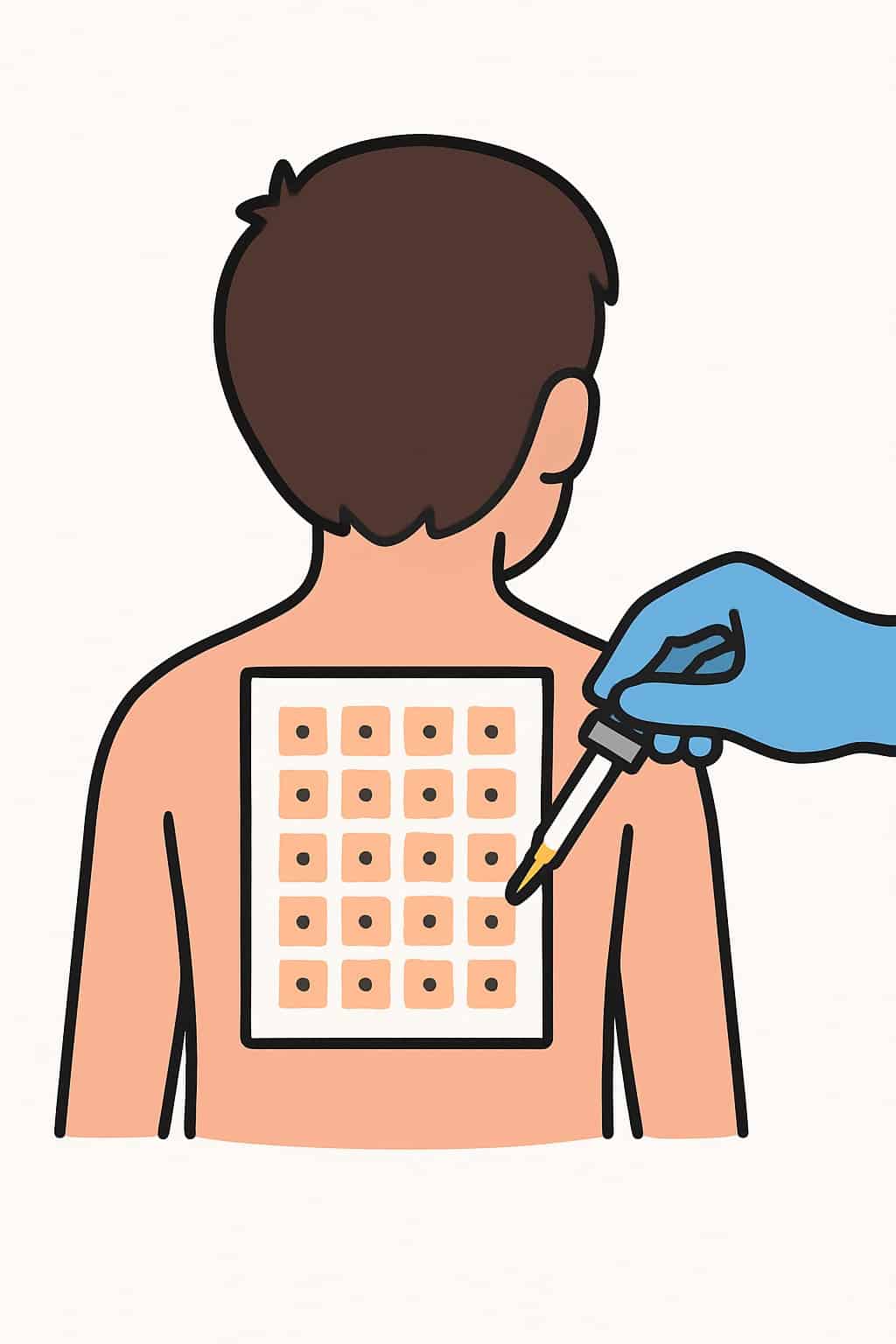
Allergy patch testing checks for delayed skin reactions to substances that can cause allergic contact dermatitis. Small amounts of many common allergens are placed on adhesive patches, which are applied to the skin (often the back) and left in place for a set time. The skin is examined at least twice, usually after 48 hours and again at 72 to 96 hours or later. A multi-allergen panel tests several substances at once, such as metals, fragrances, preservatives, rubber chemicals, dyes, and ingredients in personal care products.
Also known as: Patch testing, Contact allergy patch test, Allergic contact dermatitis testing, Patch test panel
Preparation & Next Steps
Everything you need to know before and after your procedure
Before Care
- Plan for 2 to 3 visits over 4 to 7 days for placement and readings.
- Bring a list of your skin care, hair, cosmetic, and workplace products, with ingredient lists if available.
- Tell the clinic about tape or adhesive sensitivities and any past severe skin reactions.
- Ask the clinic about medicines that can affect results, such as topical steroids on the test area, oral steroids, immunosuppressants, or recent phototherapy.
- Avoid heavy sun on the planned test area and keep the skin free of lotions or oils on the day of placement.
- Shower before the appointment since the area must stay dry while patches are on.
- Wear loose clothing that allows access to the back or upper arms.
- Arrange your schedule to avoid swimming, saunas, and intense exercise while patches are in place.
- Confirm how many visits will be needed and the timing of each reading.
After Care
- Keep patches dry until removal; avoid bathing, swimming, and heavy sweating.
- Do not apply creams, ointments, or powders on the test area until the final reading unless the clinic gives other instructions.
- Wear soft, loose clothing to reduce rubbing and keep patches in place.
- If a patch lifts, contact the clinic for guidance on whether to reinforce or leave it as is.
- After removal, keep marker outlines and the test area dry until the last reading.
- Avoid sun on the test area until the final reading is completed.
- Expect mild itching; avoid scratching to prevent skin breakdown.
- Notify the clinic if you develop severe pain, spreading redness, pus, or large blisters.
- Save photos of reactions if the clinic requests them for comparison at later readings.
- Review results with the clinician and discuss avoidance strategies for any confirmed allergens.
Clinical Information
Important medical details about this procedure
Indications
- Suspected allergic contact dermatitis
- Chronic or recurrent eczema not improving with standard care
- Rashes that worsen with specific products or at work
- Eyelid, face, or hand dermatitis
- Reactions to topical medicines or adhesives
- Occupational exposures to chemicals, metals, or rubber
Alternatives
- Careful avoidance and reintroduction of suspected products
- Repeat open application test (applying a product to a small area repeatedly at home as instructed by a clinician)
- Using fragrance-free or hypoallergenic products while tracking flares
- Skin prick testing or blood IgE testing for immediate allergies (not useful for contact dermatitis)
- Photopatch testing when a sun-related allergy is suspected
Risks
- Itching, redness, or a flare of dermatitis at test sites
- Blistering or swelling at strong positive sites
- Temporary skin color change after reactions
- Adhesive irritation unrelated to allergens
- Infection at scratched or open areas (rare)
- False positive or false negative results
Contraindications
- Extensive active dermatitis on the test area
- Recent sunburn or heavy tanning on the test area
- Inability to keep the area dry and avoid heavy sweating during testing
- Use of medicines that can suppress skin reactions, which may limit test accuracy
- Inability to attend multiple visits for readings
Recovery Timeline
What to expect during your recovery
Most people continue normal daily activities during testing. Local itching or redness is common and usually settles within a few days after the final reading.
Typical Range
2–7 days
Return to Work
0–1 days
Recovery Milestones
Keep patches dry and avoid heavy sweating while they are in place
First reading and patch removal; area remains marked and should stay dry
Final reading; most local reactions begin to settle
Fading of any residual redness or discoloration at test sites
Frequently Asked Questions
Common questions and expert answers about this procedure
What does patch testing check for?
What does patch testing check for?
It checks for delayed skin allergies that cause contact dermatitis from substances like metals, fragrances, and preservatives.
How many visits are needed and how long does it take?
How many visits are needed and how long does it take?
It usually needs 2 to 3 visits over 4 to 7 days: placement, a first reading around 48 hours, and a later reading at 72 to 96 hours or beyond.
Does patch testing check food or seasonal allergies?
Does patch testing check food or seasonal allergies?
No. Patch testing looks for delayed contact allergies. Food and pollen allergies are typically evaluated with skin prick or blood IgE tests.
Will it hurt?
Will it hurt?
Most people feel itching or mild discomfort where a reaction occurs. Strong reactions can blister but usually heal without scarring.
Can I shower or exercise during testing?
Can I shower or exercise during testing?
While patches are on, keep the area dry and avoid heavy sweating. After removal, follow clinic guidance until the final reading.
How many allergens are in a multi-allergen panel?
How many allergens are in a multi-allergen panel?
Panels vary by clinic and your history. They often include common metals, fragrances, preservatives, rubber chemicals, and dyes.
What if I get a strong reaction?
What if I get a strong reaction?
Contact the clinic. They may assess the site, adjust the schedule, or provide care after readings are completed.
Are children or pregnant people tested?
Are children or pregnant people tested?
Patch testing can be performed when indicated. Clinics consider timing, comfort, and the need for results when planning testing.
References
Medical literature and sources