%20--%3e%3csvg%20version='1.0'%20id='Layer_1'%20xmlns='http://www.w3.org/2000/svg'%20xmlns:xlink='http://www.w3.org/1999/xlink'%20x='0px'%20y='0px'%20viewBox='0%200%20755.52%20814.35'%20style='enable-background:new%200%200%20755.52%20814.35;'%20xml:space='preserve'%3e%3cstyle%20type='text/css'%3e%20.st0{fill:%231ae5ce;stroke:%231ae5ce;stroke-width:7;stroke-miterlimit:10;}%20.st1{fill:%23FFFFFF;stroke:%231ae5ce;stroke-width:7;stroke-miterlimit:10;}%20.st2{fill:%231ae5ce;stroke:%23FFFFFF;stroke-width:7;stroke-miterlimit:10;}%20.st3{fill:%23FFFFFF;stroke:%23FFFFFF;stroke-width:6;stroke-miterlimit:10;}%20%3c/style%3e%3cg%20id='Dark_Logo_00000159431215648494653180000015900878925932721032_'%3e%3cpath%20id='shield_00000152259091539869183100000001926543869452564382_'%20class='st0'%20d='M711.13,173.42%20c-3.37-49.07-38.92-44.9-75.96-52.18c-67.4-13.25-130.47-34.47-192.36-63.92c-22.48-10.7-41.88-25.74-65.05-26.28%20c-23.17,0.54-42.58,15.59-65.05,26.28c-61.89,29.45-124.95,50.68-192.36,63.92c-37.04,7.28-72.59,3.11-75.96,52.18%20c-1.55,22.6,0.34,46.4,1.05,68.92c5.99,190.78,52.91,345.39,206.27,466.46c29.71,23.46,74.51,55.8,108.84,70.75%20c5.99,2.61,11.7,3.73,17.21,3.75c5.51-0.02,11.22-1.14,17.21-3.75c34.33-14.95,79.12-47.3,108.84-70.75%20c153.37-121.07,200.28-275.68,206.27-466.46C710.79,219.82,712.68,196.02,711.13,173.42z'/%3e%3cpath%20id='magnifyingglass_00000073685934697636024790000000342567780940956808_'%20class='st1'%20d='M648.78,624.21l-96.64-104.65%20c34.89-40.63,55.98-93.46,55.98-151.21c0-128.27-103.98-232.24-232.24-232.24S143.63,240.08,143.63,368.35%20s103.98,232.24,232.24,232.24c48.87,0,94.21-15.11,131.62-40.89l97.18,105.24c11.25,12.18,30.24,12.93,42.42,1.69l0,0%20C659.27,655.38,660.03,636.39,648.78,624.21z'/%3e%3ccircle%20id='ellipse_00000129904010550392394720000017056154833629780114_'%20class='st2'%20cx='375.87'%20cy='368.35'%20r='181.21'/%3e%3cpath%20id='dollarsign_00000057140127156649725250000003772530148495155891_'%20class='st3'%20d='M362.91,492.03v-23.91%20c0-2.01-1.58-3.69-3.59-3.77c-18.49-0.78-37.12-5.4-49.4-11.83c-1.75-0.92-2.53-3.01-1.76-4.84l5.87-13.89%20c0.86-2.02,3.23-2.88,5.2-1.89c12.94,6.52,30.45,11.44,49.18,11.44c26.02,0,43.6-12.73,43.6-30.43c0-17.08-14.29-27.63-41.4-36.95%20c-37.37-12.42-60.46-26.7-60.46-53.72c0-24.97,20.29-44.11,52.22-49.51c1.8-0.31,3.11-1.89,3.11-3.72v-24.35%20c0-2.09,1.69-3.78,3.78-3.78h15.16c2.09,0,3.78,1.69,3.78,3.78v22.71c0,2.01,1.58,3.67,3.58,3.77c17.85,0.92,30.88,4.75,40.61,9.1%20c1.92,0.86,2.79,3.09,1.94,5.01l-6.08,13.6c-0.85,1.91-3.09,2.77-4.99,1.91c-8.37-3.8-22.38-8.95-42.75-8.95%20c-28.21,0-38.84,14.28-38.84,26.7c0,16.15,13.56,24.22,45.44,35.4c37.74,13.04,56.79,29.19,56.79,56.82%20c0,23.85-19.05,46.23-54.78,52.3c-1.8,0.31-3.11,1.89-3.11,3.72v25.28c0,2.09-1.69,3.78-3.78,3.78h-15.53%20C364.6,495.81,362.91,494.12,362.91,492.03z'/%3e%3c/g%3e%3c/svg%3e)
Allergy skin test (intradermal drug/bug allergen) Diagnostic Imaging
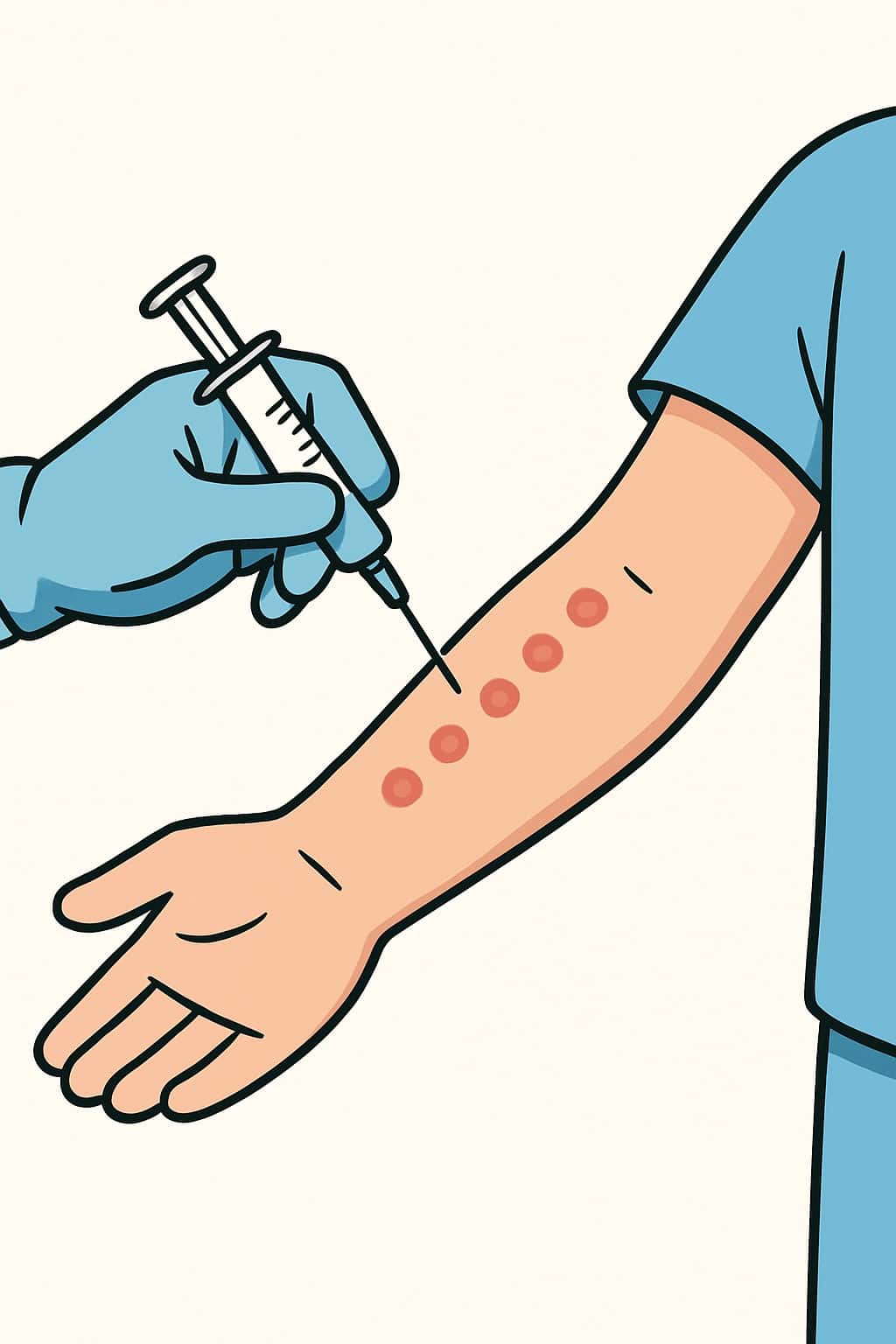
An intradermal allergy skin test checks for allergy to a specific drug or stinging insect venom.
Overview
An intradermal allergy skin test checks for allergy to a specific drug or stinging insect venom. A tiny amount of the suspected allergen is injected just under the skin, then the site is watched for a small raised, itchy bump. This test is often used when a skin prick test is negative or unclear, or when testing certain drugs or venoms where intradermal testing is standard. Results help the care team decide next steps, such as avoidance, graded drug challenge, or venom immunotherapy.
Also known as: Intradermal allergy test, Drug allergy skin test, Venom allergy skin test
Preparation & Next Steps
Everything you need to know before and after your procedure
Before Care
- Confirm with the clinic which medicines to pause before testing; some antihistamines and certain antidepressants can affect results.
- Share a list of all medicines and supplements, including eye drops and creams.
- Tell the staff about asthma, heart conditions, pregnancy, or past severe reactions.
- Avoid lotions, perfumes, or oils on forearms on the day of testing so the skin is clean and dry.
- Wear short sleeves or loose clothing so the forearm or upper arm is easy to access.
- Plan to stay for observation after the test in case symptoms occur.
- Bring a summary of the past reaction: what happened, timing, treatment, and records if available.
- Eat a light meal beforehand unless the clinic gives different instructions.
- Arrange transportation if feeling anxious about possible symptoms after testing.
After Care
- Expect mild redness or itching at the test site; a cool compress can be soothing.
- Avoid scratching the site to prevent irritation.
- Keep the marked test area dry and intact until the staff says the reading is complete.
- Note any delayed symptoms in the next 24 to 48 hours and report them to the clinic.
- Follow the written plan you receive about next steps, such as blood tests, challenge, or avoidance.
- Resume normal diet and activities unless the clinic advises otherwise.
- Save a copy of your results in your personal health records.
- Contact the clinic if you develop widespread hives, swelling away from the test site, trouble breathing, chest tightness, or dizziness.
Clinical Information
Important medical details about this procedure
Indications
- Suspected penicillin or other antibiotic allergy
- History of reaction to local anesthetics or perioperative medicines
- Evaluation of stinging insect venom allergy (bees, wasps, hornets, yellow jackets, fire ants)
- Clarifying an unclear past reaction before future treatment
- Confirming sensitization before starting venom immunotherapy
Alternatives
- Skin prick test
- Specific IgE blood test
- Graded drug challenge under supervision
- Drug desensitization when needed for treatment
- Observation and avoidance based on history
- Patch testing for delayed contact-type rashes when appropriate
Risks
- Temporary redness, swelling, or itching at the test site
- Small bruise or skin irritation
- False positive or false negative result
- Delayed local reaction hours after testing
- Rare whole-body reaction such as hives, wheezing, or anaphylaxis
- Very rare infection at the injection site
- Lightheadedness or fainting
Contraindications
- Extensive skin disease at the test site that prevents reading results
- Inability to pause medicines that strongly block skin test responses
- Unstable asthma or recent severe allergic reaction that has not stabilized
- Past severe reaction to skin testing without appropriate monitoring available
Recovery Timeline
What to expect during your recovery
Most people return to normal activities right after testing. Minor itching or redness at the site may last 1 to 2 days.
Typical Range
0–2 days
Return to Work
0–1 days
Recovery Milestones
Resume normal daily activities
Avoid scratching or heavy rubbing over the test area
Most redness and itching fade
Frequently Asked Questions
Common questions and expert answers about this procedure
What is an intradermal allergy skin test?
What is an intradermal allergy skin test?
It is a test where a tiny amount of a drug or insect venom is injected just under the skin to see if a small allergic bump forms.
How is this different from a skin prick test?
How is this different from a skin prick test?
A prick test puts allergen on the skin surface with a small poke. An intradermal test places a tiny amount under the skin and can be more sensitive for some drugs and venoms.
How long does the test take?
How long does the test take?
Most visits take 30 to 90 minutes, including check-in, testing, reading the result after about 15 to 20 minutes, and brief observation.
Will it hurt?
Will it hurt?
You may feel a quick pinprick and slight pressure. Mild itching can occur if the test is positive.
Can I take my medicines before the test?
Can I take my medicines before the test?
Some medicines, especially antihistamines, can affect results. The clinic will give timing guidance on which ones to pause and which to continue.
How accurate is the test?
How accurate is the test?
It is helpful but not perfect. Results are interpreted with your history and may be combined with blood tests or a supervised drug challenge.
Is there a risk of a severe reaction?
Is there a risk of a severe reaction?
Severe reactions are uncommon, but staff have emergency treatment available and observe you after testing as a safety step.
What happens after I get the result?
What happens after I get the result?
The team explains what the result means and discusses next steps, such as avoidance, further testing, graded challenge, or treatment like venom immunotherapy.
References
Medical literature and sources