%20--%3e%3csvg%20version='1.0'%20id='Layer_1'%20xmlns='http://www.w3.org/2000/svg'%20xmlns:xlink='http://www.w3.org/1999/xlink'%20x='0px'%20y='0px'%20viewBox='0%200%20755.52%20814.35'%20style='enable-background:new%200%200%20755.52%20814.35;'%20xml:space='preserve'%3e%3cstyle%20type='text/css'%3e%20.st0{fill:%231ae5ce;stroke:%231ae5ce;stroke-width:7;stroke-miterlimit:10;}%20.st1{fill:%23FFFFFF;stroke:%231ae5ce;stroke-width:7;stroke-miterlimit:10;}%20.st2{fill:%231ae5ce;stroke:%23FFFFFF;stroke-width:7;stroke-miterlimit:10;}%20.st3{fill:%23FFFFFF;stroke:%23FFFFFF;stroke-width:6;stroke-miterlimit:10;}%20%3c/style%3e%3cg%20id='Dark_Logo_00000159431215648494653180000015900878925932721032_'%3e%3cpath%20id='shield_00000152259091539869183100000001926543869452564382_'%20class='st0'%20d='M711.13,173.42%20c-3.37-49.07-38.92-44.9-75.96-52.18c-67.4-13.25-130.47-34.47-192.36-63.92c-22.48-10.7-41.88-25.74-65.05-26.28%20c-23.17,0.54-42.58,15.59-65.05,26.28c-61.89,29.45-124.95,50.68-192.36,63.92c-37.04,7.28-72.59,3.11-75.96,52.18%20c-1.55,22.6,0.34,46.4,1.05,68.92c5.99,190.78,52.91,345.39,206.27,466.46c29.71,23.46,74.51,55.8,108.84,70.75%20c5.99,2.61,11.7,3.73,17.21,3.75c5.51-0.02,11.22-1.14,17.21-3.75c34.33-14.95,79.12-47.3,108.84-70.75%20c153.37-121.07,200.28-275.68,206.27-466.46C710.79,219.82,712.68,196.02,711.13,173.42z'/%3e%3cpath%20id='magnifyingglass_00000073685934697636024790000000342567780940956808_'%20class='st1'%20d='M648.78,624.21l-96.64-104.65%20c34.89-40.63,55.98-93.46,55.98-151.21c0-128.27-103.98-232.24-232.24-232.24S143.63,240.08,143.63,368.35%20s103.98,232.24,232.24,232.24c48.87,0,94.21-15.11,131.62-40.89l97.18,105.24c11.25,12.18,30.24,12.93,42.42,1.69l0,0%20C659.27,655.38,660.03,636.39,648.78,624.21z'/%3e%3ccircle%20id='ellipse_00000129904010550392394720000017056154833629780114_'%20class='st2'%20cx='375.87'%20cy='368.35'%20r='181.21'/%3e%3cpath%20id='dollarsign_00000057140127156649725250000003772530148495155891_'%20class='st3'%20d='M362.91,492.03v-23.91%20c0-2.01-1.58-3.69-3.59-3.77c-18.49-0.78-37.12-5.4-49.4-11.83c-1.75-0.92-2.53-3.01-1.76-4.84l5.87-13.89%20c0.86-2.02,3.23-2.88,5.2-1.89c12.94,6.52,30.45,11.44,49.18,11.44c26.02,0,43.6-12.73,43.6-30.43c0-17.08-14.29-27.63-41.4-36.95%20c-37.37-12.42-60.46-26.7-60.46-53.72c0-24.97,20.29-44.11,52.22-49.51c1.8-0.31,3.11-1.89,3.11-3.72v-24.35%20c0-2.09,1.69-3.78,3.78-3.78h15.16c2.09,0,3.78,1.69,3.78,3.78v22.71c0,2.01,1.58,3.67,3.58,3.77c17.85,0.92,30.88,4.75,40.61,9.1%20c1.92,0.86,2.79,3.09,1.94,5.01l-6.08,13.6c-0.85,1.91-3.09,2.77-4.99,1.91c-8.37-3.8-22.38-8.95-42.75-8.95%20c-28.21,0-38.84,14.28-38.84,26.7c0,16.15,13.56,24.22,45.44,35.4c37.74,13.04,56.79,29.19,56.79,56.82%20c0,23.85-19.05,46.23-54.78,52.3c-1.8,0.31-3.11,1.89-3.11,3.72v25.28c0,2.09-1.69,3.78-3.78,3.78h-15.53%20C364.6,495.81,362.91,494.12,362.91,492.03z'/%3e%3c/g%3e%3c/svg%3e)
Arterial Doppler Ultrasound (Legs) Diagnostic Imaging
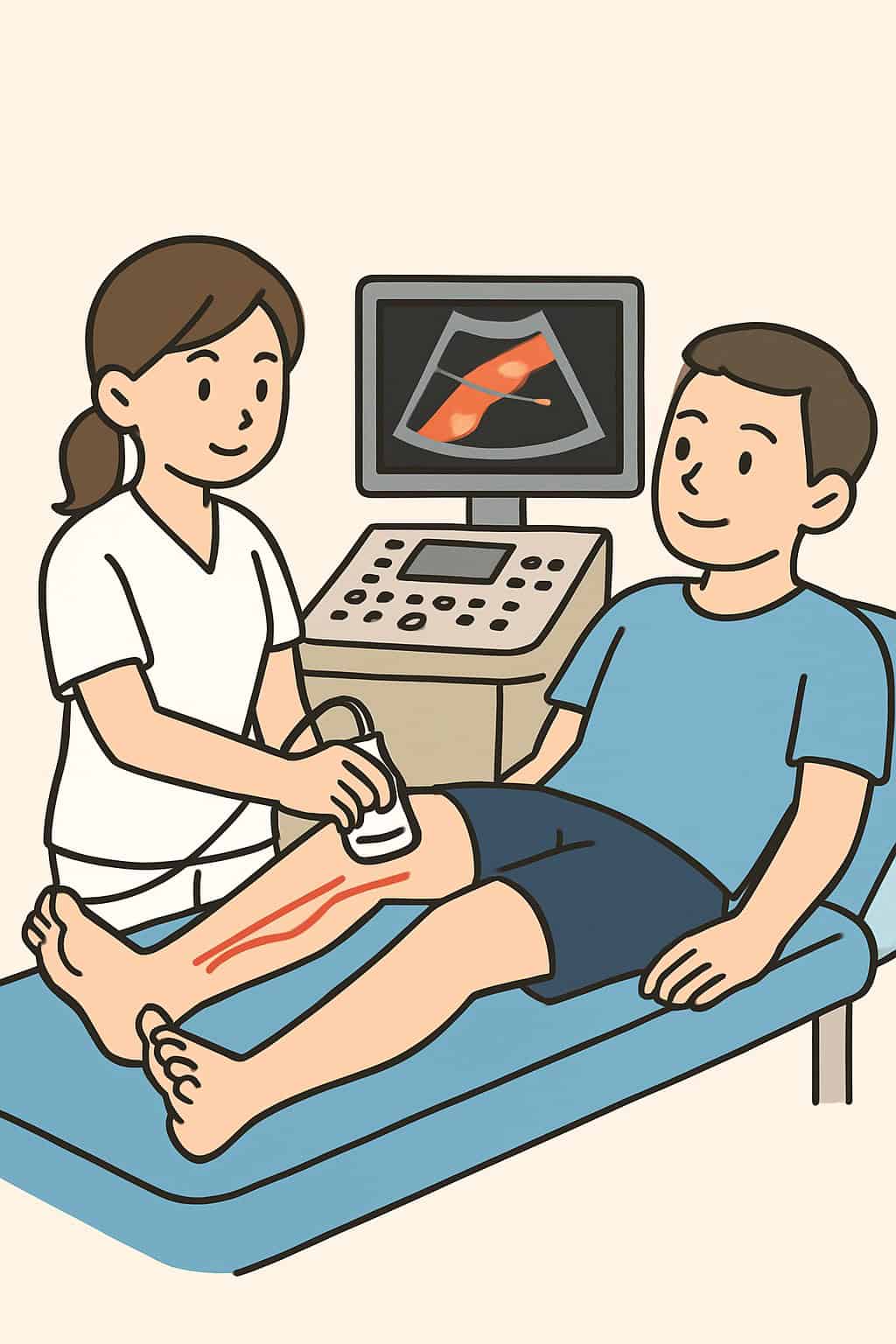
An arterial Doppler ultrasound of the legs is a noninvasive imaging test that uses sound waves to show blood flow in the leg arteries.
Overview
An arterial Doppler ultrasound of the legs is a noninvasive imaging test that uses sound waves to show blood flow in the leg arteries. The Doppler part measures the speed and direction of moving blood, which helps identify areas of narrowing or blockage. Clinicians use this test to evaluate symptoms of peripheral artery disease, check circulation to wounds, and monitor stents or bypass grafts. It does not use radiation and typically does not require needles or contrast dye.
Also known as: Lower extremity arterial duplex ultrasound, Peripheral arterial Doppler (legs), Leg arterial ultrasound, Arterial duplex of lower limbs
Preparation & Next Steps
Everything you need to know before and after your procedure
Before Care
- No fasting is usually needed for a leg arterial ultrasound
- Wear loose shorts or pants that can be rolled above the thighs
- Avoid lotions or oils on your legs the day of the test so cuffs and gel work well
- Bring a list of your medicines and any prior vascular procedures
- Carry copies of prior vascular studies or reports if available
- Plan for about 30–60 minutes; both legs or added measurements can take longer
- You may be asked to remove compression stockings before the exam
- If you use a cane, walker, or wheelchair, bring it for safe movement
- Arrive a bit early to confirm registration and contact information
After Care
- Wipe off any remaining ultrasound gel; it does not stain skin
- Resume normal activities, eating, and medicines unless your clinic says otherwise
- Temporary marks or redness from blood pressure cuffs usually fade quickly
- Ask the imaging center how and when results will be shared
- Keep tracking leg symptoms such as walking distance and pain pattern
- Store a copy of the report with your medical records when available
- If you notice worsening leg pain, color change, coldness, or new numbness, contact a clinician
- Schedule any recommended follow-up testing or appointments
Clinical Information
Important medical details about this procedure
Indications
- Leg pain with walking (claudication)
- Rest pain in the feet or toes
- Nonhealing foot or leg wounds
- Cool, pale, or bluish feet or toes
- Diminished or absent pulses in the feet
- Follow-up after arterial stent or bypass surgery
- Preoperative mapping of arteries for procedures
- Monitoring known peripheral artery disease
Alternatives
- Ankle-brachial index (ABI) and toe-brachial index (TBI)
- Segmental limb pressures and pulse volume recordings
- CT angiography (CTA) of the lower extremities
- MR angiography (MRA) of the lower extremities
- Catheter-based angiography
- Clinical exam and symptom monitoring
Risks
- No known risks from diagnostic ultrasound itself
- Temporary discomfort from probe pressure or blood pressure cuffs
- Skin irritation from ultrasound gel is rare
- Inconclusive images if there are dressings, wounds, or heavy calcification
- Results may lead to additional testing if unclear
Contraindications
- No widely recognized absolute contraindications for diagnostic ultrasound
- Limited exam if there are open wounds, casts, or bulky dressings
- Difficulty lying still or severe pain may limit image quality
Recovery Timeline
What to expect during your recovery
There is no medical recovery period after an arterial Doppler ultrasound of the legs. Most people return to normal activities right away.
Typical Range
Same day
Return to Work
Same day
Recovery Milestones
Resume normal daily activities
Temporary skin impressions from cuffs fade
Review results and any next steps with your care team
Frequently Asked Questions
Common questions and expert answers about this procedure
What does a leg arterial Doppler ultrasound show?
What does a leg arterial Doppler ultrasound show?
It shows how blood moves through the arteries in your legs and can identify areas of narrowing or blockage that may reduce circulation.
How long does the test take?
How long does the test take?
Most exams take 30–60 minutes. It can take longer if both legs are studied in detail or if additional measurements are included.
Does it use radiation or contrast dye?
Does it use radiation or contrast dye?
No. Ultrasound uses sound waves, not radiation, and typically does not use contrast dye.
Is the test painful?
Is the test painful?
It is generally painless. You may feel firm pressure from the probe or snug blood pressure cuffs during measurements.
Is this the same as a test for blood clots?
Is this the same as a test for blood clots?
No. An arterial Doppler evaluates arteries. A separate venous ultrasound is used to look for blood clots in the veins.
Do I need to fast or stop my medicines?
Do I need to fast or stop my medicines?
There is usually no special preparation. Follow any specific instructions from the imaging center.
Can stents or bypass grafts be checked with this test?
Can stents or bypass grafts be checked with this test?
Yes. Arterial duplex ultrasound is commonly used to monitor stents and bypass grafts in the legs.
What can affect how clear the images are?
What can affect how clear the images are?
Open wounds, heavy bandaging, severe artery calcification, or body habitus can limit the view. Sometimes other imaging tests are used to gather more detail.
References
Medical literature and sources