%20--%3e%3csvg%20version='1.0'%20id='Layer_1'%20xmlns='http://www.w3.org/2000/svg'%20xmlns:xlink='http://www.w3.org/1999/xlink'%20x='0px'%20y='0px'%20viewBox='0%200%20755.52%20814.35'%20style='enable-background:new%200%200%20755.52%20814.35;'%20xml:space='preserve'%3e%3cstyle%20type='text/css'%3e%20.st0{fill:%231ae5ce;stroke:%231ae5ce;stroke-width:7;stroke-miterlimit:10;}%20.st1{fill:%23FFFFFF;stroke:%231ae5ce;stroke-width:7;stroke-miterlimit:10;}%20.st2{fill:%231ae5ce;stroke:%23FFFFFF;stroke-width:7;stroke-miterlimit:10;}%20.st3{fill:%23FFFFFF;stroke:%23FFFFFF;stroke-width:6;stroke-miterlimit:10;}%20%3c/style%3e%3cg%20id='Dark_Logo_00000159431215648494653180000015900878925932721032_'%3e%3cpath%20id='shield_00000152259091539869183100000001926543869452564382_'%20class='st0'%20d='M711.13,173.42%20c-3.37-49.07-38.92-44.9-75.96-52.18c-67.4-13.25-130.47-34.47-192.36-63.92c-22.48-10.7-41.88-25.74-65.05-26.28%20c-23.17,0.54-42.58,15.59-65.05,26.28c-61.89,29.45-124.95,50.68-192.36,63.92c-37.04,7.28-72.59,3.11-75.96,52.18%20c-1.55,22.6,0.34,46.4,1.05,68.92c5.99,190.78,52.91,345.39,206.27,466.46c29.71,23.46,74.51,55.8,108.84,70.75%20c5.99,2.61,11.7,3.73,17.21,3.75c5.51-0.02,11.22-1.14,17.21-3.75c34.33-14.95,79.12-47.3,108.84-70.75%20c153.37-121.07,200.28-275.68,206.27-466.46C710.79,219.82,712.68,196.02,711.13,173.42z'/%3e%3cpath%20id='magnifyingglass_00000073685934697636024790000000342567780940956808_'%20class='st1'%20d='M648.78,624.21l-96.64-104.65%20c34.89-40.63,55.98-93.46,55.98-151.21c0-128.27-103.98-232.24-232.24-232.24S143.63,240.08,143.63,368.35%20s103.98,232.24,232.24,232.24c48.87,0,94.21-15.11,131.62-40.89l97.18,105.24c11.25,12.18,30.24,12.93,42.42,1.69l0,0%20C659.27,655.38,660.03,636.39,648.78,624.21z'/%3e%3ccircle%20id='ellipse_00000129904010550392394720000017056154833629780114_'%20class='st2'%20cx='375.87'%20cy='368.35'%20r='181.21'/%3e%3cpath%20id='dollarsign_00000057140127156649725250000003772530148495155891_'%20class='st3'%20d='M362.91,492.03v-23.91%20c0-2.01-1.58-3.69-3.59-3.77c-18.49-0.78-37.12-5.4-49.4-11.83c-1.75-0.92-2.53-3.01-1.76-4.84l5.87-13.89%20c0.86-2.02,3.23-2.88,5.2-1.89c12.94,6.52,30.45,11.44,49.18,11.44c26.02,0,43.6-12.73,43.6-30.43c0-17.08-14.29-27.63-41.4-36.95%20c-37.37-12.42-60.46-26.7-60.46-53.72c0-24.97,20.29-44.11,52.22-49.51c1.8-0.31,3.11-1.89,3.11-3.72v-24.35%20c0-2.09,1.69-3.78,3.78-3.78h15.16c2.09,0,3.78,1.69,3.78,3.78v22.71c0,2.01,1.58,3.67,3.58,3.77c17.85,0.92,30.88,4.75,40.61,9.1%20c1.92,0.86,2.79,3.09,1.94,5.01l-6.08,13.6c-0.85,1.91-3.09,2.77-4.99,1.91c-8.37-3.8-22.38-8.95-42.75-8.95%20c-28.21,0-38.84,14.28-38.84,26.7c0,16.15,13.56,24.22,45.44,35.4c37.74,13.04,56.79,29.19,56.79,56.82%20c0,23.85-19.05,46.23-54.78,52.3c-1.8,0.31-3.11,1.89-3.11,3.72v25.28c0,2.09-1.69,3.78-3.78,3.78h-15.53%20C364.6,495.81,362.91,494.12,362.91,492.03z'/%3e%3c/g%3e%3c/svg%3e)
Barium enema (lower GI contrast X-ray) Diagnostic Imaging
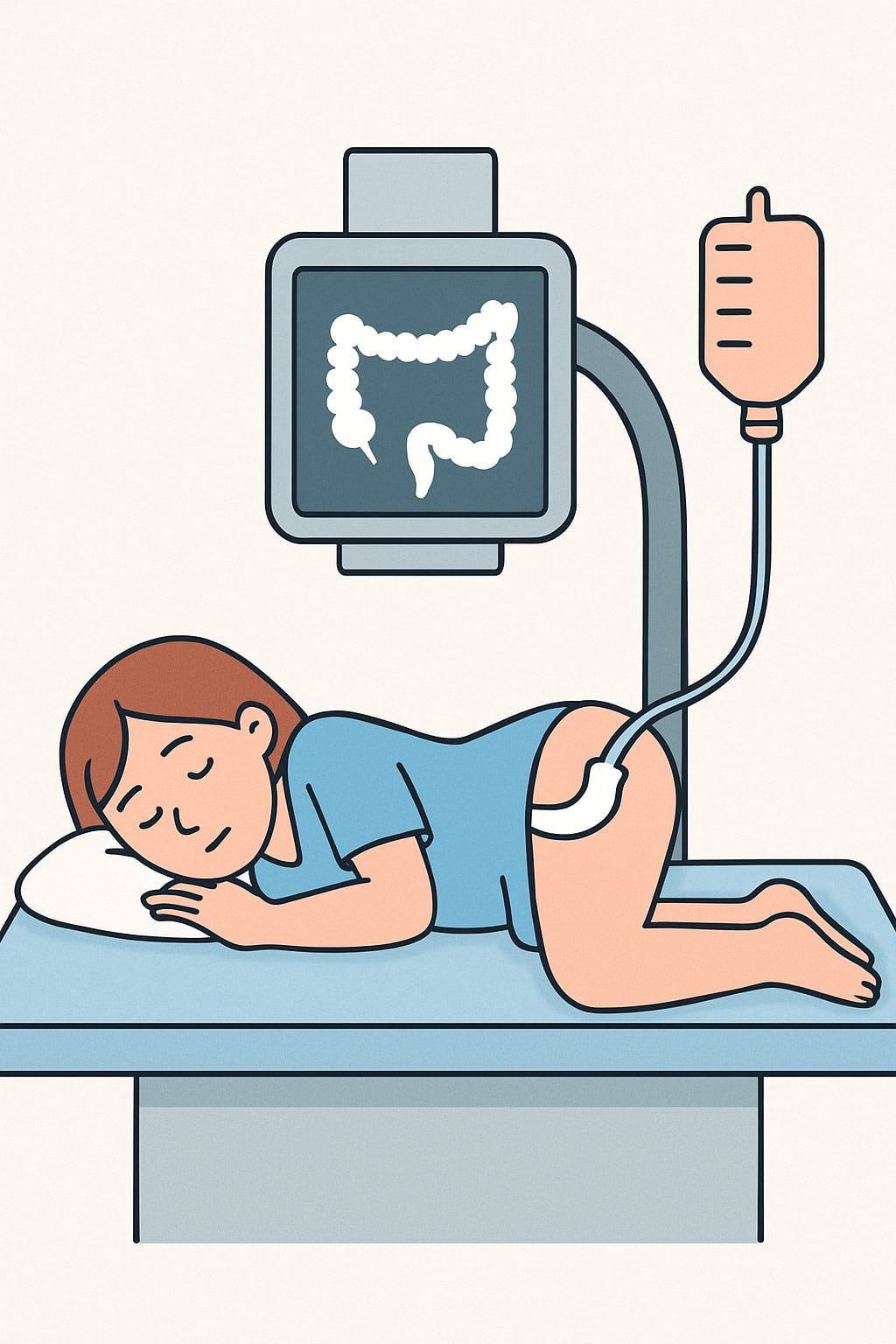
A barium enema is an imaging test that uses X-rays and a contrast liquid called barium sulfate to show the large intestine (colon and rectum).
Overview
A barium enema is an imaging test that uses X-rays and a contrast liquid called barium sulfate to show the large intestine (colon and rectum). The liquid coats the lining of the bowel so the outline shows up clearly on X-ray. In a double-contrast study, air is also added to improve detail. During the test, a small soft tip is placed in the rectum to gently fill the colon with barium while a radiologist uses fluoroscopy, which is a live X-ray video. You may be asked to change positions so the colon can be seen from different angles. The exam is usually done as an outpatient visit.
Also known as: Lower GI series, Lower GI X-ray, Barium enema X-ray, Double-contrast barium enema
Preparation & Next Steps
Everything you need to know before and after your procedure
Before Care
- Follow the bowel preparation instructions from the imaging center, which often include a clear liquid diet, laxatives, or enemas.
- Do not eat or drink for a set time before the test if instructed by the facility.
- Ask the imaging center about taking or adjusting routine medicines, especially diabetes medicines and blood thinners.
- Tell the staff about pregnancy, recent colon procedures, allergies (including latex), and past reactions to contrast or adhesives.
- Hydrate the day before as allowed by your prep plan to reduce the chance of constipation after the test.
- Wear comfortable clothing and leave jewelry and metal objects at home when possible.
- Bring a photo ID, insurance information, a referral or order, and a current medication list.
- Plan your schedule so you have bathroom access after the exam as the barium passes.
- Arrive early to review consent forms and confirm the prep you completed.
After Care
- Drink extra clear fluids over the next day unless you were told otherwise, to help flush the barium.
- Expect light-colored or white stools and more gas for a day or two.
- Resume normal eating as allowed; adding fiber-rich foods can help maintain regular bowel movements.
- Follow any instructions you received about using a gentle laxative if you become constipated.
- You can usually return to routine activities the same day once cramping eases.
- Protect clothing with a disposable pad for a few hours if minor leakage occurs.
- Monitor for concerning symptoms such as severe or worsening abdominal pain, fever, inability to pass gas or stool, or significant rectal bleeding, and contact a clinician.
- Review how and when you will receive results; reports are typically sent to your ordering clinician.
- Keep a short log of symptoms if you had the test for ongoing bowel issues to discuss at follow-up.
Clinical Information
Important medical details about this procedure
Indications
- Changes in bowel habits or unexplained abdominal pain
- Rectal bleeding or anemia workup
- Suspected blockage or narrowing of the colon
- Diverticular disease assessment
- Evaluation of inflammatory bowel disease anatomy
- Colon evaluation when colonoscopy is incomplete or unavailable
- Assessment for structural problems such as fistulas or large polyps
Alternatives
- Colonoscopy (with ability to biopsy or remove polyps)
- Flexible sigmoidoscopy
- CT colonography (virtual colonoscopy)
- Stool-based screening tests such as FIT or stool DNA tests
- Abdominal imaging for related concerns (CT or MRI) depending on the question
Risks
- Exposure to ionizing radiation
- Abdominal cramping, bloating, or discomfort during and after the test
- Constipation or hard stools from retained barium
- Rare bowel perforation
- Rare allergic or sensitivity reactions to latex or lubricants used with the enema tip
- Dehydration if fluid intake is low after the exam
Contraindications
- Known or suspected pregnancy
- Known or suspected bowel perforation
- Severe active colitis or toxic megacolon
- Immediately after certain colon procedures (recent biopsy or polyp removal) unless cleared by the clinician
Recovery Timeline
What to expect during your recovery
Most people resume normal activities the same day. Mild cramping, gas, or pale stools can last 1 to 2 days as the barium passes.
Typical Range
0–2 days
Return to Work
0–1 days
Recovery Milestones
Resume light daily activities once you leave the imaging center
Increase fluid intake to help clear barium and reduce constipation
Expect white or light stools and extra gas
Check your portal or with your clinician for the radiology report timing
Frequently Asked Questions
Common questions and expert answers about this procedure
What is a barium enema?
What is a barium enema?
It is an X-ray exam of the colon and rectum. A liquid contrast called barium coats the bowel so its shape and lining show clearly during fluoroscopy, a live X-ray video.
How long does the test take?
How long does the test take?
The imaging part usually takes 30 to 60 minutes. You may spend extra time before and after for preparation and to use the restroom.
Will it be uncomfortable?
Will it be uncomfortable?
You may feel fullness, cramping, or pressure as the colon is filled. Changing positions and slow filling help reduce discomfort, and the feelings typically pass soon after.
Can I eat or drink before the exam?
Can I eat or drink before the exam?
Most centers require a bowel prep and may limit food or drinks beforehand. Follow the written instructions from your imaging center.
Is there radiation exposure?
Is there radiation exposure?
Yes. The test uses X-rays and fluoroscopy. The dose is kept as low as reasonably achievable while still getting diagnostic images.
What will I notice after the test?
What will I notice after the test?
You may have more gas, mild cramps, and white or light-colored stools for 1 to 2 days. Drinking fluids helps the barium pass.
When will I get results?
When will I get results?
A radiologist reviews the images and sends a report to the ordering clinician. Many reports are available within 1 to 2 business days, but timing varies.
Can this test find cancer?
Can this test find cancer?
It can show narrowing, masses, or other changes in the colon. If a concern is seen, colonoscopy is usually used for biopsy or removal.
References
Medical literature and sources