%20--%3e%3csvg%20version='1.0'%20id='Layer_1'%20xmlns='http://www.w3.org/2000/svg'%20xmlns:xlink='http://www.w3.org/1999/xlink'%20x='0px'%20y='0px'%20viewBox='0%200%20755.52%20814.35'%20style='enable-background:new%200%200%20755.52%20814.35;'%20xml:space='preserve'%3e%3cstyle%20type='text/css'%3e%20.st0{fill:%231ae5ce;stroke:%231ae5ce;stroke-width:7;stroke-miterlimit:10;}%20.st1{fill:%23FFFFFF;stroke:%231ae5ce;stroke-width:7;stroke-miterlimit:10;}%20.st2{fill:%231ae5ce;stroke:%23FFFFFF;stroke-width:7;stroke-miterlimit:10;}%20.st3{fill:%23FFFFFF;stroke:%23FFFFFF;stroke-width:6;stroke-miterlimit:10;}%20%3c/style%3e%3cg%20id='Dark_Logo_00000159431215648494653180000015900878925932721032_'%3e%3cpath%20id='shield_00000152259091539869183100000001926543869452564382_'%20class='st0'%20d='M711.13,173.42%20c-3.37-49.07-38.92-44.9-75.96-52.18c-67.4-13.25-130.47-34.47-192.36-63.92c-22.48-10.7-41.88-25.74-65.05-26.28%20c-23.17,0.54-42.58,15.59-65.05,26.28c-61.89,29.45-124.95,50.68-192.36,63.92c-37.04,7.28-72.59,3.11-75.96,52.18%20c-1.55,22.6,0.34,46.4,1.05,68.92c5.99,190.78,52.91,345.39,206.27,466.46c29.71,23.46,74.51,55.8,108.84,70.75%20c5.99,2.61,11.7,3.73,17.21,3.75c5.51-0.02,11.22-1.14,17.21-3.75c34.33-14.95,79.12-47.3,108.84-70.75%20c153.37-121.07,200.28-275.68,206.27-466.46C710.79,219.82,712.68,196.02,711.13,173.42z'/%3e%3cpath%20id='magnifyingglass_00000073685934697636024790000000342567780940956808_'%20class='st1'%20d='M648.78,624.21l-96.64-104.65%20c34.89-40.63,55.98-93.46,55.98-151.21c0-128.27-103.98-232.24-232.24-232.24S143.63,240.08,143.63,368.35%20s103.98,232.24,232.24,232.24c48.87,0,94.21-15.11,131.62-40.89l97.18,105.24c11.25,12.18,30.24,12.93,42.42,1.69l0,0%20C659.27,655.38,660.03,636.39,648.78,624.21z'/%3e%3ccircle%20id='ellipse_00000129904010550392394720000017056154833629780114_'%20class='st2'%20cx='375.87'%20cy='368.35'%20r='181.21'/%3e%3cpath%20id='dollarsign_00000057140127156649725250000003772530148495155891_'%20class='st3'%20d='M362.91,492.03v-23.91%20c0-2.01-1.58-3.69-3.59-3.77c-18.49-0.78-37.12-5.4-49.4-11.83c-1.75-0.92-2.53-3.01-1.76-4.84l5.87-13.89%20c0.86-2.02,3.23-2.88,5.2-1.89c12.94,6.52,30.45,11.44,49.18,11.44c26.02,0,43.6-12.73,43.6-30.43c0-17.08-14.29-27.63-41.4-36.95%20c-37.37-12.42-60.46-26.7-60.46-53.72c0-24.97,20.29-44.11,52.22-49.51c1.8-0.31,3.11-1.89,3.11-3.72v-24.35%20c0-2.09,1.69-3.78,3.78-3.78h15.16c2.09,0,3.78,1.69,3.78,3.78v22.71c0,2.01,1.58,3.67,3.58,3.77c17.85,0.92,30.88,4.75,40.61,9.1%20c1.92,0.86,2.79,3.09,1.94,5.01l-6.08,13.6c-0.85,1.91-3.09,2.77-4.99,1.91c-8.37-3.8-22.38-8.95-42.75-8.95%20c-28.21,0-38.84,14.28-38.84,26.7c0,16.15,13.56,24.22,45.44,35.4c37.74,13.04,56.79,29.19,56.79,56.82%20c0,23.85-19.05,46.23-54.78,52.3c-1.8,0.31-3.11,1.89-3.11,3.72v25.28c0,2.09-1.69,3.78-3.78,3.78h-15.53%20C364.6,495.81,362.91,494.12,362.91,492.03z'/%3e%3c/g%3e%3c/svg%3e)
Cardiac MRI Diagnostic Imaging
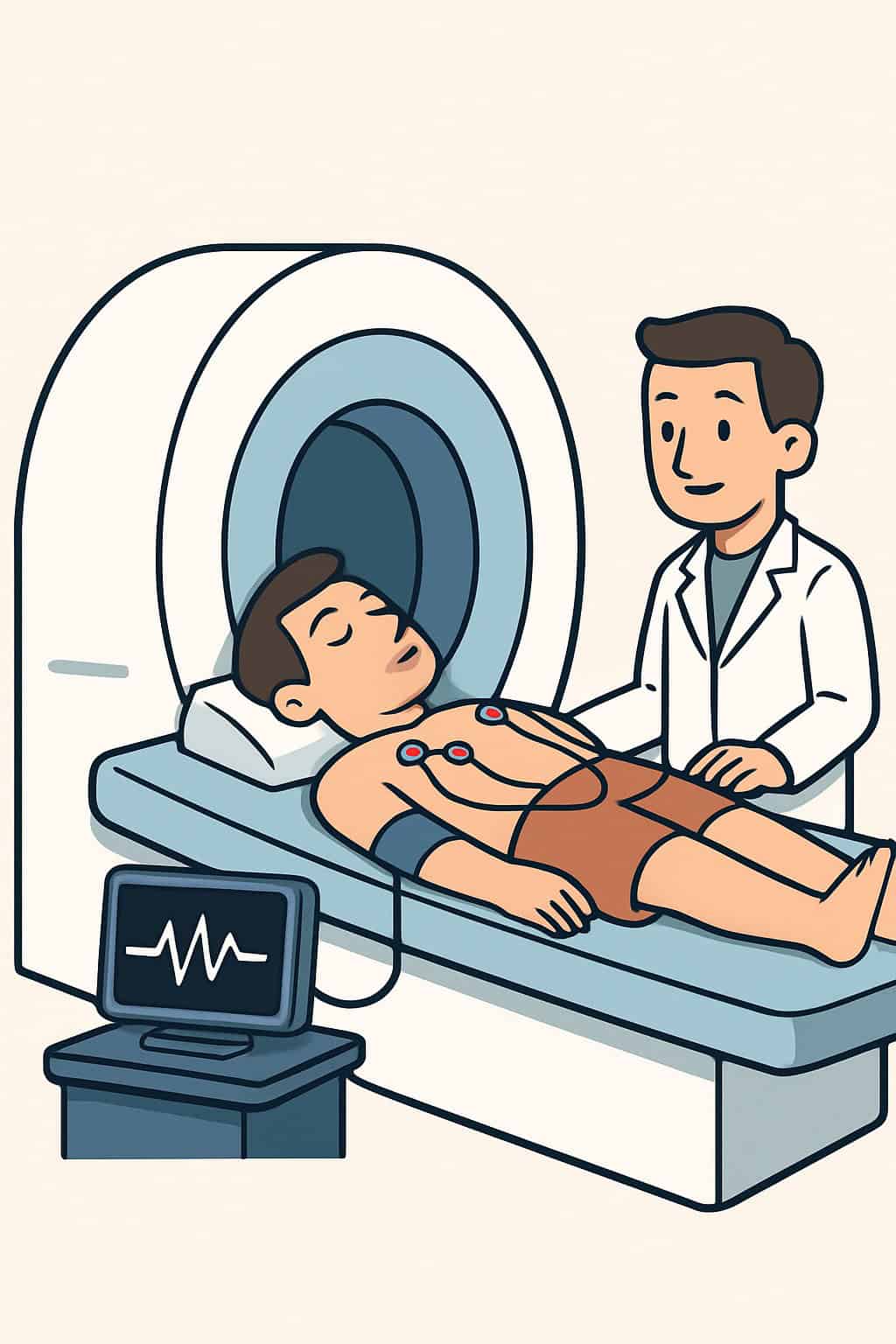
Cardiac MRI is an imaging test that uses a strong magnet and radio waves to make detailed pictures of the heart and blood vessels.
Overview
Cardiac MRI is an imaging test that uses a strong magnet and radio waves to make detailed pictures of the heart and blood vessels. It does not use ionizing radiation. The scan shows heart structure, pumping function, blood flow, scarring, and inflammation. Clinicians use cardiac MRI to help diagnose many heart problems and to plan treatment. It can show how well the heart muscle works, whether there is damage from a heart attack, and if parts of the heart have poor blood flow or inflammation.
Also known as: Heart MRI, Cardiac MR, Cardiac magnetic resonance imaging, CMR
Preparation & Next Steps
Everything you need to know before and after your procedure
Before Care
- Complete the MRI safety screening and list all implants, prior surgeries, and any metal exposures
- Bring any implant or device card for a pacemaker, defibrillator, neurostimulator, or other hardware
- Remove jewelry, watches, piercings, and wear clothing without metal zippers or snaps
- Follow the facility’s instructions about eating, drinking, and medicines; some exams or sedatives require fasting
- If contrast is planned, a recent kidney function lab may be requested
- Tell the staff about any prior reactions to contrast agents and all allergies
- Plan for 60 to 90 minutes at the imaging center; scan time varies by protocol
- Arrange a ride if sedation is planned or if you are prone to significant claustrophobia
- Let the team know if you are pregnant or might be pregnant before the scan
- Bring a photo ID, insurance card, and arrive a bit early for check-in
After Care
- Most people resume normal activities right away
- If you received gadolinium contrast, drinking fluids can help your body clear it
- The IV site may be tender; keep the bandage on for several hours and monitor for redness or swelling
- If you received sedation, follow the facility’s guidance about rest and transportation
- If an implant was placed in MRI mode, trained staff typically check and return it to usual settings after the scan
- Temporary effects from stress medicines, such as flushing or headache, usually pass quickly
- Contact a clinician if you notice a rash, trouble breathing, or worsening pain or swelling at the IV site
- Results are often available from the ordering clinician or patient portal within a few days
Clinical Information
Important medical details about this procedure
Indications
- Evaluate heart muscle function and size
- Assess damage or scarring after a heart attack
- Suspected myocarditis or cardiomyopathy
- Measure heart valve function and blood flow
- Check congenital heart disease
- Look for pericardial disease
- Evaluate cardiac tumors or masses
- Assess heart viability before procedures
Alternatives
- Transthoracic echocardiogram
- Transesophageal echocardiogram
- Cardiac CT or coronary CT angiography
- Nuclear stress test such as SPECT or PET
- Stress echocardiogram
- Invasive coronary angiography
Risks
- Noise, tight space, or discomfort from lying still
- Problems with some metal implants or fragments
- Allergic or infusion reactions to gadolinium contrast, which are uncommon
- Very rare kidney-related complications with certain gadolinium agents in severe kidney disease
- Short-lived side effects from stress medicines, such as flushing or headache
- IV placement bruising or soreness
Contraindications
- Non MRI-conditional implants or foreign bodies, such as some older pacemakers or certain aneurysm clips
- Retained metal in the eye
- Severe kidney impairment for specific gadolinium contrast agents
- History of severe reaction to gadolinium contrast
- Inability to lie flat or remain still despite support
Recovery Timeline
What to expect during your recovery
There is no medical recovery time for a standard cardiac MRI. Most people return to normal activities the same day. If sedation was used, effects usually wear off within 24 hours.
Typical Range
Same day
Return to Work
Same day
Recovery Milestones
Resume normal daily activities
Sedation effects typically resolve; avoid high-focus tasks until fully alert
Receive imaging report and plan any follow-up with the ordering clinician
Frequently Asked Questions
Common questions and expert answers about this procedure
What does a cardiac MRI show?
What does a cardiac MRI show?
It shows heart structure, pumping function, blood flow, scarring from prior injury, inflammation, and some valve and congenital issues.
How long does a cardiac MRI take?
How long does a cardiac MRI take?
Most exams take 30 to 90 minutes. Stress testing or many image sequences can add time.
Will I get contrast dye?
Will I get contrast dye?
Many cardiac MRI studies use gadolinium contrast to highlight blood flow and scar. Some questions can be answered without contrast.
Is MRI safe if I have a pacemaker or other implant?
Is MRI safe if I have a pacemaker or other implant?
Many modern implants are labeled MRI conditional. Safety screening, device checks, and facility protocols are needed. Some older devices are not MRI safe.
What if I am claustrophobic?
What if I am claustrophobic?
Options can include music, a mirror or periscope, breathing techniques, an open or wide-bore scanner, or light sedation set up in advance.
Do I have to exercise for a stress cardiac MRI?
Do I have to exercise for a stress cardiac MRI?
No. Stress MRI typically uses medicines that increase blood flow or heart rate while images are taken.
Are there risks from gadolinium contrast?
Are there risks from gadolinium contrast?
Allergic reactions are uncommon. People with severe kidney problems have a small risk of a rare condition with certain agents. Screening lowers this risk.
When will I get results?
When will I get results?
A radiologist analyzes the images and sends a report to your clinician. Many centers share results within 1 to 3 days.
References
Medical literature and sources