%20--%3e%3csvg%20version='1.0'%20id='Layer_1'%20xmlns='http://www.w3.org/2000/svg'%20xmlns:xlink='http://www.w3.org/1999/xlink'%20x='0px'%20y='0px'%20viewBox='0%200%20755.52%20814.35'%20style='enable-background:new%200%200%20755.52%20814.35;'%20xml:space='preserve'%3e%3cstyle%20type='text/css'%3e%20.st0{fill:%231ae5ce;stroke:%231ae5ce;stroke-width:7;stroke-miterlimit:10;}%20.st1{fill:%23FFFFFF;stroke:%231ae5ce;stroke-width:7;stroke-miterlimit:10;}%20.st2{fill:%231ae5ce;stroke:%23FFFFFF;stroke-width:7;stroke-miterlimit:10;}%20.st3{fill:%23FFFFFF;stroke:%23FFFFFF;stroke-width:6;stroke-miterlimit:10;}%20%3c/style%3e%3cg%20id='Dark_Logo_00000159431215648494653180000015900878925932721032_'%3e%3cpath%20id='shield_00000152259091539869183100000001926543869452564382_'%20class='st0'%20d='M711.13,173.42%20c-3.37-49.07-38.92-44.9-75.96-52.18c-67.4-13.25-130.47-34.47-192.36-63.92c-22.48-10.7-41.88-25.74-65.05-26.28%20c-23.17,0.54-42.58,15.59-65.05,26.28c-61.89,29.45-124.95,50.68-192.36,63.92c-37.04,7.28-72.59,3.11-75.96,52.18%20c-1.55,22.6,0.34,46.4,1.05,68.92c5.99,190.78,52.91,345.39,206.27,466.46c29.71,23.46,74.51,55.8,108.84,70.75%20c5.99,2.61,11.7,3.73,17.21,3.75c5.51-0.02,11.22-1.14,17.21-3.75c34.33-14.95,79.12-47.3,108.84-70.75%20c153.37-121.07,200.28-275.68,206.27-466.46C710.79,219.82,712.68,196.02,711.13,173.42z'/%3e%3cpath%20id='magnifyingglass_00000073685934697636024790000000342567780940956808_'%20class='st1'%20d='M648.78,624.21l-96.64-104.65%20c34.89-40.63,55.98-93.46,55.98-151.21c0-128.27-103.98-232.24-232.24-232.24S143.63,240.08,143.63,368.35%20s103.98,232.24,232.24,232.24c48.87,0,94.21-15.11,131.62-40.89l97.18,105.24c11.25,12.18,30.24,12.93,42.42,1.69l0,0%20C659.27,655.38,660.03,636.39,648.78,624.21z'/%3e%3ccircle%20id='ellipse_00000129904010550392394720000017056154833629780114_'%20class='st2'%20cx='375.87'%20cy='368.35'%20r='181.21'/%3e%3cpath%20id='dollarsign_00000057140127156649725250000003772530148495155891_'%20class='st3'%20d='M362.91,492.03v-23.91%20c0-2.01-1.58-3.69-3.59-3.77c-18.49-0.78-37.12-5.4-49.4-11.83c-1.75-0.92-2.53-3.01-1.76-4.84l5.87-13.89%20c0.86-2.02,3.23-2.88,5.2-1.89c12.94,6.52,30.45,11.44,49.18,11.44c26.02,0,43.6-12.73,43.6-30.43c0-17.08-14.29-27.63-41.4-36.95%20c-37.37-12.42-60.46-26.7-60.46-53.72c0-24.97,20.29-44.11,52.22-49.51c1.8-0.31,3.11-1.89,3.11-3.72v-24.35%20c0-2.09,1.69-3.78,3.78-3.78h15.16c2.09,0,3.78,1.69,3.78,3.78v22.71c0,2.01,1.58,3.67,3.58,3.77c17.85,0.92,30.88,4.75,40.61,9.1%20c1.92,0.86,2.79,3.09,1.94,5.01l-6.08,13.6c-0.85,1.91-3.09,2.77-4.99,1.91c-8.37-3.8-22.38-8.95-42.75-8.95%20c-28.21,0-38.84,14.28-38.84,26.7c0,16.15,13.56,24.22,45.44,35.4c37.74,13.04,56.79,29.19,56.79,56.82%20c0,23.85-19.05,46.23-54.78,52.3c-1.8,0.31-3.11,1.89-3.11,3.72v25.28c0,2.09-1.69,3.78-3.78,3.78h-15.53%20C364.6,495.81,362.91,494.12,362.91,492.03z'/%3e%3c/g%3e%3c/svg%3e)
Carotid artery duplex ultrasound Diagnostic Imaging
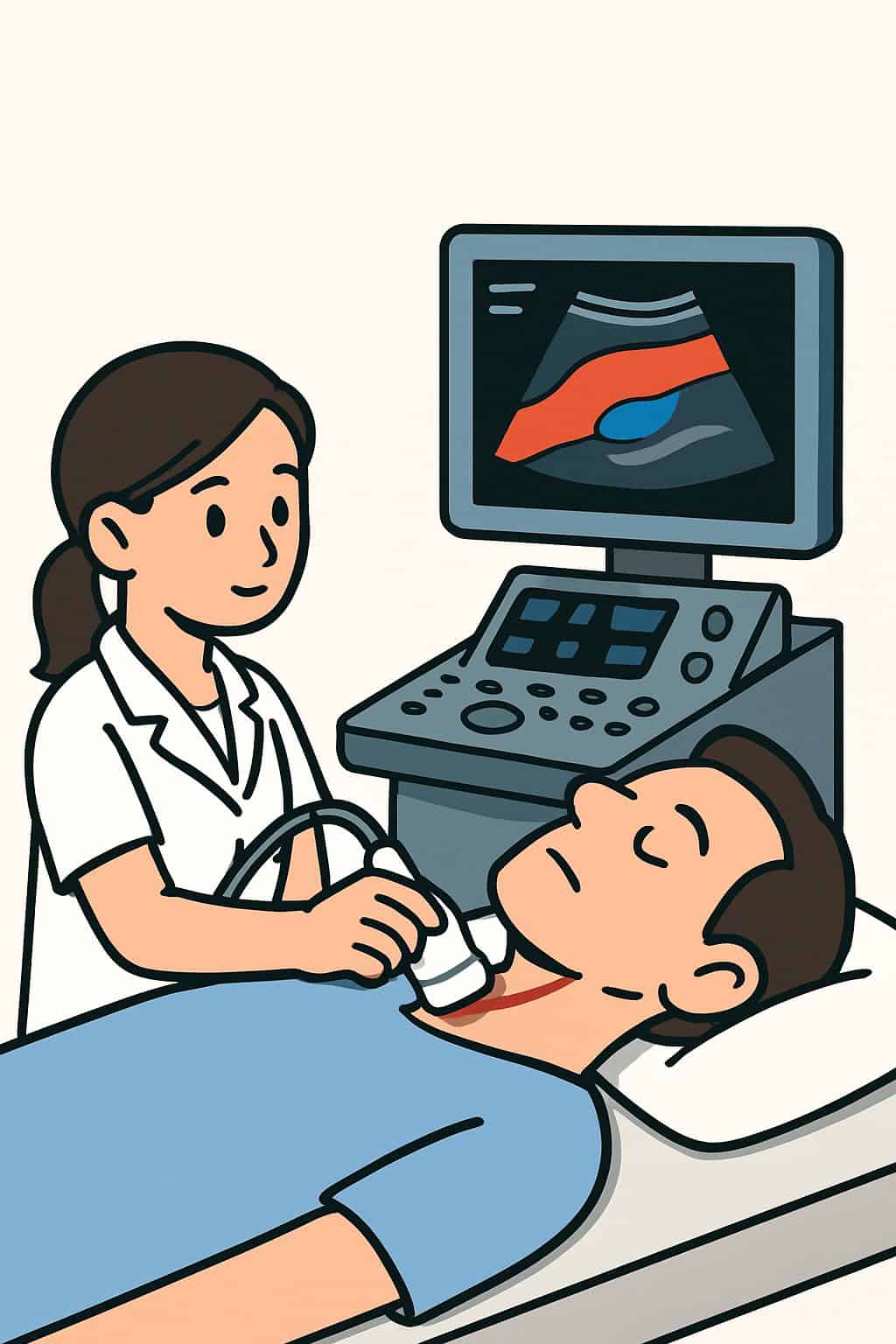
A carotid artery duplex ultrasound is a painless imaging test that uses sound waves to show the carotid arteries in your neck and how blood flows through them.
Overview
A carotid artery duplex ultrasound is a painless imaging test that uses sound waves to show the carotid arteries in your neck and how blood flows through them. Duplex means it combines standard ultrasound images with Doppler, which measures the speed and direction of blood flow. Clinicians use this test to look for plaque buildup and narrowing that may raise the risk of stroke. It is also used to check blood flow after carotid surgery or stenting and to monitor known carotid disease over time.
Also known as: Carotid ultrasound, Carotid duplex scan, Carotid Doppler
Preparation & Next Steps
Everything you need to know before and after your procedure
Before Care
- Wear a loose shirt with an open collar and avoid necklaces or tight turtlenecks.
- Bring a list of your medicines, including blood thinners and supplements.
- Bring prior carotid imaging reports or dates of past tests if available.
- If you had carotid surgery or a stent, bring the procedure date and facility name.
- Arrive a little early to confirm registration and insurance details.
- Ask the imaging center if they prefer you to avoid nicotine or caffeine for a few hours before the test.
- Plan for about 30 to 60 minutes on site, including check-in and scanning time.
- Confirm if a referral or authorization is needed by your insurance plan.
- Tell the staff about any neck pain, limited neck motion, or recent injuries.
After Care
- You can wipe off the gel and return to normal activities right away.
- Confirm how and when you will receive results, such as through a portal or a follow-up call.
- Keep your next appointment if ongoing monitoring was discussed.
- Store your report in your personal health records for future comparison.
- Continue taking your usual medicines as prescribed by your clinician.
- If you were asked to track blood pressure or cholesterol, keep a simple log.
- Contact the ordering clinician with questions about the report wording or next steps.
- Report any new or worsening neurologic symptoms such as sudden face droop, arm weakness, trouble speaking, or vision loss to a clinician promptly.
- Ask about lifestyle and risk factor management if plaque or narrowing was found.
Clinical Information
Important medical details about this procedure
Indications
- Evaluation after symptoms of transient ischemic attack or stroke
- A whooshing sound in the neck called a carotid bruit
- Follow-up of known carotid artery narrowing or plaque
- Preoperative screening before certain heart or vascular surgeries
- Monitoring after carotid endarterectomy or stent placement
- Assessment in people with risk factors like atherosclerosis, diabetes, or smoking
Alternatives
- CT angiography of the neck
- MR angiography of the neck
- Catheter-based carotid angiography
- Medical management of risk factors without immediate imaging
- Physical exam and risk assessment when imaging is not available
Risks
- Mild pressure or discomfort from the probe on the neck
- Skin irritation from the gel is rare
- Incidental findings that may lead to more tests
- False positives or false negatives that may affect decisions
Contraindications
- No absolute contraindications for standard ultrasound
- Open wounds, fresh surgical sites, or dressings over the neck area
- Inability to lie still or follow instructions during the scan
Recovery Timeline
What to expect during your recovery
There is no medical recovery period for a standard carotid ultrasound. Most people resume normal activities immediately after the scan.
Typical Range
Same day
Return to Work
Same day
Recovery Milestones
Resume normal daily activities and driving if you feel well
Review results in your portal or by phone when available
Discuss results and follow-up plan with the ordering clinician
Frequently Asked Questions
Common questions and expert answers about this procedure
What does a carotid duplex ultrasound show?
What does a carotid duplex ultrasound show?
It shows the carotid artery walls, plaque, and how fast blood flows. This helps estimate any narrowing that could raise stroke risk.
How long does the test take?
How long does the test take?
The scan itself often takes 15 to 30 minutes. With check-in and setup, plan for about 30 to 60 minutes total.
Does it use radiation or contrast dye?
Does it use radiation or contrast dye?
No. It uses sound waves, not X-rays. Contrast is not used in a standard carotid ultrasound.
Is the test painful?
Is the test painful?
Most people feel only mild pressure from the probe and cool gel on the skin. Discomfort is usually brief.
How accurate is carotid ultrasound?
How accurate is carotid ultrasound?
It is widely used to screen for and monitor carotid disease. Like any test, it can have limits, and results are sometimes confirmed with CTA, MRA, or angiography.
Will I need repeat scans?
Will I need repeat scans?
Repeat timing depends on your results and overall risk. Some people with known narrowing are monitored at intervals to watch for changes.
What do the results mean?
What do the results mean?
Reports often describe percent narrowing ranges and plaque features. Your clinician considers these findings along with your symptoms and risk factors.
Can it be done if I have a carotid stent or had surgery?
Can it be done if I have a carotid stent or had surgery?
Yes. Ultrasound is commonly used to check blood flow after a stent or endarterectomy.
References
Medical literature and sources