%20--%3e%3csvg%20version='1.0'%20id='Layer_1'%20xmlns='http://www.w3.org/2000/svg'%20xmlns:xlink='http://www.w3.org/1999/xlink'%20x='0px'%20y='0px'%20viewBox='0%200%20755.52%20814.35'%20style='enable-background:new%200%200%20755.52%20814.35;'%20xml:space='preserve'%3e%3cstyle%20type='text/css'%3e%20.st0{fill:%231ae5ce;stroke:%231ae5ce;stroke-width:7;stroke-miterlimit:10;}%20.st1{fill:%23FFFFFF;stroke:%231ae5ce;stroke-width:7;stroke-miterlimit:10;}%20.st2{fill:%231ae5ce;stroke:%23FFFFFF;stroke-width:7;stroke-miterlimit:10;}%20.st3{fill:%23FFFFFF;stroke:%23FFFFFF;stroke-width:6;stroke-miterlimit:10;}%20%3c/style%3e%3cg%20id='Dark_Logo_00000159431215648494653180000015900878925932721032_'%3e%3cpath%20id='shield_00000152259091539869183100000001926543869452564382_'%20class='st0'%20d='M711.13,173.42%20c-3.37-49.07-38.92-44.9-75.96-52.18c-67.4-13.25-130.47-34.47-192.36-63.92c-22.48-10.7-41.88-25.74-65.05-26.28%20c-23.17,0.54-42.58,15.59-65.05,26.28c-61.89,29.45-124.95,50.68-192.36,63.92c-37.04,7.28-72.59,3.11-75.96,52.18%20c-1.55,22.6,0.34,46.4,1.05,68.92c5.99,190.78,52.91,345.39,206.27,466.46c29.71,23.46,74.51,55.8,108.84,70.75%20c5.99,2.61,11.7,3.73,17.21,3.75c5.51-0.02,11.22-1.14,17.21-3.75c34.33-14.95,79.12-47.3,108.84-70.75%20c153.37-121.07,200.28-275.68,206.27-466.46C710.79,219.82,712.68,196.02,711.13,173.42z'/%3e%3cpath%20id='magnifyingglass_00000073685934697636024790000000342567780940956808_'%20class='st1'%20d='M648.78,624.21l-96.64-104.65%20c34.89-40.63,55.98-93.46,55.98-151.21c0-128.27-103.98-232.24-232.24-232.24S143.63,240.08,143.63,368.35%20s103.98,232.24,232.24,232.24c48.87,0,94.21-15.11,131.62-40.89l97.18,105.24c11.25,12.18,30.24,12.93,42.42,1.69l0,0%20C659.27,655.38,660.03,636.39,648.78,624.21z'/%3e%3ccircle%20id='ellipse_00000129904010550392394720000017056154833629780114_'%20class='st2'%20cx='375.87'%20cy='368.35'%20r='181.21'/%3e%3cpath%20id='dollarsign_00000057140127156649725250000003772530148495155891_'%20class='st3'%20d='M362.91,492.03v-23.91%20c0-2.01-1.58-3.69-3.59-3.77c-18.49-0.78-37.12-5.4-49.4-11.83c-1.75-0.92-2.53-3.01-1.76-4.84l5.87-13.89%20c0.86-2.02,3.23-2.88,5.2-1.89c12.94,6.52,30.45,11.44,49.18,11.44c26.02,0,43.6-12.73,43.6-30.43c0-17.08-14.29-27.63-41.4-36.95%20c-37.37-12.42-60.46-26.7-60.46-53.72c0-24.97,20.29-44.11,52.22-49.51c1.8-0.31,3.11-1.89,3.11-3.72v-24.35%20c0-2.09,1.69-3.78,3.78-3.78h15.16c2.09,0,3.78,1.69,3.78,3.78v22.71c0,2.01,1.58,3.67,3.58,3.77c17.85,0.92,30.88,4.75,40.61,9.1%20c1.92,0.86,2.79,3.09,1.94,5.01l-6.08,13.6c-0.85,1.91-3.09,2.77-4.99,1.91c-8.37-3.8-22.38-8.95-42.75-8.95%20c-28.21,0-38.84,14.28-38.84,26.7c0,16.15,13.56,24.22,45.44,35.4c37.74,13.04,56.79,29.19,56.79,56.82%20c0,23.85-19.05,46.23-54.78,52.3c-1.8,0.31-3.11,1.89-3.11,3.72v25.28c0,2.09-1.69,3.78-3.78,3.78h-15.53%20C364.6,495.81,362.91,494.12,362.91,492.03z'/%3e%3c/g%3e%3c/svg%3e)
Carotid Duplex Ultrasound Diagnostic Imaging
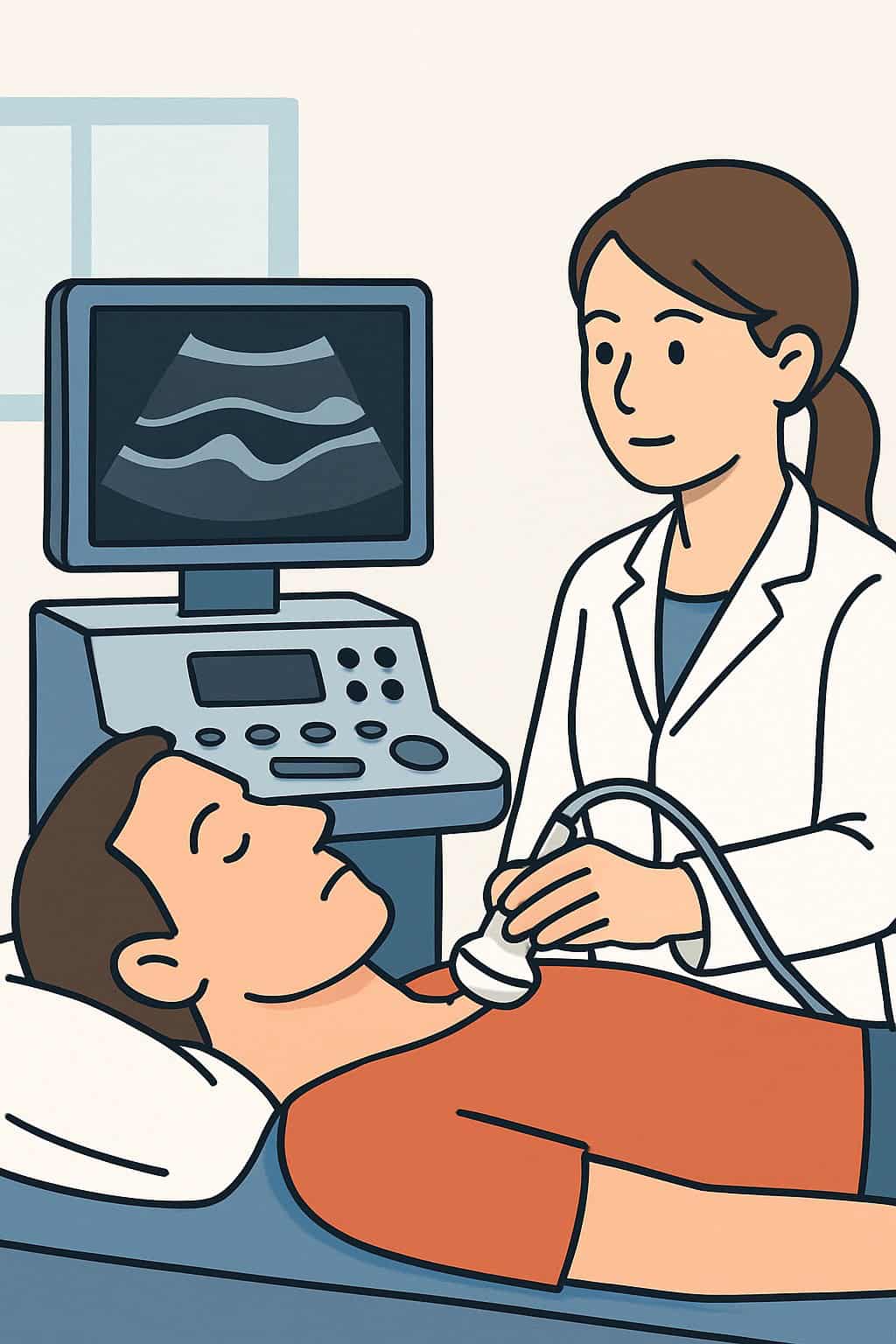
A carotid duplex ultrasound is a noninvasive test that uses sound waves to create pictures of the carotid arteries in the neck and measure how blood flows through them.
Overview
A carotid duplex ultrasound is a noninvasive test that uses sound waves to create pictures of the carotid arteries in the neck and measure how blood flows through them. It combines standard ultrasound imaging with Doppler, which shows the speed and direction of blood flow. Clinicians use it to look for plaque buildup and narrowing that could reduce blood flow to the brain. The test does not use radiation or needles and is usually done in an outpatient imaging center or vascular lab.
Also known as: Carotid ultrasound, Carotid artery duplex, Carotid Doppler
Preparation & Next Steps
Everything you need to know before and after your procedure
Before Care
- Wear a loose, open-neck shirt to allow access to the sides of your neck
- Avoid thick lotions, makeup, or oils on the neck on the day of the test so the probe makes good contact
- Remove necklaces and earbuds; bring a case for jewelry or hearing devices
- Bring a photo ID, insurance card, and any referral or order forms
- Carry a list of your medicines and major health conditions
- Let the staff know about prior neck surgery, stents, or radiation
- Bring prior imaging reports or CDs if available for comparison
- Arrive a little early to complete check-in paperwork
- Arrange accessibility or language assistance with the facility if needed
- Confirm how and when you will receive the results
After Care
- Wipe off any remaining gel; normal skin care is fine
- Resume normal eating, driving, and daily activities right away
- Keep track of how to access your report and images through the portal if offered
- Review the results summary when available and note any next steps listed
- Schedule any follow-up imaging or appointments that were ordered
- Store a copy of the report with your personal medical records
- If the test was done to monitor a prior surgery or stent, note the recommended surveillance interval provided in the report
- Contact a clinician if you develop sudden weakness, face droop, speech trouble, or vision loss
Clinical Information
Important medical details about this procedure
Indications
- Evaluation of stroke or transient ischemic attack symptoms such as sudden weakness, speech trouble, or vision changes
- A whooshing sound in the neck called a carotid bruit
- Follow-up of known carotid artery narrowing or plaque
- Surveillance after carotid endarterectomy or carotid stenting
- Assessment when carotid disease is suspected based on other vascular disease
- Preoperative vascular assessment in selected surgeries when requested
Alternatives
- CT angiography (CTA) of the neck
- MR angiography (MRA) of the neck
- Catheter-based carotid angiography
- Transcranial Doppler to assess blood flow in brain arteries
Risks
- No ionizing radiation exposure
- Mild pressure or brief discomfort from the probe on the neck
- Rare skin irritation from the gel
- Results can be limited by heavy calcification or anatomy
- Possibility of false positive or false negative findings
- Incidental findings that may lead to more tests
Contraindications
- No known absolute contraindications
- Open wounds, fresh incisions, or bulky dressings on the neck
- Inability to lie still or turn the neck comfortably
- Recent neck surgery or severe neck pain that limits positioning
Recovery Timeline
What to expect during your recovery
There is no medical recovery period for a carotid duplex ultrasound. Most people return to normal activities immediately after the exam.
Typical Range
Same day
Return to Work
Same day
Recovery Milestones
Resume normal daily activities and driving
Review exam instructions for accessing results
Confirm results and any follow-up plans with the ordering clinic
Frequently Asked Questions
Common questions and expert answers about this procedure
What does a carotid duplex ultrasound show?
What does a carotid duplex ultrasound show?
It shows the structure of the carotid arteries and measures how blood flows through them to look for plaque and narrowing.
How is the test performed?
How is the test performed?
A technologist applies gel to your neck and moves a small handheld probe over the skin while capturing images and blood flow signals.
How long does it take?
How long does it take?
Most exams take about 30 to 45 minutes, depending on how many views are needed and whether both sides are scanned.
Does it use radiation or contrast dye?
Does it use radiation or contrast dye?
No. Diagnostic ultrasound uses sound waves, not radiation, and carotid duplex does not use contrast dye.
Do I need to fast or stop my medicines?
Do I need to fast or stop my medicines?
Fasting is typically not required, and most people continue their usual medicines. Follow any specific instructions from the ordering clinic.
Can I drive myself home?
Can I drive myself home?
Yes. There is no sedation for this test, so you can drive and return to normal activities afterward.
How accurate is it?
How accurate is it?
It can estimate the degree of narrowing using blood flow measurements. Image quality and interpretation can vary, and sometimes CTA or MRA is used for more detail.
Is it used for screening without symptoms?
Is it used for screening without symptoms?
Major guidelines do not recommend routine screening of adults without symptoms of carotid disease. Testing is usually focused on people with symptoms or specific clinical concerns.
References
Medical literature and sources