%20--%3e%3csvg%20version='1.0'%20id='Layer_1'%20xmlns='http://www.w3.org/2000/svg'%20xmlns:xlink='http://www.w3.org/1999/xlink'%20x='0px'%20y='0px'%20viewBox='0%200%20755.52%20814.35'%20style='enable-background:new%200%200%20755.52%20814.35;'%20xml:space='preserve'%3e%3cstyle%20type='text/css'%3e%20.st0{fill:%231ae5ce;stroke:%231ae5ce;stroke-width:7;stroke-miterlimit:10;}%20.st1{fill:%23FFFFFF;stroke:%231ae5ce;stroke-width:7;stroke-miterlimit:10;}%20.st2{fill:%231ae5ce;stroke:%23FFFFFF;stroke-width:7;stroke-miterlimit:10;}%20.st3{fill:%23FFFFFF;stroke:%23FFFFFF;stroke-width:6;stroke-miterlimit:10;}%20%3c/style%3e%3cg%20id='Dark_Logo_00000159431215648494653180000015900878925932721032_'%3e%3cpath%20id='shield_00000152259091539869183100000001926543869452564382_'%20class='st0'%20d='M711.13,173.42%20c-3.37-49.07-38.92-44.9-75.96-52.18c-67.4-13.25-130.47-34.47-192.36-63.92c-22.48-10.7-41.88-25.74-65.05-26.28%20c-23.17,0.54-42.58,15.59-65.05,26.28c-61.89,29.45-124.95,50.68-192.36,63.92c-37.04,7.28-72.59,3.11-75.96,52.18%20c-1.55,22.6,0.34,46.4,1.05,68.92c5.99,190.78,52.91,345.39,206.27,466.46c29.71,23.46,74.51,55.8,108.84,70.75%20c5.99,2.61,11.7,3.73,17.21,3.75c5.51-0.02,11.22-1.14,17.21-3.75c34.33-14.95,79.12-47.3,108.84-70.75%20c153.37-121.07,200.28-275.68,206.27-466.46C710.79,219.82,712.68,196.02,711.13,173.42z'/%3e%3cpath%20id='magnifyingglass_00000073685934697636024790000000342567780940956808_'%20class='st1'%20d='M648.78,624.21l-96.64-104.65%20c34.89-40.63,55.98-93.46,55.98-151.21c0-128.27-103.98-232.24-232.24-232.24S143.63,240.08,143.63,368.35%20s103.98,232.24,232.24,232.24c48.87,0,94.21-15.11,131.62-40.89l97.18,105.24c11.25,12.18,30.24,12.93,42.42,1.69l0,0%20C659.27,655.38,660.03,636.39,648.78,624.21z'/%3e%3ccircle%20id='ellipse_00000129904010550392394720000017056154833629780114_'%20class='st2'%20cx='375.87'%20cy='368.35'%20r='181.21'/%3e%3cpath%20id='dollarsign_00000057140127156649725250000003772530148495155891_'%20class='st3'%20d='M362.91,492.03v-23.91%20c0-2.01-1.58-3.69-3.59-3.77c-18.49-0.78-37.12-5.4-49.4-11.83c-1.75-0.92-2.53-3.01-1.76-4.84l5.87-13.89%20c0.86-2.02,3.23-2.88,5.2-1.89c12.94,6.52,30.45,11.44,49.18,11.44c26.02,0,43.6-12.73,43.6-30.43c0-17.08-14.29-27.63-41.4-36.95%20c-37.37-12.42-60.46-26.7-60.46-53.72c0-24.97,20.29-44.11,52.22-49.51c1.8-0.31,3.11-1.89,3.11-3.72v-24.35%20c0-2.09,1.69-3.78,3.78-3.78h15.16c2.09,0,3.78,1.69,3.78,3.78v22.71c0,2.01,1.58,3.67,3.58,3.77c17.85,0.92,30.88,4.75,40.61,9.1%20c1.92,0.86,2.79,3.09,1.94,5.01l-6.08,13.6c-0.85,1.91-3.09,2.77-4.99,1.91c-8.37-3.8-22.38-8.95-42.75-8.95%20c-28.21,0-38.84,14.28-38.84,26.7c0,16.15,13.56,24.22,45.44,35.4c37.74,13.04,56.79,29.19,56.79,56.82%20c0,23.85-19.05,46.23-54.78,52.3c-1.8,0.31-3.11,1.89-3.11,3.72v25.28c0,2.09-1.69,3.78-3.78,3.78h-15.53%20C364.6,495.81,362.91,494.12,362.91,492.03z'/%3e%3c/g%3e%3c/svg%3e)
CT abdomen with contrast Diagnostic Imaging
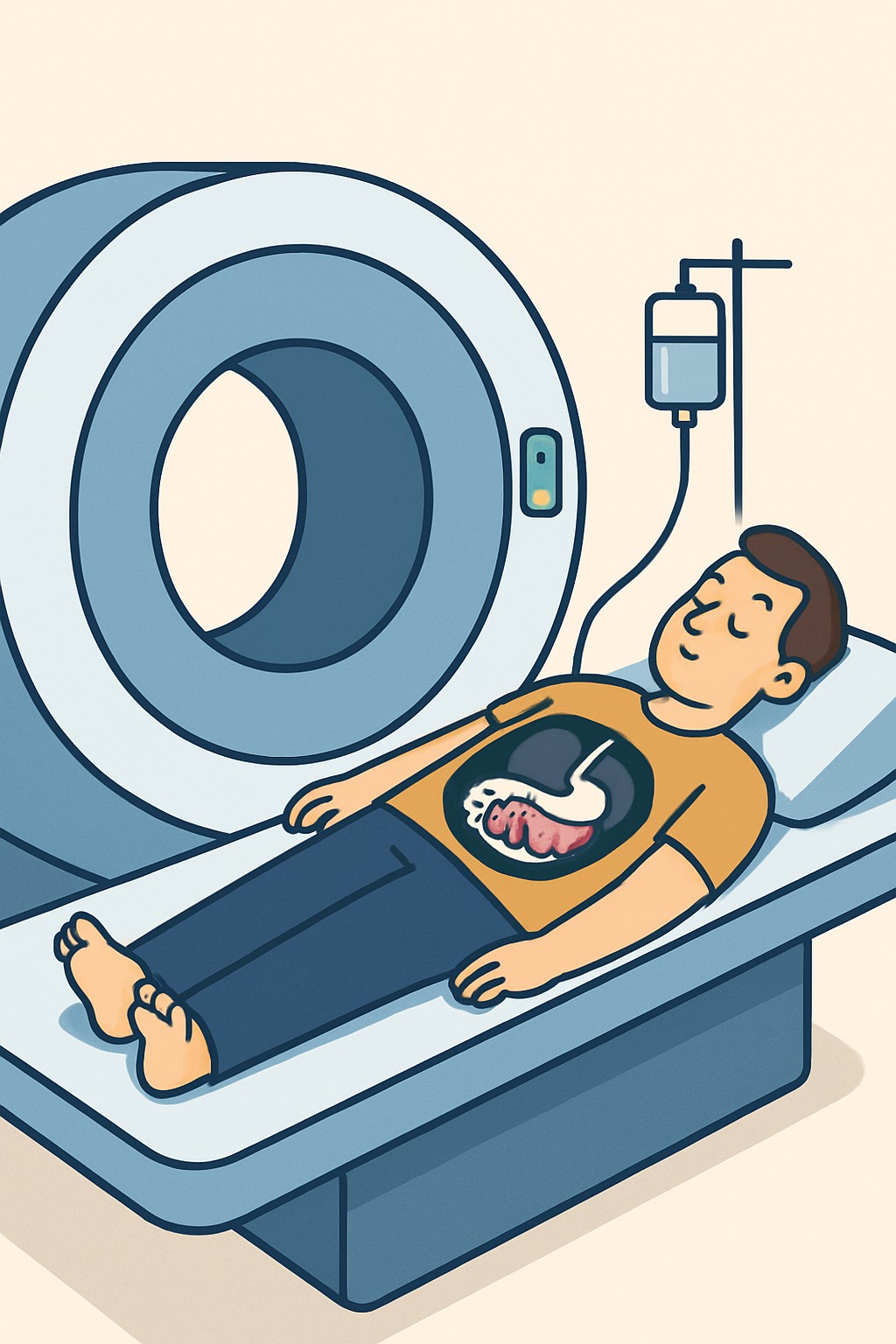
A CT abdomen with contrast is an imaging test that uses X-rays and a computer to create detailed pictures of the organs and blood vessels in your abdomen.
Overview
A CT abdomen with contrast is an imaging test that uses X-rays and a computer to create detailed pictures of the organs and blood vessels in your abdomen. A small amount of iodine-based contrast is injected into a vein to help highlight structures and find problems more clearly. This scan is often used to look for infection, inflammation, bleeding, blockages, or tumors. It helps clinicians plan care or check how treatment is working.
Also known as: Abdominal CT with contrast, CT abdomen with IV contrast
Preparation & Next Steps
Everything you need to know before and after your procedure
Before Care
- Confirm appointment instructions, arrival time, and how long the visit will take
- Tell the imaging center about allergies, prior contrast reactions, asthma, kidney or thyroid disease, diabetes, or possible pregnancy
- A recent blood test to check kidney function may be requested based on your history
- Follow the facility’s fasting instructions; some centers ask you not to eat for a few hours before the scan
- Drink water beforehand unless you were told to limit fluids
- Ask whether any medicines, such as metformin, need temporary changes around the scan
- Wear comfortable clothing without metal and leave jewelry at home
- Bring a photo ID, insurance card, and a current list of your medicines and supplements
- Bring prior imaging reports or discs if available for comparison
- If you expect to receive a sedative for anxiety, arrange a safe ride home
After Care
- You can usually return to normal activities right away
- Keep the small bandage over the IV site for several hours and watch for increasing redness, swelling, or pain
- Drink water over the rest of the day to help flush the contrast unless you were told to limit fluids
- Mild warmth, a metallic taste, or brief nausea may occur and usually fade quickly
- Contact a clinician if you notice hives, itching, swelling, shortness of breath, or fever after the scan
- Resume your usual diet and medicines unless the care team gave different instructions
- If you received a sedative, plan quiet activities until the effects wear off and follow facility guidance about driving
- If contrast leaked under the skin, monitor the area and contact the facility if pain, firmness, or swelling increases
- Check your patient portal or ask when your radiology report and images will be ready
Clinical Information
Important medical details about this procedure
Indications
- Unexplained abdominal pain or tenderness
- Suspected infection or abscess
- Evaluation of tumors, cysts, or masses
- Trauma to the abdomen
- Unexplained fever with abdominal concern
- Bowel inflammation such as diverticulitis
- Liver, spleen, pancreas, or kidney disease evaluation
- Vascular concerns like aneurysm or abnormal blood flow
Alternatives
- Ultrasound of the abdomen
- MRI of the abdomen (with or without contrast)
- CT without contrast when appropriate
- Nuclear medicine scans for specific conditions
- Watchful waiting with clinical follow-up when safe
Risks
- Radiation exposure from the CT scan
- Allergic or infusion reaction to iodinated contrast (rare)
- Nausea, warmth, or metallic taste during injection
- Kidney effects from contrast in susceptible people
- Worsening of some thyroid conditions
- Bruising or soreness at the IV site
- Contrast leaking under the skin at the IV site (extravasation)
Contraindications
- Known severe reaction to iodinated contrast without a preplanned protocol
- Significantly reduced kidney function when contrast cannot be used safely
- Uncontrolled hyperthyroidism
- Pregnancy when the expected benefit does not clearly outweigh radiation risk
- Inability to lie still or follow instructions without support or sedation
Recovery Timeline
What to expect during your recovery
Most people have no downtime after a CT abdomen with contrast and continue normal activities the same day. Minor IV site soreness can occur and usually improves quickly.
Typical Range
Same day
Return to Work
Same day
Recovery Milestones
Resume normal daily activities
Stay hydrated as allowed to help clear contrast
IV site tenderness typically improves
If a mild sedative was used, effects usually wear off within a day
Frequently Asked Questions
Common questions and expert answers about this procedure
What is a CT abdomen with contrast?
What is a CT abdomen with contrast?
It is a CT scan of the belly organs using an iodine-based dye injected into a vein. The contrast makes blood vessels and soft tissues easier to see.
Why is contrast used for this scan?
Why is contrast used for this scan?
Contrast helps highlight inflammation, infection, bleeding, and tumors. It improves the ability to detect and define many abdominal problems.
How long does the scan take and what will I feel?
How long does the scan take and what will I feel?
The scan itself often takes under 10 minutes, though your visit may be longer. You may feel a warm rush or a metallic taste when contrast is injected.
Is it safe if I have kidney disease or diabetes?
Is it safe if I have kidney disease or diabetes?
People with reduced kidney function have a higher risk from iodinated contrast. Imaging teams often check kidney labs and adjust the plan when needed.
I have a shellfish allergy. Is contrast safe?
I have a shellfish allergy. Is contrast safe?
Shellfish allergy does not predict contrast reactions. The main risk factor is a prior reaction to iodinated contrast. Tell the imaging team about any reactions you have had.
Do I need to fast before the scan?
Do I need to fast before the scan?
Policies vary. Many centers ask you to avoid eating for a few hours before the test, while clear liquids are often allowed. Follow the facility’s instructions.
How much radiation is involved?
How much radiation is involved?
CT uses ionizing radiation. The dose is managed to be as low as reasonably achievable. Any single scan carries a small potential increase in lifetime cancer risk.
When will I get results?
When will I get results?
A radiologist reviews the images and sends a report to your ordering clinician. Many centers release results to the patient portal within a day or two.
References
Medical literature and sources