%20--%3e%3csvg%20version='1.0'%20id='Layer_1'%20xmlns='http://www.w3.org/2000/svg'%20xmlns:xlink='http://www.w3.org/1999/xlink'%20x='0px'%20y='0px'%20viewBox='0%200%20755.52%20814.35'%20style='enable-background:new%200%200%20755.52%20814.35;'%20xml:space='preserve'%3e%3cstyle%20type='text/css'%3e%20.st0{fill:%231ae5ce;stroke:%231ae5ce;stroke-width:7;stroke-miterlimit:10;}%20.st1{fill:%23FFFFFF;stroke:%231ae5ce;stroke-width:7;stroke-miterlimit:10;}%20.st2{fill:%231ae5ce;stroke:%23FFFFFF;stroke-width:7;stroke-miterlimit:10;}%20.st3{fill:%23FFFFFF;stroke:%23FFFFFF;stroke-width:6;stroke-miterlimit:10;}%20%3c/style%3e%3cg%20id='Dark_Logo_00000159431215648494653180000015900878925932721032_'%3e%3cpath%20id='shield_00000152259091539869183100000001926543869452564382_'%20class='st0'%20d='M711.13,173.42%20c-3.37-49.07-38.92-44.9-75.96-52.18c-67.4-13.25-130.47-34.47-192.36-63.92c-22.48-10.7-41.88-25.74-65.05-26.28%20c-23.17,0.54-42.58,15.59-65.05,26.28c-61.89,29.45-124.95,50.68-192.36,63.92c-37.04,7.28-72.59,3.11-75.96,52.18%20c-1.55,22.6,0.34,46.4,1.05,68.92c5.99,190.78,52.91,345.39,206.27,466.46c29.71,23.46,74.51,55.8,108.84,70.75%20c5.99,2.61,11.7,3.73,17.21,3.75c5.51-0.02,11.22-1.14,17.21-3.75c34.33-14.95,79.12-47.3,108.84-70.75%20c153.37-121.07,200.28-275.68,206.27-466.46C710.79,219.82,712.68,196.02,711.13,173.42z'/%3e%3cpath%20id='magnifyingglass_00000073685934697636024790000000342567780940956808_'%20class='st1'%20d='M648.78,624.21l-96.64-104.65%20c34.89-40.63,55.98-93.46,55.98-151.21c0-128.27-103.98-232.24-232.24-232.24S143.63,240.08,143.63,368.35%20s103.98,232.24,232.24,232.24c48.87,0,94.21-15.11,131.62-40.89l97.18,105.24c11.25,12.18,30.24,12.93,42.42,1.69l0,0%20C659.27,655.38,660.03,636.39,648.78,624.21z'/%3e%3ccircle%20id='ellipse_00000129904010550392394720000017056154833629780114_'%20class='st2'%20cx='375.87'%20cy='368.35'%20r='181.21'/%3e%3cpath%20id='dollarsign_00000057140127156649725250000003772530148495155891_'%20class='st3'%20d='M362.91,492.03v-23.91%20c0-2.01-1.58-3.69-3.59-3.77c-18.49-0.78-37.12-5.4-49.4-11.83c-1.75-0.92-2.53-3.01-1.76-4.84l5.87-13.89%20c0.86-2.02,3.23-2.88,5.2-1.89c12.94,6.52,30.45,11.44,49.18,11.44c26.02,0,43.6-12.73,43.6-30.43c0-17.08-14.29-27.63-41.4-36.95%20c-37.37-12.42-60.46-26.7-60.46-53.72c0-24.97,20.29-44.11,52.22-49.51c1.8-0.31,3.11-1.89,3.11-3.72v-24.35%20c0-2.09,1.69-3.78,3.78-3.78h15.16c2.09,0,3.78,1.69,3.78,3.78v22.71c0,2.01,1.58,3.67,3.58,3.77c17.85,0.92,30.88,4.75,40.61,9.1%20c1.92,0.86,2.79,3.09,1.94,5.01l-6.08,13.6c-0.85,1.91-3.09,2.77-4.99,1.91c-8.37-3.8-22.38-8.95-42.75-8.95%20c-28.21,0-38.84,14.28-38.84,26.7c0,16.15,13.56,24.22,45.44,35.4c37.74,13.04,56.79,29.19,56.79,56.82%20c0,23.85-19.05,46.23-54.78,52.3c-1.8,0.31-3.11,1.89-3.11,3.72v25.28c0,2.09-1.69,3.78-3.78,3.78h-15.53%20C364.6,495.81,362.91,494.12,362.91,492.03z'/%3e%3c/g%3e%3c/svg%3e)
CT Angiography Chest (for PE) Diagnostic Imaging
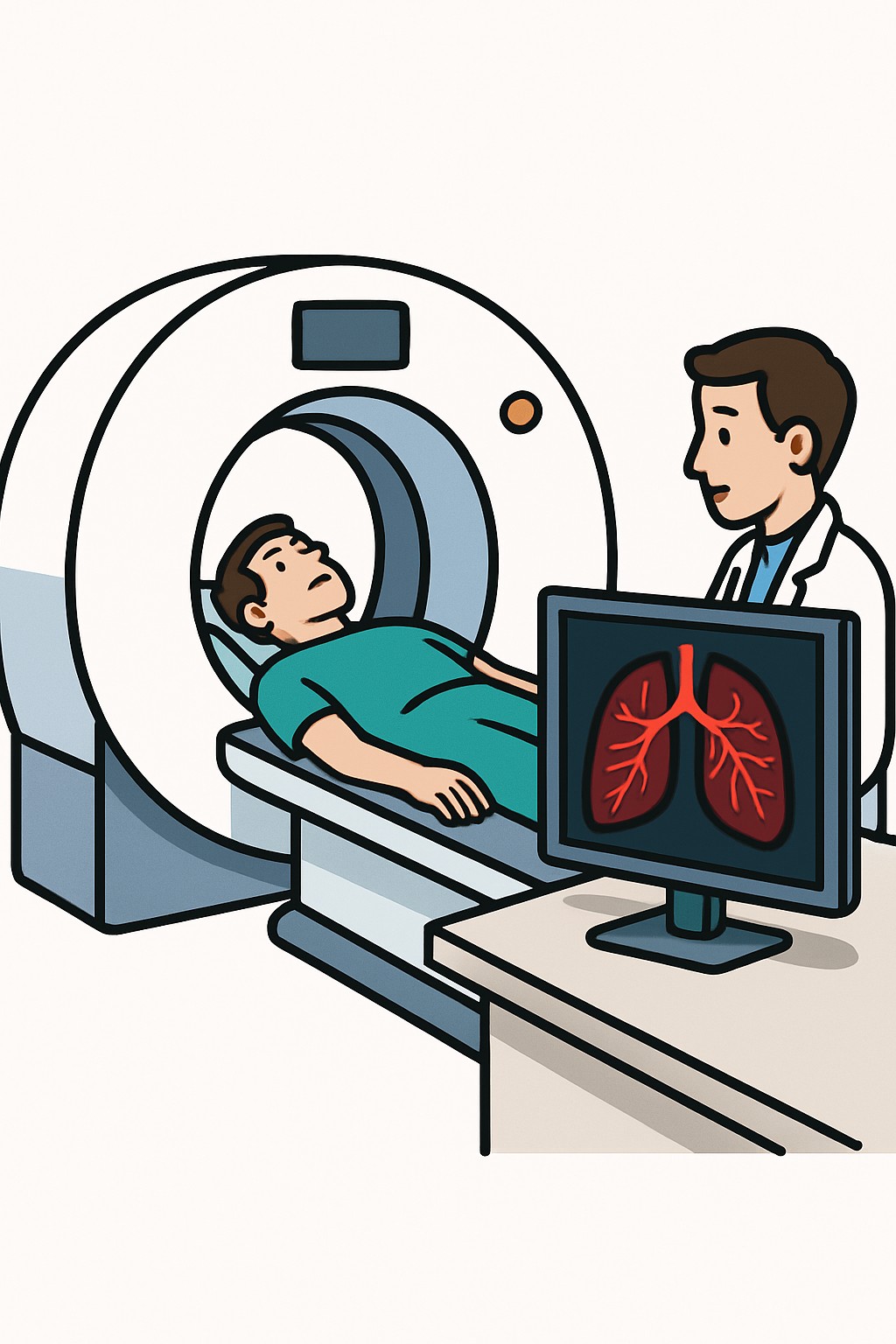
CT angiography of the chest (CTA) uses a CT scanner and an iodine-based contrast dye injected into a vein to make the blood vessels in the lungs visible.
Overview
CT angiography of the chest (CTA) uses a CT scanner and an iodine-based contrast dye injected into a vein to make the blood vessels in the lungs visible. It creates detailed pictures of the pulmonary arteries where blood clots can lodge. This test is commonly done when a pulmonary embolism (PE) is suspected. It helps clinicians confirm or rule out a clot and look for other causes of chest pain or shortness of breath.
Also known as: CT pulmonary angiography, CTA chest for pulmonary embolism, CTPA
Preparation & Next Steps
Everything you need to know before and after your procedure
Before Care
- Confirm the appointment instructions, including arrival time and any fasting requirements for contrast.
- Bring a list of all medicines and supplements, and note any allergies, especially to iodinated contrast.
- Tell the imaging staff about kidney problems, prior contrast reactions, asthma, or thyroid disease.
- Let the team know if you are or could be pregnant, or if you are breastfeeding.
- Ask how to manage diabetes medicines on the day of contrast imaging if you use them.
- Hydrate with water before the exam unless you were told to restrict fluids.
- Wear comfortable clothing without metal and be ready to remove jewelry or metal objects.
- Arrange transportation if you expect to receive any calming medicine or feel unwell.
- Bring a photo ID, insurance card, and prior chest or lung imaging if available.
After Care
- You can usually return to normal activities right after the scan unless told otherwise.
- Drink water over the next day to help your body clear the contrast, if you do not have fluid limits.
- Keep the small bandage over the IV site for a few hours; watch for redness, swelling, or pain.
- Contact a clinician if you notice hives, facial swelling, wheezing, or trouble breathing after the exam.
- Report new or worsening chest pain, fainting, or shortness of breath to a clinician.
- Call your care team if you see decreased urine output or dark urine after contrast.
- Review how and when results will be shared, such as through a portal or a follow-up visit.
- If you have a history of contrast reaction and develop a rash or itching later, inform your care team.
Clinical Information
Important medical details about this procedure
Indications
- Signs and symptoms concerning for pulmonary embolism such as sudden shortness of breath, chest pain, or rapid heart rate
- Elevated D-dimer when PE is suspected
- High or intermediate clinical probability of PE based on scoring tools
- Follow-up assessment when prior imaging was unclear or symptoms persist
- Evaluation of known PE to assess clot burden or complications
Alternatives
- Ventilation-perfusion (V/Q) lung scan
- Ultrasound of the legs to look for deep vein thrombosis
- MR angiography in selected cases
- Catheter-based pulmonary angiography
- Clinical observation with repeat testing when appropriate
- D-dimer blood test as a screening tool in low-risk cases
Risks
- Exposure to ionizing radiation
- Allergic or allergic-like reaction to iodine contrast
- Kidney stress or injury related to contrast in susceptible people
- Bruising or discomfort at the IV site
- Incidental findings that may need more testing
- False-negative or false-positive results
Contraindications
- Known severe reaction to iodinated contrast in the past
- Significant kidney impairment where contrast risk is high
- Inability to lie flat or hold breath long enough for imaging
- Pregnancy when a non-radiation alternative is suitable
- Unstable condition without monitoring or IV access
Recovery Timeline
What to expect during your recovery
Most people resume normal activities right after a chest CTA. Minor IV site tenderness or a warm feeling from the contrast usually fades quickly.
Typical Range
Same day
Return to Work
Same day
Recovery Milestones
Resume routine daily activities
Increase fluid intake if not restricted to help clear contrast
Monitor the IV site and watch for delayed rash or itching
Frequently Asked Questions
Common questions and expert answers about this procedure
What is the difference between CTA chest and CTPA?
What is the difference between CTA chest and CTPA?
They refer to the same test. CT pulmonary angiography (CTPA) is a CTA focused on the pulmonary arteries to look for clots.
How long does the scan take?
How long does the scan take?
The scan itself is quick, often a few minutes. Total time, including check-in and IV placement, is usually under an hour.
Will I get contrast?
Will I get contrast?
Yes, a small IV is placed to inject iodine contrast so the lung arteries show clearly on the CT images.
Can I eat or drink before the test?
Can I eat or drink before the test?
Policies vary. Many centers allow clear liquids and ask you to avoid solid food for a few hours. Follow the facility’s instructions.
Is it safe if I have kidney problems?
Is it safe if I have kidney problems?
Kidney function may be checked because contrast can stress the kidneys in some people. Teams weigh risks and benefits and may adjust the plan.
What about pregnancy or breastfeeding?
What about pregnancy or breastfeeding?
During pregnancy, imaging choices consider radiation exposure and alternatives. For breastfeeding, very little contrast enters milk, and major groups state breastfeeding can continue.
What if I had a contrast allergy before?
What if I had a contrast allergy before?
Tell the team. They may consider different imaging, special precautions, or medicines before the exam depending on your history.
When will I get results?
When will I get results?
A radiologist reads the images and sends a report to your ordering clinician, who will share results and next steps.
References
Medical literature and sources