%20--%3e%3csvg%20version='1.0'%20id='Layer_1'%20xmlns='http://www.w3.org/2000/svg'%20xmlns:xlink='http://www.w3.org/1999/xlink'%20x='0px'%20y='0px'%20viewBox='0%200%20755.52%20814.35'%20style='enable-background:new%200%200%20755.52%20814.35;'%20xml:space='preserve'%3e%3cstyle%20type='text/css'%3e%20.st0{fill:%231ae5ce;stroke:%231ae5ce;stroke-width:7;stroke-miterlimit:10;}%20.st1{fill:%23FFFFFF;stroke:%231ae5ce;stroke-width:7;stroke-miterlimit:10;}%20.st2{fill:%231ae5ce;stroke:%23FFFFFF;stroke-width:7;stroke-miterlimit:10;}%20.st3{fill:%23FFFFFF;stroke:%23FFFFFF;stroke-width:6;stroke-miterlimit:10;}%20%3c/style%3e%3cg%20id='Dark_Logo_00000159431215648494653180000015900878925932721032_'%3e%3cpath%20id='shield_00000152259091539869183100000001926543869452564382_'%20class='st0'%20d='M711.13,173.42%20c-3.37-49.07-38.92-44.9-75.96-52.18c-67.4-13.25-130.47-34.47-192.36-63.92c-22.48-10.7-41.88-25.74-65.05-26.28%20c-23.17,0.54-42.58,15.59-65.05,26.28c-61.89,29.45-124.95,50.68-192.36,63.92c-37.04,7.28-72.59,3.11-75.96,52.18%20c-1.55,22.6,0.34,46.4,1.05,68.92c5.99,190.78,52.91,345.39,206.27,466.46c29.71,23.46,74.51,55.8,108.84,70.75%20c5.99,2.61,11.7,3.73,17.21,3.75c5.51-0.02,11.22-1.14,17.21-3.75c34.33-14.95,79.12-47.3,108.84-70.75%20c153.37-121.07,200.28-275.68,206.27-466.46C710.79,219.82,712.68,196.02,711.13,173.42z'/%3e%3cpath%20id='magnifyingglass_00000073685934697636024790000000342567780940956808_'%20class='st1'%20d='M648.78,624.21l-96.64-104.65%20c34.89-40.63,55.98-93.46,55.98-151.21c0-128.27-103.98-232.24-232.24-232.24S143.63,240.08,143.63,368.35%20s103.98,232.24,232.24,232.24c48.87,0,94.21-15.11,131.62-40.89l97.18,105.24c11.25,12.18,30.24,12.93,42.42,1.69l0,0%20C659.27,655.38,660.03,636.39,648.78,624.21z'/%3e%3ccircle%20id='ellipse_00000129904010550392394720000017056154833629780114_'%20class='st2'%20cx='375.87'%20cy='368.35'%20r='181.21'/%3e%3cpath%20id='dollarsign_00000057140127156649725250000003772530148495155891_'%20class='st3'%20d='M362.91,492.03v-23.91%20c0-2.01-1.58-3.69-3.59-3.77c-18.49-0.78-37.12-5.4-49.4-11.83c-1.75-0.92-2.53-3.01-1.76-4.84l5.87-13.89%20c0.86-2.02,3.23-2.88,5.2-1.89c12.94,6.52,30.45,11.44,49.18,11.44c26.02,0,43.6-12.73,43.6-30.43c0-17.08-14.29-27.63-41.4-36.95%20c-37.37-12.42-60.46-26.7-60.46-53.72c0-24.97,20.29-44.11,52.22-49.51c1.8-0.31,3.11-1.89,3.11-3.72v-24.35%20c0-2.09,1.69-3.78,3.78-3.78h15.16c2.09,0,3.78,1.69,3.78,3.78v22.71c0,2.01,1.58,3.67,3.58,3.77c17.85,0.92,30.88,4.75,40.61,9.1%20c1.92,0.86,2.79,3.09,1.94,5.01l-6.08,13.6c-0.85,1.91-3.09,2.77-4.99,1.91c-8.37-3.8-22.38-8.95-42.75-8.95%20c-28.21,0-38.84,14.28-38.84,26.7c0,16.15,13.56,24.22,45.44,35.4c37.74,13.04,56.79,29.19,56.79,56.82%20c0,23.85-19.05,46.23-54.78,52.3c-1.8,0.31-3.11,1.89-3.11,3.72v25.28c0,2.09-1.69,3.78-3.78,3.78h-15.53%20C364.6,495.81,362.91,494.12,362.91,492.03z'/%3e%3c/g%3e%3c/svg%3e)
CT scan of abdomen & pelvis (without contrast) Diagnostic Imaging
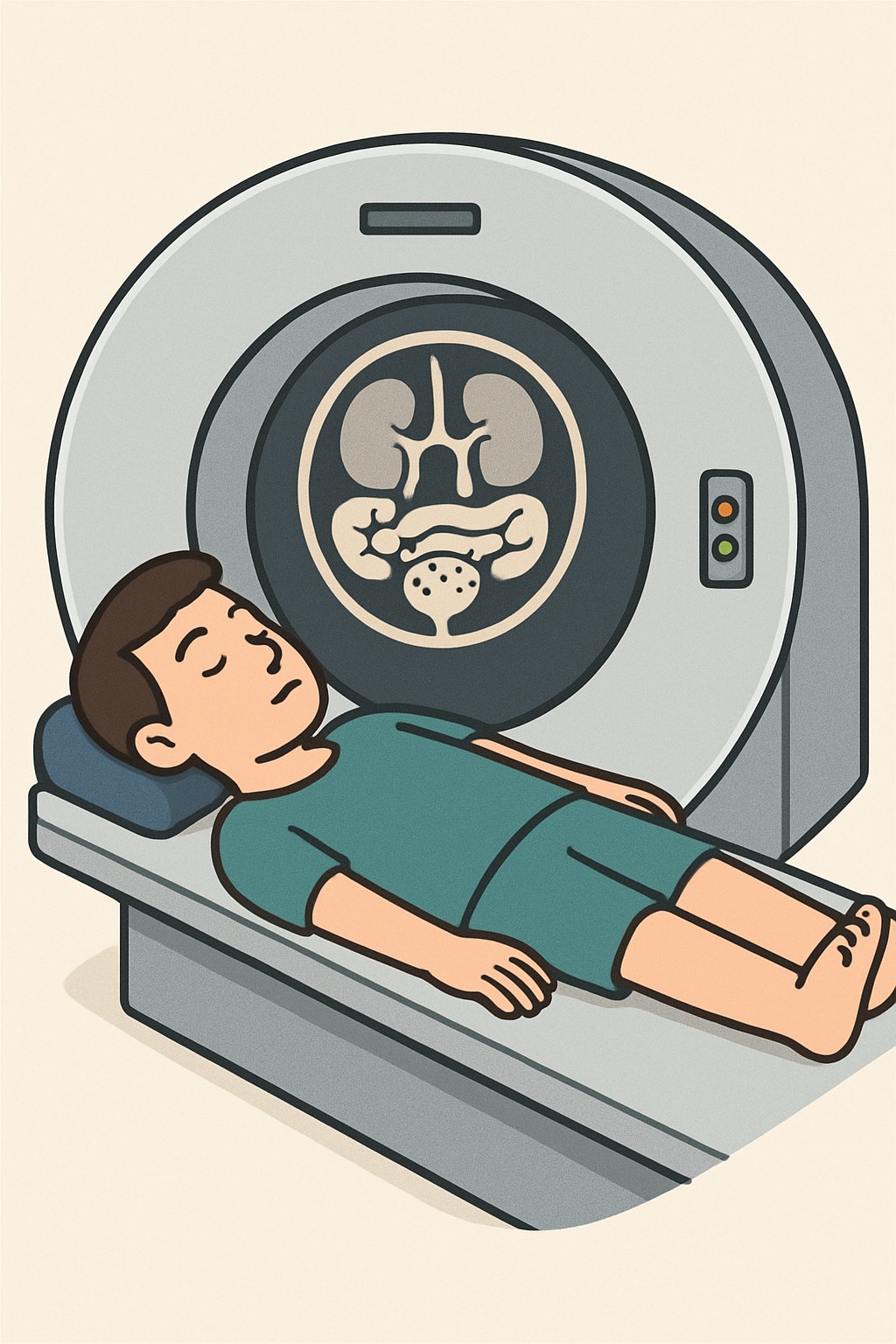
A non-contrast CT scan of the abdomen and pelvis uses x-rays and a computer to create detailed cross-section images of the belly and pelvic area.
Overview
A non-contrast CT scan of the abdomen and pelvis uses x-rays and a computer to create detailed cross-section images of the belly and pelvic area. No contrast dye is given by IV or by mouth for this study. Clinicians use this test to look for causes of pain, check for kidney or ureter stones, and assess certain injuries or conditions when speed is important or contrast is not advised. The scan itself is quick, and most people can return to normal activities right away.
Also known as: Non-contrast CT A/P, CT abdomen and pelvis without contrast, CT A/P without contrast
Preparation & Next Steps
Everything you need to know before and after your procedure
Before Care
- Bring your photo ID, insurance card, and the imaging order if you have it
- Wear comfortable clothing without metal; remove jewelry, belts, and piercings if possible
- Tell the imaging staff if you are or might be pregnant
- Arrive a little early to complete safety screening questions and paperwork
- You usually do not need to fast for a non-contrast CT unless the facility tells you otherwise
- Bring prior imaging reports or a CD/USB of images for comparison if available
- Inform staff about any medical implants or devices (for example, pumps or stimulators)
- Plan transportation if you expect to use anti-anxiety medicine for the scan
- Follow any facility instructions about bladder filling or clothing provided on arrival
After Care
- You can typically eat, drink, and return to normal activities after the scan
- Stay hydrated as usual unless your clinician has given you different guidance
- Ask how and when results will be shared; many facilities send reports to the ordering clinician and to the patient portal
- Keep a copy of your images or report if offered for your records
- Note any new or worsening symptoms and contact a clinician with concerns or questions
- If you took a sedative for the scan, follow the facility’s guidance about activity and transportation
Clinical Information
Important medical details about this procedure
Indications
- Sudden flank pain with suspected kidney or ureter stones
- Abdominal or pelvic pain when contrast is not recommended
- Evaluation after injury to the abdomen or pelvis
- Follow-up of known urinary stones
- Blood in the urine (hematuria) workup when stones are suspected
Alternatives
- Ultrasound of the kidneys and bladder
- CT abdomen and pelvis with contrast
- MRI of the abdomen and pelvis
- Plain abdominal x-ray (KUB) in select cases
- Observation with repeat exam and labs as directed by a clinician
Risks
- Exposure to ionizing radiation
- Incidental findings that may lead to more tests
- Limited detail of blood vessels and bowel without contrast
- Anxiety or discomfort from lying still
- Potential risks to an unborn baby from radiation during pregnancy
Contraindications
- Known or possible pregnancy when another test can answer the question
- Inability to lie still or hold breath without assistance
- Body size or implanted objects that exceed scanner limits
Recovery Timeline
What to expect during your recovery
Most people have no recovery time after a non-contrast CT of the abdomen and pelvis and resume normal activities the same day.
Typical Range
Same day
Return to Work
Same day
Recovery Milestones
Resume normal daily activities
Review results via patient portal or with the ordering clinician
Complete any follow-up imaging or lab orders if requested by your clinician
Frequently Asked Questions
Common questions and expert answers about this procedure
What is a non-contrast CT of the abdomen and pelvis?
What is a non-contrast CT of the abdomen and pelvis?
It is a CT scan that makes detailed images of your belly and pelvic area without using injected or oral contrast dye.
Why would this be done without contrast?
Why would this be done without contrast?
Non-contrast CT is commonly used to look for kidney and ureter stones and may be chosen when contrast is not needed or not advised.
How long does the scan take?
How long does the scan take?
The scan itself often takes only a few minutes, but plan about 15–30 minutes for check-in and positioning.
Will it hurt?
Will it hurt?
The scan is painless. You may need to lie still and briefly hold your breath while images are taken.
Does it use radiation?
Does it use radiation?
Yes. CT uses x-rays. Facilities work to keep the dose as low as reasonably achievable while still getting good images.
Can I eat or drink before the test?
Can I eat or drink before the test?
Usually yes for non-contrast CT. Follow any specific instructions from the imaging center.
Is it safe if I am pregnant?
Is it safe if I am pregnant?
Tell the imaging staff if you are or might be pregnant. Other tests like ultrasound or MRI may be considered. CT may be used if the benefits outweigh the risks.
When will I get the results?
When will I get the results?
A radiologist reviews the images and sends a report to the ordering clinician, often the same day or within a few days.