%20--%3e%3csvg%20version='1.0'%20id='Layer_1'%20xmlns='http://www.w3.org/2000/svg'%20xmlns:xlink='http://www.w3.org/1999/xlink'%20x='0px'%20y='0px'%20viewBox='0%200%20755.52%20814.35'%20style='enable-background:new%200%200%20755.52%20814.35;'%20xml:space='preserve'%3e%3cstyle%20type='text/css'%3e%20.st0{fill:%231ae5ce;stroke:%231ae5ce;stroke-width:7;stroke-miterlimit:10;}%20.st1{fill:%23FFFFFF;stroke:%231ae5ce;stroke-width:7;stroke-miterlimit:10;}%20.st2{fill:%231ae5ce;stroke:%23FFFFFF;stroke-width:7;stroke-miterlimit:10;}%20.st3{fill:%23FFFFFF;stroke:%23FFFFFF;stroke-width:6;stroke-miterlimit:10;}%20%3c/style%3e%3cg%20id='Dark_Logo_00000159431215648494653180000015900878925932721032_'%3e%3cpath%20id='shield_00000152259091539869183100000001926543869452564382_'%20class='st0'%20d='M711.13,173.42%20c-3.37-49.07-38.92-44.9-75.96-52.18c-67.4-13.25-130.47-34.47-192.36-63.92c-22.48-10.7-41.88-25.74-65.05-26.28%20c-23.17,0.54-42.58,15.59-65.05,26.28c-61.89,29.45-124.95,50.68-192.36,63.92c-37.04,7.28-72.59,3.11-75.96,52.18%20c-1.55,22.6,0.34,46.4,1.05,68.92c5.99,190.78,52.91,345.39,206.27,466.46c29.71,23.46,74.51,55.8,108.84,70.75%20c5.99,2.61,11.7,3.73,17.21,3.75c5.51-0.02,11.22-1.14,17.21-3.75c34.33-14.95,79.12-47.3,108.84-70.75%20c153.37-121.07,200.28-275.68,206.27-466.46C710.79,219.82,712.68,196.02,711.13,173.42z'/%3e%3cpath%20id='magnifyingglass_00000073685934697636024790000000342567780940956808_'%20class='st1'%20d='M648.78,624.21l-96.64-104.65%20c34.89-40.63,55.98-93.46,55.98-151.21c0-128.27-103.98-232.24-232.24-232.24S143.63,240.08,143.63,368.35%20s103.98,232.24,232.24,232.24c48.87,0,94.21-15.11,131.62-40.89l97.18,105.24c11.25,12.18,30.24,12.93,42.42,1.69l0,0%20C659.27,655.38,660.03,636.39,648.78,624.21z'/%3e%3ccircle%20id='ellipse_00000129904010550392394720000017056154833629780114_'%20class='st2'%20cx='375.87'%20cy='368.35'%20r='181.21'/%3e%3cpath%20id='dollarsign_00000057140127156649725250000003772530148495155891_'%20class='st3'%20d='M362.91,492.03v-23.91%20c0-2.01-1.58-3.69-3.59-3.77c-18.49-0.78-37.12-5.4-49.4-11.83c-1.75-0.92-2.53-3.01-1.76-4.84l5.87-13.89%20c0.86-2.02,3.23-2.88,5.2-1.89c12.94,6.52,30.45,11.44,49.18,11.44c26.02,0,43.6-12.73,43.6-30.43c0-17.08-14.29-27.63-41.4-36.95%20c-37.37-12.42-60.46-26.7-60.46-53.72c0-24.97,20.29-44.11,52.22-49.51c1.8-0.31,3.11-1.89,3.11-3.72v-24.35%20c0-2.09,1.69-3.78,3.78-3.78h15.16c2.09,0,3.78,1.69,3.78,3.78v22.71c0,2.01,1.58,3.67,3.58,3.77c17.85,0.92,30.88,4.75,40.61,9.1%20c1.92,0.86,2.79,3.09,1.94,5.01l-6.08,13.6c-0.85,1.91-3.09,2.77-4.99,1.91c-8.37-3.8-22.38-8.95-42.75-8.95%20c-28.21,0-38.84,14.28-38.84,26.7c0,16.15,13.56,24.22,45.44,35.4c37.74,13.04,56.79,29.19,56.79,56.82%20c0,23.85-19.05,46.23-54.78,52.3c-1.8,0.31-3.11,1.89-3.11,3.72v25.28c0,2.09-1.69,3.78-3.78,3.78h-15.53%20C364.6,495.81,362.91,494.12,362.91,492.03z'/%3e%3c/g%3e%3c/svg%3e)
Echocardiogram (Transthoracic) Diagnostic Imaging
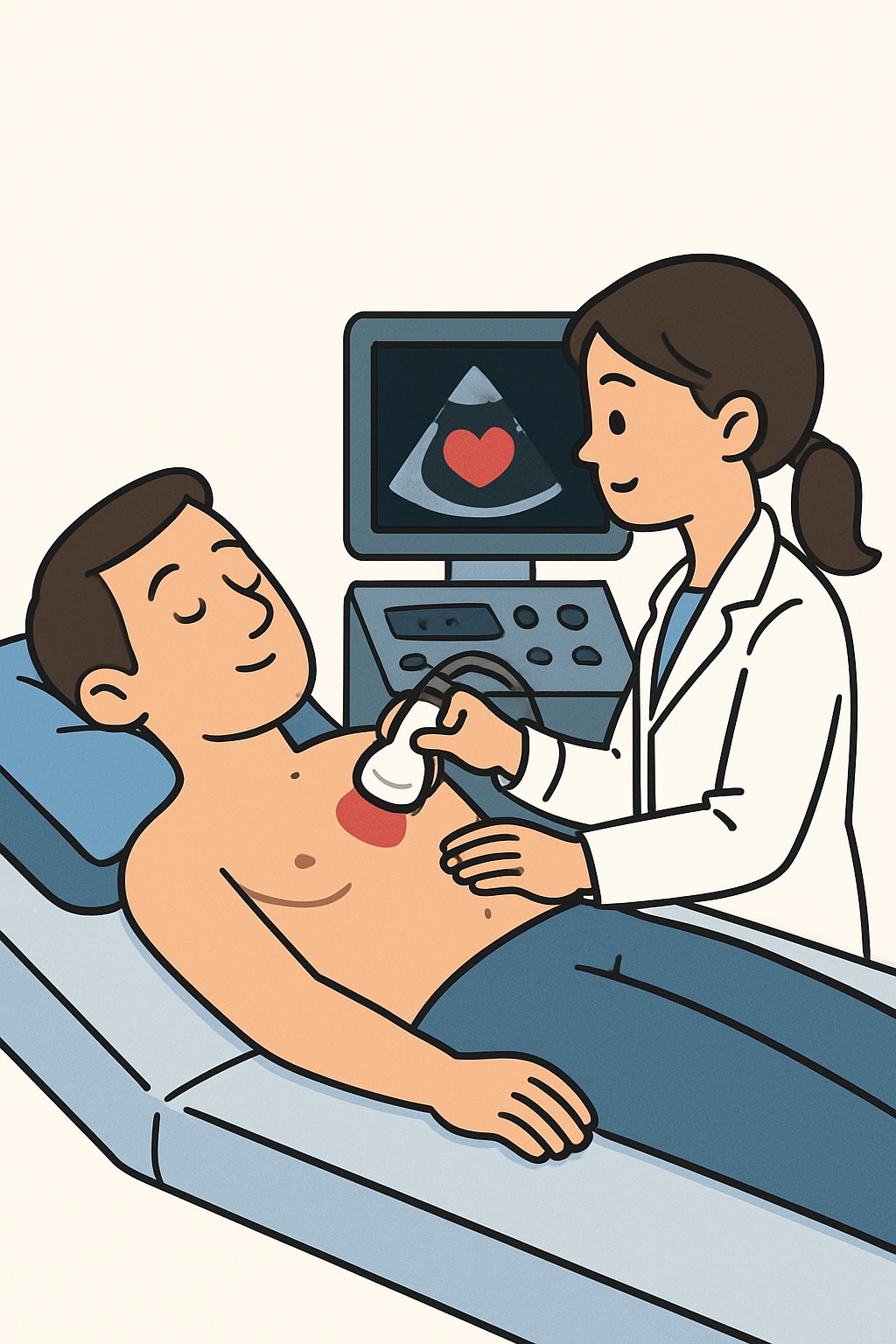
A transthoracic echocardiogram is a noninvasive ultrasound of the heart.
Overview
A transthoracic echocardiogram is a noninvasive ultrasound of the heart. A technician places a small probe on the chest to create moving pictures of the heart using sound waves. There is no radiation. The test helps show heart size, pumping strength, valve motion, and blood flow. Clinicians use it to check symptoms, monitor known heart conditions, and guide treatment planning.
Also known as: TTE, Transthoracic echo, Heart ultrasound, Cardiac ultrasound
Preparation & Next Steps
Everything you need to know before and after your procedure
Before Care
- Wear a two-piece outfit so the chest is easy to access; you will change or open a gown top
- Avoid lotions, oils, or powders on the chest the day of the test to help the electrodes and probe adhere
- Bring a current medication list and any implant or device card (for pacemaker or defibrillator)
- Confirm appointment location and check-in time; typical test time is about 30 to 60 minutes
- No fasting is usually needed for a standard TTE; follow any specific instructions if contrast or a combined test is planned
- Bring a photo ID, insurance card, and a payment method if a copay applies
- Ask the facility whether prior images are needed for comparison and how to share them
- Arrange schedule flexibility in case additional views or an IV line for contrast are needed
- Share any allergies or past reactions to ultrasound gel or contrast agents with the staff
- Limit jewelry on the neck and chest; you may be asked to remove it
After Care
- Gel is wiped off after the test; the skin may feel cool or slightly sticky for a short time
- Resume normal eating, drinking, and daily activities unless you received other instructions for a combined test
- If an IV was used for contrast, keep the site clean and dry and remove the small bandage later the same day
- Mild skin redness from electrodes or probe pressure usually fades within hours
- Ask how and when results will be communicated; many centers send a report to the ordering clinician
- Keep copies of imaging reports for your personal records when available
- Note any new or unexpected symptoms after the test and contact a clinician if concerns arise
- Schedule follow-up with the ordering clinician to review findings and next steps
- If images were compared to older studies, confirm that all prior records were available
- Check insurance coverage for any additional tests that may be recommended
Clinical Information
Important medical details about this procedure
Indications
- Heart murmur or suspected valve disease
- Shortness of breath, chest discomfort, or swelling
- Known heart failure or cardiomyopathy
- Suspected pericardial effusion (fluid around the heart)
- Assessment after a heart attack
- High blood pressure affecting the heart
- Congenital heart disease evaluation
- Monitoring pulmonary hypertension
- Suspected infection of heart valves (endocarditis)
Alternatives
- Transesophageal echocardiogram (TEE)
- Stress echocardiogram
- Cardiac MRI
- Cardiac CT
- Nuclear cardiac imaging
- Point-of-care ultrasound in clinic or emergency settings
Risks
- Temporary skin discomfort from probe pressure or adhesive pads
- Mild skin irritation from ultrasound gel or electrodes
- Rare reaction to an intravenous contrast agent if used
- Incidental findings that may need more testing
- Test limitations that can miss or understate disease
Contraindications
- No common absolute contraindications for standard TTE
- Image quality may be limited by obesity, emphysema, chest dressings, or wounds
- Inability to lie still or follow instructions can reduce accuracy
Recovery Timeline
What to expect during your recovery
Most people return to normal activities right after a standard transthoracic echocardiogram. There is no medical recovery period for the test itself.
Typical Range
Same day
Return to Work
Same day
Recovery Milestones
Resume usual daily activities
Return to work or school
Remove small bandage from IV site if contrast was used
Review results with the ordering clinician
Frequently Asked Questions
Common questions and expert answers about this procedure
What does a transthoracic echocardiogram show?
What does a transthoracic echocardiogram show?
It shows the heart chambers, pumping strength, valve structure and motion, and blood flow patterns using ultrasound.
How long does the test take?
How long does the test take?
Most exams take about 30 to 60 minutes, depending on how many views are needed.
Do I need to fast or stop medicines?
Do I need to fast or stop medicines?
Fasting is not usually needed for a standard TTE. Follow any specific instructions from the testing center for combined tests.
Is there radiation?
Is there radiation?
No. Echocardiography uses sound waves, not X-rays.
Will it hurt?
Will it hurt?
It is generally painless. You may feel cool gel and brief pressure from the probe to get clear images.
Why would contrast be used?
Why would contrast be used?
A small amount of ultrasound contrast may be injected to improve visibility of heart borders or blood flow when images are hard to see.
How is TTE different from TEE?
How is TTE different from TEE?
TTE uses a probe on the chest. TEE uses a probe in the esophagus for closer views and often needs sedation.
When will I get results?
When will I get results?
A cardiologist or trained clinician interprets the study and sends a report to the ordering clinician, often within a few days.
References
Medical literature and sources