%20--%3e%3csvg%20version='1.0'%20id='Layer_1'%20xmlns='http://www.w3.org/2000/svg'%20xmlns:xlink='http://www.w3.org/1999/xlink'%20x='0px'%20y='0px'%20viewBox='0%200%20755.52%20814.35'%20style='enable-background:new%200%200%20755.52%20814.35;'%20xml:space='preserve'%3e%3cstyle%20type='text/css'%3e%20.st0{fill:%231ae5ce;stroke:%231ae5ce;stroke-width:7;stroke-miterlimit:10;}%20.st1{fill:%23FFFFFF;stroke:%231ae5ce;stroke-width:7;stroke-miterlimit:10;}%20.st2{fill:%231ae5ce;stroke:%23FFFFFF;stroke-width:7;stroke-miterlimit:10;}%20.st3{fill:%23FFFFFF;stroke:%23FFFFFF;stroke-width:6;stroke-miterlimit:10;}%20%3c/style%3e%3cg%20id='Dark_Logo_00000159431215648494653180000015900878925932721032_'%3e%3cpath%20id='shield_00000152259091539869183100000001926543869452564382_'%20class='st0'%20d='M711.13,173.42%20c-3.37-49.07-38.92-44.9-75.96-52.18c-67.4-13.25-130.47-34.47-192.36-63.92c-22.48-10.7-41.88-25.74-65.05-26.28%20c-23.17,0.54-42.58,15.59-65.05,26.28c-61.89,29.45-124.95,50.68-192.36,63.92c-37.04,7.28-72.59,3.11-75.96,52.18%20c-1.55,22.6,0.34,46.4,1.05,68.92c5.99,190.78,52.91,345.39,206.27,466.46c29.71,23.46,74.51,55.8,108.84,70.75%20c5.99,2.61,11.7,3.73,17.21,3.75c5.51-0.02,11.22-1.14,17.21-3.75c34.33-14.95,79.12-47.3,108.84-70.75%20c153.37-121.07,200.28-275.68,206.27-466.46C710.79,219.82,712.68,196.02,711.13,173.42z'/%3e%3cpath%20id='magnifyingglass_00000073685934697636024790000000342567780940956808_'%20class='st1'%20d='M648.78,624.21l-96.64-104.65%20c34.89-40.63,55.98-93.46,55.98-151.21c0-128.27-103.98-232.24-232.24-232.24S143.63,240.08,143.63,368.35%20s103.98,232.24,232.24,232.24c48.87,0,94.21-15.11,131.62-40.89l97.18,105.24c11.25,12.18,30.24,12.93,42.42,1.69l0,0%20C659.27,655.38,660.03,636.39,648.78,624.21z'/%3e%3ccircle%20id='ellipse_00000129904010550392394720000017056154833629780114_'%20class='st2'%20cx='375.87'%20cy='368.35'%20r='181.21'/%3e%3cpath%20id='dollarsign_00000057140127156649725250000003772530148495155891_'%20class='st3'%20d='M362.91,492.03v-23.91%20c0-2.01-1.58-3.69-3.59-3.77c-18.49-0.78-37.12-5.4-49.4-11.83c-1.75-0.92-2.53-3.01-1.76-4.84l5.87-13.89%20c0.86-2.02,3.23-2.88,5.2-1.89c12.94,6.52,30.45,11.44,49.18,11.44c26.02,0,43.6-12.73,43.6-30.43c0-17.08-14.29-27.63-41.4-36.95%20c-37.37-12.42-60.46-26.7-60.46-53.72c0-24.97,20.29-44.11,52.22-49.51c1.8-0.31,3.11-1.89,3.11-3.72v-24.35%20c0-2.09,1.69-3.78,3.78-3.78h15.16c2.09,0,3.78,1.69,3.78,3.78v22.71c0,2.01,1.58,3.67,3.58,3.77c17.85,0.92,30.88,4.75,40.61,9.1%20c1.92,0.86,2.79,3.09,1.94,5.01l-6.08,13.6c-0.85,1.91-3.09,2.77-4.99,1.91c-8.37-3.8-22.38-8.95-42.75-8.95%20c-28.21,0-38.84,14.28-38.84,26.7c0,16.15,13.56,24.22,45.44,35.4c37.74,13.04,56.79,29.19,56.79,56.82%20c0,23.85-19.05,46.23-54.78,52.3c-1.8,0.31-3.11,1.89-3.11,3.72v25.28c0,2.09-1.69,3.78-3.78,3.78h-15.53%20C364.6,495.81,362.91,494.12,362.91,492.03z'/%3e%3c/g%3e%3c/svg%3e)
Extremity vein duplex scan (unilateral) Diagnostic Imaging
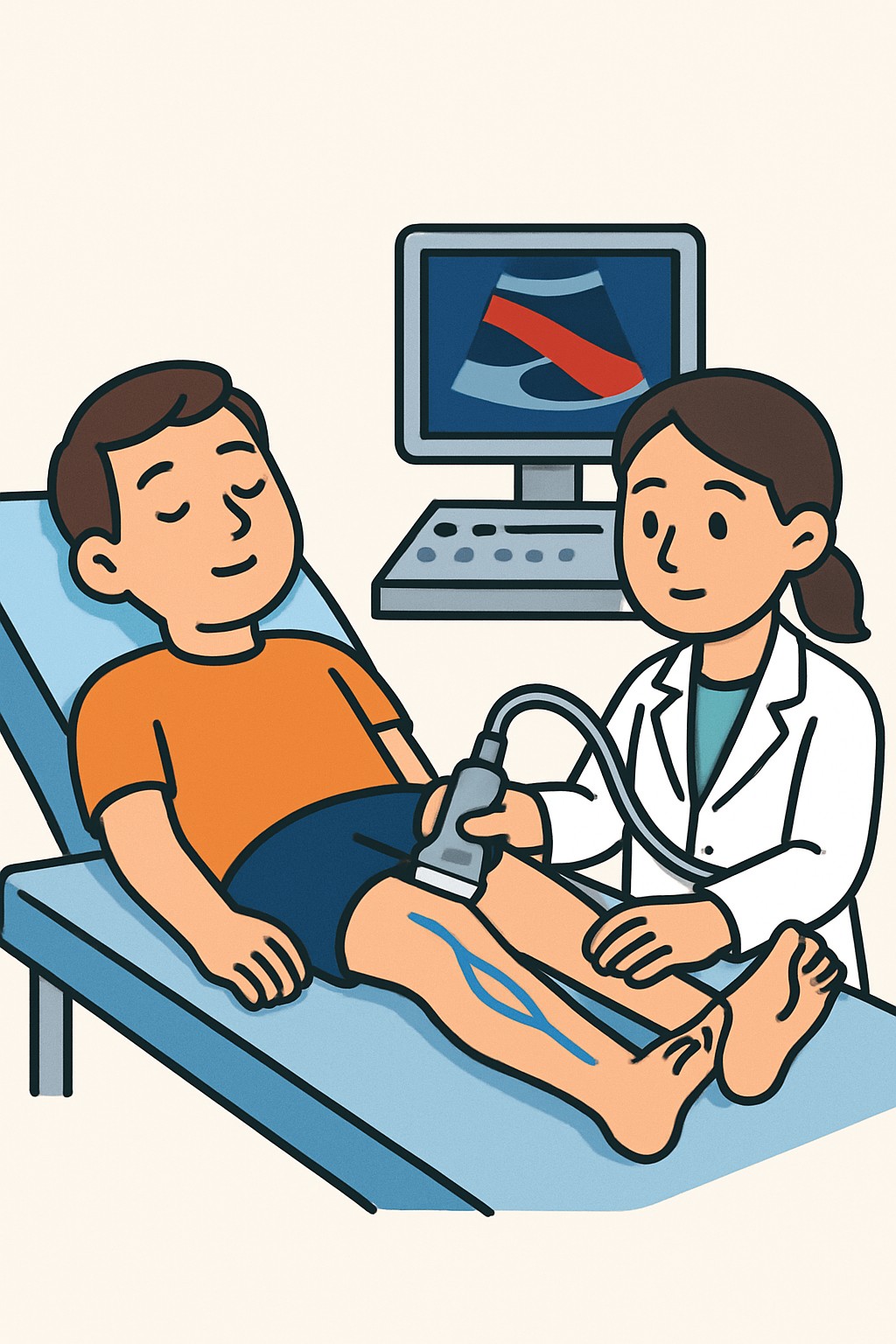
An extremity vein duplex scan is an ultrasound test that looks at the veins in one arm or one leg.
Overview
An extremity vein duplex scan is an ultrasound test that looks at the veins in one arm or one leg. Duplex means it combines standard ultrasound images of the vein structure with Doppler to show blood flow. It helps check if veins are open, if valves work, and if blood is moving in the right direction. Clinicians order this test to look for blood clots, valve problems that cause varicose veins or swelling, or to map veins before a procedure. Unilateral means only the limb with symptoms or concern is scanned. The test is noninvasive and uses sound waves, not radiation.
Also known as: Venous duplex ultrasound (one limb), Unilateral extremity venous ultrasound, DVT ultrasound (one side)
Preparation & Next Steps
Everything you need to know before and after your procedure
Before Care
- Wear loose clothing or shorts to allow easy access to the arm or leg being scanned
- Avoid lotions or oils on the limb on the day of the exam so the gel and probe make good contact
- Bring prior vascular imaging reports if available to help with comparison
- Know which side and areas have symptoms and when they started
- Plan for about 30–60 minutes at the imaging center, sometimes longer for detailed mapping
- No special diet is typically needed for this test
- You may be asked to stand briefly or change positions during the scan
- If you use compression garments, you will likely remove them for the exam and put them back on afterward
- Arrive a little early to complete check-in and verify contact information
After Care
- Wipe off any remaining ultrasound gel; it can feel cool or sticky
- Resume normal activities right away; there is no sedation or radiation
- Check your patient portal or with the ordering clinic for the report and next steps
- Keep any scheduled follow-up appointments or repeat scans
- If symptoms change or worsen after the test, inform the ordering clinician
- Have any compression garments you normally use available after the scan
- During long trips, take regular movement breaks to support circulation
Clinical Information
Important medical details about this procedure
Indications
- Signs of deep vein thrombosis (DVT) such as limb swelling or pain
- Evaluation of varicose veins or chronic venous insufficiency
- Unexplained arm or leg swelling
- Follow-up of a known DVT or venous procedure
- Pre-procedure vein mapping for bypass grafts or dialysis access
- Assessment of superficial thrombophlebitis
Alternatives
- Clinical risk assessment with blood tests such as D-dimer
- Serial ultrasound exams when the first test is inconclusive
- CT venography or MR venography when deeper veins cannot be seen well
- Contrast venography in select cases when other imaging is limited
Risks
- Minor discomfort from probe pressure or vein compression
- Temporary skin irritation from ultrasound gel
- Limited views in areas covered by casts, dressings, or severe swelling
- Small chance of missed clots in pelvic or small calf veins
- Incidental findings that may lead to more testing
Contraindications
- No absolute contraindications are commonly recognized
- Open wounds, bulky dressings, or casts that block probe contact
- Severe pain or inability to tolerate vein compression
- Inability to cooperate with position changes during the exam
Recovery Timeline
What to expect during your recovery
There is no medical recovery period for a venous duplex ultrasound. Most people leave the facility and return to usual activities immediately.
Typical Range
Same day
Return to Work
Same day
Recovery Milestones
Leave the facility and resume usual daily activities
Return to work or school as normal
Review results in the portal or with the ordering clinic and confirm any follow-up
Frequently Asked Questions
Common questions and expert answers about this procedure
What does duplex mean in this test?
What does duplex mean in this test?
Duplex combines two ultrasound modes: one shows pictures of the veins, and Doppler shows how blood flows through them, often with color to show direction.
Why is the scan unilateral instead of both sides?
Why is the scan unilateral instead of both sides?
Many orders target the limb with symptoms to answer the clinical question efficiently. Some situations call for a bilateral scan; that is a separate order.
How long does a vein duplex scan take?
How long does a vein duplex scan take?
Most exams take about 30 to 60 minutes. Detailed vein mapping or complex anatomy can take longer.
Is there any radiation or injection?
Is there any radiation or injection?
No. Ultrasound uses sound waves, not radiation, and this test does not typically use contrast injections.
Will it hurt?
Will it hurt?
It should not be painful, but you may feel firm pressure when the technologist compresses the veins to check for clots.
Do I need to fast or stop medicines?
Do I need to fast or stop medicines?
This test usually needs no special preparation. Follow any instructions provided by your ordering clinic.
Who performs and reads the exam?
Who performs and reads the exam?
A trained sonographer or vascular technologist performs the scan. A radiologist or vascular specialist reviews the images and issues a report.
What if the scan is negative but I still have symptoms?
What if the scan is negative but I still have symptoms?
Your clinician may consider repeat ultrasound or different imaging if symptoms persist and the first study did not explain them.
References
Medical literature and sources