%20--%3e%3csvg%20version='1.0'%20id='Layer_1'%20xmlns='http://www.w3.org/2000/svg'%20xmlns:xlink='http://www.w3.org/1999/xlink'%20x='0px'%20y='0px'%20viewBox='0%200%20755.52%20814.35'%20style='enable-background:new%200%200%20755.52%20814.35;'%20xml:space='preserve'%3e%3cstyle%20type='text/css'%3e%20.st0{fill:%231ae5ce;stroke:%231ae5ce;stroke-width:7;stroke-miterlimit:10;}%20.st1{fill:%23FFFFFF;stroke:%231ae5ce;stroke-width:7;stroke-miterlimit:10;}%20.st2{fill:%231ae5ce;stroke:%23FFFFFF;stroke-width:7;stroke-miterlimit:10;}%20.st3{fill:%23FFFFFF;stroke:%23FFFFFF;stroke-width:6;stroke-miterlimit:10;}%20%3c/style%3e%3cg%20id='Dark_Logo_00000159431215648494653180000015900878925932721032_'%3e%3cpath%20id='shield_00000152259091539869183100000001926543869452564382_'%20class='st0'%20d='M711.13,173.42%20c-3.37-49.07-38.92-44.9-75.96-52.18c-67.4-13.25-130.47-34.47-192.36-63.92c-22.48-10.7-41.88-25.74-65.05-26.28%20c-23.17,0.54-42.58,15.59-65.05,26.28c-61.89,29.45-124.95,50.68-192.36,63.92c-37.04,7.28-72.59,3.11-75.96,52.18%20c-1.55,22.6,0.34,46.4,1.05,68.92c5.99,190.78,52.91,345.39,206.27,466.46c29.71,23.46,74.51,55.8,108.84,70.75%20c5.99,2.61,11.7,3.73,17.21,3.75c5.51-0.02,11.22-1.14,17.21-3.75c34.33-14.95,79.12-47.3,108.84-70.75%20c153.37-121.07,200.28-275.68,206.27-466.46C710.79,219.82,712.68,196.02,711.13,173.42z'/%3e%3cpath%20id='magnifyingglass_00000073685934697636024790000000342567780940956808_'%20class='st1'%20d='M648.78,624.21l-96.64-104.65%20c34.89-40.63,55.98-93.46,55.98-151.21c0-128.27-103.98-232.24-232.24-232.24S143.63,240.08,143.63,368.35%20s103.98,232.24,232.24,232.24c48.87,0,94.21-15.11,131.62-40.89l97.18,105.24c11.25,12.18,30.24,12.93,42.42,1.69l0,0%20C659.27,655.38,660.03,636.39,648.78,624.21z'/%3e%3ccircle%20id='ellipse_00000129904010550392394720000017056154833629780114_'%20class='st2'%20cx='375.87'%20cy='368.35'%20r='181.21'/%3e%3cpath%20id='dollarsign_00000057140127156649725250000003772530148495155891_'%20class='st3'%20d='M362.91,492.03v-23.91%20c0-2.01-1.58-3.69-3.59-3.77c-18.49-0.78-37.12-5.4-49.4-11.83c-1.75-0.92-2.53-3.01-1.76-4.84l5.87-13.89%20c0.86-2.02,3.23-2.88,5.2-1.89c12.94,6.52,30.45,11.44,49.18,11.44c26.02,0,43.6-12.73,43.6-30.43c0-17.08-14.29-27.63-41.4-36.95%20c-37.37-12.42-60.46-26.7-60.46-53.72c0-24.97,20.29-44.11,52.22-49.51c1.8-0.31,3.11-1.89,3.11-3.72v-24.35%20c0-2.09,1.69-3.78,3.78-3.78h15.16c2.09,0,3.78,1.69,3.78,3.78v22.71c0,2.01,1.58,3.67,3.58,3.77c17.85,0.92,30.88,4.75,40.61,9.1%20c1.92,0.86,2.79,3.09,1.94,5.01l-6.08,13.6c-0.85,1.91-3.09,2.77-4.99,1.91c-8.37-3.8-22.38-8.95-42.75-8.95%20c-28.21,0-38.84,14.28-38.84,26.7c0,16.15,13.56,24.22,45.44,35.4c37.74,13.04,56.79,29.19,56.79,56.82%20c0,23.85-19.05,46.23-54.78,52.3c-1.8,0.31-3.11,1.89-3.11,3.72v25.28c0,2.09-1.69,3.78-3.78,3.78h-15.53%20C364.6,495.81,362.91,494.12,362.91,492.03z'/%3e%3c/g%3e%3c/svg%3e)
Fetal non-stress test (baby heart rate monitoring) Diagnostic Imaging
A fetal non-stress test (NST) checks a baby’s heart rate while the baby is at rest and moving.
Overview
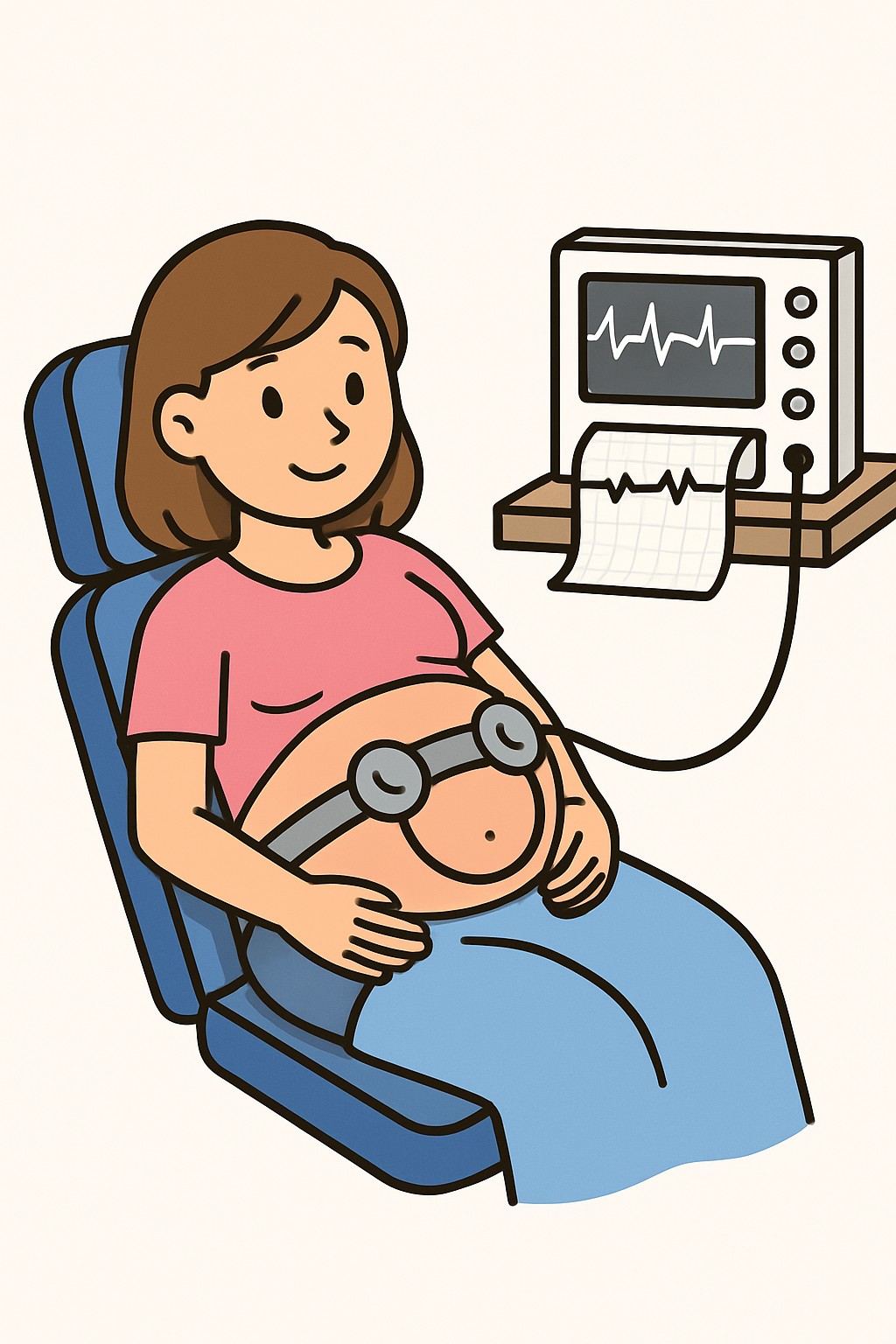
A fetal non-stress test (NST) checks a baby’s heart rate while the baby is at rest and moving. Two soft monitors are placed on the pregnant person's belly to record the baby’s heartbeat and any uterine activity. A healthy pattern usually shows the heart rate speeding up with movement. NSTs are commonly done in the third trimester when extra monitoring is needed or after the due date. The test is external, uses no medicines, and usually takes 20 to 40 minutes, though it may take longer if the baby is sleeping.
Also known as: Nonstress test, NST, Fetal heart rate test
Preparation & Next Steps
Everything you need to know before and after your procedure
Before Care
- No fasting is typically needed; follow any clinic instructions you received
- Plan enough time; the visit may last 30 to 60 minutes including setup
- Wear a two-piece outfit for easy access to your belly
- Use the restroom before the test so you can lie comfortably
- Bring a list of your medicines, allergies, and pregnancy history
- Know your baby’s usual movement pattern to report during the visit
- Ask the clinic about visitor policies if you want a support person
- Avoid heavy lotions on the belly the day of the test so sensors stick well
- Bring your ID, insurance card, and any recent ultrasound reports if available
After Care
- Most people return to normal activities right after the test
- Ask how and when results will be shared and if repeat NSTs are planned
- Keep tracking daily fetal movements using your clinic’s method
- Follow instructions if additional testing (for example, BPP) is scheduled
- Gently clean off any remaining gel to avoid skin irritation
- Note any changes in your baby’s usual movement pattern and inform a clinician
- Contact a clinician if you notice vaginal bleeding, fluid leakage, or strong, regular contractions
- Keep upcoming prenatal appointments and bring any new questions about the test results
Clinical Information
Important medical details about this procedure
Indications
- Pregnancy past the due date
- Decreased fetal movement reports
- High blood pressure or preeclampsia in pregnancy
- Diabetes in pregnancy (gestational or preexisting)
- Growth concerns such as fetal growth restriction
- Multiple pregnancy (twins or more)
- Maternal medical conditions (for example, kidney or heart disease)
- History of pregnancy loss or complications
- Follow-up after trauma or concerning symptoms
- Abnormal amniotic fluid levels noted on ultrasound
Alternatives
- Biophysical profile (BPP)
- Modified biophysical profile (NST plus amniotic fluid check)
- Contraction stress test (CST)
- Doppler ultrasound of umbilical or fetal vessels
- Daily fetal movement counting (kick counts)
- Intrapartum continuous fetal monitoring during labor when indicated
Risks
- False alarms that may lead to more testing or monitoring
- Test may take longer if the baby is asleep or not moving much
- Temporary skin irritation or discomfort from belts or gel
- Anxiety while awaiting results
- Rare need to repeat the test if tracings are unclear
Recovery Timeline
What to expect during your recovery
There is no medical recovery period from an NST. People typically resume normal activities right away.
Typical Range
Same day
Return to Work
Same day
Recovery Milestones
Resume usual daily activities
Review results in the portal or with your clinician
Attend any scheduled repeat NSTs or additional tests
Frequently Asked Questions
Common questions and expert answers about this procedure
What is a fetal non-stress test?
What is a fetal non-stress test?
It is an external test that records a baby’s heart rate and checks whether it increases with movement, which can suggest good oxygen levels.
How long does the test take?
How long does the test take?
Setup and testing usually take 20 to 40 minutes. It can take longer if the baby is sleeping or not moving much.
Is the test safe?
Is the test safe?
An NST is noninvasive and generally considered safe for both the pregnant person and the baby, with no known physical risks reported by major health sources.
What do reactive and nonreactive mean?
What do reactive and nonreactive mean?
Reactive means the baby’s heart rate shows the expected increases with movement. Nonreactive means the expected pattern did not appear, and more time or another test may be needed.
What happens during the test?
What happens during the test?
Two sensors are placed on the belly with elastic belts. One records the baby’s heartbeat and the other detects uterine activity. You may press a button when you feel movement.
Do I need to do anything special before the test?
Do I need to do anything special before the test?
No special preparation is usually needed. Wear comfortable clothing and arrive with enough time for the visit.
Can the test be done with twins?
Can the test be done with twins?
Yes. Separate sensors are used to track each baby’s heartbeat.
What if the results are unclear?
What if the results are unclear?
The test may be extended, repeated, or followed by another assessment such as a biophysical profile, depending on clinical judgment.
References
Medical literature and sources