%20--%3e%3csvg%20version='1.0'%20id='Layer_1'%20xmlns='http://www.w3.org/2000/svg'%20xmlns:xlink='http://www.w3.org/1999/xlink'%20x='0px'%20y='0px'%20viewBox='0%200%20755.52%20814.35'%20style='enable-background:new%200%200%20755.52%20814.35;'%20xml:space='preserve'%3e%3cstyle%20type='text/css'%3e%20.st0{fill:%231ae5ce;stroke:%231ae5ce;stroke-width:7;stroke-miterlimit:10;}%20.st1{fill:%23FFFFFF;stroke:%231ae5ce;stroke-width:7;stroke-miterlimit:10;}%20.st2{fill:%231ae5ce;stroke:%23FFFFFF;stroke-width:7;stroke-miterlimit:10;}%20.st3{fill:%23FFFFFF;stroke:%23FFFFFF;stroke-width:6;stroke-miterlimit:10;}%20%3c/style%3e%3cg%20id='Dark_Logo_00000159431215648494653180000015900878925932721032_'%3e%3cpath%20id='shield_00000152259091539869183100000001926543869452564382_'%20class='st0'%20d='M711.13,173.42%20c-3.37-49.07-38.92-44.9-75.96-52.18c-67.4-13.25-130.47-34.47-192.36-63.92c-22.48-10.7-41.88-25.74-65.05-26.28%20c-23.17,0.54-42.58,15.59-65.05,26.28c-61.89,29.45-124.95,50.68-192.36,63.92c-37.04,7.28-72.59,3.11-75.96,52.18%20c-1.55,22.6,0.34,46.4,1.05,68.92c5.99,190.78,52.91,345.39,206.27,466.46c29.71,23.46,74.51,55.8,108.84,70.75%20c5.99,2.61,11.7,3.73,17.21,3.75c5.51-0.02,11.22-1.14,17.21-3.75c34.33-14.95,79.12-47.3,108.84-70.75%20c153.37-121.07,200.28-275.68,206.27-466.46C710.79,219.82,712.68,196.02,711.13,173.42z'/%3e%3cpath%20id='magnifyingglass_00000073685934697636024790000000342567780940956808_'%20class='st1'%20d='M648.78,624.21l-96.64-104.65%20c34.89-40.63,55.98-93.46,55.98-151.21c0-128.27-103.98-232.24-232.24-232.24S143.63,240.08,143.63,368.35%20s103.98,232.24,232.24,232.24c48.87,0,94.21-15.11,131.62-40.89l97.18,105.24c11.25,12.18,30.24,12.93,42.42,1.69l0,0%20C659.27,655.38,660.03,636.39,648.78,624.21z'/%3e%3ccircle%20id='ellipse_00000129904010550392394720000017056154833629780114_'%20class='st2'%20cx='375.87'%20cy='368.35'%20r='181.21'/%3e%3cpath%20id='dollarsign_00000057140127156649725250000003772530148495155891_'%20class='st3'%20d='M362.91,492.03v-23.91%20c0-2.01-1.58-3.69-3.59-3.77c-18.49-0.78-37.12-5.4-49.4-11.83c-1.75-0.92-2.53-3.01-1.76-4.84l5.87-13.89%20c0.86-2.02,3.23-2.88,5.2-1.89c12.94,6.52,30.45,11.44,49.18,11.44c26.02,0,43.6-12.73,43.6-30.43c0-17.08-14.29-27.63-41.4-36.95%20c-37.37-12.42-60.46-26.7-60.46-53.72c0-24.97,20.29-44.11,52.22-49.51c1.8-0.31,3.11-1.89,3.11-3.72v-24.35%20c0-2.09,1.69-3.78,3.78-3.78h15.16c2.09,0,3.78,1.69,3.78,3.78v22.71c0,2.01,1.58,3.67,3.58,3.77c17.85,0.92,30.88,4.75,40.61,9.1%20c1.92,0.86,2.79,3.09,1.94,5.01l-6.08,13.6c-0.85,1.91-3.09,2.77-4.99,1.91c-8.37-3.8-22.38-8.95-42.75-8.95%20c-28.21,0-38.84,14.28-38.84,26.7c0,16.15,13.56,24.22,45.44,35.4c37.74,13.04,56.79,29.19,56.79,56.82%20c0,23.85-19.05,46.23-54.78,52.3c-1.8,0.31-3.11,1.89-3.11,3.72v25.28c0,2.09-1.69,3.78-3.78,3.78h-15.53%20C364.6,495.81,362.91,494.12,362.91,492.03z'/%3e%3c/g%3e%3c/svg%3e)
Fluoroscopy guidance for needle placement Diagnostic Imaging
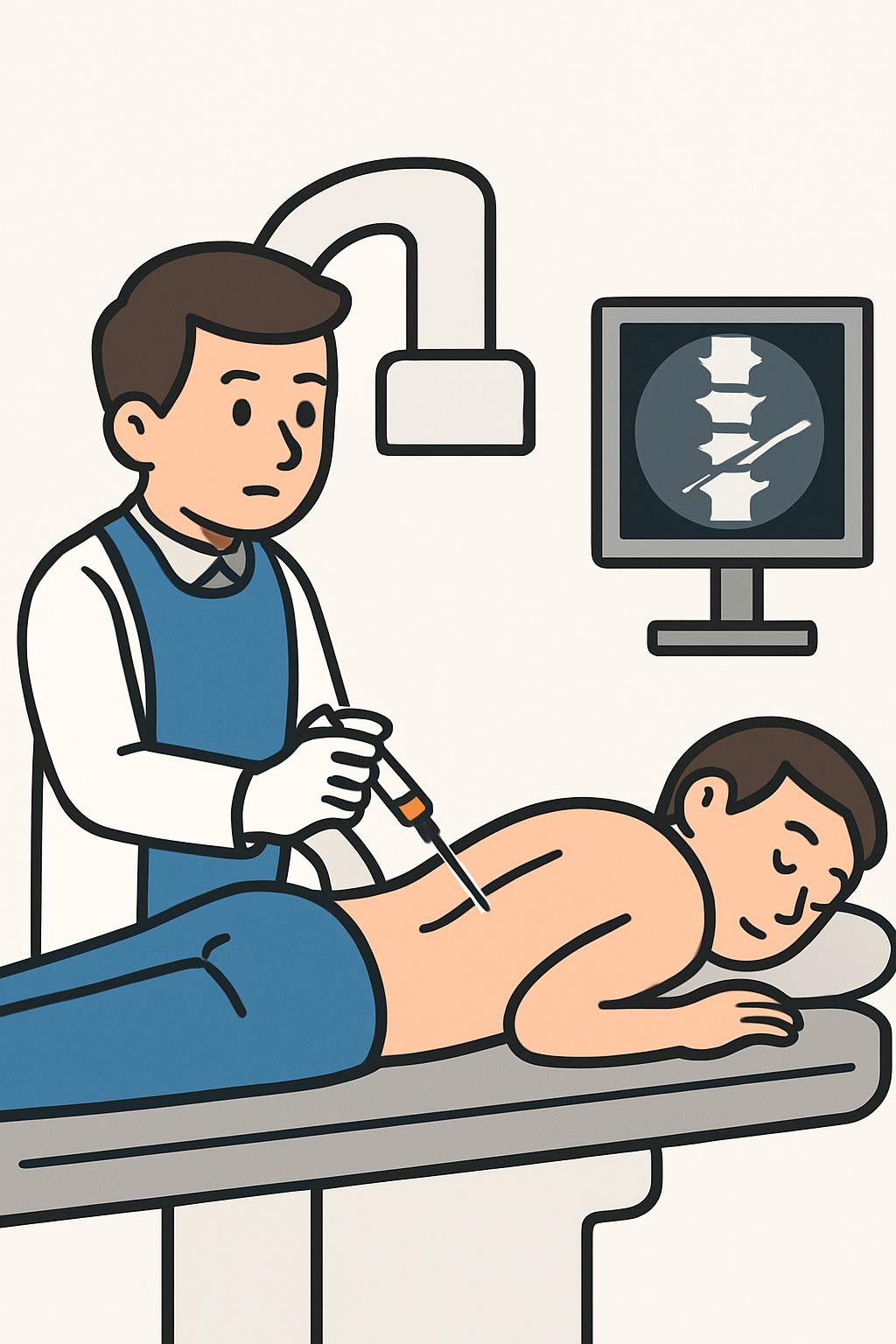
Fluoroscopy guidance for needle placement uses real-time x-ray video to help a clinician place a needle accurately.
Overview
Fluoroscopy guidance for needle placement uses real-time x-ray video to help a clinician place a needle accurately. It is often used for injections, aspirations, biopsies, nerve blocks, or to place drains or catheters. The live imaging helps the clinician see the needle path, confirm position, and avoid sensitive structures. A small amount of iodinated contrast dye may be used to verify the location before delivering medicine or collecting a sample.
Also known as: Fluoroscopic guidance, Fluoro-guided needle placement, X-ray guidance
Preparation & Next Steps
Everything you need to know before and after your procedure
Before Care
- Bring a photo ID, insurance card, and any prior relevant imaging reports or discs
- Share any allergies, especially to iodine/contrast, latex, antiseptics, or medicines
- Tell the team if you are pregnant or there is a chance of pregnancy
- Provide an up-to-date list of all medicines and supplements, including blood thinners
- Ask the care team if any medicines need timing adjustments before the procedure
- Follow any fasting instructions if sedation or anesthesia is planned
- Arrange a ride home in case sedation is used or your clinic recommends it
- Wear comfortable clothing and be prepared to remove metal or jewelry near the area
- Confirm the exact body part and side to be treated when you check in
- Follow your center’s instructions about hydration if contrast may be used
After Care
- A small bandage is usually placed; keep the area clean and dry for about a day unless told otherwise
- Mild soreness or bruising near the site is common; simple measures like rest or ice are often used
- If contrast was used, many centers encourage drinking fluids over the day to help clear it; confirm with your care team
- If you received sedation, driving and important decision-making are typically restricted for the rest of the day
- Avoid heavy lifting or strenuous activity involving the treated area for 24–48 hours, as commonly recommended for needle procedures
- Watch for increasing pain, spreading redness or warmth, drainage, numbness or weakness, fever, or chills; contact the clinic if these occur
- A small amount of spotting at the site may occur; apply gentle pressure and call if bleeding continues
- Know how and when you will receive results if a sample was taken; pathology or culture results may take several days
- Track how your symptoms change after the procedure to discuss at follow-up
- Confirm when to resume any medicines that were adjusted for the procedure
Clinical Information
Important medical details about this procedure
Indications
- Targeted joint injections or aspirations
- Spinal procedures such as epidural or facet injections
- Nerve blocks or ablations
- Biopsy of bone or soft tissue
- Placement of drainage catheters for fluid collections
- Lumbar puncture or difficult access procedures
- Vascular access or venography when appropriate
Alternatives
- Ultrasound-guided needle placement
- CT-guided needle placement
- MRI-guided procedures in select settings
- Landmark-based (blind) technique without imaging
- Surgical or endoscopic approaches when indicated
Risks
- Radiation exposure from x-rays
- Allergic reaction to iodinated contrast (if used)
- Kidney effects in at-risk people from iodinated contrast (if used)
- Bleeding or bruising at the needle site
- Infection at the needle site
- Injury to nearby nerves, blood vessels, or organs
- Temporary increase in pain or discomfort
- Skin injury from prolonged fluoroscopy time (rare)
Contraindications
- Known severe allergy to iodinated contrast without an alternative plan
- Pregnancy when a non-radiation option is reasonably available
- Uncontrolled bleeding disorder or anticoagulation not managed for the procedure
- Active infection at the planned needle site
- Inability to cooperate or remain still for the procedure
Recovery Timeline
What to expect during your recovery
Most people resume light daily activities the same day. Soreness at the site may last a day or two, depending on where the needle was placed and whether sedation was used.
Typical Range
0–2 days
Return to Work
0–2 days
Recovery Milestones
Resume light daily activities if you feel well and were not sedated
Driving is typically restricted the day of sedation
Monitor the bandage site for bleeding, redness, or swelling
Return to normal activities if the site is comfortable
Frequently Asked Questions
Common questions and expert answers about this procedure
What is fluoroscopy and how is it different from a regular x-ray?
What is fluoroscopy and how is it different from a regular x-ray?
Fluoroscopy is a live x-ray video that shows movement in real time. A regular x-ray is a single snapshot.
Why use fluoroscopy for needle placement?
Why use fluoroscopy for needle placement?
The live images help guide the needle to the target and confirm position, which can improve accuracy and reduce repeat passes.
Will contrast dye be used?
Will contrast dye be used?
Sometimes a small amount of iodinated contrast is injected to verify needle position. It is not always needed.
How long does the procedure take?
How long does the procedure take?
Timing varies by body part and purpose. Many fluoroscopy-guided needle procedures take about 15 to 60 minutes including setup.
How much radiation is involved?
How much radiation is involved?
Exposure varies with the body area and time used. Teams use techniques to keep dose as low as reasonably achievable.
Can this be done without x-rays?
Can this be done without x-rays?
Some procedures can use ultrasound or CT guidance instead. The best method depends on the target and the purpose.
What if I am pregnant or might be pregnant?
What if I am pregnant or might be pregnant?
X-rays are generally avoided in pregnancy when a good alternative exists. Your team may consider ultrasound guidance or other options.
Who performs the procedure?
Who performs the procedure?
It is commonly done by a radiologist, pain specialist, or other trained clinician, often with a technologist assisting.
References
Medical literature and sources