%20--%3e%3csvg%20version='1.0'%20id='Layer_1'%20xmlns='http://www.w3.org/2000/svg'%20xmlns:xlink='http://www.w3.org/1999/xlink'%20x='0px'%20y='0px'%20viewBox='0%200%20755.52%20814.35'%20style='enable-background:new%200%200%20755.52%20814.35;'%20xml:space='preserve'%3e%3cstyle%20type='text/css'%3e%20.st0{fill:%231ae5ce;stroke:%231ae5ce;stroke-width:7;stroke-miterlimit:10;}%20.st1{fill:%23FFFFFF;stroke:%231ae5ce;stroke-width:7;stroke-miterlimit:10;}%20.st2{fill:%231ae5ce;stroke:%23FFFFFF;stroke-width:7;stroke-miterlimit:10;}%20.st3{fill:%23FFFFFF;stroke:%23FFFFFF;stroke-width:6;stroke-miterlimit:10;}%20%3c/style%3e%3cg%20id='Dark_Logo_00000159431215648494653180000015900878925932721032_'%3e%3cpath%20id='shield_00000152259091539869183100000001926543869452564382_'%20class='st0'%20d='M711.13,173.42%20c-3.37-49.07-38.92-44.9-75.96-52.18c-67.4-13.25-130.47-34.47-192.36-63.92c-22.48-10.7-41.88-25.74-65.05-26.28%20c-23.17,0.54-42.58,15.59-65.05,26.28c-61.89,29.45-124.95,50.68-192.36,63.92c-37.04,7.28-72.59,3.11-75.96,52.18%20c-1.55,22.6,0.34,46.4,1.05,68.92c5.99,190.78,52.91,345.39,206.27,466.46c29.71,23.46,74.51,55.8,108.84,70.75%20c5.99,2.61,11.7,3.73,17.21,3.75c5.51-0.02,11.22-1.14,17.21-3.75c34.33-14.95,79.12-47.3,108.84-70.75%20c153.37-121.07,200.28-275.68,206.27-466.46C710.79,219.82,712.68,196.02,711.13,173.42z'/%3e%3cpath%20id='magnifyingglass_00000073685934697636024790000000342567780940956808_'%20class='st1'%20d='M648.78,624.21l-96.64-104.65%20c34.89-40.63,55.98-93.46,55.98-151.21c0-128.27-103.98-232.24-232.24-232.24S143.63,240.08,143.63,368.35%20s103.98,232.24,232.24,232.24c48.87,0,94.21-15.11,131.62-40.89l97.18,105.24c11.25,12.18,30.24,12.93,42.42,1.69l0,0%20C659.27,655.38,660.03,636.39,648.78,624.21z'/%3e%3ccircle%20id='ellipse_00000129904010550392394720000017056154833629780114_'%20class='st2'%20cx='375.87'%20cy='368.35'%20r='181.21'/%3e%3cpath%20id='dollarsign_00000057140127156649725250000003772530148495155891_'%20class='st3'%20d='M362.91,492.03v-23.91%20c0-2.01-1.58-3.69-3.59-3.77c-18.49-0.78-37.12-5.4-49.4-11.83c-1.75-0.92-2.53-3.01-1.76-4.84l5.87-13.89%20c0.86-2.02,3.23-2.88,5.2-1.89c12.94,6.52,30.45,11.44,49.18,11.44c26.02,0,43.6-12.73,43.6-30.43c0-17.08-14.29-27.63-41.4-36.95%20c-37.37-12.42-60.46-26.7-60.46-53.72c0-24.97,20.29-44.11,52.22-49.51c1.8-0.31,3.11-1.89,3.11-3.72v-24.35%20c0-2.09,1.69-3.78,3.78-3.78h15.16c2.09,0,3.78,1.69,3.78,3.78v22.71c0,2.01,1.58,3.67,3.58,3.77c17.85,0.92,30.88,4.75,40.61,9.1%20c1.92,0.86,2.79,3.09,1.94,5.01l-6.08,13.6c-0.85,1.91-3.09,2.77-4.99,1.91c-8.37-3.8-22.38-8.95-42.75-8.95%20c-28.21,0-38.84,14.28-38.84,26.7c0,16.15,13.56,24.22,45.44,35.4c37.74,13.04,56.79,29.19,56.79,56.82%20c0,23.85-19.05,46.23-54.78,52.3c-1.8,0.31-3.11,1.89-3.11,3.72v25.28c0,2.09-1.69,3.78-3.78,3.78h-15.53%20C364.6,495.81,362.91,494.12,362.91,492.03z'/%3e%3c/g%3e%3c/svg%3e)
Holter monitor test (24-hour heart ECG recording) Diagnostic Imaging
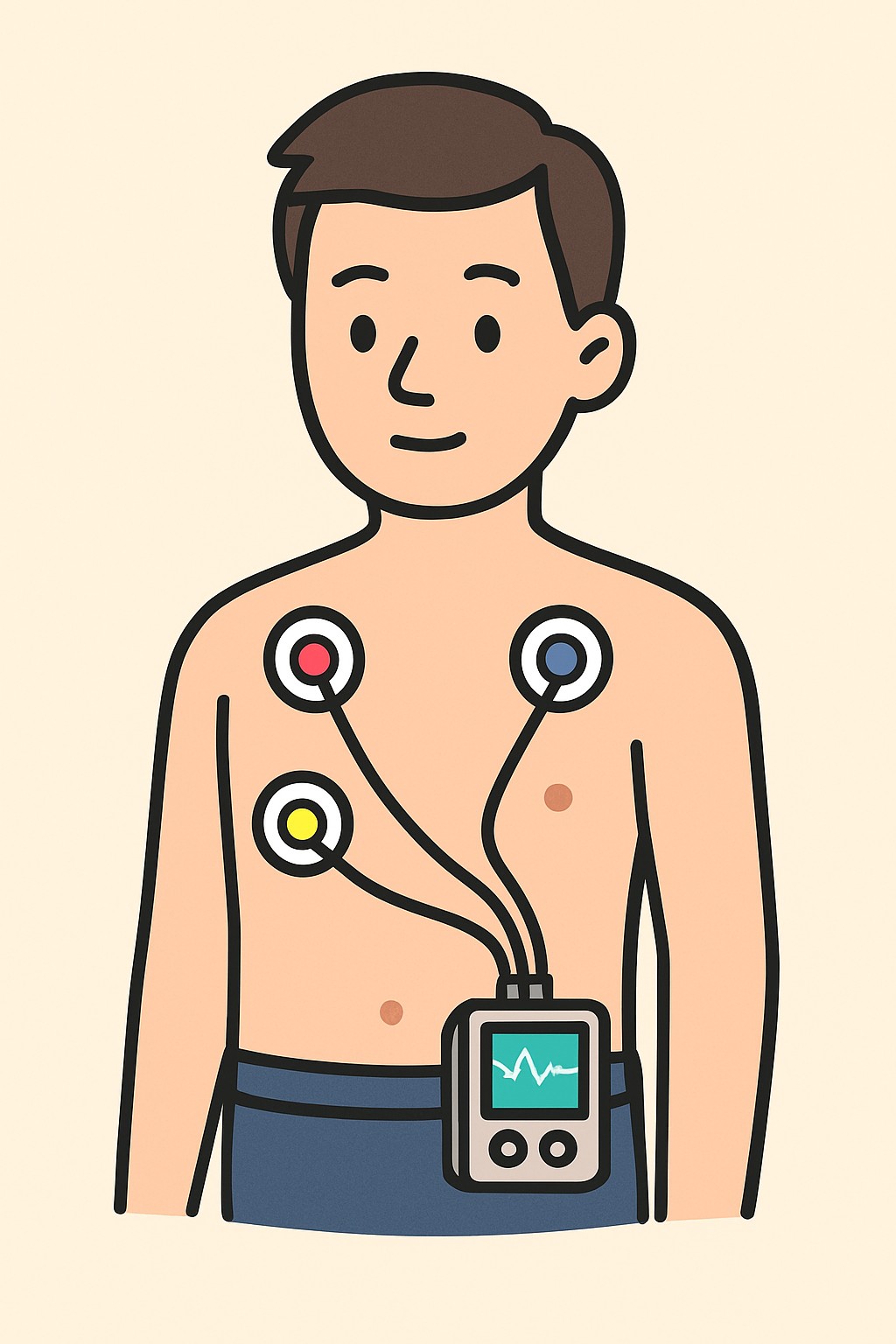
A Holter monitor test is a 24-hour recording of your heart’s electrical activity.
Overview
A Holter monitor test is a 24-hour recording of your heart’s electrical activity. Small sticky patches (electrodes) are placed on the chest and connected to a portable recorder you wear under your clothes. This continuous ECG helps find irregular heart rhythms that may not show up during a short, in-office ECG. It can also help check how well treatments for rhythm problems are working.
Also known as: 24-hour Holter, Ambulatory ECG, 24-hour EKG, Holter monitoring, Cardiac event recording (24-hour), Portable heart monitor
Preparation & Next Steps
Everything you need to know before and after your procedure
Before Care
- Shower or bathe before the appointment because most standard monitors must stay dry during wear
- Do not apply lotions, oils, or powders on the chest the day of placement to help electrodes stick
- Wear a comfortable two-piece outfit so the recorder can clip to a belt or waistband
- Bring an up-to-date list of your medicines and any known skin or tape allergies
- Ask the clinic how to keep a symptom diary and whether there is a button to mark events
- Plan normal daily activities during the recording to capture typical heart rhythms
- Confirm any work or sports restrictions, especially around water or contact activities
- Arrange how and when you will return the device and diary after the monitoring period
- Keep cell phones, magnets, and strong electrical tools away from the recorder as instructed
- If you have excess chest hair, be aware the clinic may shave small areas to improve contact
After Care
- Keep the monitor and electrodes dry unless you are told your device is water resistant
- Avoid removing or repositioning electrodes; if one loosens, follow the kit instructions or contact the clinic
- Carry on with usual daily activities to capture typical heart rhythms unless told otherwise
- Press the event marker if your device has one when you feel symptoms, then note the time and what you felt
- Record symptoms, activities, medicines, and sleep times in the diary as instructed
- Keep magnets, high-voltage equipment, and strong speakers away from the device
- If skin becomes very irritated, blisters, or bleeds around an electrode, contact the clinic
- Return the monitor, leads, and diary on time so the data can be analyzed
- After removal, gently clean any adhesive residue; skin redness usually fades within a day
- Expect results to be reviewed by a clinician after analysis; the clinic will share the report and next steps
Clinical Information
Important medical details about this procedure
Indications
- Palpitations or feeling of skipped or rapid beats
- Dizziness or lightheaded spells
- Fainting or near-fainting episodes
- Shortness of breath or chest discomfort with activity or rest
- Suspected atrial fibrillation or other arrhythmias
- Monitoring response to medicines for heart rhythm
- Intermittent slow heart rate or pauses
- Evaluation after a stroke or transient ischemic attack for occult arrhythmia
Alternatives
- Standard 12-lead ECG in the clinic
- Extended patch monitor (7–14 days or longer)
- Event recorder (patient-activated)
- Mobile cardiac telemetry
- Implantable loop recorder for infrequent symptoms
- Consumer wearable ECG features for screening (not a replacement for clinical monitoring)
Risks
- Skin irritation or rash from adhesive electrodes
- Allergic reaction to adhesive materials
- Discomfort from wires or tape on the skin
- Data gaps if electrodes loosen or are removed
- Privacy concerns because daily activities and symptoms are logged
- Interference from strong magnets or electrical fields may affect recording
Contraindications
- Active skin infection or severe dermatitis at electrode sites
- History of significant adhesive allergy without alternatives available
- Inability to keep the device dry if the monitor is not water resistant
- Work or environments where wearing external wires is unsafe
Recovery Timeline
What to expect during your recovery
There is no medical recovery time. People usually continue normal activities during the 24-hour recording and return the device as scheduled.
Typical Range
Same day
Return to Work
Same day
Recovery Milestones
Wear monitor during normal daily activities while keeping it dry
Remove and return monitor and diary as instructed
Await analysis and review results with the clinic
Frequently Asked Questions
Common questions and expert answers about this procedure
What is a Holter monitor?
What is a Holter monitor?
It is a portable device that records your heart’s electrical activity continuously for about 24 hours using chest electrodes and a small recorder.
How is this different from a regular ECG?
How is this different from a regular ECG?
A clinic ECG records only a few seconds. A Holter records continuously for a full day to catch rhythm problems that come and go.
Can I shower or swim while wearing it?
Can I shower or swim while wearing it?
Most standard 24-hour Holter monitors are not water resistant, so bathing and swimming are usually avoided until the monitor is removed.
Will it hurt or give me shocks?
Will it hurt or give me shocks?
No. It only records electrical signals from your heart. Some people notice mild skin irritation where electrodes are placed.
What activities are okay during the test?
What activities are okay during the test?
Normal daily activities are encouraged to capture typical rhythms. Avoid getting the device wet and keep strong magnets or high-voltage tools away.
What if an electrode falls off?
What if an electrode falls off?
Follow the kit instructions to reattach if provided, or contact the clinic for guidance. Note the time in your diary.
When will I get results?
When will I get results?
After you return the monitor, the recording is analyzed and a report is created. Many clinics share results within several days.
Is there radiation exposure?
Is there radiation exposure?
No. A Holter monitor only records your heart’s electrical signals and does not use radiation.
References
Medical literature and sources