%20--%3e%3csvg%20version='1.0'%20id='Layer_1'%20xmlns='http://www.w3.org/2000/svg'%20xmlns:xlink='http://www.w3.org/1999/xlink'%20x='0px'%20y='0px'%20viewBox='0%200%20755.52%20814.35'%20style='enable-background:new%200%200%20755.52%20814.35;'%20xml:space='preserve'%3e%3cstyle%20type='text/css'%3e%20.st0{fill:%231ae5ce;stroke:%231ae5ce;stroke-width:7;stroke-miterlimit:10;}%20.st1{fill:%23FFFFFF;stroke:%231ae5ce;stroke-width:7;stroke-miterlimit:10;}%20.st2{fill:%231ae5ce;stroke:%23FFFFFF;stroke-width:7;stroke-miterlimit:10;}%20.st3{fill:%23FFFFFF;stroke:%23FFFFFF;stroke-width:6;stroke-miterlimit:10;}%20%3c/style%3e%3cg%20id='Dark_Logo_00000159431215648494653180000015900878925932721032_'%3e%3cpath%20id='shield_00000152259091539869183100000001926543869452564382_'%20class='st0'%20d='M711.13,173.42%20c-3.37-49.07-38.92-44.9-75.96-52.18c-67.4-13.25-130.47-34.47-192.36-63.92c-22.48-10.7-41.88-25.74-65.05-26.28%20c-23.17,0.54-42.58,15.59-65.05,26.28c-61.89,29.45-124.95,50.68-192.36,63.92c-37.04,7.28-72.59,3.11-75.96,52.18%20c-1.55,22.6,0.34,46.4,1.05,68.92c5.99,190.78,52.91,345.39,206.27,466.46c29.71,23.46,74.51,55.8,108.84,70.75%20c5.99,2.61,11.7,3.73,17.21,3.75c5.51-0.02,11.22-1.14,17.21-3.75c34.33-14.95,79.12-47.3,108.84-70.75%20c153.37-121.07,200.28-275.68,206.27-466.46C710.79,219.82,712.68,196.02,711.13,173.42z'/%3e%3cpath%20id='magnifyingglass_00000073685934697636024790000000342567780940956808_'%20class='st1'%20d='M648.78,624.21l-96.64-104.65%20c34.89-40.63,55.98-93.46,55.98-151.21c0-128.27-103.98-232.24-232.24-232.24S143.63,240.08,143.63,368.35%20s103.98,232.24,232.24,232.24c48.87,0,94.21-15.11,131.62-40.89l97.18,105.24c11.25,12.18,30.24,12.93,42.42,1.69l0,0%20C659.27,655.38,660.03,636.39,648.78,624.21z'/%3e%3ccircle%20id='ellipse_00000129904010550392394720000017056154833629780114_'%20class='st2'%20cx='375.87'%20cy='368.35'%20r='181.21'/%3e%3cpath%20id='dollarsign_00000057140127156649725250000003772530148495155891_'%20class='st3'%20d='M362.91,492.03v-23.91%20c0-2.01-1.58-3.69-3.59-3.77c-18.49-0.78-37.12-5.4-49.4-11.83c-1.75-0.92-2.53-3.01-1.76-4.84l5.87-13.89%20c0.86-2.02,3.23-2.88,5.2-1.89c12.94,6.52,30.45,11.44,49.18,11.44c26.02,0,43.6-12.73,43.6-30.43c0-17.08-14.29-27.63-41.4-36.95%20c-37.37-12.42-60.46-26.7-60.46-53.72c0-24.97,20.29-44.11,52.22-49.51c1.8-0.31,3.11-1.89,3.11-3.72v-24.35%20c0-2.09,1.69-3.78,3.78-3.78h15.16c2.09,0,3.78,1.69,3.78,3.78v22.71c0,2.01,1.58,3.67,3.58,3.77c17.85,0.92,30.88,4.75,40.61,9.1%20c1.92,0.86,2.79,3.09,1.94,5.01l-6.08,13.6c-0.85,1.91-3.09,2.77-4.99,1.91c-8.37-3.8-22.38-8.95-42.75-8.95%20c-28.21,0-38.84,14.28-38.84,26.7c0,16.15,13.56,24.22,45.44,35.4c37.74,13.04,56.79,29.19,56.79,56.82%20c0,23.85-19.05,46.23-54.78,52.3c-1.8,0.31-3.11,1.89-3.11,3.72v25.28c0,2.09-1.69,3.78-3.78,3.78h-15.53%20C364.6,495.81,362.91,494.12,362.91,492.03z'/%3e%3c/g%3e%3c/svg%3e)
Home sleep study (unattended polysomnography) Diagnostic Imaging
A home sleep study is a test you do at home overnight to check for sleep breathing problems, most often obstructive sleep apnea.
Overview
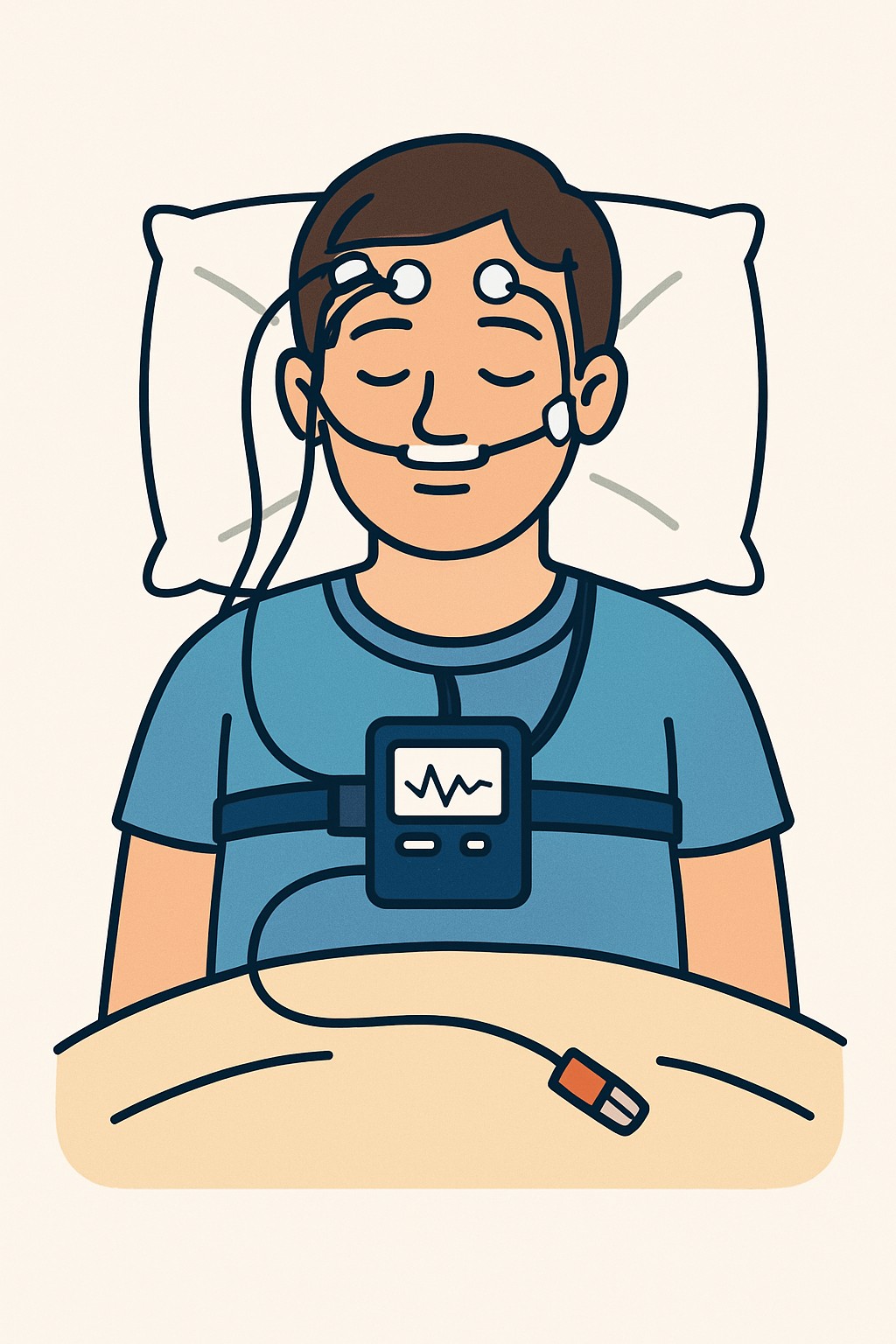
A home sleep study is a test you do at home overnight to check for sleep breathing problems, most often obstructive sleep apnea. You wear a small monitor with sensors that track breathing, airflow, oxygen level, heart rate, snoring, and body position while you sleep. It is called unattended because no technologist is present. Many people find it more comfortable than a lab study. Results are reviewed by a sleep clinician, who uses the data and your symptoms to decide on next steps.
Also known as: Home sleep apnea test, HSAT, Unattended sleep study, Portable sleep test
Preparation & Next Steps
Everything you need to know before and after your procedure
Before Care
- Review the setup instructions or video from the sleep center ahead of time
- Confirm how you will pick up, return, and get help for the device after hours
- Charge the device or insert fresh batteries and make sure it powers on
- Keep skin clean and dry where sensors will attach; avoid heavy lotions right before bed
- Remove nail polish or acrylic from one fingernail for the oxygen finger sensor to read correctly
- Plan for a typical night at home with minimal interruptions and a comfortable sleep space
- Gather a pen, any sleep log forms, and a clock or phone alarm for start and stop times
- Have a mirror available to help with sensor placement if needed
- If you use other nighttime medical devices, review any special instructions from the sleep center
- Arrange a safe path to the bathroom to avoid tripping on wires during the night
After Care
- In the morning, stop the recording and gently remove all sensors as instructed
- Check the device or app for an indicator that the recording completed successfully
- Clean your skin with mild soap and water and note any redness or irritation
- Pack the device, sensors, and paperwork in the return case or envelope
- Return or ship the kit promptly using the method provided by the sleep center
- Write down anything unusual about your night, such as awakenings or equipment issues
- Ask how results will be shared; timing varies by clinic and review process
- Report major equipment problems or very poor sleep to the sleep center; a repeat night or in-lab study may be arranged
- Contact the clinic if you develop a severe skin reaction, bleeding at sensor sites, or new breathing trouble
- Keep follow-up appointments to discuss the report and possible next steps
Clinical Information
Important medical details about this procedure
Indications
- Loud snoring and witnessed pauses in breathing during sleep
- Excessive daytime sleepiness or fatigue
- Morning headaches, dry mouth, or restless sleep
- Evaluating suspected obstructive sleep apnea in adults
- Monitoring sleep-disordered breathing in people with obesity and related symptoms
- Assessment linked to high blood pressure or heart rhythm concerns when OSA is suspected
Alternatives
- In-lab sleep study (attended polysomnography)
- Overnight oxygen saturation screening
- Sleep questionnaires and risk tools, such as STOP-Bang
- Sleep medicine consultation by video or in person
- Repeat clinical assessment over time
Risks
- Skin irritation or tape allergy at sensor sites
- Discomfort or poor sleep due to the equipment
- Technical problems that may require a repeat test
- Underestimation of apnea severity compared with an in-lab study
- Inconclusive results if sensors shift or fall off
Contraindications
- Significant heart or lung disease that needs closer monitoring
- Suspected central sleep apnea or sleep-related hypoventilation
- Neuromuscular disease with breathing muscle weakness
- Chronic opioid use
- History of stroke
- Severe insomnia or when other sleep disorders are suspected
Recovery Timeline
What to expect during your recovery
There is no medical recovery period. Most people resume normal activities after removing the sensors. You might feel a bit tired the next day if sleep was shorter than usual.
Typical Range
Same day
Return to Work
Same day
Recovery Milestones
Resume normal daily activities after removing sensors
Return or ship the device and paperwork as instructed
Review results with a clinician when available
Frequently Asked Questions
Common questions and expert answers about this procedure
What does a home sleep study measure?
What does a home sleep study measure?
It typically tracks breathing effort, airflow through the nose, blood oxygen level, heart rate, snoring sounds, and body position while you sleep.
How is it different from an in-lab sleep study?
How is it different from an in-lab sleep study?
It is done at home without a technologist and usually uses fewer sensors. It is mainly for checking obstructive sleep apnea and may not detect other sleep disorders.
Who is a typical candidate for a home sleep study?
Who is a typical candidate for a home sleep study?
Adults with signs and symptoms that suggest obstructive sleep apnea and without complex medical conditions that require in-lab monitoring.
What if I cannot sleep or a sensor falls off?
What if I cannot sleep or a sensor falls off?
Many recordings still provide enough data. If the study is incomplete or unclear, the sleep center may ask for a repeat night or schedule an in-lab study.
Is a home sleep study safe?
Is a home sleep study safe?
It is noninvasive. The most common issues are mild skin irritation or discomfort from adhesives and straps.
How many nights does the test take?
How many nights does the test take?
Often one night is enough. Some programs use two nights or repeat a study if the first night is unclear.
Can it diagnose problems other than obstructive sleep apnea?
Can it diagnose problems other than obstructive sleep apnea?
It is designed mainly to evaluate obstructive sleep apnea. Other sleep disorders usually need an in-lab study.