%20--%3e%3csvg%20version='1.0'%20id='Layer_1'%20xmlns='http://www.w3.org/2000/svg'%20xmlns:xlink='http://www.w3.org/1999/xlink'%20x='0px'%20y='0px'%20viewBox='0%200%20755.52%20814.35'%20style='enable-background:new%200%200%20755.52%20814.35;'%20xml:space='preserve'%3e%3cstyle%20type='text/css'%3e%20.st0{fill:%231ae5ce;stroke:%231ae5ce;stroke-width:7;stroke-miterlimit:10;}%20.st1{fill:%23FFFFFF;stroke:%231ae5ce;stroke-width:7;stroke-miterlimit:10;}%20.st2{fill:%231ae5ce;stroke:%23FFFFFF;stroke-width:7;stroke-miterlimit:10;}%20.st3{fill:%23FFFFFF;stroke:%23FFFFFF;stroke-width:6;stroke-miterlimit:10;}%20%3c/style%3e%3cg%20id='Dark_Logo_00000159431215648494653180000015900878925932721032_'%3e%3cpath%20id='shield_00000152259091539869183100000001926543869452564382_'%20class='st0'%20d='M711.13,173.42%20c-3.37-49.07-38.92-44.9-75.96-52.18c-67.4-13.25-130.47-34.47-192.36-63.92c-22.48-10.7-41.88-25.74-65.05-26.28%20c-23.17,0.54-42.58,15.59-65.05,26.28c-61.89,29.45-124.95,50.68-192.36,63.92c-37.04,7.28-72.59,3.11-75.96,52.18%20c-1.55,22.6,0.34,46.4,1.05,68.92c5.99,190.78,52.91,345.39,206.27,466.46c29.71,23.46,74.51,55.8,108.84,70.75%20c5.99,2.61,11.7,3.73,17.21,3.75c5.51-0.02,11.22-1.14,17.21-3.75c34.33-14.95,79.12-47.3,108.84-70.75%20c153.37-121.07,200.28-275.68,206.27-466.46C710.79,219.82,712.68,196.02,711.13,173.42z'/%3e%3cpath%20id='magnifyingglass_00000073685934697636024790000000342567780940956808_'%20class='st1'%20d='M648.78,624.21l-96.64-104.65%20c34.89-40.63,55.98-93.46,55.98-151.21c0-128.27-103.98-232.24-232.24-232.24S143.63,240.08,143.63,368.35%20s103.98,232.24,232.24,232.24c48.87,0,94.21-15.11,131.62-40.89l97.18,105.24c11.25,12.18,30.24,12.93,42.42,1.69l0,0%20C659.27,655.38,660.03,636.39,648.78,624.21z'/%3e%3ccircle%20id='ellipse_00000129904010550392394720000017056154833629780114_'%20class='st2'%20cx='375.87'%20cy='368.35'%20r='181.21'/%3e%3cpath%20id='dollarsign_00000057140127156649725250000003772530148495155891_'%20class='st3'%20d='M362.91,492.03v-23.91%20c0-2.01-1.58-3.69-3.59-3.77c-18.49-0.78-37.12-5.4-49.4-11.83c-1.75-0.92-2.53-3.01-1.76-4.84l5.87-13.89%20c0.86-2.02,3.23-2.88,5.2-1.89c12.94,6.52,30.45,11.44,49.18,11.44c26.02,0,43.6-12.73,43.6-30.43c0-17.08-14.29-27.63-41.4-36.95%20c-37.37-12.42-60.46-26.7-60.46-53.72c0-24.97,20.29-44.11,52.22-49.51c1.8-0.31,3.11-1.89,3.11-3.72v-24.35%20c0-2.09,1.69-3.78,3.78-3.78h15.16c2.09,0,3.78,1.69,3.78,3.78v22.71c0,2.01,1.58,3.67,3.58,3.77c17.85,0.92,30.88,4.75,40.61,9.1%20c1.92,0.86,2.79,3.09,1.94,5.01l-6.08,13.6c-0.85,1.91-3.09,2.77-4.99,1.91c-8.37-3.8-22.38-8.95-42.75-8.95%20c-28.21,0-38.84,14.28-38.84,26.7c0,16.15,13.56,24.22,45.44,35.4c37.74,13.04,56.79,29.19,56.79,56.82%20c0,23.85-19.05,46.23-54.78,52.3c-1.8,0.31-3.11,1.89-3.11,3.72v25.28c0,2.09-1.69,3.78-3.78,3.78h-15.53%20C364.6,495.81,362.91,494.12,362.91,492.03z'/%3e%3c/g%3e%3c/svg%3e)
Knee MRI without contrast Diagnostic Imaging
A knee MRI without contrast uses a strong magnet and radio waves to create detailed pictures of the knee joint without injecting dye.
Overview
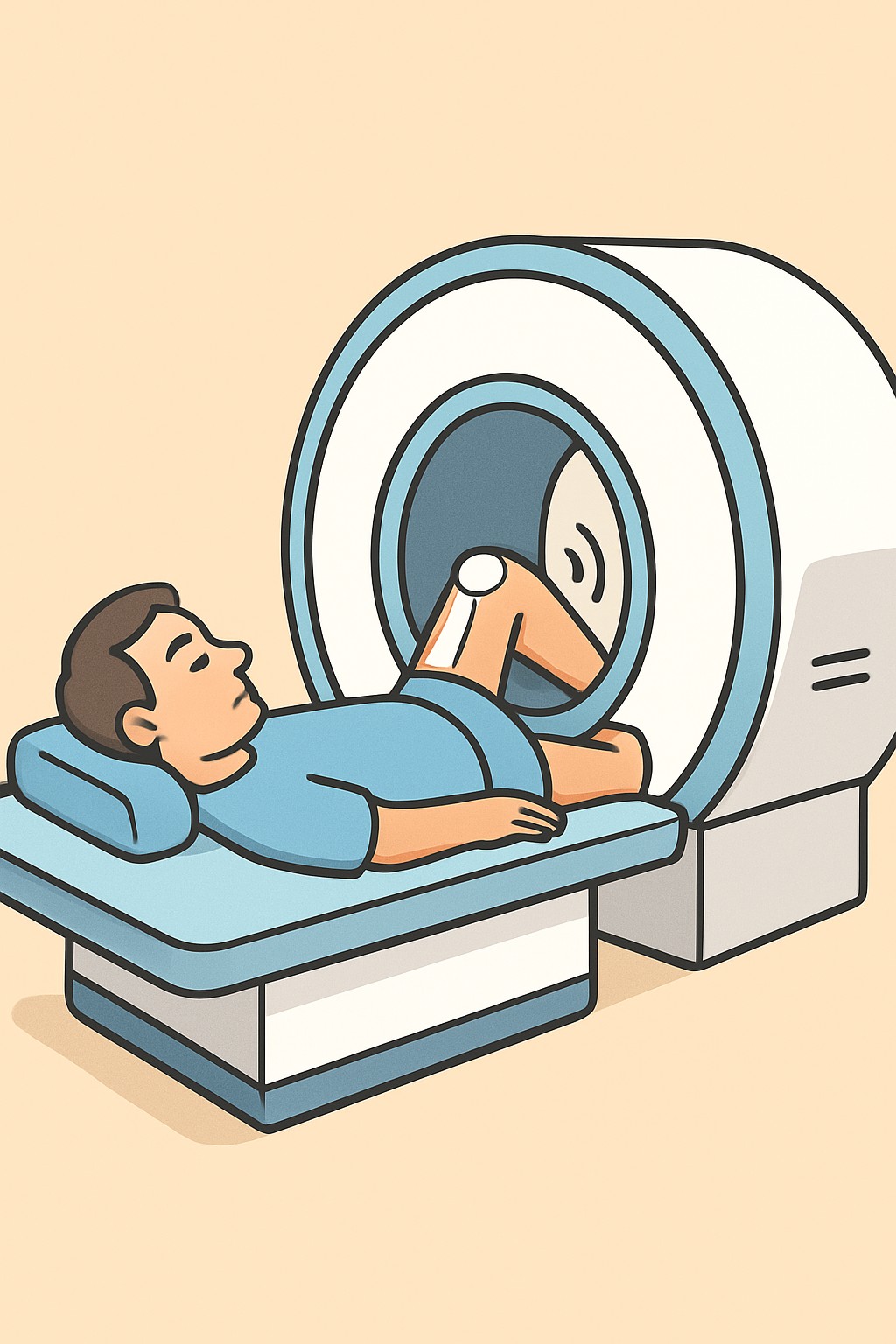
A knee MRI without contrast uses a strong magnet and radio waves to create detailed pictures of the knee joint without injecting dye. It shows soft tissues like the menisci, ligaments, tendons, cartilage, and the joint lining, as well as bone marrow. Clinicians order this test to look for injuries, unexplained knee pain, swelling, locking or catching, or to plan and check treatment. MRI does not use ionizing radiation.
Also known as: Non-contrast knee MRI, MRI knee no contrast, Knee MR imaging
Preparation & Next Steps
Everything you need to know before and after your procedure
Before Care
- Complete the MRI safety questionnaire and report any implants, metal fragments, surgeries, or tattoos.
- Bring implant or device cards so staff can confirm MRI conditions.
- Remove jewelry, piercings, hairpins, and clothing with zippers or snaps; wear metal-free clothing if possible.
- Tell the team about medication patches, insulin pumps, or continuous glucose monitors; some must be removed before scanning.
- No contrast is planned, so fasting is usually not required; follow any instructions from the imaging center.
- Arrive a bit early to check in and store personal items that cannot enter the scan room.
- Discuss motion limits or pain that may make it hard to hold still so positioning aids can be arranged.
- If you are prone to claustrophobia, ask the ordering clinician in advance about options such as an open MRI or calming medicine.
- Inform staff if you are or might be pregnant so they can follow safety policies.
- Expect loud sounds during scanning; hearing protection is provided.
After Care
- Most people resume normal activities right after the scan.
- If calming medicine was used, plan quiet time until fully alert and follow the facility’s instructions.
- Mild stiffness from lying still can occur; gentle movement usually helps.
- Check that you know how and when your results will be delivered (portal, disc, or sent to your clinician).
- Keep any device or implant cards with your records for future imaging visits.
- If a skin patch or sensor was removed for the scan, reapply or replace it per the manufacturer or clinician instructions.
- Contact the imaging center if you notice unexpected skin warmth, burns, or persistent pain related to the scan.
- Ask your clinician how the results fit into your overall care plan once the report is available.
Clinical Information
Important medical details about this procedure
Indications
- Knee pain, swelling, or stiffness
- Suspected meniscus or ligament tear (ACL, PCL, MCL, LCL)
- Cartilage injury or osteoarthritis assessment
- Knee locking, catching, or instability
- Tendon or muscle injury around the knee
- Bone marrow changes such as stress reaction or occult fracture
- Evaluation before or after knee surgery
- Persistent symptoms after normal X-rays
Alternatives
- X-ray to assess bones and joint space
- Ultrasound for superficial tendons, ligaments, and fluid
- CT scan for detailed bone imaging
- Physical exam with a period of watchful waiting
- Arthrocentesis to analyze joint fluid when infection or gout is suspected
- Arthroscopy as a diagnostic and treatment procedure in select cases
- MRI with contrast or MR arthrogram when specific questions require it
Risks
- Anxiety or claustrophobia inside the scanner
- Loud knocking sounds that may be uncomfortable
- Image blurring if movement occurs, which may require repeat images
- Heating or burns if metal objects, medication patches, or certain wires are present
- Interference with some implanted devices if they are not MRI-conditional
- Incidental findings that may lead to more tests
Contraindications
- Implanted devices or foreign bodies that are not MRI-safe (for example, some pacemakers or aneurysm clips)
- Known or suspected metal fragment in the eye
- Inability to lie still or severe claustrophobia without a plan for support
- Unstable medical conditions that cannot be monitored safely in MRI
Recovery Timeline
What to expect during your recovery
There is no medical recovery period for a standard knee MRI without contrast. Most people return to normal activities the same day.
Typical Range
Same day
Return to Work
Same day
Recovery Milestones
Resume normal daily activities
Review how and when results will be shared
Discuss MRI findings with your clinician as scheduled
Frequently Asked Questions
Common questions and expert answers about this procedure
What does a knee MRI without contrast show?
What does a knee MRI without contrast show?
It shows detailed images of menisci, ligaments, tendons, cartilage, bone marrow, and joint lining to help find tears, swelling, and other problems.
How long does the scan take?
How long does the scan take?
Most knee MRIs take about 30 to 60 minutes, depending on the scanner and how many image sets are needed.
Will it hurt?
Will it hurt?
The scan is painless. You will need to hold still. The machine is noisy, but hearing protection is provided.
Is MRI safe if I have metal or an implant?
Is MRI safe if I have metal or an implant?
Some implants are MRI-conditional and can be scanned under set rules. Others are not safe. Staff check device details before scanning.
Why no contrast for this exam?
Why no contrast for this exam?
Most knee injuries and degenerative changes are visible without contrast. Contrast is reserved for specific questions or after some surgeries.
What is the difference between MRI and X-ray?
What is the difference between MRI and X-ray?
MRI shows soft tissues in detail and uses no ionizing radiation. X-rays show bones and joint space well but have limited soft tissue detail.
When will I get results?
When will I get results?
A radiologist reviews the images and sends a report to your clinician, often within 1 to 2 business days depending on the facility.
References
Medical literature and sources