%20--%3e%3csvg%20version='1.0'%20id='Layer_1'%20xmlns='http://www.w3.org/2000/svg'%20xmlns:xlink='http://www.w3.org/1999/xlink'%20x='0px'%20y='0px'%20viewBox='0%200%20755.52%20814.35'%20style='enable-background:new%200%200%20755.52%20814.35;'%20xml:space='preserve'%3e%3cstyle%20type='text/css'%3e%20.st0{fill:%231ae5ce;stroke:%231ae5ce;stroke-width:7;stroke-miterlimit:10;}%20.st1{fill:%23FFFFFF;stroke:%231ae5ce;stroke-width:7;stroke-miterlimit:10;}%20.st2{fill:%231ae5ce;stroke:%23FFFFFF;stroke-width:7;stroke-miterlimit:10;}%20.st3{fill:%23FFFFFF;stroke:%23FFFFFF;stroke-width:6;stroke-miterlimit:10;}%20%3c/style%3e%3cg%20id='Dark_Logo_00000159431215648494653180000015900878925932721032_'%3e%3cpath%20id='shield_00000152259091539869183100000001926543869452564382_'%20class='st0'%20d='M711.13,173.42%20c-3.37-49.07-38.92-44.9-75.96-52.18c-67.4-13.25-130.47-34.47-192.36-63.92c-22.48-10.7-41.88-25.74-65.05-26.28%20c-23.17,0.54-42.58,15.59-65.05,26.28c-61.89,29.45-124.95,50.68-192.36,63.92c-37.04,7.28-72.59,3.11-75.96,52.18%20c-1.55,22.6,0.34,46.4,1.05,68.92c5.99,190.78,52.91,345.39,206.27,466.46c29.71,23.46,74.51,55.8,108.84,70.75%20c5.99,2.61,11.7,3.73,17.21,3.75c5.51-0.02,11.22-1.14,17.21-3.75c34.33-14.95,79.12-47.3,108.84-70.75%20c153.37-121.07,200.28-275.68,206.27-466.46C710.79,219.82,712.68,196.02,711.13,173.42z'/%3e%3cpath%20id='magnifyingglass_00000073685934697636024790000000342567780940956808_'%20class='st1'%20d='M648.78,624.21l-96.64-104.65%20c34.89-40.63,55.98-93.46,55.98-151.21c0-128.27-103.98-232.24-232.24-232.24S143.63,240.08,143.63,368.35%20s103.98,232.24,232.24,232.24c48.87,0,94.21-15.11,131.62-40.89l97.18,105.24c11.25,12.18,30.24,12.93,42.42,1.69l0,0%20C659.27,655.38,660.03,636.39,648.78,624.21z'/%3e%3ccircle%20id='ellipse_00000129904010550392394720000017056154833629780114_'%20class='st2'%20cx='375.87'%20cy='368.35'%20r='181.21'/%3e%3cpath%20id='dollarsign_00000057140127156649725250000003772530148495155891_'%20class='st3'%20d='M362.91,492.03v-23.91%20c0-2.01-1.58-3.69-3.59-3.77c-18.49-0.78-37.12-5.4-49.4-11.83c-1.75-0.92-2.53-3.01-1.76-4.84l5.87-13.89%20c0.86-2.02,3.23-2.88,5.2-1.89c12.94,6.52,30.45,11.44,49.18,11.44c26.02,0,43.6-12.73,43.6-30.43c0-17.08-14.29-27.63-41.4-36.95%20c-37.37-12.42-60.46-26.7-60.46-53.72c0-24.97,20.29-44.11,52.22-49.51c1.8-0.31,3.11-1.89,3.11-3.72v-24.35%20c0-2.09,1.69-3.78,3.78-3.78h15.16c2.09,0,3.78,1.69,3.78,3.78v22.71c0,2.01,1.58,3.67,3.58,3.77c17.85,0.92,30.88,4.75,40.61,9.1%20c1.92,0.86,2.79,3.09,1.94,5.01l-6.08,13.6c-0.85,1.91-3.09,2.77-4.99,1.91c-8.37-3.8-22.38-8.95-42.75-8.95%20c-28.21,0-38.84,14.28-38.84,26.7c0,16.15,13.56,24.22,45.44,35.4c37.74,13.04,56.79,29.19,56.79,56.82%20c0,23.85-19.05,46.23-54.78,52.3c-1.8,0.31-3.11,1.89-3.11,3.72v25.28c0,2.09-1.69,3.78-3.78,3.78h-15.53%20C364.6,495.81,362.91,494.12,362.91,492.03z'/%3e%3c/g%3e%3c/svg%3e)
Knee X-ray (complete 4+ views) Diagnostic Imaging
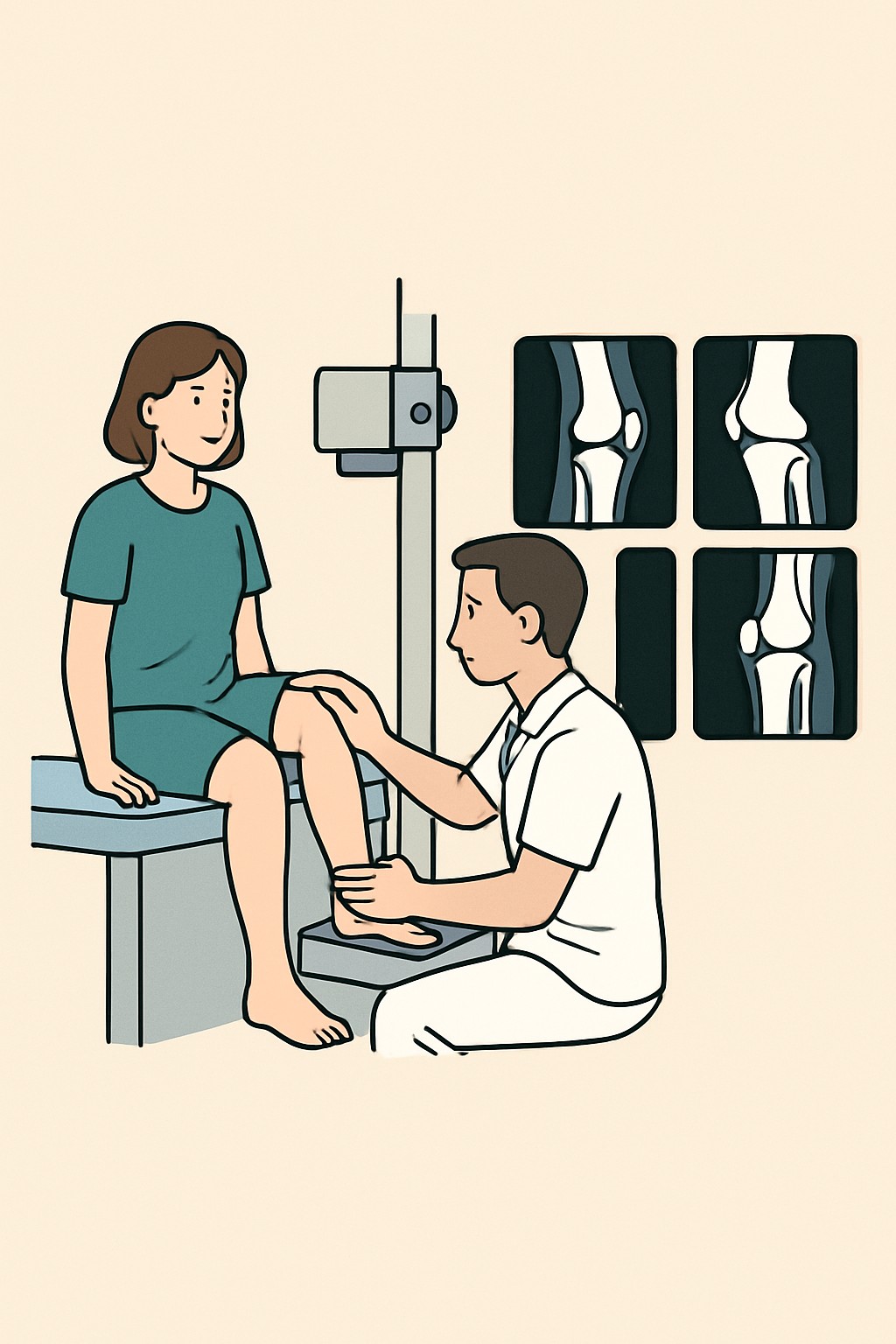
A knee X-ray with 4 or more views is a set of plain radiographs taken from different angles to show the bones of the knee.
Overview
A knee X-ray with 4 or more views is a set of plain radiographs taken from different angles to show the bones of the knee. It does not use contrast dye or sedation. Clinicians use this study to look for fractures, dislocations, arthritis changes, bone alignment, or hardware position after surgery. It can also show signs of bone infection or tumors, but soft tissues like ligaments and cartilage are not well seen on X-ray.
Also known as: Knee radiograph, Knee plain film, Knee series, Knee x-ray 4 views
Preparation & Next Steps
Everything you need to know before and after your procedure
Before Care
- Bring the imaging order, photo ID, insurance card, and any prior knee images or reports if available
- Wear loose, comfortable clothing; you may be asked to change into a gown
- Remove metal objects near the knee, such as jewelry, belts, or clothing with zippers or snaps
- Tell the imaging staff if you are or might be pregnant
- Inform staff about prior surgeries, metal implants, or hardware in the knee or leg
- Arrive a little early to complete check-in and confirm how results will be delivered
- If knee pain limits movement, let the technologist know so positions can be adjusted
- Plan footwear that is easy to remove; you may be asked to stand for some views
- No fasting or special diet is typically needed for a standard knee X-ray
After Care
- You can usually return to normal activities right after the X-ray
- If you arrived with a brace, splint, or assistive device, continue using it as previously directed by your care team
- Ask when the report will be ready and how you will receive results
- Keep copies of images or reports for your records when offered
- If additional imaging is ordered based on the results, schedule it when contacted
- Contact the ordering clinic with questions about findings or next steps
- Report any new or worsening symptoms to your clinician
Clinical Information
Important medical details about this procedure
Indications
- Acute knee injury with pain, swelling, or deformity
- Suspected fracture or dislocation
- Chronic knee pain or stiffness
- Evaluation for osteoarthritis or other degenerative changes
- Follow-up of known fractures or post-surgical hardware
- Assessment of bone infection or tumor
- Checking alignment before or after treatment
Alternatives
- MRI of the knee for ligaments, menisci, cartilage, or occult fractures
- CT scan for complex fractures or detailed bone mapping
- Ultrasound to assess effusion or some tendon issues
- Bone scan or nuclear medicine studies for infection or stress injury
- Watchful waiting with clinical follow-up when appropriate
Risks
- Low dose exposure to ionizing radiation
- Extra caution needed during pregnancy due to fetal sensitivity to radiation
- Discomfort from positioning the knee during imaging
- Incidental findings that may lead to more tests
Contraindications
- Known or suspected pregnancy, especially if imaging could expose the abdomen
- Inability to remain still or be positioned safely
- Severe pain or instability that prevents required positions
Recovery Timeline
What to expect during your recovery
There is no medical recovery period from a knee X-ray. Most people resume normal activities right away.
Typical Range
Same day
Return to Work
Same day
Recovery Milestones
Resume normal daily activities
Obtain preliminary report if available
Review final report with the ordering clinician
Frequently Asked Questions
Common questions and expert answers about this procedure
What does a 4+ view knee X-ray mean?
What does a 4+ view knee X-ray mean?
It is a series of four or more images taken from different angles to better show the knee bones and alignment.
Do I need to fast or stop medicines?
Do I need to fast or stop medicines?
No special diet or medicine changes are typically needed for a standard knee X-ray.
Will I be exposed to radiation?
Will I be exposed to radiation?
Yes, X-rays use a low dose of ionizing radiation. No radiation remains in your body after the exam.
Can an X-ray show ligaments or cartilage tears?
Can an X-ray show ligaments or cartilage tears?
Not well. X-rays show bones. MRI is often used to evaluate ligaments, menisci, and cartilage.
How long does the exam take?
How long does the exam take?
Most knee X-ray exams take about 10 to 15 minutes, depending on positioning and the number of views.
Will it hurt?
Will it hurt?
The X-ray itself is painless. Holding certain positions may be uncomfortable if your knee is injured.
Do I need an order or referral?
Do I need an order or referral?
Many imaging centers require an order from a licensed clinician. Check local requirements and your insurance.
When will I get results?
When will I get results?
A radiologist reviews the images and sends a report to the ordering clinician, often the same day or within a couple of days.
References
Medical literature and sources