%20--%3e%3csvg%20version='1.0'%20id='Layer_1'%20xmlns='http://www.w3.org/2000/svg'%20xmlns:xlink='http://www.w3.org/1999/xlink'%20x='0px'%20y='0px'%20viewBox='0%200%20755.52%20814.35'%20style='enable-background:new%200%200%20755.52%20814.35;'%20xml:space='preserve'%3e%3cstyle%20type='text/css'%3e%20.st0{fill:%231ae5ce;stroke:%231ae5ce;stroke-width:7;stroke-miterlimit:10;}%20.st1{fill:%23FFFFFF;stroke:%231ae5ce;stroke-width:7;stroke-miterlimit:10;}%20.st2{fill:%231ae5ce;stroke:%23FFFFFF;stroke-width:7;stroke-miterlimit:10;}%20.st3{fill:%23FFFFFF;stroke:%23FFFFFF;stroke-width:6;stroke-miterlimit:10;}%20%3c/style%3e%3cg%20id='Dark_Logo_00000159431215648494653180000015900878925932721032_'%3e%3cpath%20id='shield_00000152259091539869183100000001926543869452564382_'%20class='st0'%20d='M711.13,173.42%20c-3.37-49.07-38.92-44.9-75.96-52.18c-67.4-13.25-130.47-34.47-192.36-63.92c-22.48-10.7-41.88-25.74-65.05-26.28%20c-23.17,0.54-42.58,15.59-65.05,26.28c-61.89,29.45-124.95,50.68-192.36,63.92c-37.04,7.28-72.59,3.11-75.96,52.18%20c-1.55,22.6,0.34,46.4,1.05,68.92c5.99,190.78,52.91,345.39,206.27,466.46c29.71,23.46,74.51,55.8,108.84,70.75%20c5.99,2.61,11.7,3.73,17.21,3.75c5.51-0.02,11.22-1.14,17.21-3.75c34.33-14.95,79.12-47.3,108.84-70.75%20c153.37-121.07,200.28-275.68,206.27-466.46C710.79,219.82,712.68,196.02,711.13,173.42z'/%3e%3cpath%20id='magnifyingglass_00000073685934697636024790000000342567780940956808_'%20class='st1'%20d='M648.78,624.21l-96.64-104.65%20c34.89-40.63,55.98-93.46,55.98-151.21c0-128.27-103.98-232.24-232.24-232.24S143.63,240.08,143.63,368.35%20s103.98,232.24,232.24,232.24c48.87,0,94.21-15.11,131.62-40.89l97.18,105.24c11.25,12.18,30.24,12.93,42.42,1.69l0,0%20C659.27,655.38,660.03,636.39,648.78,624.21z'/%3e%3ccircle%20id='ellipse_00000129904010550392394720000017056154833629780114_'%20class='st2'%20cx='375.87'%20cy='368.35'%20r='181.21'/%3e%3cpath%20id='dollarsign_00000057140127156649725250000003772530148495155891_'%20class='st3'%20d='M362.91,492.03v-23.91%20c0-2.01-1.58-3.69-3.59-3.77c-18.49-0.78-37.12-5.4-49.4-11.83c-1.75-0.92-2.53-3.01-1.76-4.84l5.87-13.89%20c0.86-2.02,3.23-2.88,5.2-1.89c12.94,6.52,30.45,11.44,49.18,11.44c26.02,0,43.6-12.73,43.6-30.43c0-17.08-14.29-27.63-41.4-36.95%20c-37.37-12.42-60.46-26.7-60.46-53.72c0-24.97,20.29-44.11,52.22-49.51c1.8-0.31,3.11-1.89,3.11-3.72v-24.35%20c0-2.09,1.69-3.78,3.78-3.78h15.16c2.09,0,3.78,1.69,3.78,3.78v22.71c0,2.01,1.58,3.67,3.58,3.77c17.85,0.92,30.88,4.75,40.61,9.1%20c1.92,0.86,2.79,3.09,1.94,5.01l-6.08,13.6c-0.85,1.91-3.09,2.77-4.99,1.91c-8.37-3.8-22.38-8.95-42.75-8.95%20c-28.21,0-38.84,14.28-38.84,26.7c0,16.15,13.56,24.22,45.44,35.4c37.74,13.04,56.79,29.19,56.79,56.82%20c0,23.85-19.05,46.23-54.78,52.3c-1.8,0.31-3.11,1.89-3.11,3.72v25.28c0,2.09-1.69,3.78-3.78,3.78h-15.53%20C364.6,495.81,362.91,494.12,362.91,492.03z'/%3e%3c/g%3e%3c/svg%3e)
Limb arterial plethysmography (pulse volume) Diagnostic Imaging
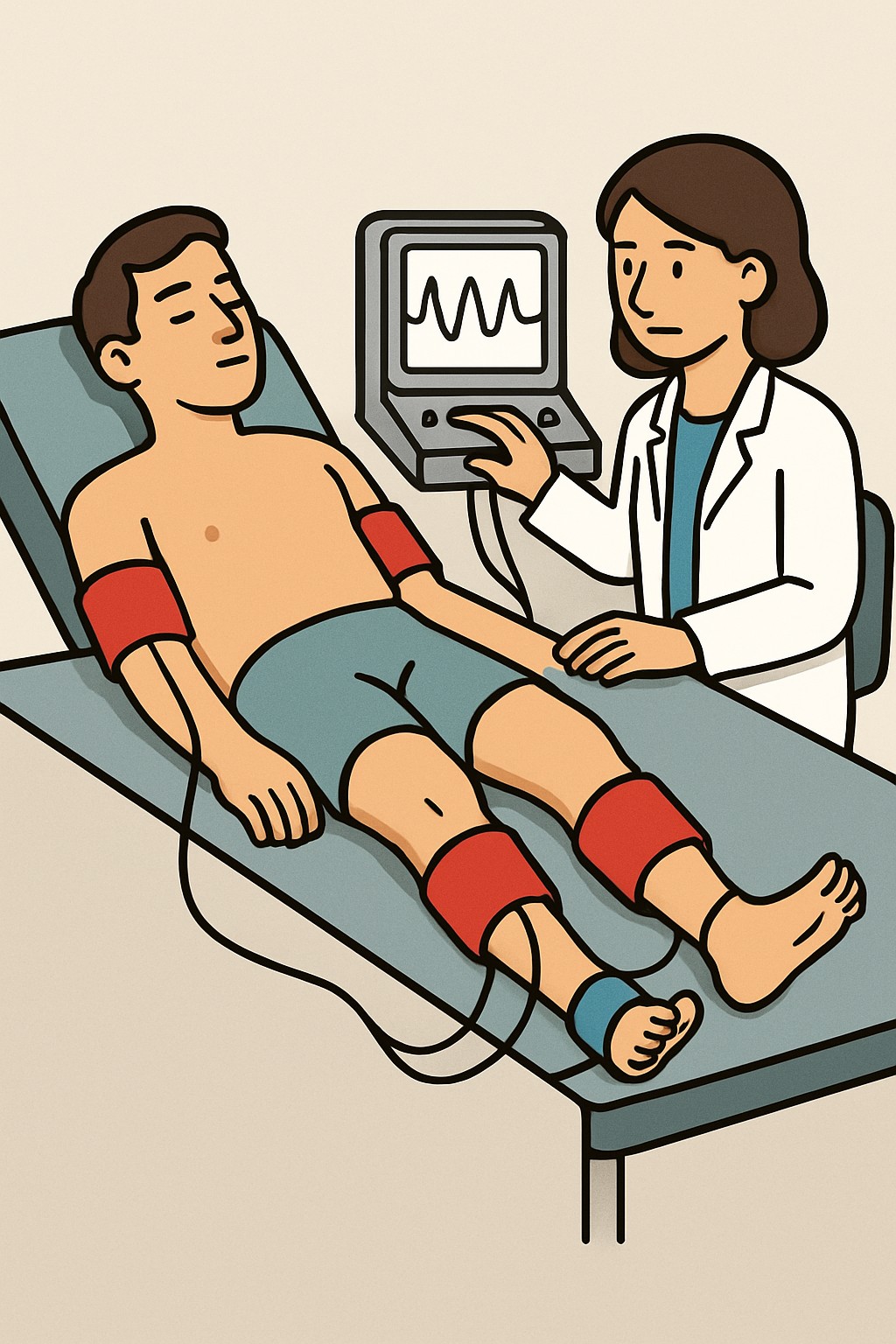
Limb arterial plethysmography, often called pulse volume recording (PVR), is a noninvasive test that uses blood pressure cuffs and sensors to measure changes in limb volume with each heartbeat.
Overview
Limb arterial plethysmography, often called pulse volume recording (PVR), is a noninvasive test that uses blood pressure cuffs and sensors to measure changes in limb volume with each heartbeat. These changes create waveforms that reflect blood flow to the arms, legs, or toes. Clinics use PVR to help evaluate peripheral artery disease (PAD), to estimate how severe blockages are, and to locate where along the limb blood flow may be reduced. It can be done at rest and sometimes after brief exercise to see how circulation responds.
Also known as: Pulse volume recording (PVR), Segmental limb plethysmography, Arterial pulse volume test, Physiologic arterial testing
Preparation & Next Steps
Everything you need to know before and after your procedure
Before Care
- Wear loose clothing so cuffs can be placed on your thighs, calves, ankles, or toes
- Avoid applying lotions or oils on the limbs the day of the test so cuffs do not slip
- Many labs ask you to avoid nicotine and caffeine for several hours before testing because they affect blood vessels
- Bring a current list of medicines and vascular procedures you have had
- Arrive a bit early for check-in and to confirm your medical history
- If you use compression stockings, ask the lab whether to remove them before the test
- Bring comfortable walking shoes in case an exercise portion is performed
- Plan for 30 to 90 minutes, depending on how many limb segments are measured
After Care
- You can usually return to normal activities right after the test
- Mild redness or impressions from cuffs should fade within hours
- If there was an exercise portion, rest as needed the same day
- Keep skin clean and dry where cuffs were placed
- Resume using compression garments if you normally wear them, unless your clinician advised otherwise
- Review how and when you will receive results from the lab or ordering clinician
- Contact a clinician if you notice new or worsening leg pain, color changes, coolness, or numbness
- Ask the clinic how results will guide next steps, such as more imaging or treatment options
Clinical Information
Important medical details about this procedure
Indications
- Leg pain with walking (claudication)
- Foot or toe pain at rest due to poor circulation
- Nonhealing wounds or ulcers on the legs or feet
- Coldness, numbness, or color changes in a limb
- Follow-up after a stent, bypass, or other revascularization
- Assessment when ankle-brachial index is unreliable (for example, calcified vessels in diabetes or kidney disease)
Alternatives
- Ankle-brachial index (ABI) or toe-brachial index (TBI)
- Arterial duplex ultrasound
- Transcutaneous oxygen measurement (TcPO2) or skin perfusion pressure
- Exercise treadmill vascular testing
- CT angiography (CTA) or MR angiography (MRA)
- Catheter-based angiography (invasive imaging)
Risks
- Temporary discomfort or tightness from inflated cuffs
- Skin irritation or redness where cuffs contact the skin
- Rare bruising from cuff pressure
- Dizziness or leg fatigue if an exercise portion is included
- Test limitations in the presence of severe swelling or open wounds
Contraindications
- Open wounds, severe skin infection, or recent surgery where a cuff would be placed
- Severe pain or intolerance to cuff inflation
- Fragile skin or conditions where pressure could cause injury at the cuff site
Recovery Timeline
What to expect during your recovery
This is a noninvasive test with no medical recovery period. Most people return to usual activity right away.
Typical Range
Same day
Return to Work
Same day
Recovery Milestones
Resume normal daily activities
Temporary skin marks from cuffs fade
Review test results if available in your portal
Frequently Asked Questions
Common questions and expert answers about this procedure
What is limb arterial plethysmography (pulse volume)?
What is limb arterial plethysmography (pulse volume)?
It is a test that uses blood pressure cuffs and sensors to record blood flow waveforms in the arms or legs. The waveforms help show if arteries are narrowed or blocked.
How is the test performed?
How is the test performed?
Cuffs are placed on the limb segments and gently inflated. Sensors record volume changes with each heartbeat. Pressures may be compared to arm readings, and sometimes a short walk test is added.
How long does it take?
How long does it take?
Most studies take 30 to 60 minutes. Adding multiple limb segments or an exercise portion can take longer.
Does it involve radiation or needles?
Does it involve radiation or needles?
No. It is noninvasive, uses no needles, and does not use radiation.
Is the test painful?
Is the test painful?
You may feel tightness when the cuffs inflate. This can be uncomfortable but usually lasts less than a minute at a time.
Do I need to fast or stop medicines?
Do I need to fast or stop medicines?
Fasting is usually not required. Many labs ask people to avoid nicotine and caffeine for a few hours because these can change blood flow. Follow any instructions from the testing site.
What can affect the results?
What can affect the results?
Smoking, caffeine, very cold temperatures, swelling, tight clothing, and bandages can change readings. The test is helpful even when arteries are calcified and pressure readings are hard to interpret.
How are results reported?
How are results reported?
Reports describe waveform shapes and segmental changes. A drop in waveforms between segments suggests where a blockage may be. The report may also include ankle or toe pressure ratios.
References
Medical literature and sources