%20--%3e%3csvg%20version='1.0'%20id='Layer_1'%20xmlns='http://www.w3.org/2000/svg'%20xmlns:xlink='http://www.w3.org/1999/xlink'%20x='0px'%20y='0px'%20viewBox='0%200%20755.52%20814.35'%20style='enable-background:new%200%200%20755.52%20814.35;'%20xml:space='preserve'%3e%3cstyle%20type='text/css'%3e%20.st0{fill:%231ae5ce;stroke:%231ae5ce;stroke-width:7;stroke-miterlimit:10;}%20.st1{fill:%23FFFFFF;stroke:%231ae5ce;stroke-width:7;stroke-miterlimit:10;}%20.st2{fill:%231ae5ce;stroke:%23FFFFFF;stroke-width:7;stroke-miterlimit:10;}%20.st3{fill:%23FFFFFF;stroke:%23FFFFFF;stroke-width:6;stroke-miterlimit:10;}%20%3c/style%3e%3cg%20id='Dark_Logo_00000159431215648494653180000015900878925932721032_'%3e%3cpath%20id='shield_00000152259091539869183100000001926543869452564382_'%20class='st0'%20d='M711.13,173.42%20c-3.37-49.07-38.92-44.9-75.96-52.18c-67.4-13.25-130.47-34.47-192.36-63.92c-22.48-10.7-41.88-25.74-65.05-26.28%20c-23.17,0.54-42.58,15.59-65.05,26.28c-61.89,29.45-124.95,50.68-192.36,63.92c-37.04,7.28-72.59,3.11-75.96,52.18%20c-1.55,22.6,0.34,46.4,1.05,68.92c5.99,190.78,52.91,345.39,206.27,466.46c29.71,23.46,74.51,55.8,108.84,70.75%20c5.99,2.61,11.7,3.73,17.21,3.75c5.51-0.02,11.22-1.14,17.21-3.75c34.33-14.95,79.12-47.3,108.84-70.75%20c153.37-121.07,200.28-275.68,206.27-466.46C710.79,219.82,712.68,196.02,711.13,173.42z'/%3e%3cpath%20id='magnifyingglass_00000073685934697636024790000000342567780940956808_'%20class='st1'%20d='M648.78,624.21l-96.64-104.65%20c34.89-40.63,55.98-93.46,55.98-151.21c0-128.27-103.98-232.24-232.24-232.24S143.63,240.08,143.63,368.35%20s103.98,232.24,232.24,232.24c48.87,0,94.21-15.11,131.62-40.89l97.18,105.24c11.25,12.18,30.24,12.93,42.42,1.69l0,0%20C659.27,655.38,660.03,636.39,648.78,624.21z'/%3e%3ccircle%20id='ellipse_00000129904010550392394720000017056154833629780114_'%20class='st2'%20cx='375.87'%20cy='368.35'%20r='181.21'/%3e%3cpath%20id='dollarsign_00000057140127156649725250000003772530148495155891_'%20class='st3'%20d='M362.91,492.03v-23.91%20c0-2.01-1.58-3.69-3.59-3.77c-18.49-0.78-37.12-5.4-49.4-11.83c-1.75-0.92-2.53-3.01-1.76-4.84l5.87-13.89%20c0.86-2.02,3.23-2.88,5.2-1.89c12.94,6.52,30.45,11.44,49.18,11.44c26.02,0,43.6-12.73,43.6-30.43c0-17.08-14.29-27.63-41.4-36.95%20c-37.37-12.42-60.46-26.7-60.46-53.72c0-24.97,20.29-44.11,52.22-49.51c1.8-0.31,3.11-1.89,3.11-3.72v-24.35%20c0-2.09,1.69-3.78,3.78-3.78h15.16c2.09,0,3.78,1.69,3.78,3.78v22.71c0,2.01,1.58,3.67,3.58,3.77c17.85,0.92,30.88,4.75,40.61,9.1%20c1.92,0.86,2.79,3.09,1.94,5.01l-6.08,13.6c-0.85,1.91-3.09,2.77-4.99,1.91c-8.37-3.8-22.38-8.95-42.75-8.95%20c-28.21,0-38.84,14.28-38.84,26.7c0,16.15,13.56,24.22,45.44,35.4c37.74,13.04,56.79,29.19,56.79,56.82%20c0,23.85-19.05,46.23-54.78,52.3c-1.8,0.31-3.11,1.89-3.11,3.72v25.28c0,2.09-1.69,3.78-3.78,3.78h-15.53%20C364.6,495.81,362.91,494.12,362.91,492.03z'/%3e%3c/g%3e%3c/svg%3e)
MRI brain (without contrast) Diagnostic Imaging
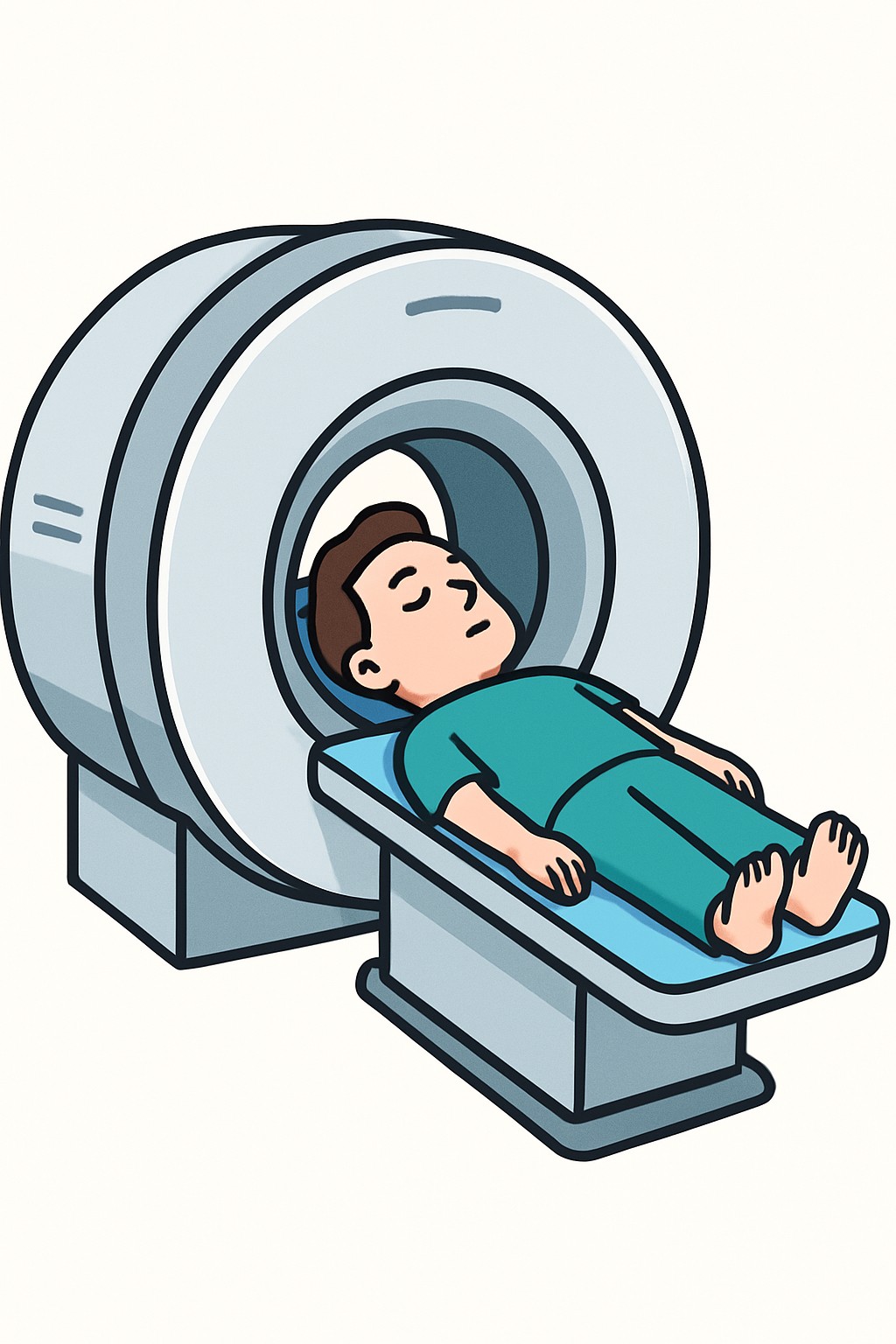
An MRI brain without contrast is an imaging test that uses a strong magnet and radio waves to create detailed pictures of the brain.
Overview
An MRI brain without contrast is an imaging test that uses a strong magnet and radio waves to create detailed pictures of the brain. It does not use dye. The scanner records signals from water in your tissues and a computer builds cross sectional images. Clinicians order this study to look for causes of symptoms such as headaches, stroke symptoms, seizures, or after head injury. It helps detect problems like bleeding, swelling, stroke, some tumors, infections, and multiple sclerosis plaques without exposing you to radiation.
Also known as: Brain MRI, Head MRI, MRI head without contrast, Non-contrast brain MRI
Preparation & Next Steps
Everything you need to know before and after your procedure
Before Care
- Complete the MRI safety screening and list all implants, surgeries, and prior metal injuries or exposures
- Bring device cards or model details for any implants such as pacemakers, stimulators, or aneurysm clips
- Tell the staff if you may have metal in your eye from grinding or welding, as an eye X ray may be needed
- Remove jewelry, piercings, watches, hearing aids, dentures, glasses, hairpins, and clothing with metal
- Avoid cosmetics with metallic particles such as some glitter or magnetic lashes on the day of the scan
- Wear comfortable metal free clothing or be ready to change into a facility gown
- Expect loud knocking sounds; ear protection is provided during the scan
- Eating and drinking are usually allowed for non contrast MRI; follow any facility instructions if sedation is planned
- Share any history of claustrophobia so the facility can discuss options such as coaching, music, or open MRI
- Arrive a little early to review forms, lockers, and expectations; leave valuables and bank cards outside the MRI room
After Care
- Most people return to normal activities right after the scan
- If a sedative was used, plan for limited activities until the effects wear off according to the facility plan
- Ears may feel temporarily sensitive or ring; this usually fades after leaving the scanner
- If you notice skin warmth, redness, or discomfort at a patch or tattoo site after the scan, contact the imaging center
- If your implant was placed in a special MRI mode, confirm any required post scan steps with your device team
- Check your patient portal or with the ordering clinician for the radiology report, which is typically available within a few days
- Keep copies of prior brain images so the radiologist can compare them with new studies
- Notify the ordering clinician about any concerns or new symptoms after the exam
Clinical Information
Important medical details about this procedure
Indications
- New or worsening headaches
- Stroke symptoms such as weakness, numbness, or trouble speaking
- Seizures or new seizure like events
- Head injury or concussion
- Evaluation of multiple sclerosis
- Dizziness or balance problems
- Hearing loss or tinnitus when brain causes are suspected
- Brain infection or inflammation suspected
- Follow up of known brain conditions without need for contrast
Alternatives
- CT scan of the head
- MRI of the brain with contrast when indicated
- MR angiography or CT angiography to evaluate blood vessels
- Carotid ultrasound for neck vessel evaluation
- Neurologic exam with observation and follow up
- Lumbar puncture when bleeding or infection is suspected
- Electroencephalogram (EEG) for seizure evaluation
Risks
- Loud sounds and possible temporary ear ringing without proper ear protection
- Feeling confined or anxious in the scanner
- Implant or metal related hazards if items are not MRI safe
- Rare skin heating or burns from metal on or in the skin, such as some patches or wires
- Incidental findings that may lead to more tests
- Movement can blur images and require repeat sequences
Contraindications
- MR unsafe implants or devices such as some pacemakers, aneurysm clips, or cochlear implants
- Metal fragment in or near the eye that has not been cleared
- External devices or monitors with long leads not approved for MRI environment
- Inability to lie flat and still for the exam without a safe plan for sedation
Recovery Timeline
What to expect during your recovery
There is no medical recovery time for a non contrast brain MRI. Most people resume normal activities immediately after leaving the scanner.
Typical Range
Same day
Return to Work
Same day
Recovery Milestones
Resume usual daily activities
If a sedative was used, expect temporary drowsiness
Review results with the ordering clinician when available
Frequently Asked Questions
Common questions and expert answers about this procedure
What is the difference between MRI with and without contrast?
What is the difference between MRI with and without contrast?
Without contrast uses only the magnet and radio waves. With contrast adds a gadolinium based dye that can highlight blood vessels, inflammation, and some tumors when needed.
How long does a brain MRI without contrast take?
How long does a brain MRI without contrast take?
The scan itself usually takes 20 to 45 minutes, depending on the sequences and how still you can lie.
Is there radiation from MRI?
Is there radiation from MRI?
No. MRI uses a magnetic field and radio waves, not X rays. There is no ionizing radiation exposure.
Can I have an MRI if I have a pacemaker or other implant?
Can I have an MRI if I have a pacemaker or other implant?
Some devices are labeled MRI conditional and can be scanned under specific settings. Others are not safe. The facility will confirm the exact make and model before scheduling.
What if I am claustrophobic?
What if I am claustrophobic?
Facilities can offer coaching, music, mirrored periscope glasses, open or wider bore scanners, and in some cases a mild sedative. Tell the team ahead of time.
Do I need to fast before a non contrast brain MRI?
Do I need to fast before a non contrast brain MRI?
Fasting is not usually required. If sedation or anesthesia is planned, the facility will provide specific eating and drinking instructions.
When will I get results?
When will I get results?
A radiologist reads the images and sends a report to the ordering clinician, often within a few days. Timing varies by site.
How is MRI different from a head CT?
How is MRI different from a head CT?
CT uses X rays and is quick, useful for bleeding or bone injury. MRI gives more detail for soft tissues like brain and spinal fluid and avoids radiation.
References
Medical literature and sources