%20--%3e%3csvg%20version='1.0'%20id='Layer_1'%20xmlns='http://www.w3.org/2000/svg'%20xmlns:xlink='http://www.w3.org/1999/xlink'%20x='0px'%20y='0px'%20viewBox='0%200%20755.52%20814.35'%20style='enable-background:new%200%200%20755.52%20814.35;'%20xml:space='preserve'%3e%3cstyle%20type='text/css'%3e%20.st0{fill:%231ae5ce;stroke:%231ae5ce;stroke-width:7;stroke-miterlimit:10;}%20.st1{fill:%23FFFFFF;stroke:%231ae5ce;stroke-width:7;stroke-miterlimit:10;}%20.st2{fill:%231ae5ce;stroke:%23FFFFFF;stroke-width:7;stroke-miterlimit:10;}%20.st3{fill:%23FFFFFF;stroke:%23FFFFFF;stroke-width:6;stroke-miterlimit:10;}%20%3c/style%3e%3cg%20id='Dark_Logo_00000159431215648494653180000015900878925932721032_'%3e%3cpath%20id='shield_00000152259091539869183100000001926543869452564382_'%20class='st0'%20d='M711.13,173.42%20c-3.37-49.07-38.92-44.9-75.96-52.18c-67.4-13.25-130.47-34.47-192.36-63.92c-22.48-10.7-41.88-25.74-65.05-26.28%20c-23.17,0.54-42.58,15.59-65.05,26.28c-61.89,29.45-124.95,50.68-192.36,63.92c-37.04,7.28-72.59,3.11-75.96,52.18%20c-1.55,22.6,0.34,46.4,1.05,68.92c5.99,190.78,52.91,345.39,206.27,466.46c29.71,23.46,74.51,55.8,108.84,70.75%20c5.99,2.61,11.7,3.73,17.21,3.75c5.51-0.02,11.22-1.14,17.21-3.75c34.33-14.95,79.12-47.3,108.84-70.75%20c153.37-121.07,200.28-275.68,206.27-466.46C710.79,219.82,712.68,196.02,711.13,173.42z'/%3e%3cpath%20id='magnifyingglass_00000073685934697636024790000000342567780940956808_'%20class='st1'%20d='M648.78,624.21l-96.64-104.65%20c34.89-40.63,55.98-93.46,55.98-151.21c0-128.27-103.98-232.24-232.24-232.24S143.63,240.08,143.63,368.35%20s103.98,232.24,232.24,232.24c48.87,0,94.21-15.11,131.62-40.89l97.18,105.24c11.25,12.18,30.24,12.93,42.42,1.69l0,0%20C659.27,655.38,660.03,636.39,648.78,624.21z'/%3e%3ccircle%20id='ellipse_00000129904010550392394720000017056154833629780114_'%20class='st2'%20cx='375.87'%20cy='368.35'%20r='181.21'/%3e%3cpath%20id='dollarsign_00000057140127156649725250000003772530148495155891_'%20class='st3'%20d='M362.91,492.03v-23.91%20c0-2.01-1.58-3.69-3.59-3.77c-18.49-0.78-37.12-5.4-49.4-11.83c-1.75-0.92-2.53-3.01-1.76-4.84l5.87-13.89%20c0.86-2.02,3.23-2.88,5.2-1.89c12.94,6.52,30.45,11.44,49.18,11.44c26.02,0,43.6-12.73,43.6-30.43c0-17.08-14.29-27.63-41.4-36.95%20c-37.37-12.42-60.46-26.7-60.46-53.72c0-24.97,20.29-44.11,52.22-49.51c1.8-0.31,3.11-1.89,3.11-3.72v-24.35%20c0-2.09,1.69-3.78,3.78-3.78h15.16c2.09,0,3.78,1.69,3.78,3.78v22.71c0,2.01,1.58,3.67,3.58,3.77c17.85,0.92,30.88,4.75,40.61,9.1%20c1.92,0.86,2.79,3.09,1.94,5.01l-6.08,13.6c-0.85,1.91-3.09,2.77-4.99,1.91c-8.37-3.8-22.38-8.95-42.75-8.95%20c-28.21,0-38.84,14.28-38.84,26.7c0,16.15,13.56,24.22,45.44,35.4c37.74,13.04,56.79,29.19,56.79,56.82%20c0,23.85-19.05,46.23-54.78,52.3c-1.8,0.31-3.11,1.89-3.11,3.72v25.28c0,2.09-1.69,3.78-3.78,3.78h-15.53%20C364.6,495.81,362.91,494.12,362.91,492.03z'/%3e%3c/g%3e%3c/svg%3e)
MRI Knee (without contrast) Diagnostic Imaging
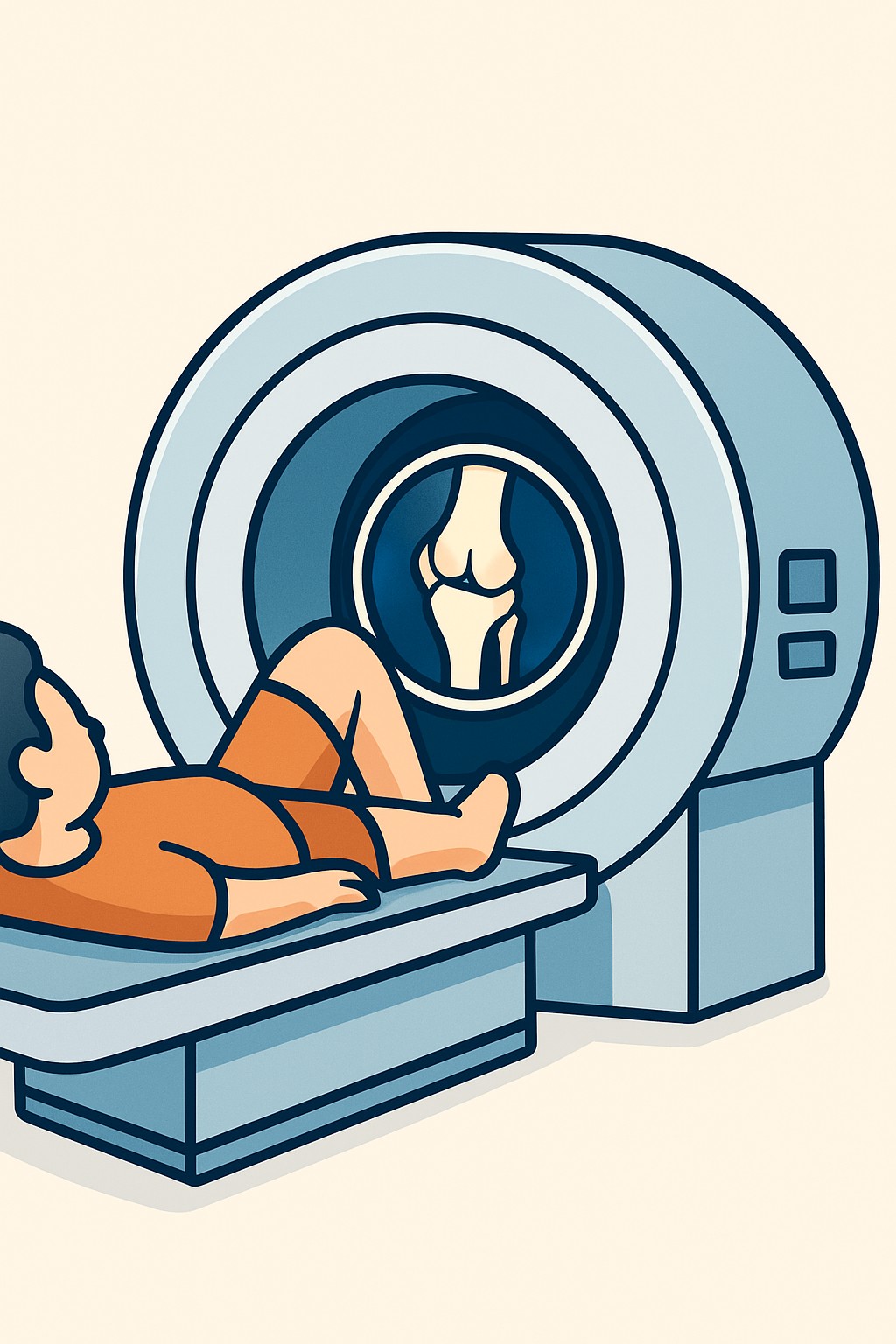
An MRI knee without contrast is a scan that uses a strong magnet and radio waves to create detailed pictures of the knee.
Overview
An MRI knee without contrast is a scan that uses a strong magnet and radio waves to create detailed pictures of the knee. It does not use contrast dye. The images show bones, cartilage, menisci, ligaments, tendons, and soft tissues. Clinicians use this test to look for injuries or conditions that may not show on an x-ray. It helps evaluate pain, swelling, locking, or instability, and can help plan treatment.
Also known as: Knee MRI without contrast, Non-contrast knee MRI, MRI of the knee (no contrast)
Preparation & Next Steps
Everything you need to know before and after your procedure
Before Care
- Complete the MRI safety questionnaire and list all prior surgeries and implants
- Bring device or implant cards so staff can confirm MRI compatibility
- Wear comfortable clothing without metal; remove jewelry, piercings, watches, and hairpins
- No fasting is usually needed for a non-contrast MRI; confirm any instructions from the imaging center
- Tell the team about any chance of pregnancy or past metal in the eyes
- Share prior knee images and reports if available to help with comparison
- Arrive a bit early to review consent and safety screening paperwork
- Discuss options for claustrophobia, such as music, a wider-bore or open MRI, or sedation if offered
- Leave valuables at home and secure items with metal before the exam
- Follow any instructions for MRI-conditional devices, including bringing necessary paperwork
After Care
- Resume normal activities after the scan unless you received sedation
- If sedation was used, arrange a ride and plan quiet rest until the medicine wears off
- Review how and when results will be shared, such as through a portal or a follow-up visit
- Keep a copy of your images or portal access details for future care
- Let the imaging center know if you notice skin irritation where coils or pads touched
- If you have an MRI-conditional device, follow the team’s instructions for any post-scan checks
- Contact your clinician about new or worsening knee pain, swelling, locking, or fever after the scan
- Store any implant safety documents from this visit with your medical records
Clinical Information
Important medical details about this procedure
Indications
- Knee pain or swelling
- Suspected meniscus tear
- Ligament injury (ACL, PCL, MCL, LCL)
- Cartilage damage or osteoarthritis changes
- Knee locking or catching
- Unexplained knee instability
- Stress fractures not seen on x-ray
- Evaluation after injury when exam is unclear
Alternatives
- Physical exam and watchful waiting
- X-ray to assess bones and joint space
- Ultrasound for effusions, cysts, or some tendon problems
- CT scan when detailed bone views are needed
- Arthroscopy as a diagnostic and treatment procedure
- Physical therapy and activity modification
Risks
- Claustrophobia or anxiety inside the scanner
- Loud noise during the scan requiring ear protection
- Discomfort from lying still
- Potential issues with metal or electronic implants if not MRI-safe
- Very rare skin heating or burns if coils or cables touch the skin
- Incidental findings that may lead to more testing
Contraindications
- MRI-unsafe implanted devices (some pacemakers, defibrillators, cochlear implants)
- Certain older aneurysm clips or metallic fragments in or near the eye
- External or internal metal objects that are not cleared as MRI-safe
- Inability to lie still or flat without sedation
- Severe claustrophobia when sedation or open MRI is not available
Recovery Timeline
What to expect during your recovery
Most people return to normal activities right after a non-contrast knee MRI. There is no medical recovery period unless sedation is used.
Typical Range
Same day
Return to Work
Same day
Recovery Milestones
Resume normal daily activities
If sedation was used, rest and avoid driving until fully alert
Review results via portal or with your clinician
Frequently Asked Questions
Common questions and expert answers about this procedure
What does without contrast mean?
What does without contrast mean?
It means no contrast dye is injected. The scan relies on the magnet and radio waves to make images.
How long does a knee MRI take?
How long does a knee MRI take?
Many MRI exams take about 30 to 60 minutes. Time varies by scanner and how many image sets are needed.
Does an MRI use radiation?
Does an MRI use radiation?
No. MRI uses a strong magnet and radio waves, not ionizing radiation.
Can I have a knee MRI if I have a pacemaker or metal implant?
Can I have a knee MRI if I have a pacemaker or metal implant?
Some devices are MRI-conditional and can be scanned with special steps. Others are not safe. The team will check device details.
What will it feel and sound like?
What will it feel and sound like?
You will lie still while the table moves into the scanner. It can be loud; ear protection is provided. You can usually talk to the technologist.
Do I need to stop eating or taking medicines?
Do I need to stop eating or taking medicines?
Fasting is usually not required for a non-contrast MRI. Follow any instructions from the imaging center.
Is an open MRI an option?
Is an open MRI an option?
Some centers offer wide-bore or open MRI, which can feel less confining. Image quality and availability vary by site.
How will I get results?
How will I get results?
A radiologist reads the images and sends a report to your clinician. You may see the report in your patient portal when it is released.
References
Medical literature and sources