%20--%3e%3csvg%20version='1.0'%20id='Layer_1'%20xmlns='http://www.w3.org/2000/svg'%20xmlns:xlink='http://www.w3.org/1999/xlink'%20x='0px'%20y='0px'%20viewBox='0%200%20755.52%20814.35'%20style='enable-background:new%200%200%20755.52%20814.35;'%20xml:space='preserve'%3e%3cstyle%20type='text/css'%3e%20.st0{fill:%231ae5ce;stroke:%231ae5ce;stroke-width:7;stroke-miterlimit:10;}%20.st1{fill:%23FFFFFF;stroke:%231ae5ce;stroke-width:7;stroke-miterlimit:10;}%20.st2{fill:%231ae5ce;stroke:%23FFFFFF;stroke-width:7;stroke-miterlimit:10;}%20.st3{fill:%23FFFFFF;stroke:%23FFFFFF;stroke-width:6;stroke-miterlimit:10;}%20%3c/style%3e%3cg%20id='Dark_Logo_00000159431215648494653180000015900878925932721032_'%3e%3cpath%20id='shield_00000152259091539869183100000001926543869452564382_'%20class='st0'%20d='M711.13,173.42%20c-3.37-49.07-38.92-44.9-75.96-52.18c-67.4-13.25-130.47-34.47-192.36-63.92c-22.48-10.7-41.88-25.74-65.05-26.28%20c-23.17,0.54-42.58,15.59-65.05,26.28c-61.89,29.45-124.95,50.68-192.36,63.92c-37.04,7.28-72.59,3.11-75.96,52.18%20c-1.55,22.6,0.34,46.4,1.05,68.92c5.99,190.78,52.91,345.39,206.27,466.46c29.71,23.46,74.51,55.8,108.84,70.75%20c5.99,2.61,11.7,3.73,17.21,3.75c5.51-0.02,11.22-1.14,17.21-3.75c34.33-14.95,79.12-47.3,108.84-70.75%20c153.37-121.07,200.28-275.68,206.27-466.46C710.79,219.82,712.68,196.02,711.13,173.42z'/%3e%3cpath%20id='magnifyingglass_00000073685934697636024790000000342567780940956808_'%20class='st1'%20d='M648.78,624.21l-96.64-104.65%20c34.89-40.63,55.98-93.46,55.98-151.21c0-128.27-103.98-232.24-232.24-232.24S143.63,240.08,143.63,368.35%20s103.98,232.24,232.24,232.24c48.87,0,94.21-15.11,131.62-40.89l97.18,105.24c11.25,12.18,30.24,12.93,42.42,1.69l0,0%20C659.27,655.38,660.03,636.39,648.78,624.21z'/%3e%3ccircle%20id='ellipse_00000129904010550392394720000017056154833629780114_'%20class='st2'%20cx='375.87'%20cy='368.35'%20r='181.21'/%3e%3cpath%20id='dollarsign_00000057140127156649725250000003772530148495155891_'%20class='st3'%20d='M362.91,492.03v-23.91%20c0-2.01-1.58-3.69-3.59-3.77c-18.49-0.78-37.12-5.4-49.4-11.83c-1.75-0.92-2.53-3.01-1.76-4.84l5.87-13.89%20c0.86-2.02,3.23-2.88,5.2-1.89c12.94,6.52,30.45,11.44,49.18,11.44c26.02,0,43.6-12.73,43.6-30.43c0-17.08-14.29-27.63-41.4-36.95%20c-37.37-12.42-60.46-26.7-60.46-53.72c0-24.97,20.29-44.11,52.22-49.51c1.8-0.31,3.11-1.89,3.11-3.72v-24.35%20c0-2.09,1.69-3.78,3.78-3.78h15.16c2.09,0,3.78,1.69,3.78,3.78v22.71c0,2.01,1.58,3.67,3.58,3.77c17.85,0.92,30.88,4.75,40.61,9.1%20c1.92,0.86,2.79,3.09,1.94,5.01l-6.08,13.6c-0.85,1.91-3.09,2.77-4.99,1.91c-8.37-3.8-22.38-8.95-42.75-8.95%20c-28.21,0-38.84,14.28-38.84,26.7c0,16.15,13.56,24.22,45.44,35.4c37.74,13.04,56.79,29.19,56.79,56.82%20c0,23.85-19.05,46.23-54.78,52.3c-1.8,0.31-3.11,1.89-3.11,3.72v25.28c0,2.09-1.69,3.78-3.78,3.78h-15.53%20C364.6,495.81,362.91,494.12,362.91,492.03z'/%3e%3c/g%3e%3c/svg%3e)
MRI lumbar spine without contrast Diagnostic Imaging
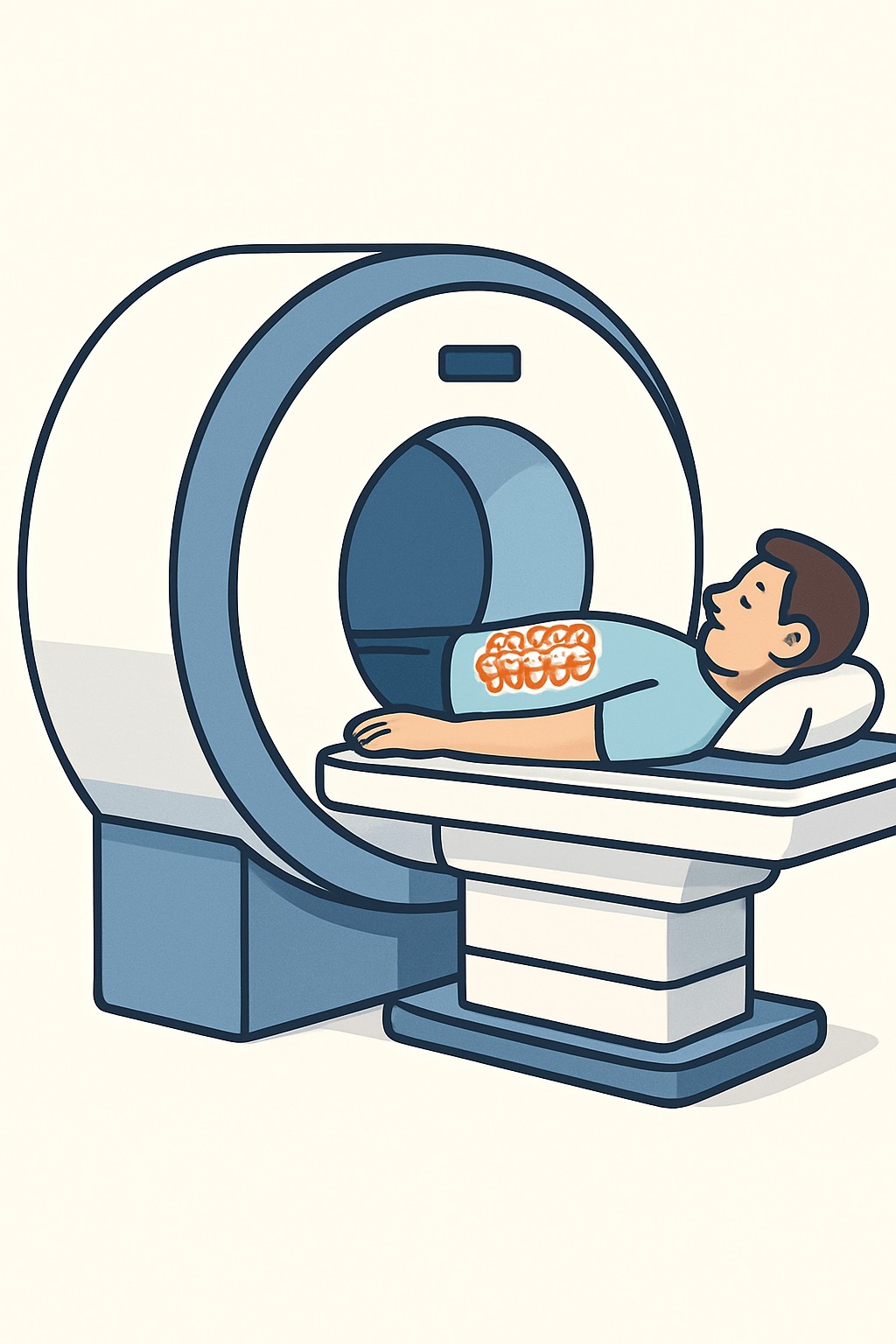
MRI lumbar spine without contrast is a scan that uses a strong magnet and radio waves to make detailed pictures of the lower back.
Overview
MRI lumbar spine without contrast is a scan that uses a strong magnet and radio waves to make detailed pictures of the lower back. It shows the vertebrae, discs, spinal canal, and nearby nerves. This exam is used to look for causes of back and leg symptoms, such as a herniated disc, spinal stenosis, infection, or tumors. No contrast dye is used, and the test does not use ionizing radiation.
Also known as: Lumbar spine MRI without contrast, MRI low back without contrast, MRI L-spine without contrast, Non-contrast lumbar MRI
Preparation & Next Steps
Everything you need to know before and after your procedure
Before Care
- Complete the MRI safety questionnaire and list all surgeries, implants, and metal exposures.
- Inform the imaging center in advance about devices such as pacemakers, stimulators, aneurysm clips, cochlear implants, or metal fragments, and bring device cards if you have them.
- Wear comfortable clothing without metal fasteners; leave jewelry, piercings, watches, and hairpins at home.
- Remove phones, keys, bank cards, and hearing aids before the scan because the magnet can pull or damage them.
- Eating and drinking are usually allowed for a non-contrast MRI; follow any facility instructions you received.
- If you are anxious in tight spaces, ask about options such as a wide-bore or open MRI, music, a mirror, or relaxation medicine policies.
- Arrive early to check in, review safety screening, and use the restroom before the exam.
- Bring a photo ID, insurance information, and any prior spine images and reports for comparison.
- Confirm any insurance authorization or referral requirements to avoid delays.
- If you use a medication patch or wearable device, ask whether it needs to be removed for the scan.
After Care
- You can usually return to normal activities right after the scan.
- Review any written instructions from the facility, especially if a relaxing medicine was used.
- Ask how and when results will be available; many centers send the report to the ordering clinician and may provide a portal or image copy.
- Keep copies of your images and the radiology report for your records if offered.
- If an implanted device was adjusted for MRI, ensure the device team confirms it has returned to its usual settings.
- Mild stiffness from lying still or brief ringing from noise may occur and typically passes soon.
- Contact the imaging center if you have trouble accessing your images or report.
- Let your clinician know if your symptoms change after the scan or if you have questions about the findings.
- Schedule any follow-up visits or tests that were recommended.
- Seek help from a clinician for unexpected symptoms after the visit, such as new dizziness, skin warmth at a contact point, or worsening pain.
Clinical Information
Important medical details about this procedure
Indications
- Persistent or severe low back pain with leg pain, numbness, or weakness
- Suspected herniated disc or spinal stenosis
- Evaluation after injury when symptoms continue
- Suspected infection or abscess in the spine
- Evaluation of known or suspected tumor or spread of cancer
- Assessment of post-surgical changes or complications
Alternatives
- Watchful waiting and conservative care such as physical therapy and medicines
- X-ray of the lumbar spine to assess alignment or fracture
- CT scan of the lumbar spine
- CT myelography when MRI is not possible
- Electromyography and nerve conduction studies to assess nerve function
Risks
- Discomfort from lying still and hearing loud tapping sounds
- Claustrophobia or anxiety inside the scanner
- Injury risk if metal objects or non-MRI-safe implants are present
- Rare heating or skin burns from external wires, patches, or metal
- Blurry images from movement, sometimes requiring repeat scans
- Incidental findings that may lead to additional tests
Contraindications
- Non-MRI-safe implanted devices such as some pacemakers or defibrillators
- Certain brain aneurysm clips or metallic fragments in sensitive areas (for example, the eye)
- Inability to remain still without available accommodations
- Severe claustrophobia when comfort options or alternative scanners are not available
Recovery Timeline
What to expect during your recovery
Most people have no recovery time and resume normal activities right away. A radiologist reviews the images and sends a report, often within a few days, but timing varies by facility.
Typical Range
Same day
Return to Work
Same day
Recovery Milestones
Resume normal daily activities
Review any facility instructions and arrange access to images or portal
Review the radiology report with the ordering clinician when available
Frequently Asked Questions
Common questions and expert answers about this procedure
What does without contrast mean?
What does without contrast mean?
No contrast dye is injected. The images rely on the magnet and radio waves alone. For many lumbar problems, non-contrast MRI provides the needed detail.
How long does a lumbar spine MRI take?
How long does a lumbar spine MRI take?
Most exams take about 30 to 60 minutes. Time varies based on the scanner, the number of image sequences, and how still you can stay.
Will the MRI hurt?
Will the MRI hurt?
The scan is painless. You will need to lie still and will hear loud knocking sounds. Ear protection is provided.
Is MRI safe if I have metal or an implant?
Is MRI safe if I have metal or an implant?
Many implants are MRI-conditional and can be scanned under specific settings. The facility will check device type and safety. Bring any device information you have.
Does MRI use radiation?
Does MRI use radiation?
No. MRI uses a strong magnet and radio waves, not ionizing radiation.
What if I get anxious in the scanner?
What if I get anxious in the scanner?
Facilities may offer wide-bore or open MRI, music, mirrors, or relaxation medicine policies. Ask about available options when scheduling.
Can I eat or drink before the exam?
Can I eat or drink before the exam?
For non-contrast MRI, eating and drinking are usually allowed unless the facility gives different instructions.
When will I get results?
When will I get results?
A radiologist interprets the images and sends a report to the ordering clinician. Reports are often ready within a few days, but timing varies.
References
Medical literature and sources