%20--%3e%3csvg%20version='1.0'%20id='Layer_1'%20xmlns='http://www.w3.org/2000/svg'%20xmlns:xlink='http://www.w3.org/1999/xlink'%20x='0px'%20y='0px'%20viewBox='0%200%20755.52%20814.35'%20style='enable-background:new%200%200%20755.52%20814.35;'%20xml:space='preserve'%3e%3cstyle%20type='text/css'%3e%20.st0{fill:%231ae5ce;stroke:%231ae5ce;stroke-width:7;stroke-miterlimit:10;}%20.st1{fill:%23FFFFFF;stroke:%231ae5ce;stroke-width:7;stroke-miterlimit:10;}%20.st2{fill:%231ae5ce;stroke:%23FFFFFF;stroke-width:7;stroke-miterlimit:10;}%20.st3{fill:%23FFFFFF;stroke:%23FFFFFF;stroke-width:6;stroke-miterlimit:10;}%20%3c/style%3e%3cg%20id='Dark_Logo_00000159431215648494653180000015900878925932721032_'%3e%3cpath%20id='shield_00000152259091539869183100000001926543869452564382_'%20class='st0'%20d='M711.13,173.42%20c-3.37-49.07-38.92-44.9-75.96-52.18c-67.4-13.25-130.47-34.47-192.36-63.92c-22.48-10.7-41.88-25.74-65.05-26.28%20c-23.17,0.54-42.58,15.59-65.05,26.28c-61.89,29.45-124.95,50.68-192.36,63.92c-37.04,7.28-72.59,3.11-75.96,52.18%20c-1.55,22.6,0.34,46.4,1.05,68.92c5.99,190.78,52.91,345.39,206.27,466.46c29.71,23.46,74.51,55.8,108.84,70.75%20c5.99,2.61,11.7,3.73,17.21,3.75c5.51-0.02,11.22-1.14,17.21-3.75c34.33-14.95,79.12-47.3,108.84-70.75%20c153.37-121.07,200.28-275.68,206.27-466.46C710.79,219.82,712.68,196.02,711.13,173.42z'/%3e%3cpath%20id='magnifyingglass_00000073685934697636024790000000342567780940956808_'%20class='st1'%20d='M648.78,624.21l-96.64-104.65%20c34.89-40.63,55.98-93.46,55.98-151.21c0-128.27-103.98-232.24-232.24-232.24S143.63,240.08,143.63,368.35%20s103.98,232.24,232.24,232.24c48.87,0,94.21-15.11,131.62-40.89l97.18,105.24c11.25,12.18,30.24,12.93,42.42,1.69l0,0%20C659.27,655.38,660.03,636.39,648.78,624.21z'/%3e%3ccircle%20id='ellipse_00000129904010550392394720000017056154833629780114_'%20class='st2'%20cx='375.87'%20cy='368.35'%20r='181.21'/%3e%3cpath%20id='dollarsign_00000057140127156649725250000003772530148495155891_'%20class='st3'%20d='M362.91,492.03v-23.91%20c0-2.01-1.58-3.69-3.59-3.77c-18.49-0.78-37.12-5.4-49.4-11.83c-1.75-0.92-2.53-3.01-1.76-4.84l5.87-13.89%20c0.86-2.02,3.23-2.88,5.2-1.89c12.94,6.52,30.45,11.44,49.18,11.44c26.02,0,43.6-12.73,43.6-30.43c0-17.08-14.29-27.63-41.4-36.95%20c-37.37-12.42-60.46-26.7-60.46-53.72c0-24.97,20.29-44.11,52.22-49.51c1.8-0.31,3.11-1.89,3.11-3.72v-24.35%20c0-2.09,1.69-3.78,3.78-3.78h15.16c2.09,0,3.78,1.69,3.78,3.78v22.71c0,2.01,1.58,3.67,3.58,3.77c17.85,0.92,30.88,4.75,40.61,9.1%20c1.92,0.86,2.79,3.09,1.94,5.01l-6.08,13.6c-0.85,1.91-3.09,2.77-4.99,1.91c-8.37-3.8-22.38-8.95-42.75-8.95%20c-28.21,0-38.84,14.28-38.84,26.7c0,16.15,13.56,24.22,45.44,35.4c37.74,13.04,56.79,29.19,56.79,56.82%20c0,23.85-19.05,46.23-54.78,52.3c-1.8,0.31-3.11,1.89-3.11,3.72v25.28c0,2.09-1.69,3.78-3.78,3.78h-15.53%20C364.6,495.81,362.91,494.12,362.91,492.03z'/%3e%3c/g%3e%3c/svg%3e)
MRI of brain (with and without contrast) Diagnostic Imaging
An MRI of the brain uses a strong magnet and radio waves to create detailed pictures of the brain and surrounding structures.
Overview
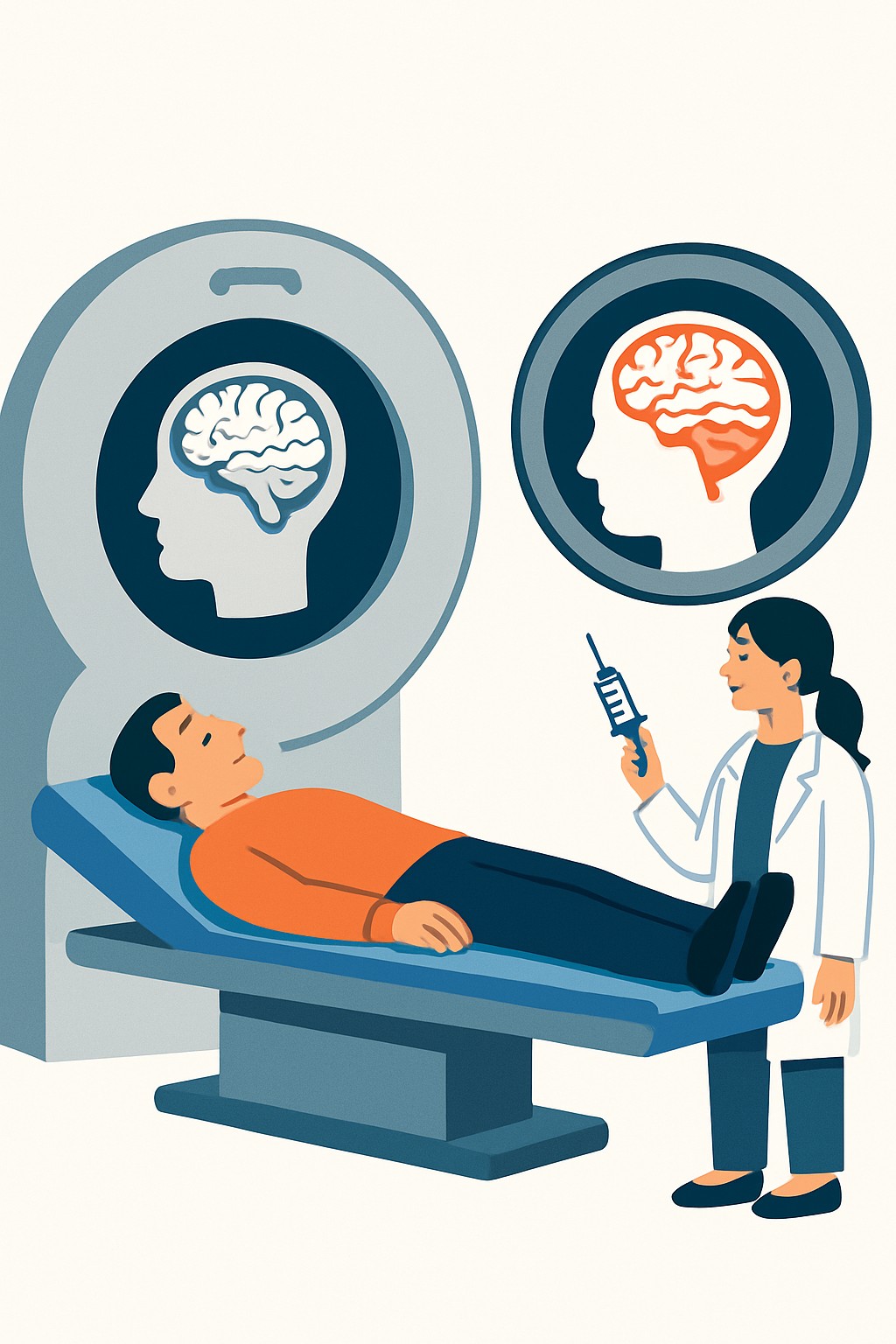
An MRI of the brain uses a strong magnet and radio waves to create detailed pictures of the brain and surrounding structures. It does not use ionizing radiation. With and without contrast means images are taken before and after an injection of a gadolinium-based contrast agent through a small IV. Contrast can highlight blood vessels and areas of abnormal tissue, which may help find or clarify certain problems.
Also known as: Brain MRI with and without contrast, MRI brain w/wo contrast, MRI head with and without contrast, MRI brain with and without gadolinium
Preparation & Next Steps
Everything you need to know before and after your procedure
Before Care
- Complete the MRI safety questionnaire and bring any implant or device cards.
- Tell the imaging staff about prior surgeries, metal fragments, or any eye injury involving metal.
- Ask if a recent kidney function blood test (eGFR) is needed before gadolinium contrast.
- Follow any eating and drinking instructions from the imaging center; many exams allow normal meals.
- Remove jewelry, piercings, watches, and hairpins; leave valuables at home when possible.
- Avoid makeup, lotions, or hair products with shimmer or metallic particles on the day of the exam.
- Wear comfortable, metal-free clothing or be ready to change into a provided gown.
- Arrive early so staff can start an IV for contrast and review consent and safety checks.
- If prone to claustrophobia, ask about comfort options such as music, an open-bore scanner, or a short-acting sedative; arrange a driver if a sedative is planned.
- Bring prior brain imaging or reports so the radiologist can compare studies.
- Tell the staff if you are pregnant or breastfeeding.
After Care
- Most people resume normal activities right away unless a sedative was used.
- Keep the small bandage over the IV site for a few hours and watch for redness or swelling.
- Drink fluids as usual to help your body clear the contrast.
- A brief warm feeling, metallic taste, or mild nausea can occur after contrast and usually passes quickly.
- Contact a clinician if you develop a rash, hives, trouble breathing, or increasing pain or swelling at the IV site.
- Temporary ringing in the ears can occur; hearing protection is removed after the scan.
- A radiologist interprets the images; check your patient portal or ask when the report will be ready.
- If you received a sedative, follow the imaging center's safety instructions and avoid driving until fully alert.
- Save a copy of your report and images for future comparison.
- If an implanted device was placed in MRI-safe mode, confirm it is returned to its usual settings per your managing clinic.
Clinical Information
Important medical details about this procedure
Indications
- New or worsening headaches
- Seizures or fainting spells
- Stroke or transient ischemic attack symptoms
- Suspected or known brain tumor
- Multiple sclerosis evaluation or follow-up
- Hearing loss, tinnitus, or vertigo (e.g., vestibular schwannoma workup)
- Vision changes or optic neuritis
- Pituitary or sellar disorders
- Infection or inflammation (meningitis, encephalitis, abscess)
- Hydrocephalus or pressure-related symptoms
- Head injury complications
- Vascular malformations or aneurysm evaluation
- Cognitive decline or dementia workup
Alternatives
- Non-contrast brain MRI
- CT head without contrast
- CT with contrast or CT angiography
- MR angiography (head or neck), with or without contrast
- Ultrasound of the head in infants (through the fontanelle)
- Electroencephalogram (EEG) for seizure evaluation
- Clinical observation with follow-up exam and testing
Risks
- Discomfort or bruising from IV placement
- Allergic-like reaction to gadolinium contrast (uncommon; severe reactions are rare)
- In people with severe kidney problems, risk of nephrogenic systemic fibrosis with some gadolinium agents
- Small amounts of gadolinium can remain in the body; health effects are unknown
- Claustrophobia or anxiety in the scanner
- Loud noise; hearing protection is used during the exam
- Heating or movement of some metal implants or metal fragments
- Contrast leaking under the skin at the IV site (extravasation)
Contraindications
- Non–MRI-conditional pacemaker or defibrillator without a supervised MRI protocol
- Certain aneurysm clips not proven MRI-safe
- Some cochlear implants or neurostimulators that are not MRI-conditional
- Metallic foreign body in the eye that has not been cleared by imaging
- Severe kidney impairment for the contrast portion of the exam
- History of severe reaction to gadolinium-based contrast
- Use of gadolinium contrast during pregnancy unless clearly needed
Recovery Timeline
What to expect during your recovery
There is usually no medical recovery period. Most people return to normal activities and work the same day. Extra time may be needed if a sedative was used.
Typical Range
Same day
Return to Work
Same day
Recovery Milestones
Resume normal daily activities
Return to work or school if no sedative was used
Remove IV bandage after several hours if dry and intact
Rest and avoid driving until fully alert if a sedative was used
Review radiology report in the patient portal when available
Frequently Asked Questions
Common questions and expert answers about this procedure
What does with and without contrast mean?
What does with and without contrast mean?
Images are taken before contrast, then a gadolinium-based dye is given through an IV and more images are taken. Contrast can make abnormal tissue and blood vessels easier to see.
How long does a brain MRI take?
How long does a brain MRI take?
Most exams take 30 to 60 minutes. Adding contrast usually adds time for the IV and the second set of images.
Does an MRI use radiation?
Does an MRI use radiation?
No. MRI uses a strong magnet and radio waves, not ionizing radiation.
Is gadolinium contrast safe if I have kidney problems?
Is gadolinium contrast safe if I have kidney problems?
People with severe kidney impairment have a higher risk of a rare condition called nephrogenic systemic fibrosis. Imaging teams often check kidney function and choose contrast agents carefully.
What if I have a pacemaker, implant, or metal in my body?
What if I have a pacemaker, implant, or metal in my body?
Many devices are MRI-conditional and can be scanned with special steps. Some older or certain implants are not safe. The MRI team will review your device details before the exam.
Can I have this MRI if I am pregnant or breastfeeding?
Can I have this MRI if I am pregnant or breastfeeding?
MRI without contrast is often considered when needed in pregnancy. Gadolinium is used only when benefits clearly outweigh risks. Breastfeeding after gadolinium is generally considered safe.
What can help if I am claustrophobic?
What can help if I am claustrophobic?
Options may include an open-bore scanner, listening to music, eye shields, or a short-acting sedative planned in advance.
When will I get my results?
When will I get my results?
A radiologist reviews the images and sends a report to your ordering clinician. Many centers release results to the patient portal within a few days.
References
Medical literature and sources