%20--%3e%3csvg%20version='1.0'%20id='Layer_1'%20xmlns='http://www.w3.org/2000/svg'%20xmlns:xlink='http://www.w3.org/1999/xlink'%20x='0px'%20y='0px'%20viewBox='0%200%20755.52%20814.35'%20style='enable-background:new%200%200%20755.52%20814.35;'%20xml:space='preserve'%3e%3cstyle%20type='text/css'%3e%20.st0{fill:%231ae5ce;stroke:%231ae5ce;stroke-width:7;stroke-miterlimit:10;}%20.st1{fill:%23FFFFFF;stroke:%231ae5ce;stroke-width:7;stroke-miterlimit:10;}%20.st2{fill:%231ae5ce;stroke:%23FFFFFF;stroke-width:7;stroke-miterlimit:10;}%20.st3{fill:%23FFFFFF;stroke:%23FFFFFF;stroke-width:6;stroke-miterlimit:10;}%20%3c/style%3e%3cg%20id='Dark_Logo_00000159431215648494653180000015900878925932721032_'%3e%3cpath%20id='shield_00000152259091539869183100000001926543869452564382_'%20class='st0'%20d='M711.13,173.42%20c-3.37-49.07-38.92-44.9-75.96-52.18c-67.4-13.25-130.47-34.47-192.36-63.92c-22.48-10.7-41.88-25.74-65.05-26.28%20c-23.17,0.54-42.58,15.59-65.05,26.28c-61.89,29.45-124.95,50.68-192.36,63.92c-37.04,7.28-72.59,3.11-75.96,52.18%20c-1.55,22.6,0.34,46.4,1.05,68.92c5.99,190.78,52.91,345.39,206.27,466.46c29.71,23.46,74.51,55.8,108.84,70.75%20c5.99,2.61,11.7,3.73,17.21,3.75c5.51-0.02,11.22-1.14,17.21-3.75c34.33-14.95,79.12-47.3,108.84-70.75%20c153.37-121.07,200.28-275.68,206.27-466.46C710.79,219.82,712.68,196.02,711.13,173.42z'/%3e%3cpath%20id='magnifyingglass_00000073685934697636024790000000342567780940956808_'%20class='st1'%20d='M648.78,624.21l-96.64-104.65%20c34.89-40.63,55.98-93.46,55.98-151.21c0-128.27-103.98-232.24-232.24-232.24S143.63,240.08,143.63,368.35%20s103.98,232.24,232.24,232.24c48.87,0,94.21-15.11,131.62-40.89l97.18,105.24c11.25,12.18,30.24,12.93,42.42,1.69l0,0%20C659.27,655.38,660.03,636.39,648.78,624.21z'/%3e%3ccircle%20id='ellipse_00000129904010550392394720000017056154833629780114_'%20class='st2'%20cx='375.87'%20cy='368.35'%20r='181.21'/%3e%3cpath%20id='dollarsign_00000057140127156649725250000003772530148495155891_'%20class='st3'%20d='M362.91,492.03v-23.91%20c0-2.01-1.58-3.69-3.59-3.77c-18.49-0.78-37.12-5.4-49.4-11.83c-1.75-0.92-2.53-3.01-1.76-4.84l5.87-13.89%20c0.86-2.02,3.23-2.88,5.2-1.89c12.94,6.52,30.45,11.44,49.18,11.44c26.02,0,43.6-12.73,43.6-30.43c0-17.08-14.29-27.63-41.4-36.95%20c-37.37-12.42-60.46-26.7-60.46-53.72c0-24.97,20.29-44.11,52.22-49.51c1.8-0.31,3.11-1.89,3.11-3.72v-24.35%20c0-2.09,1.69-3.78,3.78-3.78h15.16c2.09,0,3.78,1.69,3.78,3.78v22.71c0,2.01,1.58,3.67,3.58,3.77c17.85,0.92,30.88,4.75,40.61,9.1%20c1.92,0.86,2.79,3.09,1.94,5.01l-6.08,13.6c-0.85,1.91-3.09,2.77-4.99,1.91c-8.37-3.8-22.38-8.95-42.75-8.95%20c-28.21,0-38.84,14.28-38.84,26.7c0,16.15,13.56,24.22,45.44,35.4c37.74,13.04,56.79,29.19,56.79,56.82%20c0,23.85-19.05,46.23-54.78,52.3c-1.8,0.31-3.11,1.89-3.11,3.72v25.28c0,2.09-1.69,3.78-3.78,3.78h-15.53%20C364.6,495.81,362.91,494.12,362.91,492.03z'/%3e%3c/g%3e%3c/svg%3e)
Obstetric Ultrasound (mid-pregnancy anatomy scan) Diagnostic Imaging
An obstetric ultrasound mid-pregnancy anatomy scan uses sound waves to create pictures of the fetus and uterus.
Overview
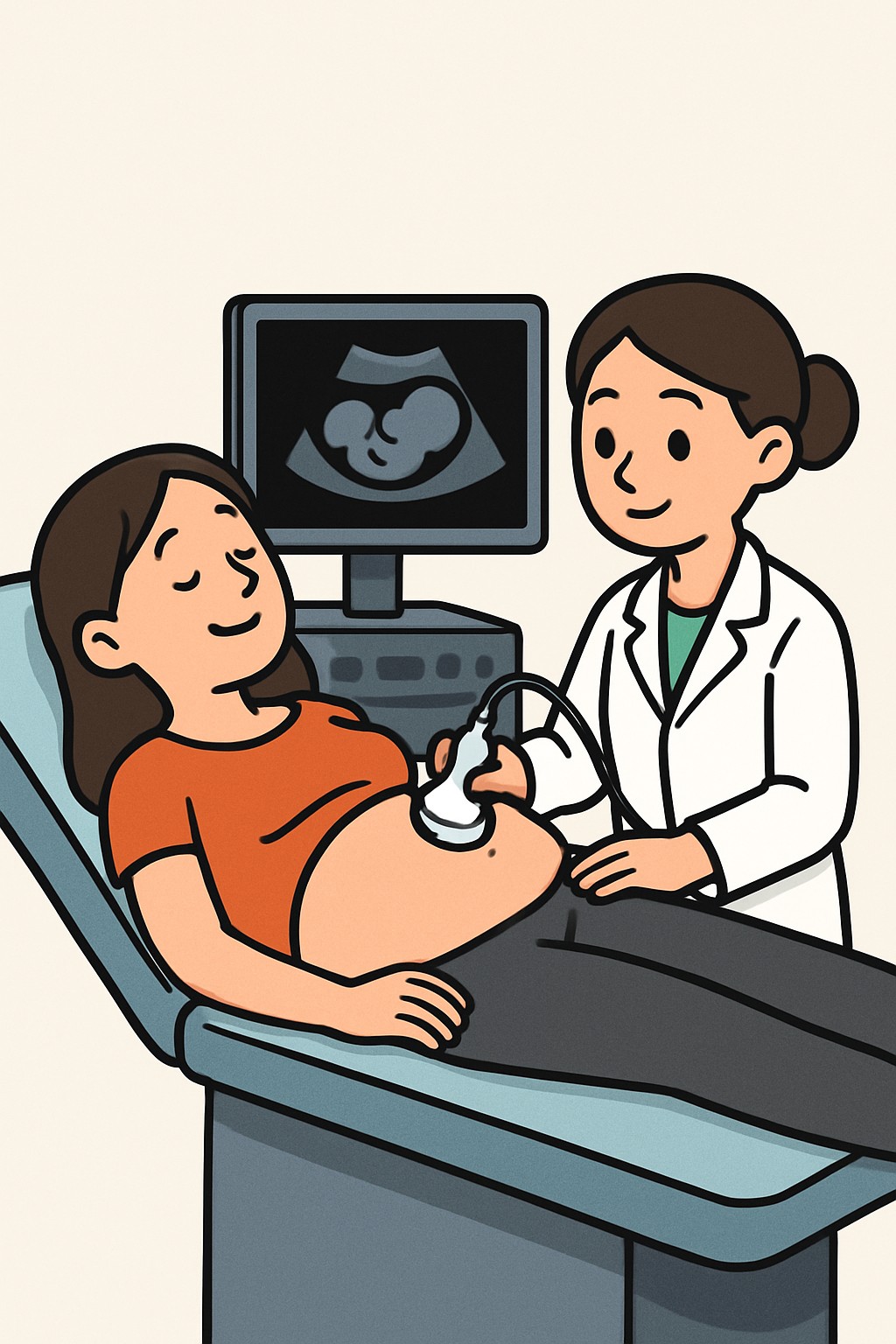
An obstetric ultrasound mid-pregnancy anatomy scan uses sound waves to create pictures of the fetus and uterus. A trained sonographer moves a small handheld probe on the abdomen with gel to capture images. This scan is usually performed in the second trimester to review the baby’s growth and major organs, the placenta, amniotic fluid, and the cervix. It helps check development, confirm the number of fetuses, and look for structural differences that may need follow-up.
Also known as: Anatomy scan, 20-week ultrasound, Second-trimester ultrasound, Fetal anatomy survey, Level 2 ultrasound
Preparation & Next Steps
Everything you need to know before and after your procedure
Before Care
- Bring a photo ID, insurance card, and any referral or order if required by your clinic
- Arrive early to complete forms and confirm contact and pharmacy details
- Wear a two-piece outfit to allow easy access to your abdomen
- Follow any clinic instructions about eating, fluid intake, or a full bladder
- Avoid heavy lotions or oils on your abdomen the day of the exam so the gel works well
- Have your current medication and allergy list available
- Bring prior prenatal records or ultrasound reports if you have them
- Ask your clinic about visitor policies if a support person plans to attend
- Plan for about 30–60 minutes, longer if views are hard to obtain
- Check your benefits with your insurer and ask the imaging center about any expected charges
After Care
- Resume normal activities; the gel wipes off and does not stain
- Review how and when you will receive the official report (portal, phone, or next visit)
- Schedule any recommended follow-up imaging or specialist consultations
- If views were incomplete, ask about a repeat scan to finish the survey
- Keep copies of the report and images for your records if offered
- Ask your clinician to explain findings and next steps at your follow-up visit
- Contact your clinician if you notice concerning symptoms such as vaginal bleeding, fluid leakage, fever, or severe pain
- Confirm the plan for additional tests if something could not be fully evaluated
- Note the gestational age and measurements in your pregnancy record
Clinical Information
Important medical details about this procedure
Indications
- Routine fetal anatomy assessment in the second trimester (often around 18–22 weeks)
- Confirm fetal growth and check major organs (brain, heart, spine, stomach, kidneys, limbs)
- Assess placenta location and cord insertion
- Measure amniotic fluid
- Confirm number of fetuses and check each fetus
- Evaluate cervix length and uterine structures
- Follow up results from earlier screening tests
- Assess symptoms such as bleeding, pain, or size-date differences
Alternatives
- First-trimester ultrasound and nuchal translucency measurement
- Prenatal screening tests (cell-free DNA or serum screening)
- Targeted or detailed ultrasound with a maternal-fetal medicine specialist
- Fetal echocardiogram when a heart concern is suspected
- Fetal MRI when ultrasound views are limited or more detail is needed
Risks
- Generally considered safe when used appropriately; no ionizing radiation
- Temporary discomfort from probe pressure or a full bladder
- Skin irritation from gel is uncommon
- Incomplete or unclear views may require a repeat scan
- False positives or false negatives can occur, leading to more tests or missed findings
- Emotional stress while waiting for or receiving results
- Non-medical keepsake ultrasounds are discouraged by the FDA
Contraindications
- No known absolute contraindications for medical use when performed by trained personnel
- Non-medical or keepsake use without a clinical reason is discouraged
Recovery Timeline
What to expect during your recovery
There is no medical recovery time after an anatomy ultrasound. Most people return to usual activities right away.
Typical Range
Same day
Return to Work
Same day
Recovery Milestones
Resume normal daily activities
Review report availability and schedule follow-up if recommended
Complete any repeat or targeted ultrasound if views were incomplete
Frequently Asked Questions
Common questions and expert answers about this procedure
When is the anatomy scan usually done?
When is the anatomy scan usually done?
It is commonly performed during the second trimester, often around 18 to 22 weeks of pregnancy.
What does this ultrasound check?
What does this ultrasound check?
It reviews fetal growth and major organs, the placenta and cord, amniotic fluid, and sometimes the cervix length.
How long does the exam take?
How long does the exam take?
Most scans take 30 to 60 minutes. It can take longer if the baby’s position makes views hard to get.
Is ultrasound safe in pregnancy?
Is ultrasound safe in pregnancy?
Diagnostic ultrasound has no ionizing radiation and is considered safe when used by trained professionals for medical reasons.
Will I learn the baby’s sex?
Will I learn the baby’s sex?
Sex can sometimes be seen, depending on position and visibility. Policies differ by clinic, and confirmation is not guaranteed.
Do I need a full bladder?
Do I need a full bladder?
Some centers ask for a partially full bladder to improve images. Follow any instructions given by your clinic.
Who performs and interprets the scan?
Who performs and interprets the scan?
A sonographer usually performs the scan. A radiologist or obstetric clinician reviews and interprets the images.
What happens if something looks abnormal or is unclear?
What happens if something looks abnormal or is unclear?
You may be scheduled for a repeat or targeted ultrasound, or referred to a specialist for more detailed evaluation.
References
Medical literature and sources