%20--%3e%3csvg%20version='1.0'%20id='Layer_1'%20xmlns='http://www.w3.org/2000/svg'%20xmlns:xlink='http://www.w3.org/1999/xlink'%20x='0px'%20y='0px'%20viewBox='0%200%20755.52%20814.35'%20style='enable-background:new%200%200%20755.52%20814.35;'%20xml:space='preserve'%3e%3cstyle%20type='text/css'%3e%20.st0{fill:%231ae5ce;stroke:%231ae5ce;stroke-width:7;stroke-miterlimit:10;}%20.st1{fill:%23FFFFFF;stroke:%231ae5ce;stroke-width:7;stroke-miterlimit:10;}%20.st2{fill:%231ae5ce;stroke:%23FFFFFF;stroke-width:7;stroke-miterlimit:10;}%20.st3{fill:%23FFFFFF;stroke:%23FFFFFF;stroke-width:6;stroke-miterlimit:10;}%20%3c/style%3e%3cg%20id='Dark_Logo_00000159431215648494653180000015900878925932721032_'%3e%3cpath%20id='shield_00000152259091539869183100000001926543869452564382_'%20class='st0'%20d='M711.13,173.42%20c-3.37-49.07-38.92-44.9-75.96-52.18c-67.4-13.25-130.47-34.47-192.36-63.92c-22.48-10.7-41.88-25.74-65.05-26.28%20c-23.17,0.54-42.58,15.59-65.05,26.28c-61.89,29.45-124.95,50.68-192.36,63.92c-37.04,7.28-72.59,3.11-75.96,52.18%20c-1.55,22.6,0.34,46.4,1.05,68.92c5.99,190.78,52.91,345.39,206.27,466.46c29.71,23.46,74.51,55.8,108.84,70.75%20c5.99,2.61,11.7,3.73,17.21,3.75c5.51-0.02,11.22-1.14,17.21-3.75c34.33-14.95,79.12-47.3,108.84-70.75%20c153.37-121.07,200.28-275.68,206.27-466.46C710.79,219.82,712.68,196.02,711.13,173.42z'/%3e%3cpath%20id='magnifyingglass_00000073685934697636024790000000342567780940956808_'%20class='st1'%20d='M648.78,624.21l-96.64-104.65%20c34.89-40.63,55.98-93.46,55.98-151.21c0-128.27-103.98-232.24-232.24-232.24S143.63,240.08,143.63,368.35%20s103.98,232.24,232.24,232.24c48.87,0,94.21-15.11,131.62-40.89l97.18,105.24c11.25,12.18,30.24,12.93,42.42,1.69l0,0%20C659.27,655.38,660.03,636.39,648.78,624.21z'/%3e%3ccircle%20id='ellipse_00000129904010550392394720000017056154833629780114_'%20class='st2'%20cx='375.87'%20cy='368.35'%20r='181.21'/%3e%3cpath%20id='dollarsign_00000057140127156649725250000003772530148495155891_'%20class='st3'%20d='M362.91,492.03v-23.91%20c0-2.01-1.58-3.69-3.59-3.77c-18.49-0.78-37.12-5.4-49.4-11.83c-1.75-0.92-2.53-3.01-1.76-4.84l5.87-13.89%20c0.86-2.02,3.23-2.88,5.2-1.89c12.94,6.52,30.45,11.44,49.18,11.44c26.02,0,43.6-12.73,43.6-30.43c0-17.08-14.29-27.63-41.4-36.95%20c-37.37-12.42-60.46-26.7-60.46-53.72c0-24.97,20.29-44.11,52.22-49.51c1.8-0.31,3.11-1.89,3.11-3.72v-24.35%20c0-2.09,1.69-3.78,3.78-3.78h15.16c2.09,0,3.78,1.69,3.78,3.78v22.71c0,2.01,1.58,3.67,3.58,3.77c17.85,0.92,30.88,4.75,40.61,9.1%20c1.92,0.86,2.79,3.09,1.94,5.01l-6.08,13.6c-0.85,1.91-3.09,2.77-4.99,1.91c-8.37-3.8-22.38-8.95-42.75-8.95%20c-28.21,0-38.84,14.28-38.84,26.7c0,16.15,13.56,24.22,45.44,35.4c37.74,13.04,56.79,29.19,56.79,56.82%20c0,23.85-19.05,46.23-54.78,52.3c-1.8,0.31-3.11,1.89-3.11,3.72v25.28c0,2.09-1.69,3.78-3.78,3.78h-15.53%20C364.6,495.81,362.91,494.12,362.91,492.03z'/%3e%3c/g%3e%3c/svg%3e)
OCT retina scan (imaging of eye) Diagnostic Imaging
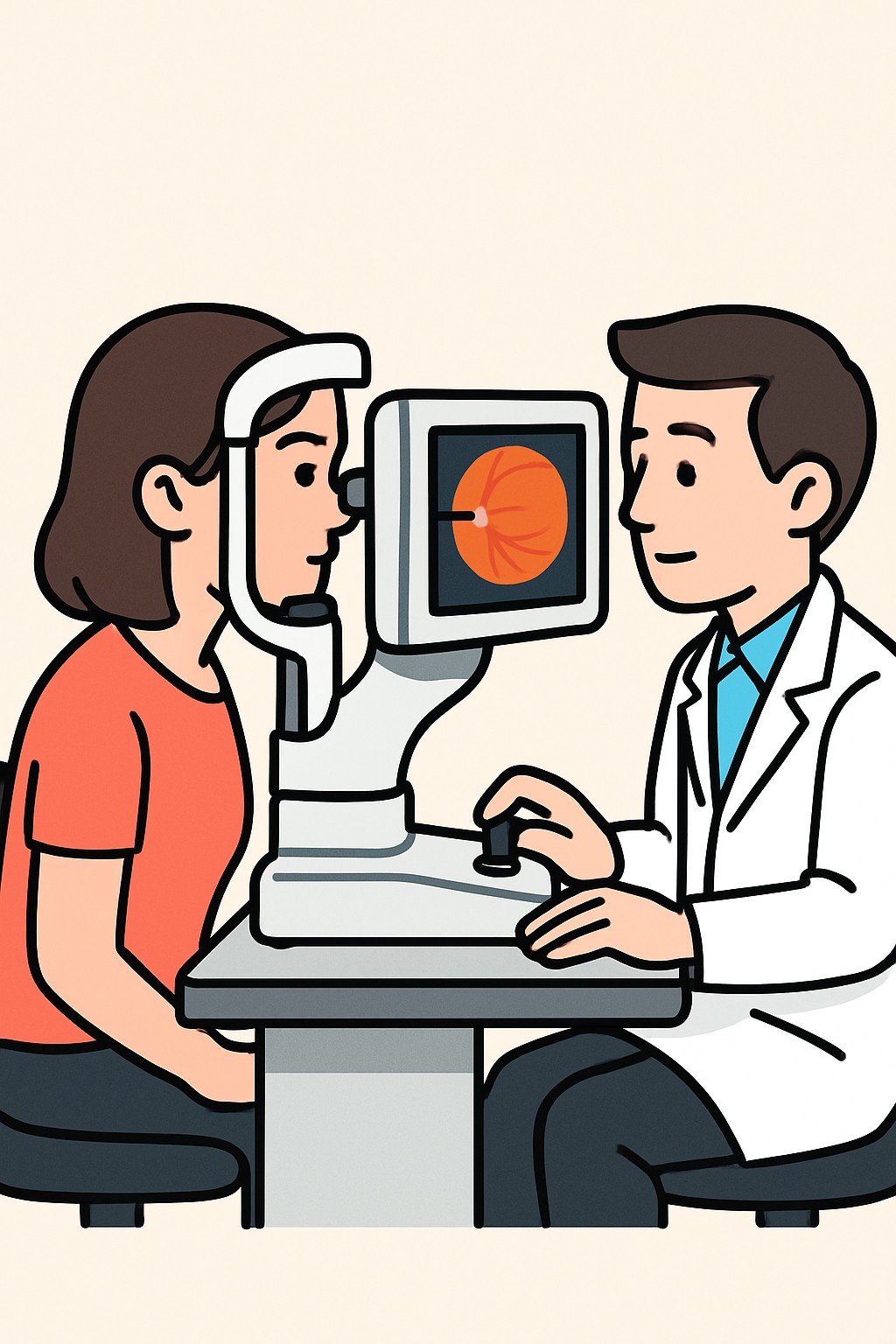
An OCT retina scan is a noninvasive imaging test that uses light waves to take detailed cross-section pictures of the back of the eye.
Overview
An OCT retina scan is a noninvasive imaging test that uses light waves to take detailed cross-section pictures of the back of the eye. It shows the layers of the retina and macula so clinicians can see swelling, thinning, or other changes. This scan helps diagnose and monitor conditions such as age-related macular degeneration, diabetic macular edema, macular holes, and other retinal problems. It is quick, painless, and does not use radiation.
Also known as: Optical coherence tomography (OCT), Retinal OCT, Macular OCT, OCT eye scan
Preparation & Next Steps
Everything you need to know before and after your procedure
Before Care
- Bring your glasses or contact lens prescription and a list of all eye drops and medicines you use
- Ask the clinic if your pupils may be dilated; many people bring sunglasses for comfort after bright lights
- Arrange transportation if you prefer not to drive while dilated
- Avoid heavy eye makeup on the day of imaging so the eyelids and lashes do not interfere with the scan
- Be ready to remove contact lenses if the clinic requests it for clearer imaging
- Share prior OCT images or retinal photos if you have them, or allow the clinic to obtain records
- Confirm how long the visit may take, including possible wait time and additional testing
- Carry your photo ID, insurance card, and a payment method for any copay
After Care
- Expect temporary light sensitivity, especially if dilated; sunglasses can make you more comfortable
- Vision may be slightly blurred for a few hours if dilation drops were used
- There is no cutting or injection with standard OCT; most people resume normal activities the same day
- Reinsert contact lenses when comfortable if they were removed for the test
- Review your results and the follow-up plan with the clinic or via the patient portal
- Keep copies of your report and images if offered for your records
- Contact the clinic if you notice persistent eye pain, new or worsening vision changes, or new floaters or flashes after the visit
- Schedule recommended follow-up visits to monitor any retinal condition
Clinical Information
Important medical details about this procedure
Indications
- Age-related macular degeneration (AMD) evaluation and monitoring
- Diabetic retinopathy and diabetic macular edema
- Macular hole or epiretinal membrane
- Central serous chorioretinopathy
- Retinal vein occlusion
- Vitreomacular traction
- Unexplained vision changes or distortion
- Glaucoma optic nerve and retinal nerve fiber layer assessment
Alternatives
- Dilated eye exam with slit-lamp evaluation
- Color fundus photography
- Fluorescein angiography (dye test of retinal circulation)
- Indocyanine green angiography
- OCT angiography (blood flow mapping without dye)
- B-scan ocular ultrasound (when media is too cloudy for OCT)
- Visual field testing (for glaucoma monitoring)
Risks
- Temporary light sensitivity from bright test lights
- Temporary blurred vision if dilation drops are used
- Mild eye irritation from dilation drops in some people
- Motion or blinking can reduce image quality and may require repeat scans
Contraindications
- Inability to keep the head still or maintain fixation during the scan
- Severe media opacity (dense cataract, corneal scarring, or vitreous hemorrhage) that blocks the view
- History of significant reaction to dilation drops if dilation is planned
Recovery Timeline
What to expect during your recovery
Most people return to normal activities right after an OCT retina scan. If your pupils are dilated, light sensitivity and blur can last a few hours.
Typical Range
Same day
Return to Work
Same day
Recovery Milestones
Resume normal daily activities
Use sunglasses and limit screen time if eyes feel sensitive after dilation
Review results and confirm any follow-up testing or visits
Frequently Asked Questions
Common questions and expert answers about this procedure
What is an OCT retina scan?
What is an OCT retina scan?
It is a noninvasive imaging test that uses light waves to create detailed cross-section pictures of the retina and macula.
Does the test hurt?
Does the test hurt?
No. You rest your chin on a support and look at a target. The machine does not touch your eye.
Will my eyes be dilated?
Will my eyes be dilated?
Dilation is not always required, but it may be used to improve image quality or to do a full exam at the same visit.
How long does it take?
How long does it take?
The scan itself usually takes a few minutes. The full visit may be longer if you have dilation or other tests.
Is there radiation or dye?
Is there radiation or dye?
Standard OCT uses light, not X-rays or dye. Some other imaging tests use dye, but OCT typically does not.
What eye problems can OCT help with?
What eye problems can OCT help with?
It helps detect and monitor macular degeneration, diabetic macular edema, macular holes, epiretinal membranes, and other retinal issues.
How often is OCT repeated?
How often is OCT repeated?
Frequency varies by condition and goals of care. It is often repeated to monitor changes over time.
Is OCT safe if I have a pacemaker or am pregnant?
Is OCT safe if I have a pacemaker or am pregnant?
Yes. OCT uses light and does not involve radiation or magnetic fields.
References
Medical literature and sources