%20--%3e%3csvg%20version='1.0'%20id='Layer_1'%20xmlns='http://www.w3.org/2000/svg'%20xmlns:xlink='http://www.w3.org/1999/xlink'%20x='0px'%20y='0px'%20viewBox='0%200%20755.52%20814.35'%20style='enable-background:new%200%200%20755.52%20814.35;'%20xml:space='preserve'%3e%3cstyle%20type='text/css'%3e%20.st0{fill:%231ae5ce;stroke:%231ae5ce;stroke-width:7;stroke-miterlimit:10;}%20.st1{fill:%23FFFFFF;stroke:%231ae5ce;stroke-width:7;stroke-miterlimit:10;}%20.st2{fill:%231ae5ce;stroke:%23FFFFFF;stroke-width:7;stroke-miterlimit:10;}%20.st3{fill:%23FFFFFF;stroke:%23FFFFFF;stroke-width:6;stroke-miterlimit:10;}%20%3c/style%3e%3cg%20id='Dark_Logo_00000159431215648494653180000015900878925932721032_'%3e%3cpath%20id='shield_00000152259091539869183100000001926543869452564382_'%20class='st0'%20d='M711.13,173.42%20c-3.37-49.07-38.92-44.9-75.96-52.18c-67.4-13.25-130.47-34.47-192.36-63.92c-22.48-10.7-41.88-25.74-65.05-26.28%20c-23.17,0.54-42.58,15.59-65.05,26.28c-61.89,29.45-124.95,50.68-192.36,63.92c-37.04,7.28-72.59,3.11-75.96,52.18%20c-1.55,22.6,0.34,46.4,1.05,68.92c5.99,190.78,52.91,345.39,206.27,466.46c29.71,23.46,74.51,55.8,108.84,70.75%20c5.99,2.61,11.7,3.73,17.21,3.75c5.51-0.02,11.22-1.14,17.21-3.75c34.33-14.95,79.12-47.3,108.84-70.75%20c153.37-121.07,200.28-275.68,206.27-466.46C710.79,219.82,712.68,196.02,711.13,173.42z'/%3e%3cpath%20id='magnifyingglass_00000073685934697636024790000000342567780940956808_'%20class='st1'%20d='M648.78,624.21l-96.64-104.65%20c34.89-40.63,55.98-93.46,55.98-151.21c0-128.27-103.98-232.24-232.24-232.24S143.63,240.08,143.63,368.35%20s103.98,232.24,232.24,232.24c48.87,0,94.21-15.11,131.62-40.89l97.18,105.24c11.25,12.18,30.24,12.93,42.42,1.69l0,0%20C659.27,655.38,660.03,636.39,648.78,624.21z'/%3e%3ccircle%20id='ellipse_00000129904010550392394720000017056154833629780114_'%20class='st2'%20cx='375.87'%20cy='368.35'%20r='181.21'/%3e%3cpath%20id='dollarsign_00000057140127156649725250000003772530148495155891_'%20class='st3'%20d='M362.91,492.03v-23.91%20c0-2.01-1.58-3.69-3.59-3.77c-18.49-0.78-37.12-5.4-49.4-11.83c-1.75-0.92-2.53-3.01-1.76-4.84l5.87-13.89%20c0.86-2.02,3.23-2.88,5.2-1.89c12.94,6.52,30.45,11.44,49.18,11.44c26.02,0,43.6-12.73,43.6-30.43c0-17.08-14.29-27.63-41.4-36.95%20c-37.37-12.42-60.46-26.7-60.46-53.72c0-24.97,20.29-44.11,52.22-49.51c1.8-0.31,3.11-1.89,3.11-3.72v-24.35%20c0-2.09,1.69-3.78,3.78-3.78h15.16c2.09,0,3.78,1.69,3.78,3.78v22.71c0,2.01,1.58,3.67,3.58,3.77c17.85,0.92,30.88,4.75,40.61,9.1%20c1.92,0.86,2.79,3.09,1.94,5.01l-6.08,13.6c-0.85,1.91-3.09,2.77-4.99,1.91c-8.37-3.8-22.38-8.95-42.75-8.95%20c-28.21,0-38.84,14.28-38.84,26.7c0,16.15,13.56,24.22,45.44,35.4c37.74,13.04,56.79,29.19,56.79,56.82%20c0,23.85-19.05,46.23-54.78,52.3c-1.8,0.31-3.11,1.89-3.11,3.72v25.28c0,2.09-1.69,3.78-3.78,3.78h-15.53%20C364.6,495.81,362.91,494.12,362.91,492.03z'/%3e%3c/g%3e%3c/svg%3e)
Pelvic ultrasound (non-obstetric) Diagnostic Imaging
A non-obstetric pelvic ultrasound uses sound waves to create images of the organs in the pelvis, such as the uterus, ovaries, fallopian tubes, cervix, and bladder.
Overview
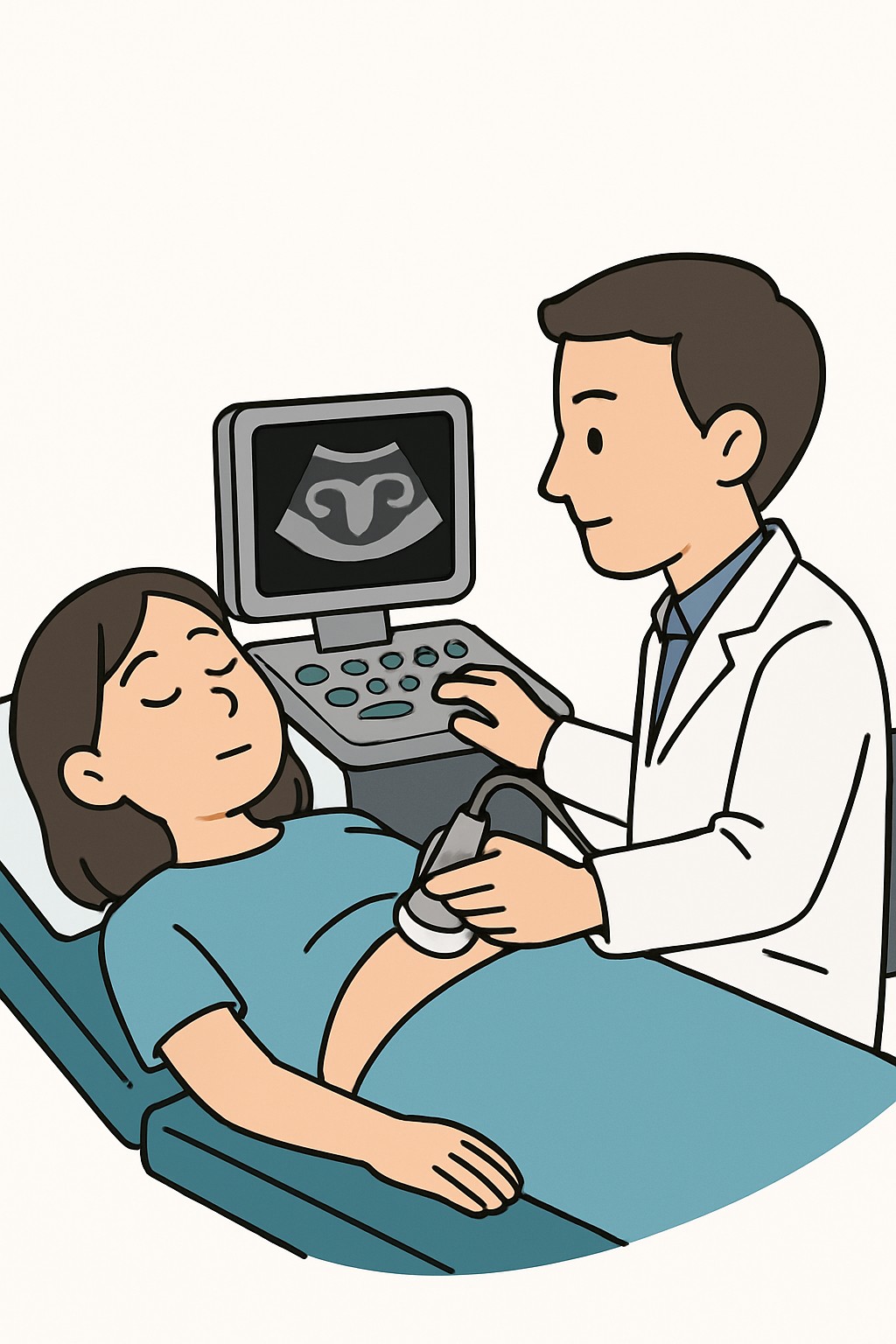
A non-obstetric pelvic ultrasound uses sound waves to create images of the organs in the pelvis, such as the uterus, ovaries, fallopian tubes, cervix, and bladder. It does not use radiation. Images are made using a small hand-held device on the lower belly (transabdominal) and often a thin probe placed a short distance inside the vagina (transvaginal) for closer views. Clinicians order this test to look for causes of symptoms like pelvic pain or abnormal bleeding, to check known conditions, or to monitor treatments. It is usually an outpatient exam and takes about 20–45 minutes.
Also known as: Pelvic sonogram, Gynecologic ultrasound, Transvaginal ultrasound, Transabdominal pelvic ultrasound, Female pelvic ultrasound
Preparation & Next Steps
Everything you need to know before and after your procedure
Before Care
- Confirm with the imaging center whether a full bladder is needed and follow their timing and fluid instructions
- Wear a two-piece outfit for easier access to the lower abdomen
- Bring a photo ID, insurance card, and the imaging order if provided
- Arrive a bit early to complete check-in and any questionnaires
- Share relevant details such as last menstrual period, pregnancy status, and pelvic symptoms
- Tell the staff about allergies, including latex, and any prior pelvic surgeries or infections
- You may be asked to keep your bladder full for transabdominal images and to empty it before a transvaginal scan
- Ask how and when you will receive results so you know what to expect
- Arrange an interpreter or support person if communication assistance is needed
After Care
- You can usually leave right after the exam and resume normal activities
- If you held your bladder, urinate and drink water for comfort
- Mild cramping or pressure may occur after a transvaginal exam and usually fades within a day
- Light spotting can occur after a transvaginal exam; use a pad if needed
- Keep the area clean and avoid introducing new products if you feel irritated
- Review how results will be delivered and the expected time frame
- Store any paperwork and the imaging center contact information for questions
- Contact a clinician if you develop severe pelvic pain, heavy bleeding, fever, or other concerning symptoms
Clinical Information
Important medical details about this procedure
Indications
- Pelvic pain or pressure
- Abnormal uterine bleeding or irregular periods
- Suspected ovarian cysts, fibroids, or pelvic masses
- Evaluation of infertility or monitoring of treatments
- Follow-up of known conditions (for example, ovarian cysts or fibroids)
- Checking intrauterine device (IUD) position
- Evaluation for pelvic inflammatory disease or abscess
- Urinary symptoms possibly related to pelvic organs
Alternatives
- Pelvic exam and history
- Blood tests or urine tests (for example, pregnancy test, hormone levels, infection testing)
- Pelvic MRI
- CT scan of the pelvis when ultrasound is limited
- Hysterosonography (saline infusion sonography) for the uterine cavity
- Hysteroscopy in select cases
- Watchful waiting with repeat exam or imaging
Risks
- No known harmful effects from diagnostic ultrasound
- Temporary discomfort from a full bladder during transabdominal imaging
- Brief pelvic pressure or mild cramping with a transvaginal probe
- Light spotting after a transvaginal exam
- Very rare risk of infection or irritation with transvaginal probe use
- Possible need for additional tests if images are unclear or show findings
- Allergy to latex covers if used, typically managed with non-latex options
Contraindications
- Patient declines or cannot tolerate a transvaginal exam
- Prepubertal patients generally do not have transvaginal imaging
- Recent pelvic surgery or severe vaginal pain where transvaginal approach may be deferred
- Latex allergy for probe covers without non-latex alternatives available
Recovery Timeline
What to expect during your recovery
Most people return to normal activities immediately after a pelvic ultrasound. Any mild discomfort or spotting from a transvaginal scan usually resolves within a day.
Typical Range
Same day
Return to Work
Same day
Recovery Milestones
Resume normal daily activities
Urinate and hydrate for comfort after holding a full bladder
Expect mild cramping or light spotting if a transvaginal scan was performed
Review results via portal or with your clinician as arranged
Frequently Asked Questions
Common questions and expert answers about this procedure
What is a non-obstetric pelvic ultrasound?
What is a non-obstetric pelvic ultrasound?
It is an imaging test that uses sound waves to view the uterus, ovaries, and other pelvic organs in people who are not being evaluated for pregnancy.
What is the difference between transabdominal and transvaginal ultrasound?
What is the difference between transabdominal and transvaginal ultrasound?
Transabdominal uses a probe on the lower belly, often with a full bladder. Transvaginal uses a thin probe in the vagina for closer views of pelvic organs.
Does a pelvic ultrasound use radiation?
Does a pelvic ultrasound use radiation?
No. Ultrasound uses sound waves, not ionizing radiation.
How long does the exam take?
How long does the exam take?
Most exams take 20–45 minutes, depending on the views needed and whether both approaches are used.
Will it hurt?
Will it hurt?
You may feel pressure on the belly from the probe or brief pelvic pressure with the transvaginal probe. Most people find it tolerable.
Do I need a full bladder?
Do I need a full bladder?
Many centers ask for a full bladder for transabdominal images because it helps show pelvic organs. Follow the instructions given by your imaging center.
Can I have the test during my period or with an IUD?
Can I have the test during my period or with an IUD?
Yes, exams are often done during menstruation and with an IUD. Tell the technologist so they can document it.
Who performs and interprets the ultrasound?
Who performs and interprets the ultrasound?
A sonographer usually performs the exam. A radiologist or qualified clinician reviews the images and issues a report.
References
Medical literature and sources