%20--%3e%3csvg%20version='1.0'%20id='Layer_1'%20xmlns='http://www.w3.org/2000/svg'%20xmlns:xlink='http://www.w3.org/1999/xlink'%20x='0px'%20y='0px'%20viewBox='0%200%20755.52%20814.35'%20style='enable-background:new%200%200%20755.52%20814.35;'%20xml:space='preserve'%3e%3cstyle%20type='text/css'%3e%20.st0{fill:%231ae5ce;stroke:%231ae5ce;stroke-width:7;stroke-miterlimit:10;}%20.st1{fill:%23FFFFFF;stroke:%231ae5ce;stroke-width:7;stroke-miterlimit:10;}%20.st2{fill:%231ae5ce;stroke:%23FFFFFF;stroke-width:7;stroke-miterlimit:10;}%20.st3{fill:%23FFFFFF;stroke:%23FFFFFF;stroke-width:6;stroke-miterlimit:10;}%20%3c/style%3e%3cg%20id='Dark_Logo_00000159431215648494653180000015900878925932721032_'%3e%3cpath%20id='shield_00000152259091539869183100000001926543869452564382_'%20class='st0'%20d='M711.13,173.42%20c-3.37-49.07-38.92-44.9-75.96-52.18c-67.4-13.25-130.47-34.47-192.36-63.92c-22.48-10.7-41.88-25.74-65.05-26.28%20c-23.17,0.54-42.58,15.59-65.05,26.28c-61.89,29.45-124.95,50.68-192.36,63.92c-37.04,7.28-72.59,3.11-75.96,52.18%20c-1.55,22.6,0.34,46.4,1.05,68.92c5.99,190.78,52.91,345.39,206.27,466.46c29.71,23.46,74.51,55.8,108.84,70.75%20c5.99,2.61,11.7,3.73,17.21,3.75c5.51-0.02,11.22-1.14,17.21-3.75c34.33-14.95,79.12-47.3,108.84-70.75%20c153.37-121.07,200.28-275.68,206.27-466.46C710.79,219.82,712.68,196.02,711.13,173.42z'/%3e%3cpath%20id='magnifyingglass_00000073685934697636024790000000342567780940956808_'%20class='st1'%20d='M648.78,624.21l-96.64-104.65%20c34.89-40.63,55.98-93.46,55.98-151.21c0-128.27-103.98-232.24-232.24-232.24S143.63,240.08,143.63,368.35%20s103.98,232.24,232.24,232.24c48.87,0,94.21-15.11,131.62-40.89l97.18,105.24c11.25,12.18,30.24,12.93,42.42,1.69l0,0%20C659.27,655.38,660.03,636.39,648.78,624.21z'/%3e%3ccircle%20id='ellipse_00000129904010550392394720000017056154833629780114_'%20class='st2'%20cx='375.87'%20cy='368.35'%20r='181.21'/%3e%3cpath%20id='dollarsign_00000057140127156649725250000003772530148495155891_'%20class='st3'%20d='M362.91,492.03v-23.91%20c0-2.01-1.58-3.69-3.59-3.77c-18.49-0.78-37.12-5.4-49.4-11.83c-1.75-0.92-2.53-3.01-1.76-4.84l5.87-13.89%20c0.86-2.02,3.23-2.88,5.2-1.89c12.94,6.52,30.45,11.44,49.18,11.44c26.02,0,43.6-12.73,43.6-30.43c0-17.08-14.29-27.63-41.4-36.95%20c-37.37-12.42-60.46-26.7-60.46-53.72c0-24.97,20.29-44.11,52.22-49.51c1.8-0.31,3.11-1.89,3.11-3.72v-24.35%20c0-2.09,1.69-3.78,3.78-3.78h15.16c2.09,0,3.78,1.69,3.78,3.78v22.71c0,2.01,1.58,3.67,3.58,3.77c17.85,0.92,30.88,4.75,40.61,9.1%20c1.92,0.86,2.79,3.09,1.94,5.01l-6.08,13.6c-0.85,1.91-3.09,2.77-4.99,1.91c-8.37-3.8-22.38-8.95-42.75-8.95%20c-28.21,0-38.84,14.28-38.84,26.7c0,16.15,13.56,24.22,45.44,35.4c37.74,13.04,56.79,29.19,56.79,56.82%20c0,23.85-19.05,46.23-54.78,52.3c-1.8,0.31-3.11,1.89-3.11,3.72v25.28c0,2.09-1.69,3.78-3.78,3.78h-15.53%20C364.6,495.81,362.91,494.12,362.91,492.03z'/%3e%3c/g%3e%3c/svg%3e)
PET-CT PSMA (prostate cancer imaging) Diagnostic Imaging
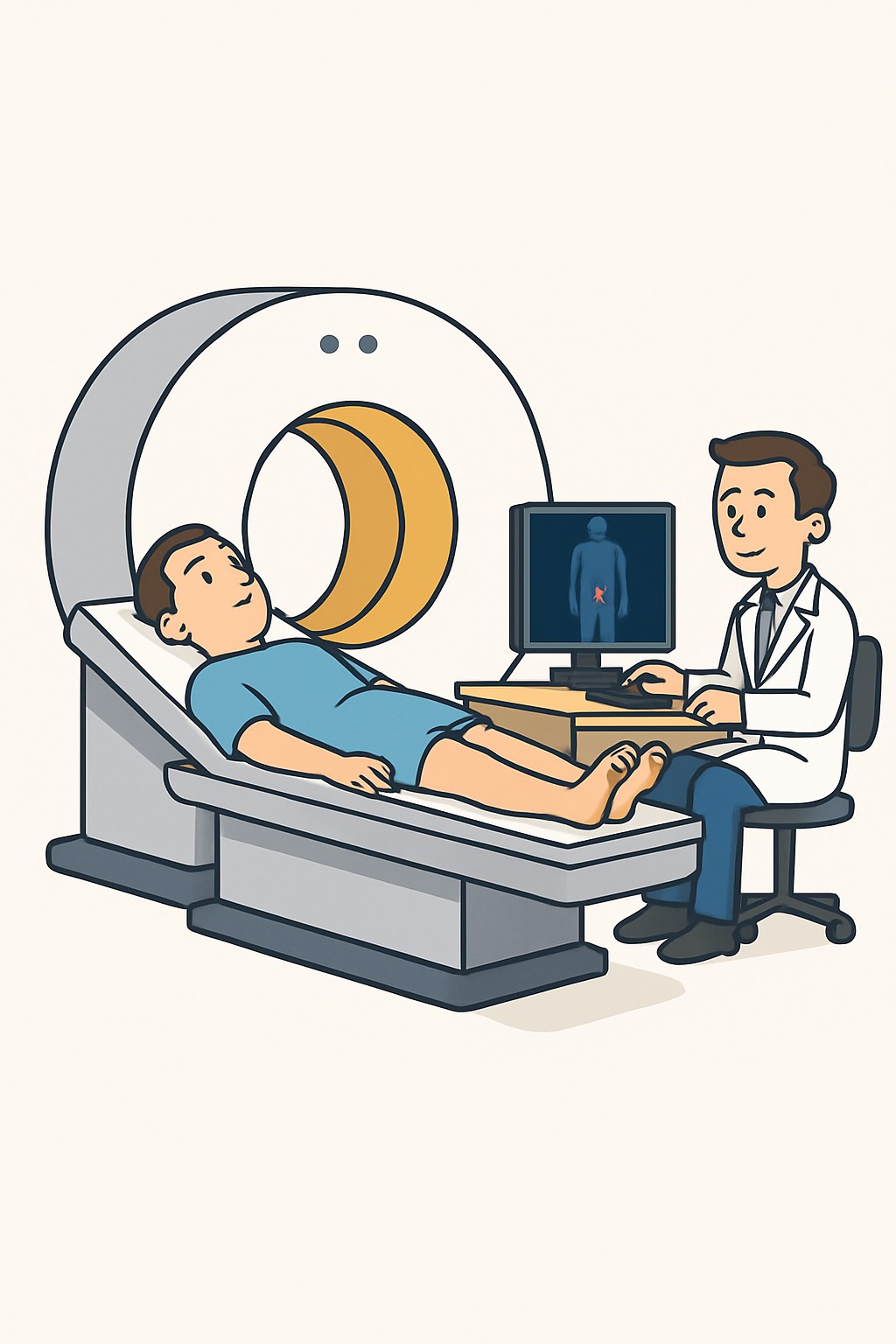
A PSMA PET-CT is an imaging test that combines PET and CT scans using a tracer that targets prostate-specific membrane antigen, a protein found on most prostate cancer cells.
Overview
A PSMA PET-CT is an imaging test that combines PET and CT scans using a tracer that targets prostate-specific membrane antigen, a protein found on most prostate cancer cells. After a small injection of the tracer, the PET scan highlights areas where the tracer collects, and the CT provides detailed anatomy. Clinicians use PSMA PET-CT to help find where prostate cancer is in the body, including lymph nodes and bones. It can help with initial staging, finding cancer when PSA is rising after treatment, and planning therapy.
Also known as: PSMA PET/CT, Prostate PSMA PET scan, PSMA PET imaging
Preparation & Next Steps
Everything you need to know before and after your procedure
Before Care
- Review the appointment instructions from the imaging center about food, drinks, and medicines for the day of the scan
- Bring a list of current medicines, allergies, and recent PSA results
- Wear warm, comfortable clothing without metal zippers, snaps, or belts if possible
- Arrive early to complete check-in forms and consent
- Plan for about 2 to 3 hours at the facility, including tracer uptake time
- Hydration is often encouraged; ask the center about drinking water before arrival
- Avoid strenuous exercise the day of the scan unless told otherwise
- Tell the staff if you might be pregnant or are breastfeeding
- Inform the team about past reactions to imaging contrast or injections
- Bring prior imaging on a disc or portal access details to help with comparison
After Care
- Resume normal activities and diet unless the imaging center gives different instructions
- Drink fluids over the next day to help clear the tracer from your body
- Urinate often for the first several hours after the scan
- Limit close, prolonged contact with infants and pregnant individuals for several hours if advised by the center
- Check the injection site for redness or swelling and inform the clinic if it worsens
- If you received iodinated CT contrast, follow any extra instructions provided by the imaging team
- Ask how and when results will be shared; many centers send a report to your referring clinician
- Keep a copy of the report and images for your records
Clinical Information
Important medical details about this procedure
Indications
- Initial staging of newly diagnosed intermediate- or high-risk prostate cancer
- Finding the source of a rising PSA after surgery or radiation (biochemical recurrence)
- Assessing spread to lymph nodes or bone
- Planning treatment such as surgery, radiation, or systemic therapy
- Restaging to evaluate response or new symptoms
- Selecting or planning PSMA-targeted radioligand therapy
Alternatives
- Conventional CT of the abdomen and pelvis
- MRI of the prostate and pelvis
- Bone scan (nuclear medicine)
- PET-CT with other tracers such as fluciclovine or choline
- Ongoing monitoring with PSA testing and clinical exam
Risks
- Radiation exposure from the PET and CT portions of the exam
- Bruising or discomfort at the injection site
- Allergic or adverse reaction to iodinated contrast if contrast-enhanced CT is used (rare)
- False-positive or false-negative findings
- Claustrophobia or discomfort from lying still
Contraindications
- Pregnancy due to radiation exposure
- Breastfeeding without specific instructions on timing after tracer injection
- Severe kidney problems if iodinated CT contrast is planned
- Inability to lie still or follow instructions during the scan
Recovery Timeline
What to expect during your recovery
Most people return to normal activities the same day. Minor tiredness or brief site soreness can occur but usually improves quickly.
Typical Range
0–1 days
Return to Work
0–1 days
Recovery Milestones
Resume normal light activities
Drink fluids and urinate often to help clear the tracer
Limit close, prolonged contact with infants and pregnant individuals if instructed
Review results with your care team when available
Frequently Asked Questions
Common questions and expert answers about this procedure
What is a PSMA PET-CT?
What is a PSMA PET-CT?
It is a scan that uses a PSMA-targeted tracer for PET and a CT image to show where prostate cancer may be located in the body.
How long does the scan take?
How long does the scan take?
Plan for about 2 to 3 hours, including time after the injection for the tracer to circulate. The imaging portion often takes 20 to 45 minutes.
Do I need to fast?
Do I need to fast?
Instructions vary by center and tracer. Many PSMA PET scans do not require fasting. Follow the imaging center's guidance.
Is contrast used for the CT part?
Is contrast used for the CT part?
Some centers use a low-dose CT without contrast. Others may use iodinated contrast to improve detail. The staff will explain their protocol.
How does PSMA PET-CT compare with CT, MRI, or bone scan?
How does PSMA PET-CT compare with CT, MRI, or bone scan?
PSMA PET-CT can be more sensitive for finding prostate cancer spread, especially in lymph nodes and bone, compared with many conventional tests.
What tracer is used?
What tracer is used?
FDA-approved PSMA-targeted tracers are used. Centers may use gallium-68 or fluorine-18 based agents, depending on availability.
Will my PSA level affect the scan?
Will my PSA level affect the scan?
PSMA PET-CT is often used when PSA is rising after treatment. The chance of finding cancer can be related to PSA and other clinical factors.
When will I get results?
When will I get results?
A radiology or nuclear medicine physician reviews the images and sends a report to your clinician, often within a few days.
References
Medical literature and sources