%20--%3e%3csvg%20version='1.0'%20id='Layer_1'%20xmlns='http://www.w3.org/2000/svg'%20xmlns:xlink='http://www.w3.org/1999/xlink'%20x='0px'%20y='0px'%20viewBox='0%200%20755.52%20814.35'%20style='enable-background:new%200%200%20755.52%20814.35;'%20xml:space='preserve'%3e%3cstyle%20type='text/css'%3e%20.st0{fill:%231ae5ce;stroke:%231ae5ce;stroke-width:7;stroke-miterlimit:10;}%20.st1{fill:%23FFFFFF;stroke:%231ae5ce;stroke-width:7;stroke-miterlimit:10;}%20.st2{fill:%231ae5ce;stroke:%23FFFFFF;stroke-width:7;stroke-miterlimit:10;}%20.st3{fill:%23FFFFFF;stroke:%23FFFFFF;stroke-width:6;stroke-miterlimit:10;}%20%3c/style%3e%3cg%20id='Dark_Logo_00000159431215648494653180000015900878925932721032_'%3e%3cpath%20id='shield_00000152259091539869183100000001926543869452564382_'%20class='st0'%20d='M711.13,173.42%20c-3.37-49.07-38.92-44.9-75.96-52.18c-67.4-13.25-130.47-34.47-192.36-63.92c-22.48-10.7-41.88-25.74-65.05-26.28%20c-23.17,0.54-42.58,15.59-65.05,26.28c-61.89,29.45-124.95,50.68-192.36,63.92c-37.04,7.28-72.59,3.11-75.96,52.18%20c-1.55,22.6,0.34,46.4,1.05,68.92c5.99,190.78,52.91,345.39,206.27,466.46c29.71,23.46,74.51,55.8,108.84,70.75%20c5.99,2.61,11.7,3.73,17.21,3.75c5.51-0.02,11.22-1.14,17.21-3.75c34.33-14.95,79.12-47.3,108.84-70.75%20c153.37-121.07,200.28-275.68,206.27-466.46C710.79,219.82,712.68,196.02,711.13,173.42z'/%3e%3cpath%20id='magnifyingglass_00000073685934697636024790000000342567780940956808_'%20class='st1'%20d='M648.78,624.21l-96.64-104.65%20c34.89-40.63,55.98-93.46,55.98-151.21c0-128.27-103.98-232.24-232.24-232.24S143.63,240.08,143.63,368.35%20s103.98,232.24,232.24,232.24c48.87,0,94.21-15.11,131.62-40.89l97.18,105.24c11.25,12.18,30.24,12.93,42.42,1.69l0,0%20C659.27,655.38,660.03,636.39,648.78,624.21z'/%3e%3ccircle%20id='ellipse_00000129904010550392394720000017056154833629780114_'%20class='st2'%20cx='375.87'%20cy='368.35'%20r='181.21'/%3e%3cpath%20id='dollarsign_00000057140127156649725250000003772530148495155891_'%20class='st3'%20d='M362.91,492.03v-23.91%20c0-2.01-1.58-3.69-3.59-3.77c-18.49-0.78-37.12-5.4-49.4-11.83c-1.75-0.92-2.53-3.01-1.76-4.84l5.87-13.89%20c0.86-2.02,3.23-2.88,5.2-1.89c12.94,6.52,30.45,11.44,49.18,11.44c26.02,0,43.6-12.73,43.6-30.43c0-17.08-14.29-27.63-41.4-36.95%20c-37.37-12.42-60.46-26.7-60.46-53.72c0-24.97,20.29-44.11,52.22-49.51c1.8-0.31,3.11-1.89,3.11-3.72v-24.35%20c0-2.09,1.69-3.78,3.78-3.78h15.16c2.09,0,3.78,1.69,3.78,3.78v22.71c0,2.01,1.58,3.67,3.58,3.77c17.85,0.92,30.88,4.75,40.61,9.1%20c1.92,0.86,2.79,3.09,1.94,5.01l-6.08,13.6c-0.85,1.91-3.09,2.77-4.99,1.91c-8.37-3.8-22.38-8.95-42.75-8.95%20c-28.21,0-38.84,14.28-38.84,26.7c0,16.15,13.56,24.22,45.44,35.4c37.74,13.04,56.79,29.19,56.79,56.82%20c0,23.85-19.05,46.23-54.78,52.3c-1.8,0.31-3.11,1.89-3.11,3.72v25.28c0,2.09-1.69,3.78-3.78,3.78h-15.53%20C364.6,495.81,362.91,494.12,362.91,492.03z'/%3e%3c/g%3e%3c/svg%3e)
Polysomnogram (Overnight Sleep Study) Diagnostic Imaging
A polysomnogram is an overnight sleep study done in a sleep lab.
Overview
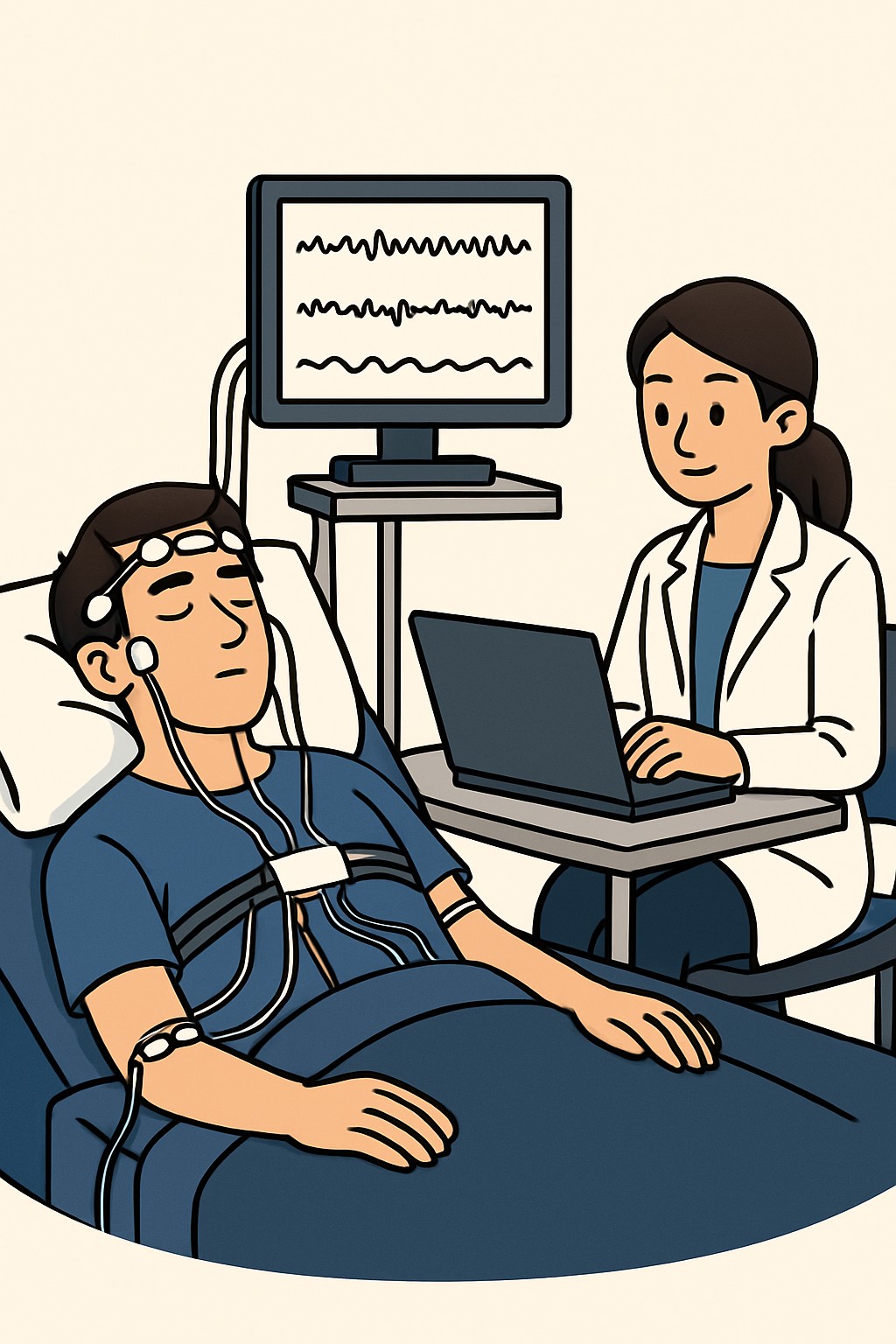
A polysomnogram is an overnight sleep study done in a sleep lab. It records brain waves, breathing, oxygen levels, heart rate, snoring, and movements while you sleep. A technologist places sensors with adhesive on your scalp, face, chest, and legs and monitors you through the night. Clinicians use the study to check for sleep-related breathing problems and other sleep disorders. Results help guide further testing or treatments, such as positive airway pressure therapy.
Also known as: Polysomnography, PSG, In-lab sleep study, Overnight sleep study
Preparation & Next Steps
Everything you need to know before and after your procedure
Before Care
- Confirm arrival time and plan for evening setup and early morning discharge
- Avoid caffeine and alcohol in the afternoon and evening unless the lab instructs otherwise
- Wash your hair and skin; avoid oils, gels, heavy lotions, and makeup so sensors stick well
- Bring comfortable sleepwear, toiletries, a change of clothes, and any needed pillows or items for comfort
- Bring a photo ID, insurance card, and a payment method if charges apply
- Carry an up-to-date list of medicines and supplements; follow any lab instructions about medicines that affect sleep or breathing
- If you use CPAP, an oral appliance, or oxygen at home, ask the lab if you should bring your equipment
- Let the lab know ahead of time about mobility needs, adhesive sensitivities, or if an interpreter or caregiver is required
- Many labs ask you to avoid daytime naps before the study; check your lab’s instructions
- Plan transportation and next-day schedule in case you feel tired after the study
After Care
- Staff will remove sensors; wash your hair and skin at home to remove any gel or adhesive residue
- Most people resume normal activities the same day, though some feel tired after a night in the lab
- Expect results after a sleep physician reviews the data; many labs schedule a follow-up within 1 to 2 weeks
- Ask how results will be shared, such as a portal message, phone call, or clinic visit
- If the study suggests sleep apnea, next steps may include a device fitting, education, or a separate titration study
- Contact the lab or clinic if you notice significant skin irritation or blisters at sensor sites
- Keep track of any recommended equipment pickups, education sessions, or follow-up appointments
- Return any borrowed items as instructed by the lab
- Check your insurance benefits for any recommended treatments or equipment
Clinical Information
Important medical details about this procedure
Indications
- Suspected obstructive sleep apnea
- Suspected central sleep apnea or hypoventilation
- Loud snoring with witnessed pauses in breathing
- Excessive daytime sleepiness or nonrestorative sleep
- Frequent awakenings, choking, or gasping at night
- Parasomnias such as sleepwalking or acting out dreams
- Possible periodic limb movement disorder
- Unexplained nocturnal events that mimic seizures
Alternatives
- Home sleep apnea test for uncomplicated obstructive sleep apnea
- Overnight pulse oximetry screening
- Actigraphy to estimate sleep patterns over days to weeks
- Sleep questionnaires such as Epworth Sleepiness Scale or STOP-Bang
- Clinical observation and review of sleep habits
Risks
- Skin irritation or rash from adhesives or tape
- Disrupted or poor sleep in an unfamiliar setting
- Discomfort from wires or sensors
- Privacy concerns due to audio and video monitoring
- Results may be limited if you sleep much less than usual
- Tripping hazard when walking with wires attached
Contraindications
- Unstable medical conditions that require hospital-level monitoring
- Open wounds, severe skin conditions, or adhesive allergy at sensor sites
- Active contagious illness needing isolation precautions
- Inability to cooperate with the study without needed support
Recovery Timeline
What to expect during your recovery
There is no medical recovery period for an overnight sleep study. Most people return to normal routines the same day, though feeling sleepy is common after a short night.
Typical Range
0–1 days
Return to Work
0–1 days
Recovery Milestones
Resume normal daily activities as you feel able
Shower to remove electrode paste and adhesive residue
Review results with the sleep clinic via portal or follow-up visit
Complete any equipment fitting or education if recommended
Frequently Asked Questions
Common questions and expert answers about this procedure
What does a polysomnogram measure?
What does a polysomnogram measure?
It records brain waves, eye movements, muscle tone, heart rate, airflow, breathing effort, oxygen level, snoring, and leg movements while you sleep.
How long does the test take?
How long does the test take?
Setup often takes 45 to 90 minutes in the evening. You are monitored for a full night of sleep and usually leave early in the morning.
Is the test painful?
Is the test painful?
No. It is noninvasive. Adhesives and sensors can feel awkward, and mild skin irritation can occur.
What if I cannot fall asleep?
What if I cannot fall asleep?
Labs can often get enough data even if you sleep less than usual. If the data are not adequate, a repeat study may be scheduled.
Will I be recorded on video?
Will I be recorded on video?
Most labs use audio and video to monitor safety and sleep behaviors. Recordings are kept under the lab’s privacy policies.
Can someone stay with me during the study?
Can someone stay with me during the study?
Policies vary. Many labs allow a parent for children or a approved caregiver when needed. Ask the lab before your appointment.
How is an in-lab study different from a home sleep apnea test?
How is an in-lab study different from a home sleep apnea test?
In-lab studies measure more signals and can check many sleep disorders. Home tests are simpler and mainly used to diagnose uncomplicated obstructive sleep apnea.
When will I get my results?
When will I get my results?
A sleep physician reviews and interprets the recording. Many labs share results within 1 to 2 weeks.
References
Medical literature and sources