%20--%3e%3csvg%20version='1.0'%20id='Layer_1'%20xmlns='http://www.w3.org/2000/svg'%20xmlns:xlink='http://www.w3.org/1999/xlink'%20x='0px'%20y='0px'%20viewBox='0%200%20755.52%20814.35'%20style='enable-background:new%200%200%20755.52%20814.35;'%20xml:space='preserve'%3e%3cstyle%20type='text/css'%3e%20.st0{fill:%231ae5ce;stroke:%231ae5ce;stroke-width:7;stroke-miterlimit:10;}%20.st1{fill:%23FFFFFF;stroke:%231ae5ce;stroke-width:7;stroke-miterlimit:10;}%20.st2{fill:%231ae5ce;stroke:%23FFFFFF;stroke-width:7;stroke-miterlimit:10;}%20.st3{fill:%23FFFFFF;stroke:%23FFFFFF;stroke-width:6;stroke-miterlimit:10;}%20%3c/style%3e%3cg%20id='Dark_Logo_00000159431215648494653180000015900878925932721032_'%3e%3cpath%20id='shield_00000152259091539869183100000001926543869452564382_'%20class='st0'%20d='M711.13,173.42%20c-3.37-49.07-38.92-44.9-75.96-52.18c-67.4-13.25-130.47-34.47-192.36-63.92c-22.48-10.7-41.88-25.74-65.05-26.28%20c-23.17,0.54-42.58,15.59-65.05,26.28c-61.89,29.45-124.95,50.68-192.36,63.92c-37.04,7.28-72.59,3.11-75.96,52.18%20c-1.55,22.6,0.34,46.4,1.05,68.92c5.99,190.78,52.91,345.39,206.27,466.46c29.71,23.46,74.51,55.8,108.84,70.75%20c5.99,2.61,11.7,3.73,17.21,3.75c5.51-0.02,11.22-1.14,17.21-3.75c34.33-14.95,79.12-47.3,108.84-70.75%20c153.37-121.07,200.28-275.68,206.27-466.46C710.79,219.82,712.68,196.02,711.13,173.42z'/%3e%3cpath%20id='magnifyingglass_00000073685934697636024790000000342567780940956808_'%20class='st1'%20d='M648.78,624.21l-96.64-104.65%20c34.89-40.63,55.98-93.46,55.98-151.21c0-128.27-103.98-232.24-232.24-232.24S143.63,240.08,143.63,368.35%20s103.98,232.24,232.24,232.24c48.87,0,94.21-15.11,131.62-40.89l97.18,105.24c11.25,12.18,30.24,12.93,42.42,1.69l0,0%20C659.27,655.38,660.03,636.39,648.78,624.21z'/%3e%3ccircle%20id='ellipse_00000129904010550392394720000017056154833629780114_'%20class='st2'%20cx='375.87'%20cy='368.35'%20r='181.21'/%3e%3cpath%20id='dollarsign_00000057140127156649725250000003772530148495155891_'%20class='st3'%20d='M362.91,492.03v-23.91%20c0-2.01-1.58-3.69-3.59-3.77c-18.49-0.78-37.12-5.4-49.4-11.83c-1.75-0.92-2.53-3.01-1.76-4.84l5.87-13.89%20c0.86-2.02,3.23-2.88,5.2-1.89c12.94,6.52,30.45,11.44,49.18,11.44c26.02,0,43.6-12.73,43.6-30.43c0-17.08-14.29-27.63-41.4-36.95%20c-37.37-12.42-60.46-26.7-60.46-53.72c0-24.97,20.29-44.11,52.22-49.51c1.8-0.31,3.11-1.89,3.11-3.72v-24.35%20c0-2.09,1.69-3.78,3.78-3.78h15.16c2.09,0,3.78,1.69,3.78,3.78v22.71c0,2.01,1.58,3.67,3.58,3.77c17.85,0.92,30.88,4.75,40.61,9.1%20c1.92,0.86,2.79,3.09,1.94,5.01l-6.08,13.6c-0.85,1.91-3.09,2.77-4.99,1.91c-8.37-3.8-22.38-8.95-42.75-8.95%20c-28.21,0-38.84,14.28-38.84,26.7c0,16.15,13.56,24.22,45.44,35.4c37.74,13.04,56.79,29.19,56.79,56.82%20c0,23.85-19.05,46.23-54.78,52.3c-1.8,0.31-3.11,1.89-3.11,3.72v25.28c0,2.09-1.69,3.78-3.78,3.78h-15.53%20C364.6,495.81,362.91,494.12,362.91,492.03z'/%3e%3c/g%3e%3c/svg%3e)
Right heart catheterization (Swan-Ganz) Diagnostic Imaging
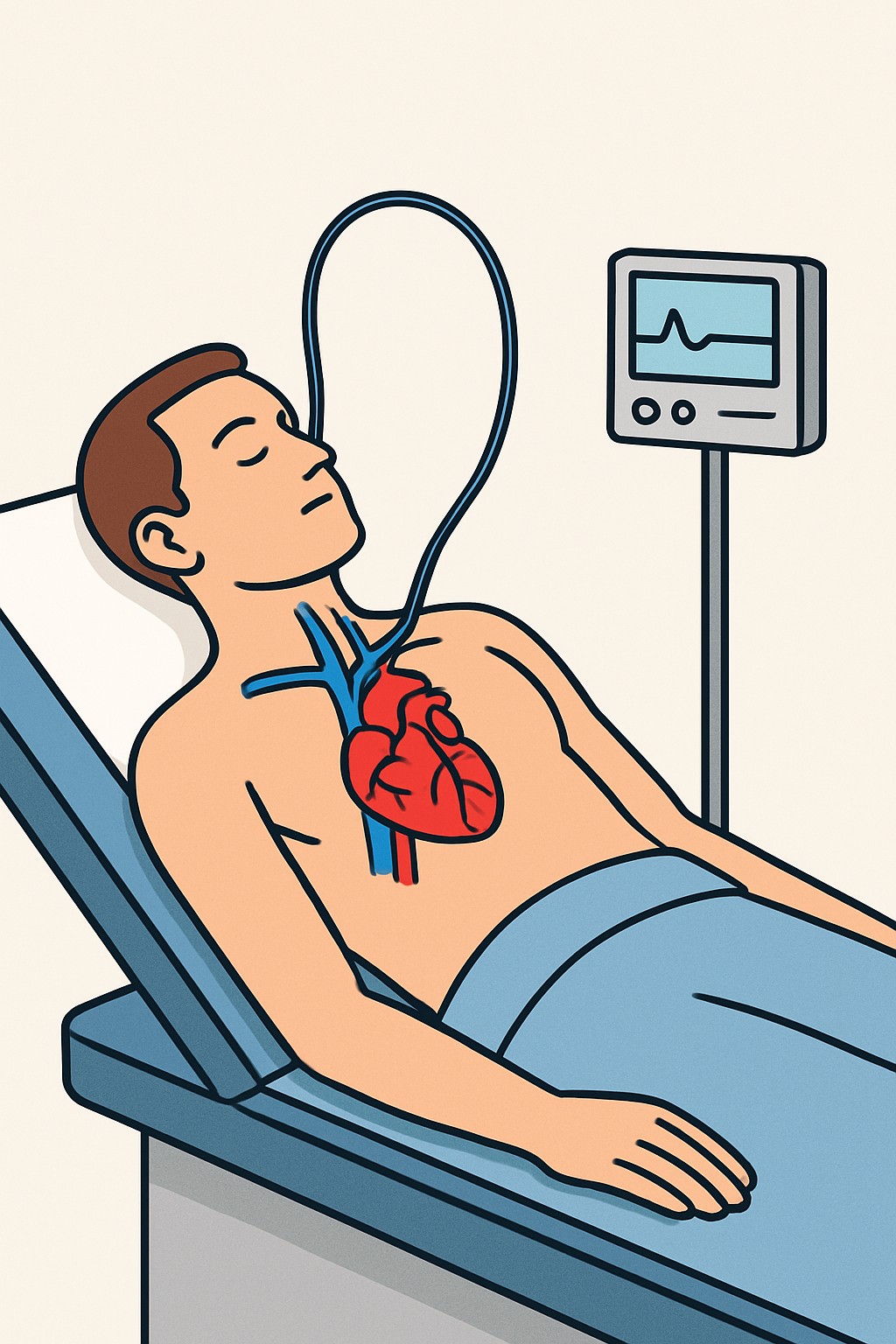
Right heart catheterization is a test that measures pressure and blood flow in the right side of the heart and in the lungs.
Overview
Right heart catheterization is a test that measures pressure and blood flow in the right side of the heart and in the lungs. A thin tube called a catheter is guided through a vein, usually in the neck, arm, or groin, into the heart and pulmonary artery. It can be done with a special device called a Swan-Ganz catheter, which has sensors to measure pressures and cardiac output. Clinicians use this procedure to evaluate shortness of breath, diagnose or confirm pulmonary hypertension, assess heart failure or shock, and guide treatment in complex heart and lung conditions. It may be a brief outpatient test or part of hospital care when close monitoring is needed.
Also known as: Pulmonary artery catheterization, Swan-Ganz catheter placement, Right-sided heart catheterization, PA catheter
Preparation & Next Steps
Everything you need to know before and after your procedure
Before Care
- Bring a current list of all medicines and supplements, including doses and any allergies
- Follow any fasting instructions if sedation is planned
- Ask the care team how to handle blood thinners or diabetes medicines before the test
- Arrange a ride home if you receive sedation
- Wear comfortable clothing and leave jewelry at home
- Share any history of bleeding problems or prior reactions to contrast, antiseptics, latex, or tape
- Expect a review of recent labs and possibly a pregnancy test when relevant
- Confirm which vein site will likely be used and plan clothing accordingly
- Bring ID, insurance information, and a list of prior procedures or implants
- Plan for either same-day discharge or a hospital stay if the catheter will remain in place for monitoring
After Care
- Keep the insertion site clean and dry as instructed; avoid soaking the area until cleared
- Leave the pressure bandage in place for the time your care team recommends
- Limit heavy lifting and strenuous movement of the arm or leg used for access for a short period
- You may have mild soreness or bruising at the site, which usually improves over a few days
- Do not drive or operate machinery for 24 hours if you received sedation
- Drink fluids as allowed by your care team unless you have fluid restrictions
- Confirm how and when you will receive results and the next steps
- Watch for concerning signs such as persistent bleeding, increasing swelling, warmth, drainage, fever, chest pain, shortness of breath, numbness, or color change in the limb, and contact a clinician if these occur
- If the catheter remains in place for monitoring, hospital staff will manage site care, measurements, and removal
- Keep follow-up appointments for review of findings or additional testing if planned
Clinical Information
Important medical details about this procedure
Indications
- Evaluate suspected or known pulmonary hypertension
- Assess unexplained shortness of breath when noninvasive tests are unclear
- Guide treatment for heart failure or shock
- Measure cardiac output and filling pressures
- Check for fluid around the lungs or heart affecting pressures
- Evaluate valve disease or congenital heart defects affecting right heart flow
- Pre-transplant or pre-procedure assessment for heart or lung conditions
- Monitor response to medicines that affect heart and lung pressures
Alternatives
- Transthoracic echocardiogram to estimate pressures and heart function
- Transesophageal echocardiogram for closer heart views
- Cardiac MRI or CT for structure and function
- Bedside ultrasound and clinical monitoring for fluid status
- Noninvasive cardiac output monitoring systems
Risks
- Bleeding or bruising at the insertion site
- Infection at the insertion site or in the bloodstream
- Abnormal heart rhythms during catheter passage
- Blood vessel injury or clot formation
- Lung-related issues such as collapsed lung with certain access sites
- Rare pulmonary artery injury
- Allergic reaction to medicines, antiseptics, or materials used
- Low blood pressure or dizziness
Contraindications
- Active skin infection at the planned insertion site
- Uncontrolled bleeding problems
- Severe allergy to local anesthetics or materials used in the procedure
- Inability to lie flat or cooperate with the procedure without safe sedation
Recovery Timeline
What to expect during your recovery
Most people return to light activities within 1 to 2 days after a simple right heart catheterization. Recovery may take longer if the catheter is left in place for monitoring in the hospital.
Typical Range
1–3 days
Return to Work
1–3 days
Recovery Milestones
Walk with assistance shortly after the procedure as allowed by staff
Resume light daily activities while protecting the access site
Gradually return to usual exercise if the site is healed and you feel well
Frequently Asked Questions
Common questions and expert answers about this procedure
What is a Swan-Ganz catheter?
What is a Swan-Ganz catheter?
It is a type of pulmonary artery catheter with sensors that measure pressures in the right heart and lungs and can measure cardiac output.
How is right heart catheterization different from left heart catheterization?
How is right heart catheterization different from left heart catheterization?
Right heart catheterization goes through a vein to the right side of the heart to measure pressures. Left heart catheterization often uses an artery to look at coronary arteries and may use more contrast dye.
How long does the procedure take?
How long does the procedure take?
The test often takes 30 to 60 minutes. It can be longer if additional measurements are needed or if the catheter stays in for monitoring.
Will I be awake?
Will I be awake?
Most people receive local numbing medicine at the insertion site and may get light sedation to help them relax.
Is contrast dye used?
Is contrast dye used?
Often no dye is needed for right heart measurements. Small amounts may be used if imaging guidance or specific tests are required.
What does the test show?
What does the test show?
It shows pressures in the heart and lungs and how much blood the heart pumps. These data help diagnose conditions like pulmonary hypertension and guide treatment.
Will I need to stay in the hospital?
Will I need to stay in the hospital?
Many tests are done as same-day procedures. If the catheter is used for ongoing monitoring or you are being treated for a serious condition, a hospital stay is common.
Is there radiation exposure?
Is there radiation exposure?
There may be brief X-ray imaging to guide the catheter. The exposure is generally low and limited to the time needed for safe placement.
References
Medical literature and sources