%20--%3e%3csvg%20version='1.0'%20id='Layer_1'%20xmlns='http://www.w3.org/2000/svg'%20xmlns:xlink='http://www.w3.org/1999/xlink'%20x='0px'%20y='0px'%20viewBox='0%200%20755.52%20814.35'%20style='enable-background:new%200%200%20755.52%20814.35;'%20xml:space='preserve'%3e%3cstyle%20type='text/css'%3e%20.st0{fill:%231ae5ce;stroke:%231ae5ce;stroke-width:7;stroke-miterlimit:10;}%20.st1{fill:%23FFFFFF;stroke:%231ae5ce;stroke-width:7;stroke-miterlimit:10;}%20.st2{fill:%231ae5ce;stroke:%23FFFFFF;stroke-width:7;stroke-miterlimit:10;}%20.st3{fill:%23FFFFFF;stroke:%23FFFFFF;stroke-width:6;stroke-miterlimit:10;}%20%3c/style%3e%3cg%20id='Dark_Logo_00000159431215648494653180000015900878925932721032_'%3e%3cpath%20id='shield_00000152259091539869183100000001926543869452564382_'%20class='st0'%20d='M711.13,173.42%20c-3.37-49.07-38.92-44.9-75.96-52.18c-67.4-13.25-130.47-34.47-192.36-63.92c-22.48-10.7-41.88-25.74-65.05-26.28%20c-23.17,0.54-42.58,15.59-65.05,26.28c-61.89,29.45-124.95,50.68-192.36,63.92c-37.04,7.28-72.59,3.11-75.96,52.18%20c-1.55,22.6,0.34,46.4,1.05,68.92c5.99,190.78,52.91,345.39,206.27,466.46c29.71,23.46,74.51,55.8,108.84,70.75%20c5.99,2.61,11.7,3.73,17.21,3.75c5.51-0.02,11.22-1.14,17.21-3.75c34.33-14.95,79.12-47.3,108.84-70.75%20c153.37-121.07,200.28-275.68,206.27-466.46C710.79,219.82,712.68,196.02,711.13,173.42z'/%3e%3cpath%20id='magnifyingglass_00000073685934697636024790000000342567780940956808_'%20class='st1'%20d='M648.78,624.21l-96.64-104.65%20c34.89-40.63,55.98-93.46,55.98-151.21c0-128.27-103.98-232.24-232.24-232.24S143.63,240.08,143.63,368.35%20s103.98,232.24,232.24,232.24c48.87,0,94.21-15.11,131.62-40.89l97.18,105.24c11.25,12.18,30.24,12.93,42.42,1.69l0,0%20C659.27,655.38,660.03,636.39,648.78,624.21z'/%3e%3ccircle%20id='ellipse_00000129904010550392394720000017056154833629780114_'%20class='st2'%20cx='375.87'%20cy='368.35'%20r='181.21'/%3e%3cpath%20id='dollarsign_00000057140127156649725250000003772530148495155891_'%20class='st3'%20d='M362.91,492.03v-23.91%20c0-2.01-1.58-3.69-3.59-3.77c-18.49-0.78-37.12-5.4-49.4-11.83c-1.75-0.92-2.53-3.01-1.76-4.84l5.87-13.89%20c0.86-2.02,3.23-2.88,5.2-1.89c12.94,6.52,30.45,11.44,49.18,11.44c26.02,0,43.6-12.73,43.6-30.43c0-17.08-14.29-27.63-41.4-36.95%20c-37.37-12.42-60.46-26.7-60.46-53.72c0-24.97,20.29-44.11,52.22-49.51c1.8-0.31,3.11-1.89,3.11-3.72v-24.35%20c0-2.09,1.69-3.78,3.78-3.78h15.16c2.09,0,3.78,1.69,3.78,3.78v22.71c0,2.01,1.58,3.67,3.58,3.77c17.85,0.92,30.88,4.75,40.61,9.1%20c1.92,0.86,2.79,3.09,1.94,5.01l-6.08,13.6c-0.85,1.91-3.09,2.77-4.99,1.91c-8.37-3.8-22.38-8.95-42.75-8.95%20c-28.21,0-38.84,14.28-38.84,26.7c0,16.15,13.56,24.22,45.44,35.4c37.74,13.04,56.79,29.19,56.79,56.82%20c0,23.85-19.05,46.23-54.78,52.3c-1.8,0.31-3.11,1.89-3.11,3.72v25.28c0,2.09-1.69,3.78-3.78,3.78h-15.53%20C364.6,495.81,362.91,494.12,362.91,492.03z'/%3e%3c/g%3e%3c/svg%3e)
Transesophageal Echocardiography (TEE) Diagnostic Imaging
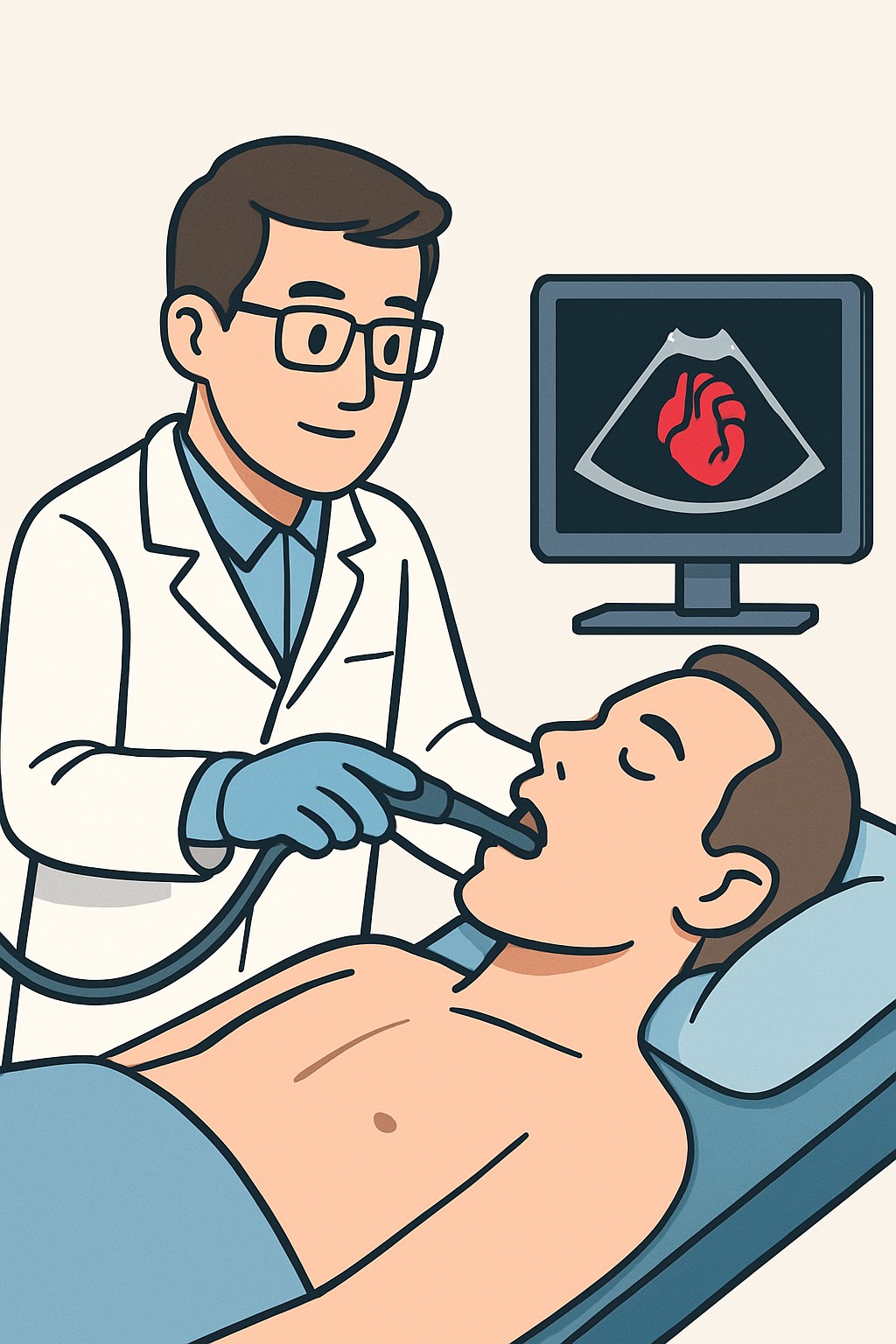
Transesophageal echocardiography is a heart ultrasound done with a thin, flexible tube placed in the esophagus, the tube that connects your mouth to your stomach.
Overview
Transesophageal echocardiography is a heart ultrasound done with a thin, flexible tube placed in the esophagus, the tube that connects your mouth to your stomach. Because the esophagus sits close to the heart, this test provides clearer images than a standard chest ultrasound. During TEE, the throat is numbed and medicines are often given to help you relax. Clinicians use TEE to look closely at heart valves, chambers, and nearby blood vessels to find problems such as clots, infection, or leaks.
Also known as: TEE, Transesophageal echo, Esophageal heart ultrasound
Preparation & Next Steps
Everything you need to know before and after your procedure
Before Care
- Follow the fasting instructions from your care team, which often means no food or drink for about 6 hours before the test
- Arrange an adult to take you home because sedating medicines are commonly used
- Bring a current list of all medicines and allergies, including over-the-counter and supplements
- Confirm instructions about blood thinners, diabetes medicines, and implanted devices such as pacemakers or defibrillators
- Tell the team about any trouble swallowing, acid reflux, or prior esophageal conditions
- Remove dentures or loose dental work before the test and bring a case for them
- Bring photo ID and insurance information and plan time for check-in and recovery
- Wear comfortable clothing and leave jewelry at home
- Expect to sign consent forms and have an IV placed for medicines
- If you develop a new fever, cough, or sore throat before the appointment, contact the clinic for guidance
After Care
- You will be monitored until the sedative wears off; plan quiet rest for the remainder of the day
- Food and drink are usually resumed once throat numbness fades and swallowing is checked
- Do not drive, use heavy machinery, or sign important documents the day of the test because of sedation effects
- Mild throat soreness or hoarseness can occur for 1 to 2 days and typically improves on its own
- Resume your usual medicines as instructed by your care team
- Keep the IV site clean and dry; minor bruising can happen and usually resolves
- Arrange how you will receive results and any next steps, such as follow-up visits or additional tests
- Contact a clinician if you have severe or worsening throat or chest pain, trouble breathing, fever, vomiting blood, black stools, or coughing up blood
Clinical Information
Important medical details about this procedure
Indications
- Evaluating heart valve disease or prosthetic valve function
- Looking for blood clots in the heart before procedures like cardioversion
- Checking for infection on heart valves or devices (endocarditis)
- Assessing the aorta for aneurysm or dissection
- Investigating the source of a stroke or transient ischemic attack
- Detailed views in congenital heart disease
- Guidance during certain heart procedures or surgery
Alternatives
- Transthoracic echocardiogram (TTE)
- Cardiac CT scan
- Cardiac MRI
- Cardiac catheterization when indicated for other reasons
Risks
- Sore throat, hoarseness, or nausea
- Reaction to sedative medicines such as drowsiness or low breathing
- Injury to teeth, mouth, or esophagus, including bleeding or very rarely a tear
- Irregular heart rhythm or low oxygen during the test
- Aspiration of stomach contents, rare
Contraindications
- Known esophageal problems such as strictures, large varices, or tumors
- Recent esophageal surgery or active upper gastrointestinal bleeding
- Severe difficulty swallowing
- Unstable neck or spine conditions limiting safe positioning
Recovery Timeline
What to expect during your recovery
Most people go home the same day and feel back to normal within about 24 hours. Throat irritation may last 1 to 2 days.
Typical Range
0–2 days
Return to Work
1–2 days
Recovery Milestones
Rest at home and avoid driving after sedation
Resume light daily activities as you feel ready
Return to normal diet once swallowing feels normal
Frequently Asked Questions
Common questions and expert answers about this procedure
What is the difference between TEE and a standard echocardiogram?
What is the difference between TEE and a standard echocardiogram?
A standard echocardiogram uses a probe on the chest. TEE places a small ultrasound probe in the esophagus to get closer to the heart for clearer images.
How long does the test take?
How long does the test take?
The exam itself often takes 30 to 60 minutes. Plan additional time for check-in, sedation, and recovery.
Will I be awake during TEE?
Will I be awake during TEE?
Your throat is numbed and you typically receive medicines that make you relaxed and drowsy. Many people have little memory of the test.
What conditions can TEE help find?
What conditions can TEE help find?
It helps evaluate heart valves, detect blood clots in the atria, look for valve infections, and assess the aorta and congenital heart problems.
Can I have TEE if I have swallowing or esophageal problems?
Can I have TEE if I have swallowing or esophageal problems?
Some esophageal conditions may increase risk. The care team reviews your history to decide if TEE is appropriate or if another test is better.
How should I prepare regarding food and medicines?
How should I prepare regarding food and medicines?
Fasting is usually required and medicine plans are individualized, especially for blood thinners and diabetes drugs. Follow the instructions provided by your care team.
How will I get my results?
How will I get my results?
A clinician often shares a preliminary impression the same day. A finalized report is issued after full review.
Is TEE safe?
Is TEE safe?
Complications are uncommon. Most are minor, like sore throat. Serious problems such as bleeding, tears, or breathing issues are rare.
References
Medical literature and sources