%20--%3e%3csvg%20version='1.0'%20id='Layer_1'%20xmlns='http://www.w3.org/2000/svg'%20xmlns:xlink='http://www.w3.org/1999/xlink'%20x='0px'%20y='0px'%20viewBox='0%200%20755.52%20814.35'%20style='enable-background:new%200%200%20755.52%20814.35;'%20xml:space='preserve'%3e%3cstyle%20type='text/css'%3e%20.st0{fill:%231ae5ce;stroke:%231ae5ce;stroke-width:7;stroke-miterlimit:10;}%20.st1{fill:%23FFFFFF;stroke:%231ae5ce;stroke-width:7;stroke-miterlimit:10;}%20.st2{fill:%231ae5ce;stroke:%23FFFFFF;stroke-width:7;stroke-miterlimit:10;}%20.st3{fill:%23FFFFFF;stroke:%23FFFFFF;stroke-width:6;stroke-miterlimit:10;}%20%3c/style%3e%3cg%20id='Dark_Logo_00000159431215648494653180000015900878925932721032_'%3e%3cpath%20id='shield_00000152259091539869183100000001926543869452564382_'%20class='st0'%20d='M711.13,173.42%20c-3.37-49.07-38.92-44.9-75.96-52.18c-67.4-13.25-130.47-34.47-192.36-63.92c-22.48-10.7-41.88-25.74-65.05-26.28%20c-23.17,0.54-42.58,15.59-65.05,26.28c-61.89,29.45-124.95,50.68-192.36,63.92c-37.04,7.28-72.59,3.11-75.96,52.18%20c-1.55,22.6,0.34,46.4,1.05,68.92c5.99,190.78,52.91,345.39,206.27,466.46c29.71,23.46,74.51,55.8,108.84,70.75%20c5.99,2.61,11.7,3.73,17.21,3.75c5.51-0.02,11.22-1.14,17.21-3.75c34.33-14.95,79.12-47.3,108.84-70.75%20c153.37-121.07,200.28-275.68,206.27-466.46C710.79,219.82,712.68,196.02,711.13,173.42z'/%3e%3cpath%20id='magnifyingglass_00000073685934697636024790000000342567780940956808_'%20class='st1'%20d='M648.78,624.21l-96.64-104.65%20c34.89-40.63,55.98-93.46,55.98-151.21c0-128.27-103.98-232.24-232.24-232.24S143.63,240.08,143.63,368.35%20s103.98,232.24,232.24,232.24c48.87,0,94.21-15.11,131.62-40.89l97.18,105.24c11.25,12.18,30.24,12.93,42.42,1.69l0,0%20C659.27,655.38,660.03,636.39,648.78,624.21z'/%3e%3ccircle%20id='ellipse_00000129904010550392394720000017056154833629780114_'%20class='st2'%20cx='375.87'%20cy='368.35'%20r='181.21'/%3e%3cpath%20id='dollarsign_00000057140127156649725250000003772530148495155891_'%20class='st3'%20d='M362.91,492.03v-23.91%20c0-2.01-1.58-3.69-3.59-3.77c-18.49-0.78-37.12-5.4-49.4-11.83c-1.75-0.92-2.53-3.01-1.76-4.84l5.87-13.89%20c0.86-2.02,3.23-2.88,5.2-1.89c12.94,6.52,30.45,11.44,49.18,11.44c26.02,0,43.6-12.73,43.6-30.43c0-17.08-14.29-27.63-41.4-36.95%20c-37.37-12.42-60.46-26.7-60.46-53.72c0-24.97,20.29-44.11,52.22-49.51c1.8-0.31,3.11-1.89,3.11-3.72v-24.35%20c0-2.09,1.69-3.78,3.78-3.78h15.16c2.09,0,3.78,1.69,3.78,3.78v22.71c0,2.01,1.58,3.67,3.58,3.77c17.85,0.92,30.88,4.75,40.61,9.1%20c1.92,0.86,2.79,3.09,1.94,5.01l-6.08,13.6c-0.85,1.91-3.09,2.77-4.99,1.91c-8.37-3.8-22.38-8.95-42.75-8.95%20c-28.21,0-38.84,14.28-38.84,26.7c0,16.15,13.56,24.22,45.44,35.4c37.74,13.04,56.79,29.19,56.79,56.82%20c0,23.85-19.05,46.23-54.78,52.3c-1.8,0.31-3.11,1.89-3.11,3.72v25.28c0,2.09-1.69,3.78-3.78,3.78h-15.53%20C364.6,495.81,362.91,494.12,362.91,492.03z'/%3e%3c/g%3e%3c/svg%3e)
Upper GI series (barium swallow exam) Diagnostic Imaging
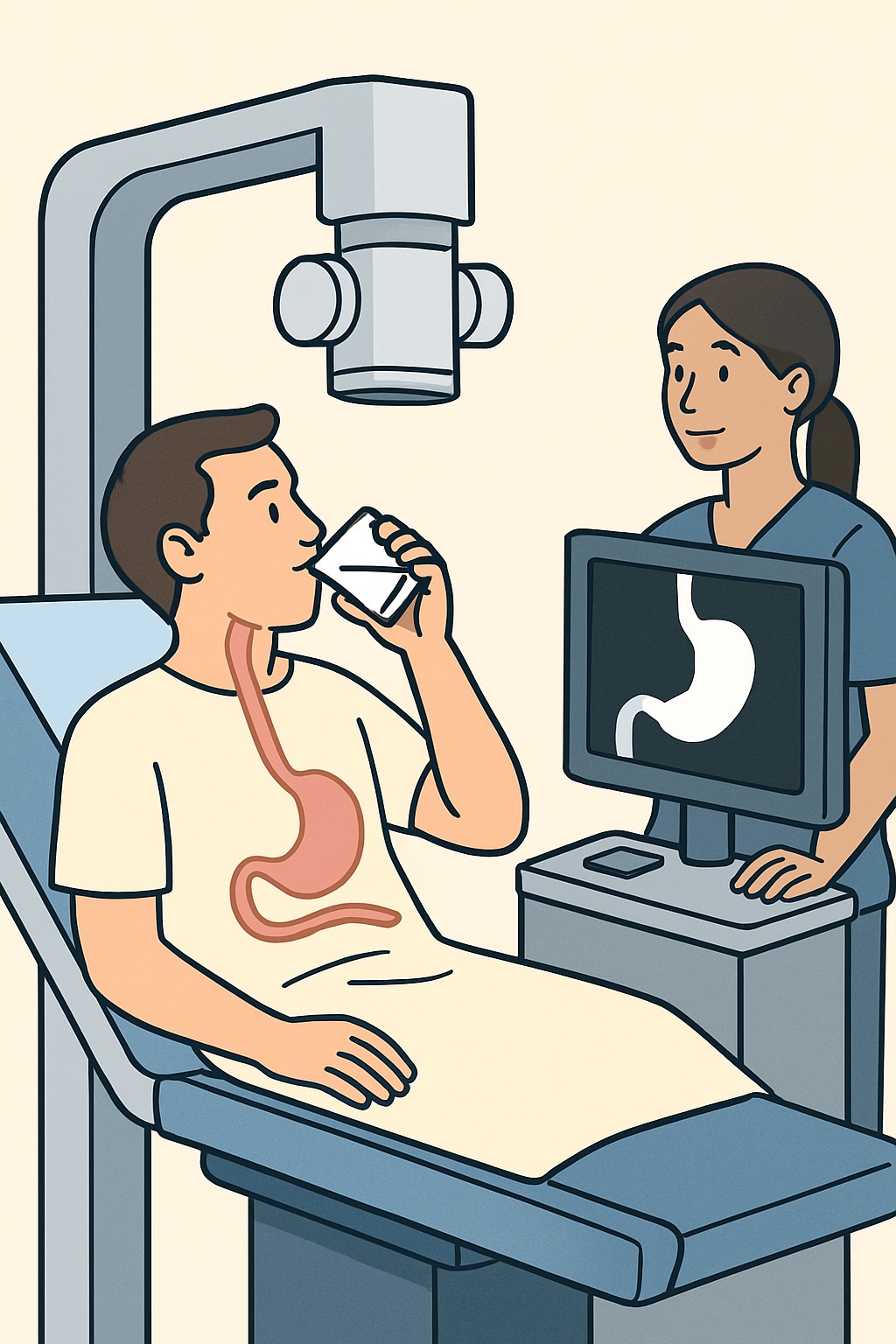
An upper GI series, also called a barium swallow exam, is an X-ray study of the esophagus, stomach, and first part of the small intestine.
Overview
An upper GI series, also called a barium swallow exam, is an X-ray study of the esophagus, stomach, and first part of the small intestine. You drink a liquid contrast called barium that coats the lining so the organs show up clearly on X-ray. Clinicians use this test to look for problems with swallowing, reflux, ulcers, narrowing, hiatal hernia, or other structural and motion issues in the upper digestive tract. It is a diagnostic imaging test and does not involve surgery.
Also known as: Upper GI series, Barium swallow, Upper gastrointestinal series, Esophagram
Preparation & Next Steps
Everything you need to know before and after your procedure
Before Care
- You may be asked not to eat or drink for several hours before the exam; follow the imaging center’s instructions.
- Ask the facility about taking regular medicines on the day of the test; some centers ask you to pause antacids before imaging.
- Wear comfortable clothing without metal fasteners; you may be asked to remove jewelry, glasses, or dentures before imaging.
- Bring a photo ID, insurance card, and a list of your medicines and allergies.
- Arrive early to complete forms and review safety questions, including recent imaging or contrast use.
- Imaging centers routinely ask about possible pregnancy because X-rays are used.
- Tell the staff about swallowing troubles, prior surgeries, or if you have limited mobility so they can plan positioning.
- Plan enough time; an upper GI series often takes about 30 to 60 minutes, and it can be longer if additional images are needed.
After Care
- You can usually resume normal activities and diet unless the facility gives different instructions.
- Your stools may look white or light for 1 to 3 days as the barium passes.
- Mild constipation can occur; many centers encourage extra fluids if allowed by your clinician.
- You may be given instructions to help pass the barium; follow the written directions from the facility.
- Contact a clinician if you develop severe or worsening abdominal pain, vomiting, fever, or no bowel movement for several days.
- Expect a radiologist to send a report to the ordering clinician; ask how you will receive results.
- Keep track of any new or changing symptoms and share them at follow-up.
- If you had any imaging reactions or discomfort during the test, note them for your medical records.
Clinical Information
Important medical details about this procedure
Indications
- Difficulty or pain with swallowing
- Frequent heartburn or suspected reflux
- Suspected hiatal hernia
- Unexplained upper abdominal pain
- Suspected ulcers or inflammation
- Feeling of food sticking in the chest
- Unexplained vomiting
- Evaluation of structural changes after prior surgery
Alternatives
- Upper endoscopy (EGD)
- Esophagram with water-soluble contrast
- Modified barium swallow (video fluoroscopic swallow study) for throat swallowing issues
- Esophageal manometry for muscle function
- pH monitoring for acid reflux
- CT or MRI when another imaging approach is needed
Risks
- Exposure to a small amount of X-ray radiation
- Temporary constipation from barium
- Rare aspiration of barium into the airway
- Very rare blockage if severe constipation occurs
- Not usually done during pregnancy because of radiation
- If a tear or perforation is present, barium can leak and cause complications
Contraindications
- Known or suspected tear or perforation of the esophagus or stomach
- Pregnancy unless the benefits clearly outweigh risks
- High risk of aspiration or inability to swallow safely
Recovery Timeline
What to expect during your recovery
Most people return to normal activities right after the exam. Temporary constipation or chalky stools may occur for a short time.
Typical Range
0–1 days
Return to Work
Same day
Recovery Milestones
Resume usual daily activities
Return to work or school if you feel well
Stools lighten as barium passes; monitor for constipation
Frequently Asked Questions
Common questions and expert answers about this procedure
What happens during an upper GI series?
What happens during an upper GI series?
You drink barium contrast while a technologist takes X-ray images, often using live X-ray (fluoroscopy) to watch swallowing and how the upper GI tract moves.
How long does the exam take?
How long does the exam take?
Many upper GI series take about 30 to 60 minutes. If a small bowel study is added, it can take several hours.
Will I be sedated or have a tube?
Will I be sedated or have a tube?
Sedation is not typically used. You usually drink the contrast by mouth and follow positioning instructions.
Can I eat or take my medicines beforehand?
Can I eat or take my medicines beforehand?
Centers often ask you to avoid eating and may ask you to pause antacids. Follow the specific instructions from the imaging facility.
Is there radiation exposure?
Is there radiation exposure?
Yes. X-rays use ionizing radiation. For most people, the dose is low and the benefits of accurate diagnosis outweigh the small risk.
Is it safe during pregnancy?
Is it safe during pregnancy?
X-ray exams are usually avoided during pregnancy unless essential. Tell the imaging team if you could be pregnant.
How is this different from a modified barium swallow?
How is this different from a modified barium swallow?
A modified barium swallow focuses on the mouth and throat during swallowing, often with a speech-language pathologist. An upper GI series looks at the esophagus, stomach, and duodenum.
When will I get results?
When will I get results?
A radiologist reviews the images and sends a report to your ordering clinician, often within 1 to 2 days. Timing varies by facility.
References
Medical literature and sources