%20--%3e%3csvg%20version='1.0'%20id='Layer_1'%20xmlns='http://www.w3.org/2000/svg'%20xmlns:xlink='http://www.w3.org/1999/xlink'%20x='0px'%20y='0px'%20viewBox='0%200%20755.52%20814.35'%20style='enable-background:new%200%200%20755.52%20814.35;'%20xml:space='preserve'%3e%3cstyle%20type='text/css'%3e%20.st0{fill:%231ae5ce;stroke:%231ae5ce;stroke-width:7;stroke-miterlimit:10;}%20.st1{fill:%23FFFFFF;stroke:%231ae5ce;stroke-width:7;stroke-miterlimit:10;}%20.st2{fill:%231ae5ce;stroke:%23FFFFFF;stroke-width:7;stroke-miterlimit:10;}%20.st3{fill:%23FFFFFF;stroke:%23FFFFFF;stroke-width:6;stroke-miterlimit:10;}%20%3c/style%3e%3cg%20id='Dark_Logo_00000159431215648494653180000015900878925932721032_'%3e%3cpath%20id='shield_00000152259091539869183100000001926543869452564382_'%20class='st0'%20d='M711.13,173.42%20c-3.37-49.07-38.92-44.9-75.96-52.18c-67.4-13.25-130.47-34.47-192.36-63.92c-22.48-10.7-41.88-25.74-65.05-26.28%20c-23.17,0.54-42.58,15.59-65.05,26.28c-61.89,29.45-124.95,50.68-192.36,63.92c-37.04,7.28-72.59,3.11-75.96,52.18%20c-1.55,22.6,0.34,46.4,1.05,68.92c5.99,190.78,52.91,345.39,206.27,466.46c29.71,23.46,74.51,55.8,108.84,70.75%20c5.99,2.61,11.7,3.73,17.21,3.75c5.51-0.02,11.22-1.14,17.21-3.75c34.33-14.95,79.12-47.3,108.84-70.75%20c153.37-121.07,200.28-275.68,206.27-466.46C710.79,219.82,712.68,196.02,711.13,173.42z'/%3e%3cpath%20id='magnifyingglass_00000073685934697636024790000000342567780940956808_'%20class='st1'%20d='M648.78,624.21l-96.64-104.65%20c34.89-40.63,55.98-93.46,55.98-151.21c0-128.27-103.98-232.24-232.24-232.24S143.63,240.08,143.63,368.35%20s103.98,232.24,232.24,232.24c48.87,0,94.21-15.11,131.62-40.89l97.18,105.24c11.25,12.18,30.24,12.93,42.42,1.69l0,0%20C659.27,655.38,660.03,636.39,648.78,624.21z'/%3e%3ccircle%20id='ellipse_00000129904010550392394720000017056154833629780114_'%20class='st2'%20cx='375.87'%20cy='368.35'%20r='181.21'/%3e%3cpath%20id='dollarsign_00000057140127156649725250000003772530148495155891_'%20class='st3'%20d='M362.91,492.03v-23.91%20c0-2.01-1.58-3.69-3.59-3.77c-18.49-0.78-37.12-5.4-49.4-11.83c-1.75-0.92-2.53-3.01-1.76-4.84l5.87-13.89%20c0.86-2.02,3.23-2.88,5.2-1.89c12.94,6.52,30.45,11.44,49.18,11.44c26.02,0,43.6-12.73,43.6-30.43c0-17.08-14.29-27.63-41.4-36.95%20c-37.37-12.42-60.46-26.7-60.46-53.72c0-24.97,20.29-44.11,52.22-49.51c1.8-0.31,3.11-1.89,3.11-3.72v-24.35%20c0-2.09,1.69-3.78,3.78-3.78h15.16c2.09,0,3.78,1.69,3.78,3.78v22.71c0,2.01,1.58,3.67,3.58,3.77c17.85,0.92,30.88,4.75,40.61,9.1%20c1.92,0.86,2.79,3.09,1.94,5.01l-6.08,13.6c-0.85,1.91-3.09,2.77-4.99,1.91c-8.37-3.8-22.38-8.95-42.75-8.95%20c-28.21,0-38.84,14.28-38.84,26.7c0,16.15,13.56,24.22,45.44,35.4c37.74,13.04,56.79,29.19,56.79,56.82%20c0,23.85-19.05,46.23-54.78,52.3c-1.8,0.31-3.11,1.89-3.11,3.72v25.28c0,2.09-1.69,3.78-3.78,3.78h-15.53%20C364.6,495.81,362.91,494.12,362.91,492.03z'/%3e%3c/g%3e%3c/svg%3e)
Wrist X-ray (3 views) Diagnostic Imaging
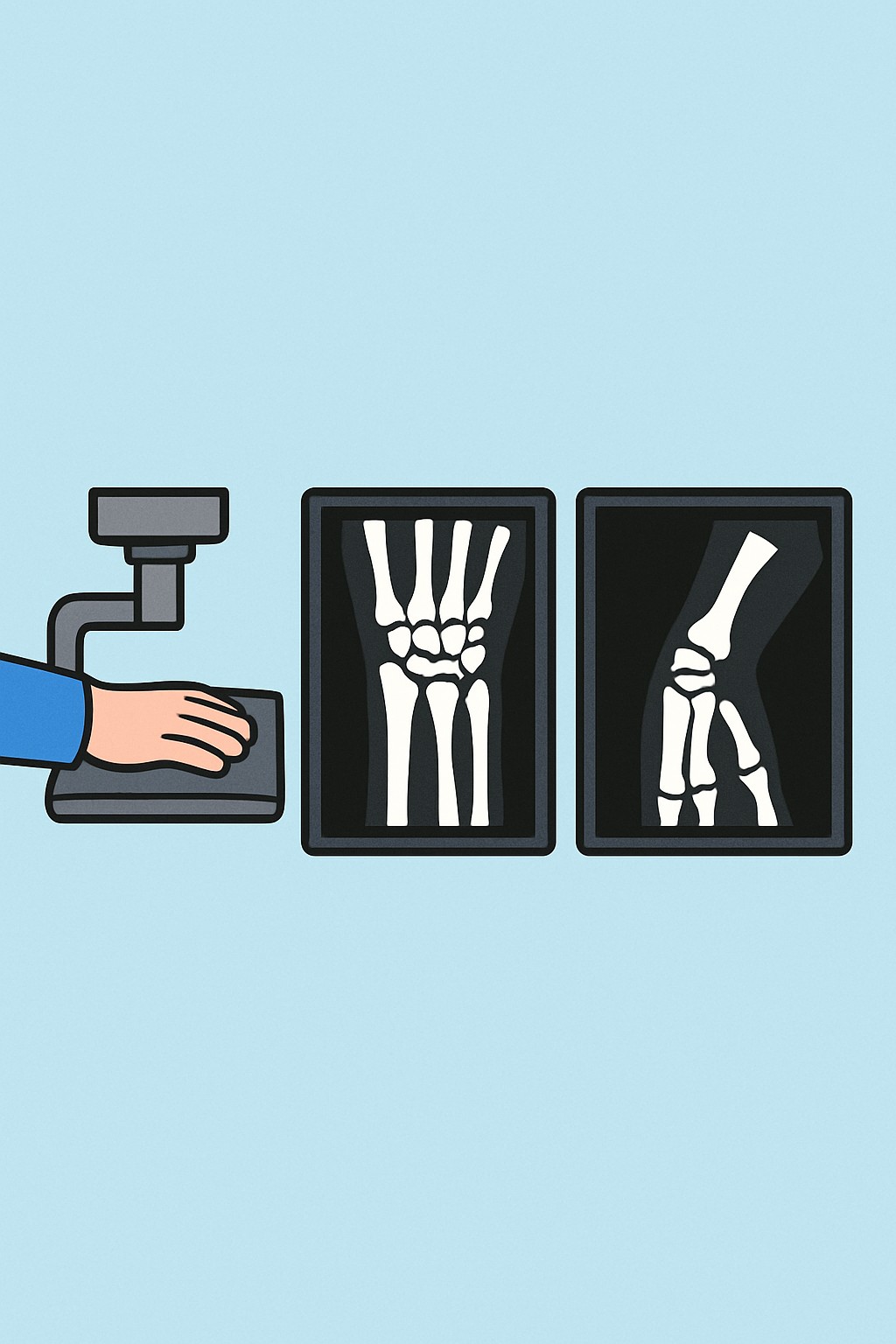
A wrist X-ray (3 views) is a set of three pictures of the wrist taken from different angles using low-dose X-rays.
Overview
A wrist X-ray (3 views) is a set of three pictures of the wrist taken from different angles using low-dose X-rays. It shows the wrist bones, the base of the hand, and the ends of the forearm bones. It is commonly used to look for broken bones, dislocations, arthritis, or other bone changes. Taking three views helps detect small or hidden fractures that might not appear on a single view.
Also known as: Three-view wrist X-ray, Wrist radiograph (3 views), Wrist X-ray series
Preparation & Next Steps
Everything you need to know before and after your procedure
Before Care
- Bring the imaging order and any prior wrist images or reports if available
- Wear short sleeves or loose clothing; you may be asked to change into a gown
- Remove jewelry, watches, or metal near the wrist and hand
- Inform the staff if you are or might be pregnant
- Tell the technologist about prior injuries, surgeries, or implants in the wrist
- Arrive a little early to confirm ID, insurance, and paperwork
- Ask about comfort options if wrist movement is painful during positioning
- Follow any facility instructions on check-in or portal setup
- Confirm how and when results will be shared with you and your clinician
After Care
- You can usually return to normal activities right after the X-ray
- Review how you will receive results; many facilities post a report to the patient portal
- If a splint or wrap was placed by another team, follow their instructions
- Protect the wrist from new strain until you understand the results and plan
- Track pain, swelling, numbness, or limited motion to discuss at follow-up
- Contact the ordering clinician if symptoms worsen or new concerning symptoms appear
- Keep copies of the report and images if offered for future care
- Ask whether any follow-up imaging is planned and when
Clinical Information
Important medical details about this procedure
Indications
- Wrist pain after a fall or injury
- Swelling, tenderness, or deformity
- Limited range of motion
- Suspected fracture or dislocation
- Follow-up on a known fracture to check healing
- Suspected arthritis or bone infection
- Evaluation for a foreign object in the wrist
Alternatives
- Physical exam and watchful waiting when appropriate
- Ultrasound for soft tissue concerns
- MRI for ligaments, cartilage, or occult fractures
- CT scan for complex fractures or detailed bone views
- Bone scan in select cases
- X-ray with a different number of views based on clinical need
Risks
- Small exposure to ionizing radiation
- Incidental findings that may need more tests
- Discomfort while holding the wrist in certain positions
- Need for repeat imaging if images are unclear
- Very low risk of skin irritation from tape or positioning aids
Contraindications
- Known or possible pregnancy without a risk–benefit review
- Inability to remain still in required positions
- Severe open wounds or bulky dressings that block imaging until addressed
Recovery Timeline
What to expect during your recovery
There is no medical recovery period from a wrist X-ray. Most people resume normal activities immediately after the exam.
Typical Range
Same day
Return to Work
Same day
Recovery Milestones
Resume normal daily activities
Access images or preliminary report if provided
Review final report and plan next steps with your clinician
Frequently Asked Questions
Common questions and expert answers about this procedure
What does 3 views mean for a wrist X-ray?
What does 3 views mean for a wrist X-ray?
It means three pictures are taken from different angles. This helps show bones that can be hidden on a single view and improves fracture detection.
How long does a wrist X-ray take?
How long does a wrist X-ray take?
The exam itself usually takes only a few minutes. Check-in and positioning may add extra time.
Will it hurt?
Will it hurt?
The X-ray is painless, but holding the wrist in certain positions may be uncomfortable if you are already sore or injured.
How much radiation is used?
How much radiation is used?
A wrist X-ray uses a small amount of radiation, generally much less than many other imaging tests. Facilities use the lowest dose needed for a clear image.
Do I need to remove jewelry or a watch?
Do I need to remove jewelry or a watch?
Yes. Metal near the wrist can block the view and should be removed before the exam.
Can a wrist X-ray show ligament or tendon injuries?
Can a wrist X-ray show ligament or tendon injuries?
X-rays show bones well but not soft tissues. MRI or ultrasound may be used if a soft tissue injury is suspected.
Is it safe during pregnancy?
Is it safe during pregnancy?
X-rays use radiation, so the need and timing are weighed carefully. Shields may be used, and other imaging without radiation may be considered.
When will I get results?
When will I get results?
A radiologist reviews the images and sends a report to the ordering clinician. Timing varies by facility and may be the same day or within a few days.
References
Medical literature and sources