%20--%3e%3csvg%20version='1.0'%20id='Layer_1'%20xmlns='http://www.w3.org/2000/svg'%20xmlns:xlink='http://www.w3.org/1999/xlink'%20x='0px'%20y='0px'%20viewBox='0%200%20755.52%20814.35'%20style='enable-background:new%200%200%20755.52%20814.35;'%20xml:space='preserve'%3e%3cstyle%20type='text/css'%3e%20.st0{fill:%231ae5ce;stroke:%231ae5ce;stroke-width:7;stroke-miterlimit:10;}%20.st1{fill:%23FFFFFF;stroke:%231ae5ce;stroke-width:7;stroke-miterlimit:10;}%20.st2{fill:%231ae5ce;stroke:%23FFFFFF;stroke-width:7;stroke-miterlimit:10;}%20.st3{fill:%23FFFFFF;stroke:%23FFFFFF;stroke-width:6;stroke-miterlimit:10;}%20%3c/style%3e%3cg%20id='Dark_Logo_00000159431215648494653180000015900878925932721032_'%3e%3cpath%20id='shield_00000152259091539869183100000001926543869452564382_'%20class='st0'%20d='M711.13,173.42%20c-3.37-49.07-38.92-44.9-75.96-52.18c-67.4-13.25-130.47-34.47-192.36-63.92c-22.48-10.7-41.88-25.74-65.05-26.28%20c-23.17,0.54-42.58,15.59-65.05,26.28c-61.89,29.45-124.95,50.68-192.36,63.92c-37.04,7.28-72.59,3.11-75.96,52.18%20c-1.55,22.6,0.34,46.4,1.05,68.92c5.99,190.78,52.91,345.39,206.27,466.46c29.71,23.46,74.51,55.8,108.84,70.75%20c5.99,2.61,11.7,3.73,17.21,3.75c5.51-0.02,11.22-1.14,17.21-3.75c34.33-14.95,79.12-47.3,108.84-70.75%20c153.37-121.07,200.28-275.68,206.27-466.46C710.79,219.82,712.68,196.02,711.13,173.42z'/%3e%3cpath%20id='magnifyingglass_00000073685934697636024790000000342567780940956808_'%20class='st1'%20d='M648.78,624.21l-96.64-104.65%20c34.89-40.63,55.98-93.46,55.98-151.21c0-128.27-103.98-232.24-232.24-232.24S143.63,240.08,143.63,368.35%20s103.98,232.24,232.24,232.24c48.87,0,94.21-15.11,131.62-40.89l97.18,105.24c11.25,12.18,30.24,12.93,42.42,1.69l0,0%20C659.27,655.38,660.03,636.39,648.78,624.21z'/%3e%3ccircle%20id='ellipse_00000129904010550392394720000017056154833629780114_'%20class='st2'%20cx='375.87'%20cy='368.35'%20r='181.21'/%3e%3cpath%20id='dollarsign_00000057140127156649725250000003772530148495155891_'%20class='st3'%20d='M362.91,492.03v-23.91%20c0-2.01-1.58-3.69-3.59-3.77c-18.49-0.78-37.12-5.4-49.4-11.83c-1.75-0.92-2.53-3.01-1.76-4.84l5.87-13.89%20c0.86-2.02,3.23-2.88,5.2-1.89c12.94,6.52,30.45,11.44,49.18,11.44c26.02,0,43.6-12.73,43.6-30.43c0-17.08-14.29-27.63-41.4-36.95%20c-37.37-12.42-60.46-26.7-60.46-53.72c0-24.97,20.29-44.11,52.22-49.51c1.8-0.31,3.11-1.89,3.11-3.72v-24.35%20c0-2.09,1.69-3.78,3.78-3.78h15.16c2.09,0,3.78,1.69,3.78,3.78v22.71c0,2.01,1.58,3.67,3.58,3.77c17.85,0.92,30.88,4.75,40.61,9.1%20c1.92,0.86,2.79,3.09,1.94,5.01l-6.08,13.6c-0.85,1.91-3.09,2.77-4.99,1.91c-8.37-3.8-22.38-8.95-42.75-8.95%20c-28.21,0-38.84,14.28-38.84,26.7c0,16.15,13.56,24.22,45.44,35.4c37.74,13.04,56.79,29.19,56.79,56.82%20c0,23.85-19.05,46.23-54.78,52.3c-1.8,0.31-3.11,1.89-3.11,3.72v25.28c0,2.09-1.69,3.78-3.78,3.78h-15.53%20C364.6,495.81,362.91,494.12,362.91,492.03z'/%3e%3c/g%3e%3c/svg%3e)
Air Ambulance Transport (helicopter) Ems Transportation
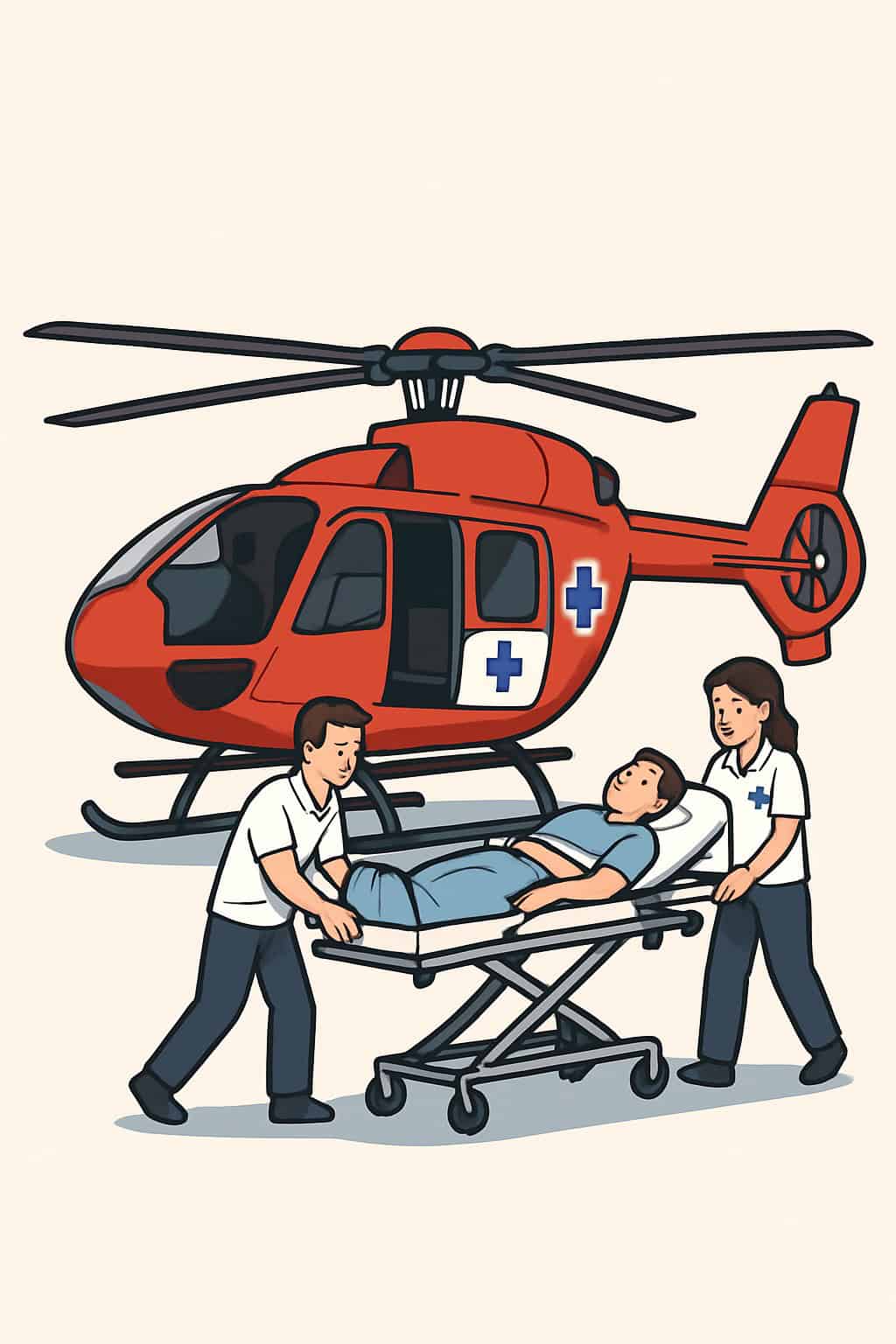
Air ambulance transport by helicopter is a medical flight service that moves a patient quickly with a trained crew and specialized equipment.
Overview
Air ambulance transport by helicopter is a medical flight service that moves a patient quickly with a trained crew and specialized equipment. It is used when speed, access, or distance make ground ambulances less suitable. Helicopter crews monitor vital signs, provide treatment during flight, and hand off care to a receiving hospital team. Flights may launch from an emergency scene or transfer a patient between facilities for time-sensitive or higher-level care.
Also known as: Helicopter EMS, HEMS, Air medical transport (rotor-wing), Life flight
Preparation & Next Steps
Everything you need to know before and after your procedure
Before Care
- Have a photo ID, insurance details, and an emergency contact available if possible
- Share current medicines, allergies, and recent medical history with the crew
- Bring only small essential items; large bags, valuables, and loose items may not be allowed
- Follow crew instructions about clothing, seat belts, and hearing protection
- Do not approach the helicopter unless guided by the crew; rotors can be dangerous
- Inform the team about devices or implants (e.g., insulin pump, pacemaker, LVAD)
- Confirm which facility you are being taken to and how family will get updates
- If this is a planned transfer, ask the sending facility to send records and imaging
- Secure eyeglasses, dentures, and personal items in labeled bags if time allows
- Expect limits on family riders due to space and safety policies
After Care
- Hand off will occur at the receiving facility; expect continued monitoring and treatment
- Keep ear protection on until staff say it is safe to remove
- Tell the care team about nausea, ear pain, headache, or new discomfort after flight
- Verify that your personal items and documents arrived with you or with staff
- Ask how to access transport records for your files or insurance if needed
- Review any forms you are given about consent, privacy, and billing
- Share updated emergency contact information with the receiving team
- If you have lingering motion sickness, let the clinical team know
- Contact your health plan with questions about coverage and prior authorization
- Note the transport company name and flight number for reference and billing questions
Clinical Information
Important medical details about this procedure
Indications
- Serious trauma requiring rapid transport to a trauma center
- Time-sensitive conditions such as stroke, heart attack, or major burns
- Medical emergencies in remote or hard-to-reach locations
- Interfacility transfer for specialized services (e.g., surgery, intensive care)
- Severe illness where traffic or distance would delay ground transport
- Specialty neonatal or pediatric critical care transport teams
Alternatives
- Ground ambulance (EMS) transport
- Fixed-wing air ambulance for long-distance transfers
- Stabilization at the nearest facility with later transfer
- Clinic or hospital-to-hospital teleconsultation while arranging transport
Risks
- Noise and vibration that can cause discomfort or temporary hearing effects
- Motion sickness, nausea, or vomiting
- Weather or visibility delays, diversions, or cancellations
- Limited cabin space and weight limits for passengers and belongings
- Potential anxiety or claustrophobia in confined spaces
- Rare risk of in-flight or landing incidents despite safety protocols
Contraindications
- Unsafe weather or landing zone conditions
- Exceeding aircraft weight or balance limits
- Need for equipment or capabilities not available on the helicopter
- Hazardous materials or environmental risks at the scene
Recovery Timeline
What to expect during your recovery
There is no recovery period from the transport itself for most people. Any recovery depends on the underlying illness or injury.
Typical Range
Same day
Return to Work
Same day
Recovery Milestones
Resume medical care under the receiving hospital team
Address motion sickness or ear fullness symptoms with the care team if present
Obtain copies of transport records and confirm follow-up plans as arranged by clinicians
Frequently Asked Questions
Common questions and expert answers about this procedure
Who is on the helicopter crew?
Who is on the helicopter crew?
Typically a pilot plus medical staff such as a flight nurse and paramedic. Some teams include respiratory therapists or specialized neonatal or pediatric staff.
Can a family member ride along?
Can a family member ride along?
Often no, due to space, weight, and safety limits. Some programs allow it when conditions permit, but policies vary.
What can I bring on the helicopter?
What can I bring on the helicopter?
Only small essential items. Large bags, unsecured items, and valuables are usually not allowed due to safety and weight limits.
How are destinations and routes decided?
How are destinations and routes decided?
The crew and dispatch choose a receiving facility based on medical needs, availability, and protocols. Weather and air traffic rules shape the route.
How noisy is it and will I get ear protection?
How noisy is it and will I get ear protection?
Helicopters are very loud. The crew typically provides ear protection and secures headsets when available.
What if weather is bad?
What if weather is bad?
Flights may be delayed, diverted, or canceled if conditions are unsafe. Ground or fixed-wing transport may be arranged instead.
How are costs and insurance handled?
How are costs and insurance handled?
Charges depend on the provider, distance, and services. Federal surprise billing protections apply in many emergency situations, but coverage varies by plan.
When is a fixed-wing airplane used instead?
When is a fixed-wing airplane used instead?
Fixed-wing air ambulances are often used for longer distances or when runway access and cabin capabilities are more suitable.
References
Medical literature and sources